
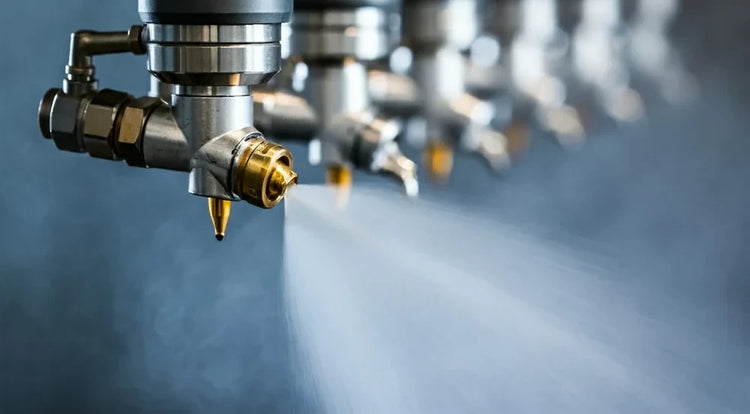
Car Wash Spray Nozzles for Tunnels & Self-Serve
Precision nozzles for every wash stage — pre-soak, detergent, high-pressure rinse, wax & protectant, wheel cleaning, and undercarriage — matched to your pump, chemistry, and throughput

Car wash nozzle performance directly affects throughput, chemical consumption, water usage, and customer satisfaction. A pre-soak nozzle that doesn't produce uniform wet-out means detergent works harder and rinse cycles run longer. A wax nozzle that atomizes inconsistently leaves blotchy protection and unhappy customers. Every wash stage has a specific nozzle requirement — pattern, flow rate, droplet size, and spray angle — that must be matched to the chemistry, pressure, and vehicle geometry.
NozzlePro supplies spray nozzles for all stages of automatic tunnel washes, in-bay automatics, self-serve bays, and commercial fleet wash facilities — sized to your pump specifications, chemical compatibility requirements, and throughput targets.
Car wash systems use different spray nozzles at each wash stage: flat-fan nozzles for pre-soak and detergent application — delivering uniform sheeted coverage across vehicle panels at low pressure; fog and mist nozzles for wax, protectant, and air-assisted detergent stages requiring fine, controlled film build; solid stream (0°) nozzles for high-pressure rinse, wheel cleaning, and undercarriage wash where maximum impact energy is needed; full-cone nozzles for dense volumetric coverage of complex vehicle shapes, wheel arches, and undercarriage manifolds; and narrow flat-fan nozzles for targeted band cleaning in tight zones. Nozzle selection at each stage balances impact, coverage uniformity, chemical efficiency, and protection of vehicle paint and trim.
Car Wash Nozzle Types
Shop by spray pattern — each matched to specific car wash application stages
Car Wash Stage Nozzle Guide
Recommended nozzle type and key benefit at every stage of the wash sequence
| Wash Stage | Objective | Recommended Nozzle | Key Benefit | Shop |
|---|---|---|---|---|
| Pre-Soak | Uniform wet-out to penetrate road film and loosen grime | Flat-Fan, Full-Cone | Even sheet coverage across panels; softens soil for detergent stage | Flat-Fan → |
| Detergent Application | Controlled dosing for chemical dwell and cleaning action | Flat-Fan (low-flow), Fog & Mist | Consistent film with minimal chemical waste; even dwell time | Fog & Mist → |
| High-Pressure Rinse | Remove soils, suds, and detergent residue rapidly | Solid Stream (0°), Narrow Flat-Fan | High impact energy for efficient soil removal; minimal water use | Solid Stream → |
| Wax & Protectant | Fine, even film for shine and lasting protection | Fog & Mist, Full-Cone | Controlled fine atomization for consistent film build across panels | Fog & Mist → |
| Wheel Cleaning | Remove brake dust and debris from rims, lug areas, and tires | Solid Stream, Narrow Flat-Fan | Concentrated impact penetrates wheel cavities; removes heavy deposits | Solid Stream → |
| Undercarriage Wash | Full-coverage flush to remove road salts and prevent corrosion | Full-Cone / Multi-Header, Solid Stream Arrays | Complete chassis coverage with angled jets; high-impact strip patterns | Full-Cone → |
Wash Stage Application Guide
Detailed nozzle recommendations for each stage of the car wash sequence
Pre-Soak
Uniform wet-out is the foundation of every wash — pre-soak that fully saturates road film, bird droppings, and insect residue before the detergent stage reduces chemical demand and improves first-pass cleaning performance. Inconsistent pre-soak creates dry patches where soil isn't loosened, forcing more aggressive chemistry or re-runs.
- Flat-fan for even sheeted coverage across panel surfaces
- Full-cone for dense coverage on mirrors and complex contours
- Low operating pressure (15–40 PSI) to maximize dwell time
| Nozzle | Why |
|---|---|
| Flat-Fan | Even sheet; efficient wet-out across panels |
| Full Cone | Dense coverage on mirrors and contours |
Detergent Application
Detergent stage performance depends on consistent film coverage and adequate dwell time — both determined by nozzle selection. Over-application wastes chemistry and increases rinse demands. Under-application or gaps in coverage leave soil on the vehicle that must be removed by high-pressure rinse alone, increasing water use and reducing throughput.
- Low-flow flat-fan for controlled, consistent detergent film
- Fog/mist for fine micro-droplet wetting and chemical efficiency
- Nozzle materials compatible with alkaline and acidic car wash chemistries
| Nozzle | Why |
|---|---|
| Flat-Fan (Low-Flow) | Consistent film; lower consumption |
| Fog & Mist | Uniform micro-droplet wetting |
High-Pressure Rinse
High-pressure rinse must remove loosened soil and detergent residue quickly without damaging paint, trim, or rubber seals. Impact energy is controlled by nozzle angle, orifice size, operating pressure, and standoff distance. Solid stream nozzles deliver maximum impact at a point; narrow flat-fan distributes impact across a band for more coverage per pass.
- Solid stream (0°) for maximum impact on stubborn soil points
- Narrow flat-fan (15°–25°) for band-pattern rinse across panel width
- Sized to pump PSI and GPM for consistent performance across all wand positions
| Nozzle | Why |
|---|---|
| Solid Stream (0°) | High-impact spot and strip removal |
| Narrow Flat-Fan | Focused bands for tight panel zones |
Wax & Protectant
Wax and protectant application quality directly affects perceived customer value and repeat business. Blotchy, streaked, or uneven protectant is immediately visible at vehicle pickup and is the leading cause of customer complaints after premium wash purchase. Fine atomization from fog/mist nozzles creates the controlled film build needed for consistent, even results.
- Fog/mist nozzles for fine, controlled wax film atomization
- Full-cone for reliable area coverage on complex panel shapes
- Air-assisted options for maximum droplet uniformity and film consistency
| Nozzle | Why |
|---|---|
| Fog & Mist | Controlled fine film atomization |
| Full Cone | Reliable area coverage on complex shapes |
Wheel Cleaning
Wheel and tire cleaning is one of the most visually evaluated wash results by customers — brake dust accumulation is immediately visible and sets customer perception of wash quality. Wheel cleaning nozzles must deliver concentrated impact into the rim face, between spokes, and into the wheel arch cavity to dislodge baked-on brake dust and road debris that surface-level spray patterns miss.
- Solid stream jets for deep penetration into wheel cavities and spoke gaps
- Narrow flat-fan for targeted coverage along rim face and tire sidewall
- Dedicated wheel arch nozzle positions for full arch coverage
| Nozzle | Why |
|---|---|
| Solid Stream | Deep reach into wheel cavities and spokes |
| Narrow Flat-Fan | Targeted coverage on rim face & sidewall |
Undercarriage Wash
Road salt, mud, and winter chemical accumulation on the chassis and undercarriage is the primary driver of long-term corrosion damage to frame rails, suspension components, and brake lines. Undercarriage wash systems must flush the full undercarriage width with adequate flow and impact to dislodge packed deposits, not just wet the surface.
- Full-cone multi-header manifolds for complete chassis width coverage
- Solid stream arrays for high-impact strip patterns on frame rails
- Angled nozzle positions to reach forward of wheel arches and rear suspension
| Nozzle | Why |
|---|---|
| Full-Cone / Multi-Header | Complete chassis width coverage |
| Solid Stream Arrays | High-impact strips on frame rails |
Nozzle Requirements by Wash Facility Type
Different wash formats require different nozzle configurations — tunnel, self-serve, and fleet each have distinct needs
- Automatic Tunnel Washes — High-throughput tunnel systems process 100+ vehicles per hour with fixed nozzle manifolds at each wash station. Every nozzle must perform consistently from the first vehicle of the day to the last — no warm-up, no drift. Flat-fan manifold bars must deliver uniform coverage across the full vehicle width; wax and protectant nozzles must produce consistent atomization on every vehicle regardless of queue speed variation.
- In-Bay Automatic (Rollover) Washes — Rollover systems use reciprocating gantry arches that pass over a stationary vehicle, requiring nozzles that deliver adequate coverage at the gantry travel speed. Pre-soak and detergent nozzles must wet the full vehicle profile in a single pass; high-pressure rinse nozzles must remove all detergent without requiring multiple passes that would reduce throughput.
- Self-Serve Bays — Self-serve wand nozzles are used by untrained consumers at varying distances and angles from the vehicle. Nozzle selection must balance maximum cleaning performance with safety — avoiding nozzle configurations that damage paint or seals when held too close. Quick-connect nozzle systems allow consumers to switch between low-pressure soap and high-pressure rinse stages.
- Fleet & Truck Wash — Commercial fleet wash facilities clean vehicles with significantly more surface area, higher ride heights, and heavier soil loads than passenger cars. Undercarriage systems must be sized for the wheelbase and chassis height of fleet vehicles; high-pressure rinse stages require higher flow rates and more nozzle positions than passenger car tunnels. Salt and mud from long-haul routes requires more aggressive soil removal than typical car wash applications.
Why Choose NozzlePro for Car Wash Systems?
Right-sized nozzles for every stage — fewer re-runs, less chemistry, better results
Application Engineering for Car Wash Operations
Car wash nozzle performance is determined by the interaction between pump pressure, orifice size, spray angle, and standoff distance — not just the catalog description. NozzlePro application engineers work with your pump specifications, wash chemistry, and throughput targets to recommend the correct nozzle at every stage of the wash sequence.
Chemical Compatibility: Car wash chemistries span a wide pH range — from alkaline pre-soak and detergent products to acidic wheel cleaners, tire dressings, and protectants. Nozzle body and seal materials must be compatible with the specific products used at each stage. 316L stainless steel handles most car wash chemistry; EPDM or Viton seals are specified based on pH and solvent content of the product.
Consistent Flow Across All Positions: In tunnel manifold systems, every nozzle in a bar must deliver identical flow and pattern — variation across the manifold creates uneven coverage and wash results. Our ISO 9001-certified manufacturing ensures tight orifice tolerances that translate to consistent performance across all nozzle positions in a multi-nozzle system.
Durability for High-Cycle Service: Car wash nozzles in busy tunnel operations cycle continuously during operating hours. Corrosion-resistant materials, hardened orifices for high-pressure positions, and robust construction ensure service life that justifies the uptime investment in the wash system.
Related Applications & Industries
Adjacent wash and cleaning applications using the same nozzle technologies
Fleet & Truck Wash
High-volume wash systems for trucks, trailers, and municipal fleets.
Fleet Wash →Car Wash Collection
Full range of car wash nozzles for all stages and facility types.
Car Wash Nozzles →Automotive Manufacturing
Parts washing, body panel cleaning, and assembly washdown nozzles.
Auto Manufacturing →Pressure Washing
Industrial pressure washing nozzles for equipment and facility cleaning.
Pressure Washing →Tank & Vessel Cleaning
CIP spray balls and rotary jet cleaners for chemical tank cleaning.
Tank Cleaning →Frequently Asked Questions
Common questions about car wash spray nozzle selection and performance
What is the best nozzle for car wash pre-soak application?
Flat-fan nozzles are the standard choice for car wash pre-soak because they deliver a uniform sheeted spray that wets the full vehicle panel surface evenly at low pressure (15–40 PSI), maximizing chemical dwell time on the soil before the detergent stage. Full-cone nozzles complement flat-fan bars by providing dense volumetric coverage on mirrors, moldings, and complex panel contours where a flat fan's linear spray may not reach. Pre-soak nozzles should be sized to deliver adequate wet-out at the lowest pressure that achieves complete surface contact — excessive pressure reduces dwell time by running solution off the surface too quickly.
What spray nozzles are used for car wash wax and protectant application?
Fog and mist nozzles (and air-assisted atomizing nozzles) are preferred for wax and protectant application because they produce fine, uniform droplets that build a consistent film across panel surfaces without streaking or blotching. The key performance requirement is droplet uniformity — coarse droplets from higher-pressure nozzles create uneven film thickness that is visible as streaks in the dried protectant. Low flow rates and fine atomization also minimize protectant consumption compared to full-cone nozzles that apply higher volumes. Nozzle material must be compatible with the protectant chemistry, which may contain silicones, polymers, or solvents that attack standard elastomers.
How do I select the right nozzle for car wash undercarriage cleaning?
Undercarriage wash nozzle selection depends on vehicle type, soil load, and available pump flow. For passenger car undercarriage systems, full-cone nozzle manifolds angled to cover the full chassis width provide complete coverage with moderate flow requirements. For truck and fleet undercarriage wash, solid stream arrays or high-impact flat-fan nozzles are needed to dislodge the heavier packed mud, road salt, and debris accumulations typical of commercial vehicles. The nozzle manifold must be sized for the wheelbase and chassis ride height of the vehicles being washed — a manifold designed for sedan ride height will miss the frame rails of an SUV or pickup truck.
What nozzle materials are compatible with car wash detergent and chemical systems?
316L stainless steel nozzle bodies are compatible with most car wash chemical products across the pH range used in typical wash sequences (pH 8–13 alkaline pre-soaks and detergents; pH 2–5 acid wheel cleaners and rinse aids). Stainless is the standard material for commercial car wash nozzles because of its corrosion resistance, ease of cleaning, and durability in continuous-service environments. Seal and gasket material selection depends on the specific chemistry: EPDM seals handle most alkaline products; Viton (FKM) is preferred for acid-based wheel cleaners, solvent-containing protectants, and tire dressings. Brass nozzles should be avoided in acid chemical stages — they corrode and introduce metallic contamination risk.
How often should car wash nozzles be replaced?
Car wash nozzle replacement frequency depends on wash volume, water quality, and chemical aggressiveness. In high-volume tunnel washes processing 300+ vehicles per day, high-pressure rinse and wheel cleaning nozzles (which operate at highest pressure and velocity) should be inspected monthly and replaced when flow rate exceeds the rated value by more than 10% at operating pressure — worn orifices increase water consumption and reduce impact energy. Wax and protectant nozzles should be inspected for clogging and pattern distortion weekly in high-volume operations. Install strainers upstream of all nozzle manifolds to extend service life by preventing debris and scale from eroding orifices prematurely.
What is the difference between a solid stream and flat-fan nozzle for car wash high-pressure rinse?
A solid stream (0°) nozzle concentrates all water flow into a single high-velocity jet, delivering maximum impact energy at a point — most effective for stubborn soil spots, wheel cleaning, and undercarriage strip cleaning. A narrow flat-fan nozzle (15°–25°) distributes that same flow across a defined band width, covering more surface area per pass at slightly lower impact per unit area. In tunnel high-pressure rinse stages, flat-fan nozzles are typically preferred for body panel rinse because they cover more surface area per wand position, reducing the number of positions required. Solid stream nozzles are used in wheel arch blasters and targeted rinse zones where maximum impact at a specific point is more important than coverage width.
Ready to Optimize Your Car Wash System?
Tell us your wash format (tunnel, rollover, self-serve, fleet), pump PSI and GPM, chemistry used, and throughput targets — we'll recommend the right nozzles for every stage.