
Spray Nozzles for
Robotic Parts Washing
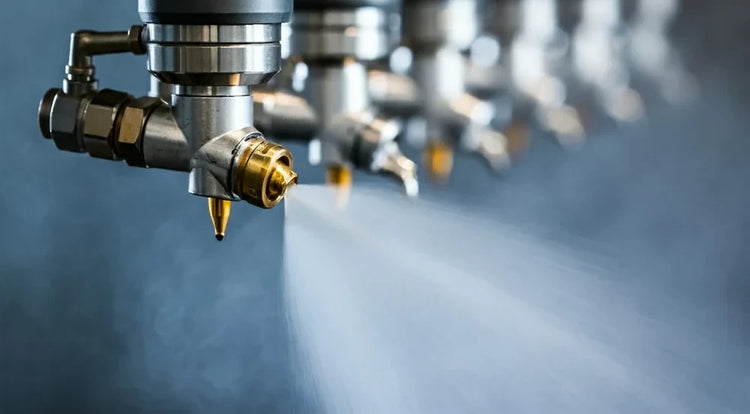
Robotic and automated parts washing systems use spray nozzles to deliver aqueous cleaning solution — detergent wash, rinse, and sometimes inhibitor — to manufactured parts at precise positions and pressures. Whether the nozzle is mounted on a robot end effector that moves around the part, fixed in a cabinet manifold that the part rotates through, or built into a tunnel wash conveyor system, the nozzle determines cleaning effectiveness, coverage uniformity, and water consumption. NozzlePro supplies flat fan, full cone, and solid stream spray nozzles in stainless steel and PVDF for the full range of automated parts washing configurations.
In a manual parts washing operation, an experienced operator adjusts the spray wand position, angle, and dwell time to compensate for difficult-to-reach areas and varying part geometries. In an automated system, that compensation disappears — the nozzles spray where they are positioned, at the flow rate and pressure the system supplies, for the duration the cycle allows. If the nozzle selection or placement does not deliver adequate impact and coverage to all surfaces that require cleaning, the part exits the washer with residual contamination. The automated system does not adapt; the nozzle specification must be correct from the start.
The three variables that determine cleaning effectiveness in an automated parts washer are impact (the force the spray delivers to the part surface, which dislodges contamination), coverage (whether every surface that requires cleaning receives adequate spray contact), and chemistry dwell time (how long the cleaning solution remains in contact with the surface before rinse). Nozzle selection directly controls the first two. The nozzle type, spray angle, operating pressure, and position in the manifold all determine whether the automated system achieves the cleaning result required.
Three Automated Parts Washing Configurations — and the Nozzle Requirements for Each
The correct nozzle selection depends on the system configuration. End-of-arm, cabinet manifold, and tunnel wash each impose different nozzle requirements.
Flat Fan, Full Cone, and Solid Stream — Choosing for Automated Washing
Each spray pattern has a specific role in automated parts washing. Understanding the trade-offs helps match the right pattern to each position in the system.
Pressure vs. coverage — the fundamental trade-off in parts washing nozzle selection
Higher pressure increases impact force and cleaning effectiveness but narrows the effective coverage width for a given nozzle angle. A flat fan nozzle at 200 PSI covers a narrower effective width than the same nozzle at 60 PSI — and the pattern edges at high pressure may not have sufficient impact for cleaning while the center zone has more than needed. For most automated aqueous parts washing at moderate pressures (15–150 PSI), a wider fan angle (65°–80°) with calculated overlap between adjacent nozzles provides better cleaning uniformity than a narrow angle at high pressure. High-pressure wash (200–500+ PSI) uses narrower angles and closer nozzle spacing to maintain coverage while delivering high impact.
Nozzle Material Selection for Aqueous Wash Chemistry
Why Material Selection Matters in Automated Washers
Automated parts washers operate continuously or in high-frequency batch cycles, with nozzles submerged or constantly wetted by the cleaning solution. The cleaning chemistry — alkaline detergents, neutral cleaners, acidic descalers, rust inhibitors — contacts the nozzle body, orifice, and seal materials on every cycle. Nozzle material selection determines both service life and whether the nozzle material contaminates the wash solution or parts being cleaned.
Brass nozzles, the historical default in many industrial wash applications, are not recommended for automated parts washing systems using alkaline cleaning chemistry or phosphate-based rust inhibitors — alkaline solutions attack brass over time, causing dezincification and eventual structural failure. More practically, copper ions from brass corrosion contaminate the wash solution and can deposit on parts, which is unacceptable in precision machining and many surface finish applications. Stainless steel nozzles eliminate this contamination risk and provide substantially longer service life in alkaline wash chemistry.
For aggressive chemistry — strong acids, high-concentration alkaline solutions, solvent blends, or oxidizing cleaners — PVDF nozzles provide chemical resistance that exceeds stainless steel. PVDF is the specification for nozzles in aggressive descaling, passivation wash, or specialty cleaning chemistry environments where stainless corrosion is a concern.
Seal material matters as much as body material
A stainless steel nozzle body with an incompatible elastomer seal fails at the seal, not the body. For hot alkaline wash chemistry (common in industrial parts washers operating at 140–180°F), EPDM seals handle the temperature and alkaline chemistry combination that degrades Buna-N (nitrile) seals rapidly. For solvent or petroleum-based cleaning chemistry, Buna-N is the correct seal; EPDM swells in petroleum solvents. Confirm seal material compatibility with your specific cleaning chemistry and operating temperature before finalizing the nozzle specification.
What to Specify for Automated Parts Washing Nozzles
Provide these details to NozzlePro's application team for a complete nozzle specification — including pattern, orifice size, material, and connection for each position in your automated wash system.
- System configuration — End-of-arm robot, cabinet manifold, or tunnel conveyor. This determines whether the primary pattern should be flat fan (sweep/tunnel), full cone (fixed manifold), or a combination.
- Part material, geometry, and contamination type — Metal machined parts with cutting oil and chips require different nozzle specification than plastic molded parts with mold release agent. Part geometry (flat plate, bore-heavy casting, open framework) determines whether flat fan or full cone provides better coverage from the planned nozzle positions.
- Cleaning chemistry — type, concentration, and temperature — Aqueous alkaline, neutral, or acidic; operating temperature (ambient, 120°F, 160°F+). This determines body material (SS or PVDF) and seal material (EPDM, Buna-N, or PTFE).
- Operating pressure — Pump output pressure at the nozzle manifold. Parts washing systems typically operate between 15 and 150 PSI for standard aqueous wash; high-pressure wash systems operate at 200–3,000 PSI. The nozzle orifice size is selected to deliver the target flow rate at this operating pressure.
- Nozzle standoff distance and coverage area required — The distance from the nozzle to the part surface, and the width or area that each nozzle position must cover. These two parameters, combined with the spray angle, determine the correct nozzle angle selection and the spacing between adjacent nozzles on a manifold.
- Number of nozzle positions and total system flow budget — The total flow rate the pump must supply is the number of active nozzles multiplied by the per-nozzle flow at operating pressure. Confirm the pump capacity before finalizing nozzle count and orifice sizes.
- Connection size and thread type — 1/4" NPT, 3/8" NPT, and 1/2" NPT are the most common connections for parts washing manifold nozzles. Confirm the thread size and type on the manifold port or robot end effector fitting.
Parts Washing Nozzle Selection by System Type and Position
| System / Position | Pattern | Angle | Pressure | Material | Key Consideration |
|---|---|---|---|---|---|
| Robot end-of-arm — flat surface sweep | Flat fan | 65°–80° | 40–150 PSI | 316 SS / EPDM | 10–15% pass overlap; lightweight body for robot arm |
| Robot end-of-arm — complex geometry | Full cone | 60°–90° | 30–100 PSI | 316 SS / EPDM | Multiple programmed positions for full part coverage |
| Cabinet manifold — top & side spray | Full cone | 60°–90° | 30–100 PSI | 316 SS / EPDM | Nozzle spacing for overlap; rotating part fixture recommended |
| Cabinet manifold — bore / cavity spray | Solid stream or narrow full cone | 0°–25° | 60–200 PSI | 316 SS / PTFE | Directed into bore or cavity opening; confirm clearance |
| Tunnel conveyor — top manifold | Flat fan | 65°–80° | 30–100 PSI | 316 SS / EPDM | Nozzle spacing for overlap at max line speed |
| Tunnel conveyor — side manifold | Flat fan | 65°–80° | 30–100 PSI | 316 SS / EPDM | Angled toward part surface; confirm no spray interference |
| High-pressure wash (>200 PSI) | Flat fan or solid stream | 15°–40° | 200–500 PSI | 316 SS / PTFE | Hardened SS or TC insert for extended orifice life |
| Acidic descale or passivation rinse | Flat fan or full cone | Per position | Per system | PVDF / PTFE | PVDF body required — SS corrodes in strong acid wash |
Designing a Robotic or Automated Parts Washing System?
Tell us your system configuration, part geometry, cleaning chemistry, operating pressure, and manifold layout. NozzlePro will specify the right nozzle pattern, orifice size, material, and connection for every position in your wash system.