
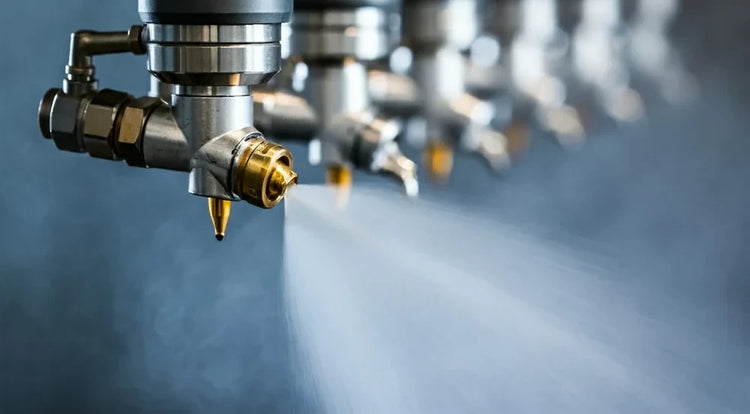
Choose the Right Nozzle.
Every Time.
Six technical guides covering every factor in spray nozzle selection — from spray pattern and angle to flow rate, materials, and connections.
Start With the Right Question
Every correct nozzle specification begins with four engineering questions. Each one maps directly to a guide below.
Cleaning, coating, cooling, dust suppression, or tank washing — the application determines nozzle type before any other variable.
Choosing a Spray NozzleFlat fan, full cone, hollow cone, and solid stream each distribute liquid differently. Pattern selection defines whether coverage, impact, or atomization leads.
Spray Pattern GuideOperating pressure and flow rate set the hydraulic envelope. Exceeding either limit shortens nozzle life and degrades spray quality.
Flow Rate & Pressure GuideChemical compatibility, temperature, and abrasion potential determine material selection — the most common source of premature nozzle failure.
Material Selection GuideComplete Selection Reference Library
Each guide covers a single variable in depth — with reference tables, decision criteria, and worked examples.
The end-to-end walkthrough for first-time specifiers and experienced engineers alike. Covers all seven selection variables with a structured decision framework.
- Identify the application purpose and process stage
- Determine the required spray pattern type
- Establish operating pressure range
- Calculate required flow rate at operating conditions
- Specify nozzle material for chemical and thermal compatibility
- Confirm spray angle for target coverage area
- Verify thread size and connection type
Visual coverage shapes from flat fan to solid stream — which pattern works for your application and why.
- Flat fan vs. full cone vs. hollow cone
- Solid stream for high-impact applications
- Air atomizing for fine mist and coating
- Overlap and spacing for uniform coverage
How spray angle interacts with standoff distance to define coverage area and spray impact on the target surface.
- Coverage area calculations at distance
- Narrow angle vs. wide angle applications
- Effect of pressure on effective spray angle
- Overlap requirements for even distribution
Understanding the hydraulic relationship between flow, pressure, and nozzle orifice size — and how to match it to your system.
- Flow rate vs. pressure curves
- K-factor and orifice sizing
- System pressure drop considerations
- Units: GPM, L/min, PSI, bar
Matching nozzle body and orifice material to the chemical, thermal, and abrasion conditions of your process.
- Stainless steel: 303, 316, hardened
- Polymers: PVDF, polypropylene, PTFE
- Wear-resistant: tungsten carbide, ceramics
- Chemical compatibility quick reference
NPT, BSPT, and metric thread standards — identifying what you have and specifying what you need for a leak-free fit.
- NPT vs. BSPT: identifying thread type
- Metric (M) thread sizing
- Seal face and gasket types
- Common pipe size to nozzle connection charts
What Information Do You Need?
Use this reference when preparing a nozzle specification or filling out a product inquiry. Required items are essential for an accurate selection; helpful items improve precision.
| Specification Parameter | Why It Matters | Status | Relevant Guide |
|---|---|---|---|
| Application purpose (cleaning, cooling, coating, etc.) | Determines the nozzle type and performance priorities | Required | Choosing a Spray Nozzle |
| Spray pattern type | Flat fan, full cone, hollow cone, or solid stream — affects coverage and impact | Required | Spray Pattern Guide |
| Operating pressure (PSI or bar) | Drives flow rate and spray quality; nozzles are rated for a pressure range | Required | Flow Rate & Pressure Guide |
| Required flow rate (GPM or L/min) | Used with pressure to select orifice size; defines liquid consumption | Required | Flow Rate & Pressure Guide |
| Liquid type and concentration | Drives material compatibility — the most common cause of premature failure | Required | Material Selection Guide |
| Operating temperature (°F or °C) | Rules out polymer materials; affects flow rate and spray angle | Required | Material Selection Guide |
| Spray angle | Defines the coverage footprint at a given standoff distance | Helpful | Spray Angle Guide |
| Standoff distance (nozzle to target) | Paired with spray angle to calculate the actual coverage area | Helpful | Spray Angle Guide |
| Thread size and connection type | NPT, BSPT, or metric — must match the existing pipe or manifold | Helpful | Thread & Connection Guide |
| Particle size or abrasiveness in liquid | Affects orifice material choice and expected service life | Optional | Material Selection Guide |
Need Help Selecting a Nozzle?
Our technical team can review your application parameters and recommend the right nozzle type, material, and orifice size for your system. No obligation.