
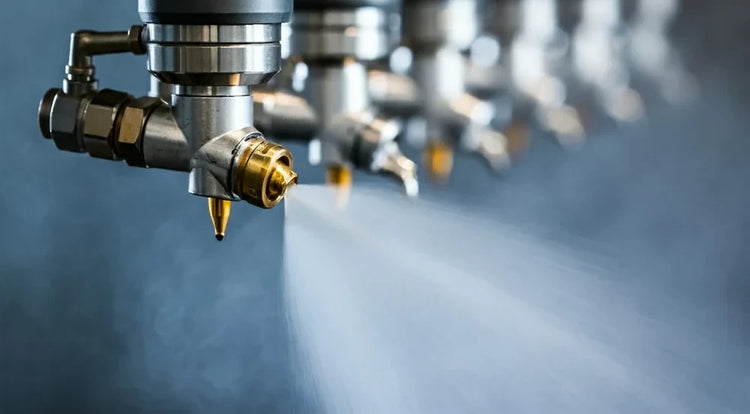
Coating & Surface Treatment Nozzles
Coating and surface treatment nozzles provide controlled, uniform liquid application for pretreatment, painting, plating, lubrication, finishing, rinsing, and protective coating processes. NozzlePro offers precision spray nozzles designed to improve coverage consistency, transfer efficiency, product quality, and process control across automated and manual production systems. Common applications include metal finishing, automotive manufacturing, food processing, electronics, wood products, and general industrial production. Browse flat fan, full cone, hollow cone, air atomizing, and specialty nozzles available in multiple flow rates, spray angles, operating pressures, connection sizes, and durable materials. Use the filters below to find the right surface treatment or coating nozzle based on the required droplet size, coverage area, fluid properties, and application rate.


Guide
Coating & Surface Treatment Nozzles: Overview & Selection Tips
This Coating & Surface Treatment collection groups nozzles and assemblies commonly used for Coating & Surface Treatment tasks across industrial lines. It makes it easier to compare nozzle types, spray patterns, materials, and connection options in one place.
Start with the process objective, then narrow by flow rate, operating pressure, coverage target, fluid compatibility, and maintenance needs. Related applications often include Coating & Surface Treatment, Cleaning & Washing, Cooling & Quenching, and Humidification & Conditioning.
Key selection factors
- Compare nozzle types and assemblies commonly used for Coating & Surface Treatment.
- Related process areas include Coating & Surface Treatment, Cleaning & Washing, Cooling & Quenching, and Humidification & Conditioning.
- Focus on spray pattern and coverage style, flow rate, pressure, and coverage requirements.
- Material options may include 303/304 stainless steel, brass, 316L stainless steel, and hardened stainless steel.
- Check inlet sizes such as 1/4 in., 1/8 in., 1/2 in., and 3/8 in. with NPT connections where available.
Common applications
- Coating & Surface Treatment
- Cleaning & Washing
- Cooling & Quenching
- Humidification & Conditioning
How to choose Coating & Surface Treatment
- Start with the required flow rate and operating pressure at the nozzle or assembly.
- Choose the spray pattern and coverage style that best matches the coverage, impact, atomization, or washdown result you need.
- Confirm material compatibility using options such as 303/304 stainless steel, brass, 316L stainless steel, and hardened stainless steel.
- Finally, verify thread style and inlet size, including 1/4 in., 1/8 in., 1/2 in., and 3/8 in. with NPT connections where available.
Related collections
Coating & Surface Treatment | Cleaning & Washing | Cooling & Quenching | Humidification & Conditioning
What Coating & Surface Treatment Nozzles Do
Built for paint coating, pre-treatment lines, and industrial finishing operations

Spray Pattern
Multiple spray patterns
Available SKUs
4986 Products
Quality
Industrial Grade
Shipping
Ships Fast
How Coating & Surface Treatment Spray Nozzles Work
Pattern, droplet size, material, and line position determine coating quality
Operating Principle
A coating nozzle breaks a liquid stream into a controlled spray pattern using either pressure alone (hydraulic atomization) or pressure plus compressed air (air atomization). Hydraulic nozzles, flat-fan, full-cone, hollow-cone, are the standard choice for pre-treatment, rinse, and spray-booth wash-down where flow is high and droplet size is forgiving. Air-atomizing nozzles produce the finest droplets and are used in paint application, adhesive spraying, and any application where uniform film build matters more than throughput. In both cases, the nozzle's job is to convert pump pressure into a stable, repeatable spray pattern that holds its shape across the full operating window of the line. Airless and air-assisted airless coating systems use industrial high-pressure spray nozzles rated for 1,000-10,000 PSI to atomise high-solids paints and adhesives without compressed air.
What to Compare
Five specs decide whether a nozzle is right for your coating or surface-treatment line:
Spray pattern - flat-fan for even conveyor coverage; full-cone for thorough wetting of complex parts; hollow-cone for round or cylindrical substrates; air-atomizing for the finest droplets at low flow
Capacity (GPM at operating PSI) - size to actual line throughput, not the nozzle's peak; oversized nozzles produce drips and uneven film, undersized nozzles starve the manifold
Pressure (PSI) - verify supply pressure at the nozzle under load, not at the pump at idle; pressure loss across a long manifold is the most common cause of pattern drift
Materials - 316L stainless steel for phosphate and alkaline cleaners, PVDF or PEEK for solvent-based or DI-rinse chemistry, ceramic or carbide seats for long service life in high-particulate solutions
Spray angle - 25° for narrow web, 65° for full-conveyor coverage, 95°-110° for overlapping curtain spray in 5-stage washers and pre-treatment booths
Installation & Maintenance
Three practical points coating-line operators ask about most:
Orientation - install with the spray axis perpendicular to the substrate; even 5° of drift causes visible film-build variation on automotive and metal-finishing parts
Spacing - overlap by 30% between adjacent nozzles in a curtain or rinse manifold so the spray pattern envelopes the part with no stripes; this is the single most common installation error in 5-stage pre-treatment washers
Inspection cycle - replace nozzles when flow drops 10% from baseline (use a calibrated bucket-and-stopwatch check, not a visual pattern inspection); a worn nozzle silently raises chemistry consumption by 15-25% and reject rates by a similar margin before the spray pattern visibly fails
Coating and Surface Treatment Applications
Applications include powder coating, liquid paint application, lubricant spraying, release agent coating, and anti-corrosion treatment.
Coating & Surface Treatment
Apply coatings, chemicals, and pretreatment fluids with repeatable coverage and controlled transfer efficiency.
Cleaning & Washing
Support rinsing, washdown, parts cleaning, and surface cleanup with coverage and impact matched to the soil load and line speed.
Cooling & Quenching
Control part temperature and process heat with spray coverage sized for the required cooling rate and heat removal.
Humidification & Conditioning
Produce droplets suited to humidity control, evaporative conditioning, and air treatment tasks.
Selecting Nozzles for Coating Applications
Match spray angle, droplet size, and flow rate to film thickness requirements, substrate geometry, and coating material viscosity.
Flow Rate & Pressure
Start with the flow rate you need at the operating pressure available at the nozzle or assembly.
Spray Pattern & Coverage
Choose the spray pattern and coverage style that best matches the coverage width, impact, atomization, or washdown result your process requires.
Materials & Connections
Select wetted materials compatible with the fluid, temperature, and wear conditions; common options may include 303/304 stainless steel, brass, 316L stainless steel, and hardened stainless steel; common sizes include 1/4 in., 1/8 in., 1/2 in., and 3/8 in. with NPT connections where available.
Maintenance & Reliability
Consider clogging risk, wear life, ease of change-out, and the maintenance routine your process can realistically support.
Industries Using Coating Spray Nozzles
Automotive, appliance, aerospace, electronics, and metal fabrication industries all use precision spray nozzles for surface treatment.
Coating Spray Nozzle FAQ
Common questions about achieving uniform coating thickness, nozzle atomization quality, and managing overspray in coating applications.
Which spray nozzle is best for phosphate pre-treatment?
For phosphate baths and phosphate-rinse zones, use 316L stainless-steel flat-fan nozzles at 15–30 PSI with a 65°–95° spray angle. Phosphate chemistry is mildly acidic, so brass or carbon-steel bodies will pit within months. For long service life, choose a 316L body with a ceramic seat, the ceramic resists abrasion from the particulate that accumulates in recirculated phosphate solution. Size the GPM to your conveyor speed and manifold spacing so the curtain spray fully envelopes the part without dwell-time variation.
What spray nozzles do automotive pre-treatment lines use?
Automotive pre-treatment lines run a fixed sequence: alkaline clean → DI rinse → phosphate → DI rinse → seal → e-coat → DI rinse. Each stage uses different nozzle materials and patterns. 316L stainless steel flat-fan handles the caustic and phosphate stages; PVDF nozzles run in the DI-rinse stages to avoid metal leach into the de-ionized water; air-atomizing nozzles are used in paint and primer application. Coverage is sized for conveyor line speed (typically 6–12 ft/min) and conveyor width, with 30% pattern overlap between adjacent nozzles in every stage.
Which nozzle is best for powder coating prep washing?
Powder coating prep washing uses a 5-stage washer - clean, rinse, phosphate, rinse, seal, with flat-fan nozzles throughout. 316L stainless-steel bodies with a 95°–110° spray angle at 15–25 PSI is the standard spec for stages 1–4; the wide angle gives full part coverage at the typical 8–12 inch standoff. Avoid hollow-cone in this application, flat-fan delivers more uniform substrate coverage on flat-stamped and tubular parts. For the seal stage, drop pressure to 10–15 PSI to avoid disturbing the conversion-coat film.
How do I size a spray nozzle for my coating line?
Three numbers determine the right nozzle: flow rate (GPM at your operating pressure), spray angle (matched to your substrate width and standoff distance), and material (matched to your chemistry). To get the right spec, you need line speed, conveyor width, the chemistry of each stage, target film build, and your manifold layout. Send these to our engineers and we will spec the nozzle model, pattern overlap, manifold spacing, and replacement schedule for the entire line.
What is the difference between coating nozzles and general-purpose spray nozzles?
Coating and surface-treatment nozzles are selected for fine droplet control, predictable flow at low PSI, and chemistry-specific body materials. A general-purpose industrial nozzle dropped into a paint booth would over-atomize, cause runs, and produce uneven film build; in a phosphate stage, a brass or carbon-steel body would corrode in weeks. The nozzles in this collection are built around droplet uniformity across the full spray pattern, material compatibility with finishing-line chemistry, and predictable wear behaviour over thousands of operating hours.
Related Precision Spray Products
Air atomizing, flat fan, and air-assisted nozzles are the primary Nozzle types used in coating and surface treatment systems.

NPHU
The NozzlePro NPHU Series features male-threaded flat fan spray nozzles designed to produce a thin, uniform sheet of liquid with consistent droplet distribution. The tapered spray pattern supports even coverage when adjacent nozzle patterns are properly overlapped, making the series well suited for cleaning, rinsing, cooling, coating, lubrication, and surface-treatment processes. NPHU nozzles are generally used for capacities of 0.1 and greater and are available with spray angles ranging from 15° to 110°. Available male inlet sizes include 1/8, 1/4, 3/8, 1/2, and 3/4 inch, depending on the selected capacity and spray angle. Choose from brass, 303/304 stainless steel, and 316L stainless steel, then use the filters below to compare spray angle, capacity, flow rate, inlet size, and material.

NP3U
Compare NP3U by spray performance, material compatibility, connection size, and application fit.

NPHV
The NozzlePro NPHV Series features small-capacity flat fan spray nozzles designed to produce a thin, uniform sheet of liquid with consistent droplet distribution. These compact nozzles are ideal for low-flow cleaning, rinsing, cooling, coating, lubrication, and controlled liquid application where precise coverage is required. Available spray angles range from 15° to 110°, supporting narrow, concentrated sprays as well as wider overlapping coverage. Choose from 1/8- and 1/4-inch inlet connections and material options including brass, 303/304 stainless steel, and 316L stainless steel. Use the filters below to compare spray angle, capacity, flow rate, operating pressure, inlet size, and material across the NPHV flat spray nozzle series.

NPQV
Compare NPQV by spray performance, material compatibility, connection size, and application fit.

NPQU
Compare NPQU by spray performance, material compatibility, connection size, and application fit.

NPHP
The NozzlePro NPHP Series features hardened stainless steel, high-pressure spray nozzles engineered for concentrated impact and repeatable performance in demanding industrial processes. The collection primarily includes high-pressure flat fan patterns, with 0-degree solid stream models available when concentrated cleaning force is required. NPHP models are available in multiple spray angles and capacities with 1/8- or 1/4-inch NPT inlet configurations to match different flow, pressure, and coverage requirements. Common applications include pressure washing, equipment and parts cleaning, surface preparation, coating, and other processes requiring focused spray impact. Use the filters below to compare spray pattern, spray angle, capacity, operating pressure, flow rate, and inlet size across the NPHP high-pressure nozzle series.

NPHPV
Compare NPHPV by spray performance, material compatibility, connection size, and application fit.
Need Help Selecting the Right Nozzle?
Our engineering team is ready to help you find the perfect spray solution for your application.