
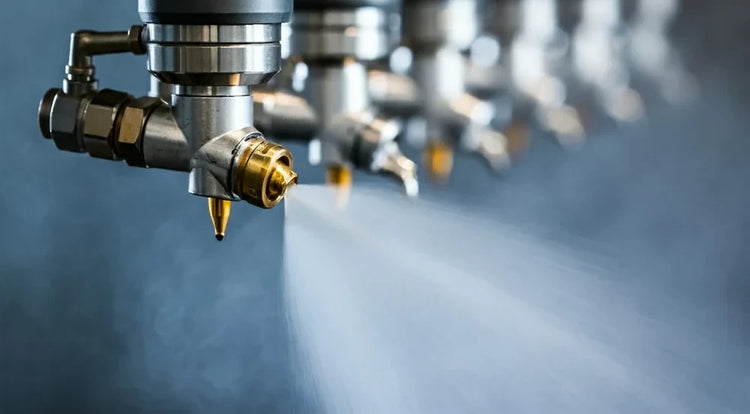
Use our Spray Nozzle Selection Guide or contact our engineers for personalized recommendations.
FAQ
- How do I choose the right spray nozzle?
- What materials are NozzlePro nozzles made of?
- What industries do your nozzles serve?
- What types of spray nozzles does NozzlePro offer?
- How do I choose the right spray pattern for my application?
- What materials are your nozzles made from?
- What is the difference between Full Cone and Hollow Cone nozzles?
- Do NozzlePro nozzles work with both air and liquid systems?
- Are your nozzles FDA or USDA compliant?
- Do you offer quick-connect or fast-change nozzles?
- Can I use NozzlePro nozzles for corrosive fluids or chemicals?
- Are replacement parts and accessories available?
- How do I measure flow rate or droplet size?
- What is nozzle wear and how does it affect performance?
- How do I verify that I’m getting the correct flow rate?
- What is the difference between 304 and 316 Stainless Steel nozzles?
- Which nozzle type is best for clogging resistance?
- Is PVDF (Kynar) or Stainless Steel better for acid applications?
- What is the lifespan of a brass spray nozzle vs. stainless steel?
- Can I use standard nozzles for food processing applications?
- Why is my carbide spray nozzle cracking?
- What is the best nozzle material for spraying abrasive slurries?
- What is the difference between NPT and BSPT threads, and which do I need?
- Do I need to install a line strainer or filter before my spray nozzle?
- How tight should I torque my spray nozzles during installation?
- Can I use thread sealant tape (Teflon tape) on my nozzles?
- What is the best way to clean a clogged spray nozzle?
- Do you offer engineering support for custom applications?
- How do I calculate spray coverage and flow rate?
- Can NozzlePro help replace my existing nozzle from another brand?
- What is the maximum operating temperature for NozzlePro nozzles?
- How does fluid viscosity affect the spray pattern?
- How does changing the pressure affect the flow rate?
- How do I know when my spray nozzle is worn out and needs replacement?
- What is the minimum pressure required to operate a spray nozzle?
- What is the difference between static and rotary tank cleaning nozzles?
- Which spray nozzle pattern provides the highest impact force?
- How can I reduce spray drift or misting in my application?
- Where are NozzlePro products manufactured?
- Do you follow sustainable manufacturing practices?
- Who is NozzlePro?
- How can I contact customer support?
- Where is NozzlePro located?
- What payment methods do you accept?
- Can I place an order without creating an account?
- Where is my order confirmation?
- Can I change or cancel my order after placing it?
- Do you offer bulk or distributor pricing?
- What countries do you ship to?
- How much is shipping?
- Can I track my order?
- Do you charge sales tax?
- Do you offer Net 30 payment terms?
- How long does delivery take?
- What is your return policy?
- How do I initiate a return?
- When will I receive my refund?
Product Information
- How do I choose the right spray nozzle?
- What materials are NozzlePro nozzles made of?
- What industries do your nozzles serve?
- What types of spray nozzles does NozzlePro offer?
- How do I choose the right spray pattern for my application?
- What materials are your nozzles made from?
- What is the difference between Full Cone and Hollow Cone nozzles?
- Do NozzlePro nozzles work with both air and liquid systems?
- Are your nozzles FDA or USDA compliant?
- Do you offer quick-connect or fast-change nozzles?
- Can I use NozzlePro nozzles for corrosive fluids or chemicals?
- Are replacement parts and accessories available?
- How do I measure flow rate or droplet size?
- What is nozzle wear and how does it affect performance?
- How do I verify that I’m getting the correct flow rate?
How do I choose the right spray nozzle?
What materials are NozzlePro nozzles made of?
Our products are made from high-grade stainless steel, brass, and other corrosion-resistant alloys suitable for industrial environments.
What industries do your nozzles serve?
NozzlePro products are used across Food & Beverage, Automotive, Chemical Processing, Agriculture, Pulp & Paper, Mining, and Power Generation industries. View application examples on our Industries Served page.
What types of spray nozzles does NozzlePro offer?
NozzlePro offers a complete range of industrial spray nozzles, including Flat Fan, Full Cone, Hollow Cone, Solid Stream, Air Atomizing, and Quick-Connect types. Each design delivers specific spray coverage, droplet size, and impact suited for different applications. Learn more on our Spray Pattern Guide.
How do I choose the right spray pattern for my application?
The right spray pattern depends on your desired coverage area, impact force, and fluid type. For example, flat fan nozzles are ideal for washing and rinsing, while full cone nozzles work best for uniform coverage and cooling. Use our Spray Pattern Classification Guide for detailed selection criteria.
What materials are your nozzles made from?
Our spray nozzles are manufactured from 316 stainless steel, brass, and PVDF, offering superior corrosion resistance, durability, and performance. Stainless steel is ideal for high-pressure and sanitary applications, while brass is commonly used for lower-pressure or general-purpose spraying.
What is the difference between Full Cone and Hollow Cone nozzles?
A Full Cone nozzle produces a uniform, solid spray for complete area coverage—ideal for cooling and washing. A Hollow Cone nozzle creates a ring-shaped spray, perfect for gas scrubbing, chemical processing, or dust suppression. Both types are available in various flow rates and angles.
Do NozzlePro nozzles work with both air and liquid systems?
Yes. We manufacture both liquid-only and air-assisted atomizing nozzles for precision spraying. Air atomizing nozzles combine compressed air and liquid for ultra-fine mist applications such as humidification and coating.
Are your nozzles FDA or USDA compliant?
Yes. Our stainless steel and PVDF series are designed for food and beverage environments, following FDA-compliant material standards. Please check each product’s specification sheet for compliance details.
Do you offer quick-connect or fast-change nozzles?
Absolutely. NozzlePro’s Quick-Connect Nozzles (NPQC Series) allow tool-free installation and replacement, saving time during maintenance. Ideal for car wash, food processing, and CIP systems.
Can I use NozzlePro nozzles for corrosive fluids or chemicals?
Yes, but always select a material compatible with your fluid. For corrosive chemicals, 316L stainless steel or PVDF is recommended. Our engineers can help verify chemical compatibility before purchase.
Are replacement parts and accessories available?
Yes, we carry gaskets, caps, adapters, and strainer assemblies for all major nozzle types. You can find these under the Accessories section on each product page or in our Accessories Collection.
How do I measure flow rate or droplet size?
Use our Flow Rate Calculator to determine flow at any pressure. Droplet size depends on pressure, fluid viscosity, and nozzle type—our calculators and charts can guide you in optimizing system performance.
What is nozzle wear and how does it affect performance?
Nozzle wear occurs when abrasive or corrosive fluids erode the orifice, reducing spray precision and increasing flow rate. Even 10% wear can result in significant product loss. Use our Nozzle Wear Cost Calculator to estimate operational impact.
How do I verify that I’m getting the correct flow rate?
You can verify flow by comparing actual output to rated flow on the product datasheet. If variation exceeds ±5%, the nozzle may be worn or clogged and should be replaced.
Material & Durability
- What is the difference between 304 and 316 Stainless Steel nozzles?
- Which nozzle type is best for clogging resistance?
- Is PVDF (Kynar) or Stainless Steel better for acid applications?
- What is the lifespan of a brass spray nozzle vs. stainless steel?
- Can I use standard nozzles for food processing applications?
- Why is my carbide spray nozzle cracking?
- What is the best nozzle material for spraying abrasive slurries?
What is the difference between 304 and 316 Stainless Steel nozzles?
The main difference is that 316 Stainless Steel contains molybdenum, which offers superior corrosion resistance to chlorides and industrial chemicals compared to 304 Stainless Steel. While 304 is the standard for general use, NozzlePro standardizes on 316SS to ensure our nozzles last longer in harsh chemical environments, marine applications, and food processing facilities using caustic cleaners.
Which nozzle type is best for clogging resistance?
Spiral nozzles (also known as pigtail or corkscrew nozzles) offer the best clogging resistance. Their design lacks an internal vane, providing a large "maximum free passage" that allows debris and solids to pass through without blocking the orifice. These are ideal for scrubbing towers, fire suppression, and wastewater applications.
Is PVDF (Kynar) or Stainless Steel better for acid applications?
PVDF (Kynar) is generally superior for handling strong acids like sulfuric or hydrochloric acid, where stainless steel may corrode over time. While 316 Stainless Steel is excellent for solvents and heat, PVDF provides high-purity chemical resistance without metal leaching. Choose PVDF for acid lines; choose Stainless Steel for high-temperature or high-impact applications.
What is the lifespan of a brass spray nozzle vs. stainless steel?
Stainless steel nozzles typically last 4 to 5 times longer than brass nozzles under the same operating pressure. Brass is a softer metal and is highly susceptible to wear from fluid erosion, especially if the water contains even trace amounts of particulates. We recommend avoiding brass for high-pressure industrial washing or abrasive fluid applications.
Can I use standard nozzles for food processing applications?
You must use food-grade materials compliant with FDA or USDA standards, such as 316 Stainless Steel, PVDF, or Food-Grade Polypropylene. Standard industrial nozzles may contain brass, lower-grade seals, or lubricants not safe for food contact. NozzlePro’s 316SS and PVDF lines are ideal for clean-in-place (CIP) and direct food contact zones due to their non-porous, sanitary finish.
Why is my carbide spray nozzle cracking?
Tungsten carbide is extremely wear-resistant but brittle and sensitive to thermal shock. If you run cold water through a hot carbide nozzle (or vice versa), it can fracture. Additionally, overtightening during installation can crack the carbide insert. For applications with rapid temperature changes, a hardened stainless steel nozzle may be a more durable choice despite faster wear.
What is the best nozzle material for spraying abrasive slurries?
Ceramic or Tungsten Carbide nozzles are the industry standard for abrasive fluids (like limestone slurry, clay, or wet sand). These materials are much harder than steel and resist the "sandblasting" effect of particulates that would widen a stainless steel orifice in hours. While more expensive upfront, they drastically reduce downtime and replacement frequency.
Installation and Maintenance
- What is the difference between NPT and BSPT threads, and which do I need?
- Do I need to install a line strainer or filter before my spray nozzle?
- How tight should I torque my spray nozzles during installation?
- Can I use thread sealant tape (Teflon tape) on my nozzles?
- What is the best way to clean a clogged spray nozzle?
What is the difference between NPT and BSPT threads, and which do I need?
NPT (National Pipe Taper) is the standard thread type used in the United States and Canada, featuring a 60° thread angle. BSPT (British Standard Pipe Taper) is common in Europe, Asia, and Australia, featuring a 55° thread angle. These threads are not compatible. Please check your existing pipe fittings to ensure you order the matching thread type to prevent leaks or damage.
Do I need to install a line strainer or filter before my spray nozzle?
Yes, we highly recommend installing a line strainer or filter upstream from your nozzle. This prevents debris from clogging the nozzle orifice, which can distort spray patterns and reduce flow. For standard nozzles, a 50 to 100-mesh strainer is common; for fine misting nozzles, use a 200-mesh strainer.
How tight should I torque my spray nozzles during installation?
Avoid overtightening, as this can strip threads or crack plastic nozzles. Generally, install the nozzle "hand-tight" and then give it an additional 1/4 to 1/2 turn with a wrench. Always ensure the threads are clean before installation.
Can I use thread sealant tape (Teflon tape) on my nozzles?
Yes, thread sealant tape is recommended for most metal-to-metal connections (like Stainless Steel) to ensure a leak-free seal. However, use caution with plastic (PVDF) nozzles; excessive tape or overtightening can cause the plastic female fitting to crack due to outward pressure.
What is the best way to clean a clogged spray nozzle?
Soak the nozzle in a cleaning solution compatible with the material. If mechanical cleaning is needed, use a soft-bristled brush or a wooden toothpick. Never use metal objects (like wire, nails, or needles) to clean the orifice, as even microscopic scratches can permanently ruin the spray pattern and flow accuracy.
Technical Support
- Do you offer engineering support for custom applications?
- How do I calculate spray coverage and flow rate?
- Can NozzlePro help replace my existing nozzle from another brand?
Do you offer engineering support for custom applications?
Yes. Our team provides technical guidance for custom nozzle configurations and system design assistance.
How do I calculate spray coverage and flow rate?
Visit our Spray Calculators & Tools page to calculate flow, pressure, and coverage based on your system parameters.
Can NozzlePro help replace my existing nozzle from another brand?
Absolutely. Send your current model number or specifications, and our engineers will provide an equivalent NozzlePro model. Another option is to search your current model number or SKU in the search bar of our Nozzle Search tool to find any matching nozzles.
Technical Performance
- What is the maximum operating temperature for NozzlePro nozzles?
- How does fluid viscosity affect the spray pattern?
- How does changing the pressure affect the flow rate?
- How do I know when my spray nozzle is worn out and needs replacement?
- What is the minimum pressure required to operate a spray nozzle?
- What is the difference between static and rotary tank cleaning nozzles?
- Which spray nozzle pattern provides the highest impact force?
- How can I reduce spray drift or misting in my application?
What is the maximum operating temperature for NozzlePro nozzles?
This depends on the material. Our 316 Stainless Steel nozzles can generally withstand temperatures upwards of 800°F (426°C), provided the seals/gaskets in your system are compatible. Our PVDF (Kynar) nozzles are rated for temperatures up to approximately 200°F (93°C) to 300°F (149°C) depending on operating pressure.
How does fluid viscosity affect the spray pattern?
Rated flow rates are based on water. Fluids with higher viscosity (thicker than water) will experience a lower flow rate, a narrower spray angle, and larger droplet sizes at the same pressure. You may need to increase system pressure or select a larger nozzle size to compensate for high-viscosity fluids.
How does changing the pressure affect the flow rate?
Flow rate increases with pressure, but not linearly. The relationship follows the square root law: to double the flow rate, you must quadruple the pressure.
How do I know when my spray nozzle is worn out and needs replacement?
Nozzle wear is often invisible to the naked eye. Signs of wear include a visible "streaking" in the spray pattern, a decrease in pressure (due to the orifice enlarging), or an increase in flow rate. If the flow rate has increased by more than 10-15% over the nominal rating at a given pressure, the nozzle should be replaced to avoid wasting expensive chemicals or water.
What is the minimum pressure required to operate a spray nozzle?
While most hydraulic nozzles will pass fluid at very low pressures, a fully developed spray pattern typically requires a minimum of 10–20 PSI (0.7–1.4 bar). Below this pressure, the nozzle may only "dribble" or produce a collapsed angle rather than a uniform spray.
What is the difference between static and rotary tank cleaning nozzles?
Static spray balls are stationary nozzles that rinse tanks by cascading fluid over the walls, ideal for light rinsing and low-impact cleaning. Rotary tank cleaning nozzles spin under fluid pressure to provide high-impact, 360-degree coverage, making them better suited for removing tough residues, scale, or thick sludges in food and chemical processing tanks.
Which spray nozzle pattern provides the highest impact force?
Solid stream (0° spray angle) and narrow-angle flat fan nozzles (15° to 25°) produce the highest impact force per square inch. As the spray angle widens (e.g., to 65° or 110°), the impact force spreads out and decreases significantly. If your goal is deep cleaning or cutting, choose the narrowest angle possible that still covers your target area.
How can I reduce spray drift or misting in my application?
To reduce drift, you must increase the droplet size by lowering your operating pressure or selecting a nozzle with a larger orifice size. "Drift" occurs when droplets are too small (mist) and are carried away by air currents. Switching to an air-induction nozzle or a low-pressure flat fan nozzle is the most effective hardware solution for drift control.
Sustainability & Manufacturing
- Where are NozzlePro products manufactured?
- Do you follow sustainable manufacturing practices?
Where are NozzlePro products manufactured?
Our nozzles are precision-engineered and quality tested to ISO standards in our global manufacturing facilities.
Do you follow sustainable manufacturing practices?
Yes, NozzlePro is committed to minimizing waste and optimizing energy efficiency through sustainable production methods.
Company & Contact
- Who is NozzlePro?
- How can I contact customer support?
- Where is NozzlePro located?
Who is NozzlePro?
NozzlePro is a division of SuperKlean Washdown Products, providing high-performance industrial spray nozzles for demanding applications.
How can I contact customer support?
You can reach us via our Contact Page.
Where is NozzlePro located?
Our headquarters are based in Burlingame, California, with distribution centers across North America.
Payment
- What payment methods do you accept?
What payment methods do you accept?
We accept Visa, MasterCard, American Express, Discover, PayPal, Apple Pay, Amazon Pay, Google Pay, and Shopify Payments. Corporate purchase orders are available for approved accounts.
Ordering and delivery
- Can I place an order without creating an account?
- Where is my order confirmation?
- Can I change or cancel my order after placing it?
- Do you offer bulk or distributor pricing?
- What countries do you ship to?
- How much is shipping?
- Can I track my order?
- Do you charge sales tax?
- Do you offer Net 30 payment terms?
- How long does delivery take?
Can I place an order without creating an account?
Yes. You can check out as a guest or create an account for faster repeat orders, order tracking, and access to your order history.
Where is my order confirmation?
Order confirmations are automatically sent to your email once your purchase is completed. Check your spam or promotions folder if you don’t see it within a few minutes.
Can I change or cancel my order after placing it?
Orders can only be changed or canceled within 1 hour of purchase. Contact us immediately at sales@nozzle-pro.com.
Do you offer bulk or distributor pricing?
Yes. NozzlePro provides volume-based discounts and distributor programs. Please contact our sales team for details.
What countries do you ship to?
We ship to most regions worldwide. For shipping outside North America, contact our team for a quote.
How much is shipping?
Shipping costs are calculated at checkout and depend on weight, size, and destination. Expedited options are available.
Can I track my order?
Yes. Once shipped, you’ll receive an email with tracking information.
Do you charge sales tax?
Sales tax is automatically calculated at checkout based on your location and local tax regulations.
Do you offer Net 30 payment terms?
Yes, Net 30 terms are available for qualified business accounts. Contact sales@nozzle-pro.com to apply.
How long does delivery take?
Standard U.S. delivery typically takes 3–5 business days. International orders may take 7–14 business days depending on customs.
Returns & Refunds
- What is your return policy?
- How do I initiate a return?
- When will I receive my refund?
What is your return policy?
Please view NozzlePro's return policy here.
How do I initiate a return?
Contact sales@nozzle-pro.com with your order number. You’ll receive a prepaid label and return instructions.
When will I receive my refund?
Refunds are typically processed within 3–5 business days after the returned item is inspected.