
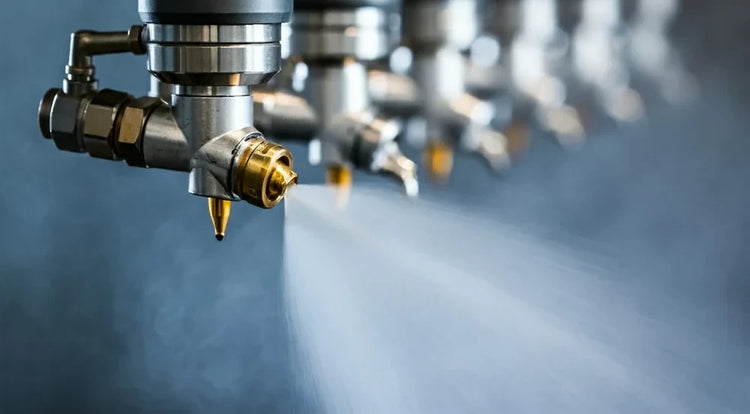
Odor Control Spray Nozzles
Fog, mist, hydraulic atomizing, flat-fan, spiral, and cluster nozzles for odor suppression at wastewater treatment facilities, food processing plants, composting operations, waste and recycling tipping floors, and industrial process odor sources — neutralizer chemistry matched to odor compound type with nozzle material compatibility confirmed
Industrial odor control is a chemistry problem delivered by a fluid mechanics system. The spray nozzle's role is to produce the droplet size and coverage that maximizes contact between the airborne odor compound and the neutralizing agent — but which neutralizing agent is effective depends entirely on the chemical identity of the odor compound. Hydrogen sulfide (H₂S), the rotten-egg odor dominant in wastewater treatment and sewer systems, is an acidic gas neutralized by oxidizing agents (sodium hypochlorite, hydrogen peroxide, chlorine dioxide) and absorbed by alkaline solutions (sodium hydroxide, potassium permanganate). Ammonia (NH₃), dominant in animal processing and composting, is a basic gas neutralized by acidic agents (citric acid, sulfuric acid scrubbing) and absorbed by acidic atomized mist. Volatile organic compounds (VOCs) from food processing, rendering, and industrial processes are typically controlled by chemical masking agents or biological neutralizers — neither of which affects H₂S or NH₃ significantly. Specifying the wrong neutralizer for the actual odor compound produces a system that creates the impression of control (visible spray, chemical odor from the neutralizer) without chemically reacting with the target compound.
NozzlePro supplies fog and mist nozzles, hydraulic atomizing nozzles, flat-fan nozzles, spiral nozzles, and cluster nozzle systems for the full range of industrial odor control applications — with droplet size specified for the target odor compound's vapor pressure and diffusion characteristics, nozzle material confirmed against the specific neutralizer chemistry, and system design matched to whether the odor source is an enclosed zone (indoor fog blanket) or an open-air source (curtain perimeter). ISO 9001 certified manufacturing.
What spray nozzle is best for odor control? Fog and mist nozzles (Dv50 10–60 µm) for airborne odor compound capture in enclosed zones — fine droplets maximize surface area for neutralizer contact with gaseous H₂S and NH₃ molecules and remain airborne for 10–30 seconds for adequate contact time. Hydraulic atomizing nozzles (Dv50 30–80 µm) for controlled neutralizer dosing at specific odor source points (aeration basin headspace, specific conveyor zones) where precise droplet size and coverage pattern are required. Flat-fan nozzles for linear odor curtains at doorways, conveyor entry points, and building perimeter gaps. Cluster nozzles for large indoor spaces (tipping floors, composting buildings) where multiple spray points from a single supply connection provide blanket coverage. Neutralizer chemistry: sodium hypochlorite or hydrogen peroxide solution for H₂S-dominant odor (wastewater, sewer); citric acid or acidic neutralizer for NH₃-dominant odor (animal processing, composting); biological enzymatic neutralizer for VOC-complex odors (food processing, rendering). Nozzle body material: 316L SS standard; Hastelloy C-276 for sodium hypochlorite above 5% concentration; PVDF for bleach concentrations above 10% or HCl-based neutralizers.
Odor Compound Chemistry — Why Neutralizer Selection Must Precede Nozzle Selection
H₂S, NH₃, and VOC odor compounds each require different neutralizer chemistry — and different nozzle body materials
The Three Primary Industrial Odor Compound Families and Their Correct Neutralizer Agents
Hydrogen Sulfide (H₂S) — Wastewater, Sewer, Anaerobic Digestion: H₂S is an acidic, reducing gas (pKa = 7.0 in water) with a detection threshold of approximately 0.5 ppb — detectable at concentrations a thousand times below the OSHA PEL of 1 ppm for 8-hour TWA. It is generated by sulfate-reducing bacteria in anaerobic environments: sewage collection systems, wastewater treatment primary clarifiers, anaerobic digesters, and sludge thickening and dewatering operations. Neutralizing agents: oxidizing agents (sodium hypochlorite — bleach, hydrogen peroxide H₂O₂, chlorine dioxide ClO₂, potassium permanganate KMnO₄) oxidize H₂S to sulfate ions, eliminating the odor. Sodium hypochlorite at 0.5–2% solution is the most widely used; hydrogen peroxide at 3–10% is more expensive but leaves no chlorine residue. pH note: H₂S at ambient pH is approximately 50% in undissociated gas form and 50% ionized — alkaline conditions (pH above 9) shift the equilibrium toward ionized sulfide, reducing gas phase concentration and odor emission. Misting an alkaline solution (NaOH, 0.1–0.5%) over H₂S emission points raises the boundary layer pH and reduces H₂S gas evolution.
Ammonia (NH₃) — Animal Processing, Composting, Livestock: NH₃ is a basic, reducing gas (detection threshold 1–5 ppm; OSHA PEL 50 ppm) generated by biological nitrogen mineralization in composting, animal production, rendering, and food processing operations. Neutralizing agents: weak acidic solutions (citric acid, phosphoric acid at 0.5–2% concentration) convert NH₃ to ammonium salt (non-volatile), eliminating the gas phase. Important: applying an oxidizing agent (bleach) to NH₃-dominated odor does not produce the correct chemical reaction and may generate chloramine compounds with their own odor and toxicity concerns. Applying acidic neutralizer to H₂S-dominant odor also does not produce effective suppression. The correct chemistry depends entirely on whether the dominant odor compound is H₂S, NH₃, or VOC — not on generic "odor neutralizer" product selection.
Volatile Organic Compounds (VOCs) — Food Processing, Rendering, Industrial: VOC odors from food processing (frying oils, fermentation, meat rendering) are chemically complex mixtures of aldehydes, ketones, sulfur organics, and amines — no single chemical neutralizer reacts with all of them. Control approaches: (1) biological enzymatic neutralizers containing microorganisms or enzymes that metabolize VOC odor compounds — effective but require the correct biological agent matched to the VOC mixture; (2) masking agents (plant-derived essential oil emulsions) that alter the perceived odor character without chemically reacting — useful for nuisance odor management but not for regulatory compliance systems; (3) chemical oxidation with ozone or hydrogen peroxide for certain VOC compounds — more effective than masking but requires matched oxidant dose to VOC loading. For mixed H₂S + VOC odors (common in rendering and meat processing): a two-stage approach — oxidizing agent for H₂S followed by enzymatic or masking agent for VOC residual — provides better results than any single agent.
Odor Control Applications by Source Type
Seven odor source types — each with distinct odor compound chemistry, enclosure geometry, and nozzle specification
Wastewater Treatment Plant Odor Control
Primary clarifiers, sludge thickeners, dewatering buildings, headworks screening areas, and covered aeration basins generate H₂S at concentrations routinely exceeding 50–500 ppm in the headspace above the process — well above the 0.5 ppb human detection threshold and approaching OSHA action levels. Fog nozzle systems or hydraulic atomizing nozzles inside covered structures deliver oxidizing neutralizer (sodium hypochlorite 0.5–2% or H₂O₂ 3–10%) as a fine mist that contacts the H₂S-laden air within the enclosure. For open basins: perimeter fog curtain nozzles reduce odor escape at basin boundaries. Automated control from H₂S monitor readings provides demand-based neutralizer dosing that reduces chemical consumption by 30–50% compared to continuous operation.
Nozzle: Fog/mist (Dv50 15–50 µm) or hydraulic atomizing; 316L SS for dilute hypochlorite (<2%); Hastelloy C-276 for concentrated hypochlorite (>5%); PVDF for undiluted bleach; automated H₂S monitor interlock; chemical injection point upstream of pump, not at nozzle.
Fog & Mist Nozzles →Composting Facility and Biosolids Processing Odor Control
Active composting piles generate both H₂S (from anaerobic pockets in the pile) and NH₃ (from nitrogen mineralization) — the mix of both odor compounds complicates neutralizer selection. NH₃ dominates in the early thermophilic stage when pH is high (pH 7.5–9) and nitrogen is active; H₂S can dominate in the mesophilic and maturation stages and when the pile is turned (releasing trapped anaerobic gases). Fog nozzle curtain systems on the perimeter of the composting building or around outdoor windrows; cluster nozzles for covered or indoor composting facilities. Neutralizer: a blended acidic + oxidizing agent is often most effective for the mixed odor stream; biological enzymatic neutralizers are also widely used in composting facilities as they address both NH₃ and VOC fractions simultaneously.
Nozzle: Cluster nozzles for indoor blanket coverage; fog perimeter curtains for outdoor windrows; 316L SS standard; confirm neutralizer chemistry against specific agent and nozzle material; automated wind speed and humidity interlock for outdoor systems; downwind monitoring for compliance.
Cluster Nozzles →Food Processing and Rendering Odor Control
Rendering plants, poultry processing, red meat processing, and frying operations generate complex VOC odor streams containing aldehydes, ketones, sulfur organics, and amines — the most chemically complex industrial odor challenge. The mix varies by process: rendering generates sulfur organics and trimethylamine; poultry processing generates NH₃ and sulfur compounds from evisceration; frying generates aldehydes from lipid oxidation. Hydraulic atomizing nozzles at specific source points (evisceration zone, rendering cooker discharge, fryer exhaust) deliver targeted neutralizer dosing; flat-fan curtains at doorways and building ventilation exits reduce escape. Enzyme-based biological neutralizers are most broadly effective for the complex VOC mixture but require matched biological agent to the specific VOC profile.
Nozzle: Hydraulic atomizing for targeted source point dosing; flat-fan for linear curtains at doorways and ventilation exits; 316L SS for enzyme-based neutralizers; confirm chemical compatibility before deployment; source identification sampling before system design.
Hydraulic Atomizing →Waste Handling Tipping Floors and Transfer Stations
Municipal solid waste (MSW) tipping floors, waste transfer stations, and materials recovery facilities (MRF) generate complex mixed odors from decomposing organic waste — H₂S, NH₃, VOCs, and microbial metabolites. The large open floor area and frequent large door openings for waste vehicle access make enclosure-based control impractical — odor curtains at door openings and high-volume fog blanket systems within the building are the primary controls. Cluster nozzles on the ceiling or overhead structure provide broad fog blanket coverage of the tipping floor. Atomized biological neutralizer or masking agent delivered by fog system provides continuous odor suppression during waste handling operations. Automated interlock to building exhaust fan speed for outdoor wind compensation.
Nozzle: Cluster nozzles on ceiling/overhead for tipping floor blanket; fog curtain systems at vehicle door openings; high-volume capacity for large floor areas; 316L SS; automated control from odor monitor or production schedule; drainage provision to collect settled spray water.
Cluster Nozzles →Sewer Lift Station and Wet Well Odor Control
Sewer lift station wet wells, force main discharge points, and manhole headspaces generate concentrated H₂S from sulfate reduction in the anaerobic liquid phase — H₂S concentrations of 10–500 ppm in the headspace are common at high-sulfate wastewater locations. Fog nozzle systems installed inside the wet well vent or within the lift station valve vault deliver dilute oxidizing neutralizer (sodium hypochlorite or H₂O₂) continuously or on a timed cycle to suppress H₂S evolution and prevent escape through the vent system. Compact design required for confined space installation. ATEX/explosion-proof electrical equipment if H₂S concentrations above LEL are possible (lower explosive limit for H₂S: 4.3% v/v = 43,000 ppm — extremely high, but OSHA requires LEL monitoring above 500 ppm).
Nozzle: Compact fog nozzle in vent riser or valve vault; timed cycle control (10–30 min intervals) for chemical efficiency; Hastelloy C-276 for concentrated hypochlorite; 316L SS for dilute hypochlorite <2%; explosion-proof electrical hardware if LEL risk assessed; confined space entry procedures for installation and maintenance.
Fog & Mist Nozzles →Landfill Perimeter Odor Curtain Systems
Active landfill working faces and leachate handling areas generate H₂S, NH₃, and complex VOC odors from decomposing waste — odors that can reach neighboring communities and trigger regulatory complaints and permit violations. Perimeter spray systems on elevated masts or booms create a fog curtain downwind of the odor source to intercept odor molecules before they reach the community boundary. System effectiveness depends on wind speed, wind direction, and atmospheric stability — wind speed above 5 m/s rapidly disperses both the odor and the fog curtain, reducing effectiveness. Automated control from wind direction and speed sensors: curtain activates on the downwind perimeter only (wind direction tracking); reduces water and chemical consumption by 60–80% vs. full perimeter continuous operation.
Nozzle: Full-cone or fog nozzles on perimeter mast booms; wind direction automated sector control; 316L SS for biological or masking neutralizers; automated wind speed cutoff above 5 m/s (fog curtain ineffective above this); UV-resistant polymer components on outdoor systems; winterization provisions in cold climates.
Full-Cone Nozzles →Industrial Process Vent and Stack Odor Control
Chemical processing, pharmaceutical manufacturing, industrial cooking, and fermentation operations generate process odors through vent and stack emissions — H₂S from chemical processing, amines and organics from pharmaceutical synthesis, complex VOCs from food and fermentation. Hydraulic atomizing nozzle injection into the vent duct or stack housing delivers neutralizer directly into the odor stream before it reaches the stack exit — higher contact efficiency than perimeter or ambient fog systems because the odor and neutralizer are in forced contact within the duct before dispersion. Chemical dosing rate from the vent flow rate and measured odor concentration (continuous H₂S or VOC monitor). 316L SS or Hastelloy depending on the specific process stream chemistry.
Nozzle: Hydraulic atomizing injection nozzles mounted in duct wall; Dv50 matched to duct velocity and residence time calculation; 316L SS or Hastelloy per process chemistry; automated interlock to process run signal; inline odor monitor for demand-based dosing; chemical injection pump and dilution system upstream of nozzle.
Hydraulic Atomizing →Odor Control Nozzle Selection Reference
Application, nozzle type, odor compound, neutralizer agent, body material, and key configuration notes
| Application | Nozzle Type | Odor Compound | Target Dv50 | Body Material | Key Configuration and Neutralizer Notes |
|---|---|---|---|---|---|
| Wastewater Primary Clarifier / Headworks | Fog/Mist or Hydraulic Atomizing inside cover | H₂S dominant | 15–50 µm | 316L SS (<2% NaOCl); Hastelloy C-276 (>5%) | NaOCl 0.5–2% or H₂O₂ 3–10% neutralizer; alkaline mist (pH 10–11) as alternative H₂S evolution suppressor; automated H₂S monitor interlock; covered enclosure required for adequate contact time; drainage from settled spray; chemical injection upstream of pump, not at nozzle orifice |
| Sludge Dewatering Building | Fog/Mist blanket + door curtains | H₂S + NH₃ mixed | 15–40 µm | 316L SS; Hastelloy for hypochlorite above 2% | Blend oxidizing + acidic neutralizer for H₂S + NH₃ mix; automated occupancy interlock — higher dosing rate when building occupied; mechanical exhaust ventilation as primary control; fog nozzle as supplemental; drain provision for accumulated spray water; OSHA H₂S monitoring for worker safety compliance |
| Composting (Indoor / Covered) | Cluster Nozzles on overhead structure | NH₃ dominant + H₂S | 20–60 µm | 316L SS; PVDF for acidic neutralizers below pH 4 | Citric acid 0.5–2% for NH₃; blended acid + oxidizer for mixed H₂S + NH₃; biological enzymatic neutralizer also effective for combined odor stream; wind compensation interlock for outdoor or semi-open facilities; automated pile-turn interlock for peak dosing during pile turning events |
| Food Processing (Rendering, Poultry) | Hydraulic Atomizing at source points + flat-fan curtains | VOC complex + NH₃ | 30–80 µm | 316L SS; PVDF if acidic neutralizer pH <4 | Biological enzymatic neutralizer matched to specific VOC profile; odor sampling and analysis before system design to identify dominant compounds; flat-fan curtains at doorways and ventilation exits; targeted hydraulic atomizing at highest-intensity source points; NSF/food-contact rated neutralizer required if spray contacts food surfaces or packaging |
| Waste Tipping Floor / Transfer Station | Cluster Nozzles ceiling + door curtains | Mixed H₂S, NH₃, VOC | 20–60 µm | 316L SS | High-volume fog blanket for large floor area; automated building exhaust speed interlock; biological or masking neutralizer for complex MSW odor mix; drainage from settled spray; door curtain fog systems at vehicle entry doors during waste receipt operations; odor monitor for demand-based dosing |
| Sewer Lift Station Wet Well | Compact Fog Nozzle in vent riser | H₂S (concentrated) | 10–30 µm | Hastelloy C-276 or PVDF for concentrated hypochlorite | NaOCl or H₂O₂ timed-cycle dosing; ATEX/explosion-proof electrical hardware if H₂S above 500 ppm (LEL monitoring required above this level); confined space entry procedures for installation and maintenance; compact manifold sized for vent pipe diameter; check for H₂S corrosion on stainless components in high-concentration environments |
| Landfill Perimeter Curtain | Full-Cone or fog on perimeter mast booms | H₂S + VOC mixed | 20–80 µm | 316L SS; UV-resistant outdoor components | Wind direction sector automation — curtain only on downwind perimeter; wind speed cutoff above 5 m/s; UV-stabilized polymer manifold components for outdoor exposure; biological or masking neutralizer for complex landfill odor mix; winter freeze protection on supply lines; downwind odor monitoring for compliance verification |
| Industrial Duct / Vent Injection | Hydraulic Atomizing in duct wall | Process-specific (H₂S, amines, VOC) | 30–80 µm (matched to duct velocity) | 316L SS or Hastelloy per process chemistry | Duct residence time calculation to confirm adequate contact time before stack exit; injection flow rate from duct flow rate × odor concentration × stoichiometric dose; inline H₂S or VOC monitor for demand-based dosing; stainless duct liner recommended where acidic neutralizer is injected; ATEX electrical hardware for flammable or explosive duct gases |
Nozzle Types for Industrial Odor Control
Six nozzle categories matched to odor source geometry, indoor vs. outdoor deployment, and neutralizer chemistry
Fog & Mist Nozzles
Standard for enclosed odor control at wastewater treatment structures, sludge dewatering buildings, and sewer wet wells — any application where maximizing the surface area of neutralizer in contact with the odor-laden air is the primary objective. Fog and mist nozzles produce 10–60 µm Dv50 droplets that remain airborne for 10–30 seconds in still air — providing extended contact time between neutralizer droplets and H₂S or NH₃ molecules in the enclosed air space. The large surface-to-volume ratio of fine fog droplets means that a given volume of neutralizer solution provides dramatically more reactive surface area than the same volume as coarser drops: 10 µm droplets have 1,000× more surface area per unit volume than 100 µm drops. This maximizes neutralizer efficiency — more odor compound is neutralized per liter of chemical used.
Shop Fog & Mist NozzlesHydraulic Atomizing Nozzles
For targeted neutralizer dosing at specific odor source points where precise droplet size and controlled coverage pattern produce higher efficiency than general fog blanket systems. In food processing and industrial duct injection applications, hydraulic atomizing nozzles deliver a calibrated droplet spectrum (30–80 µm Dv50) at controlled flow rates that can be modulated by supply pressure — enabling demand-based control from an upstream odor monitor. Also used in wastewater headworks where a specific spray direction targets the surface of the process basin directly rather than blanketing the entire enclosed air volume. The adjustable flow rate at varying pressures makes hydraulic atomizing the most controllable of the odor suppression nozzle types for integrated instrumented systems.
Shop Hydraulic AtomizingFlat-Fan Nozzles
For linear odor curtains at doorways, building perimeter openings, conveyor entry and exit points, and any linear boundary where odor-laden air must be intercepted before escaping to the ambient environment. The linear spray pattern from flat-fan nozzles creates an air curtain across the full width of the opening — from a single nozzle position with a fan angle wide enough to span the opening, or from a manifold of nozzles on a header bar for wider openings. In food processing facilities, flat-fan nozzle curtains at the boundaries between odor-generating process zones (evisceration, rendering) and product handling or packaging areas contain odors within their source zone without the general air contamination from overhead fog systems that can contact food product surfaces.
Shop Flat-Fan NozzlesSpiral Nozzles
For wastewater applications where the spray water or neutralizer solution contains suspended solids or where nozzle clogging from biological growth is a concern — spiral nozzles have a wide free passage (up to 15 mm on some sizes) that passes solids and biological particles that would block standard fog nozzle orifices. The wide-angle conical spray pattern from spiral nozzles (typically 90°–150°) provides broad coverage from a single position without the clogging risk of fine fog orifices. Particularly useful in sludge handling areas, biosolids buildings, and any location where the spray water supply is not well filtered — common in wastewater treatment where the supply is often plant service water rather than clean municipal supply.
Shop Spiral NozzlesCluster Nozzles
For large indoor spaces where high spray density from multiple spray points is required from a limited number of supply connections — composting buildings, waste tipping floors, large processing rooms. Cluster nozzles deliver 4–8 individual spray orifices from a single pipe connection, providing broad coverage in a large area without the extensive piping runs that a comparable number of individual nozzle positions would require. Each orifice in the cluster contributes to the overall fog blanket within the space; the multiple-orifice design also provides redundancy if individual orifices partially block. The cluster body typically delivers the combined flow of all orifices from one manifold thread — simplifying the piping design for large spaces with many required spray points.
Shop Cluster NozzlesFull-Cone Nozzles
For outdoor perimeter curtain systems at landfills and open-air composting operations where the broader coverage from a full-cone pattern is more effective than a flat-fan curtain against variable wind direction, and where the coarser droplets (80–300 µm) carry sufficient mass to project through wind without being deflected as fine fog would be. Also used as supplemental nozzles at large doorway openings where a full-cone mounted above the door center provides greater vertical coverage range than a flat-fan nozzle positioned at the same point. In outdoor applications, the higher flow rate of full-cone nozzles reduces evaporation loss — important where drier climates cause fine fog droplets to evaporate before they can contact odor molecules.
Shop Full-Cone NozzlesOdor Control System Design Principles
Five parameters that determine whether an odor control spray system achieves target suppression and regulatory compliance
- Identify the Dominant Odor Compound Before Selecting the Neutralizer — Mismatched Chemistry Produces No Suppression — Selecting a neutralizer before identifying the dominant odor compound is the most common cause of odor control system failure in industrial applications. A sodium hypochlorite fog system applied to NH₃-dominant composting odor does not react effectively with ammonia (oxidation of NH₃ by hypochlorite at low concentration produces chloramine, not suppression). An acidic citric acid mist applied to H₂S-dominant wastewater odor does not neutralize H₂S (the acid does not oxidize sulfide; it slightly increases H₂S volatility from the liquid surface by lowering pH). Before designing a spray system, obtain at minimum a qualitative odor characterization: measure H₂S with a direct-reading electrochemical sensor; measure NH₃ with a colorimetric test or sensor; note the olfactory character (rotten egg = H₂S; ammonia/urine = NH₃; organic/chemical = VOC). For regulated facilities requiring documented odor reduction: have a professional odor laboratory analyze a sample using olfactometry (dilution-to-threshold odor unit measurement) and gas chromatography for compound identification. This analysis costs $500–2,000 and provides the compound-specific data needed to select the correct neutralizer and specify the spray system for the actual odor source.
- Nozzle Body Material Must Be Confirmed Against the Specific Neutralizer Chemistry Before Ordering — Neutralizer chemicals for industrial odor control are frequently corrosive to standard nozzle body materials — a fact the generic "odor control nozzle" selection process routinely overlooks with expensive consequences. Sodium hypochlorite (bleach) is aggressively corrosive to 316L stainless steel at concentrations above 2–3% — in concentrated form, hypochlorite attacks the passive oxide layer on SS and causes rapid pitting corrosion. Standard service: 316L SS acceptable for dilute hypochlorite below 2%; Hastelloy C-276 for hypochlorite 2–10%; PVDF body for undiluted bleach or concentrations above 10%. Acidic neutralizers (citric acid, phosphoric acid at pH below 4): PVDF body; verify SS compatibility at specific acid concentration and temperature before using 316L SS in acidic systems. Biological enzymatic neutralizers (pH 6–8): 316L SS is standard and compatible. Masking agent neutralizers (plant oil emulsions): 316L SS compatible; verify no solvent components that attack SS passivation. For any new neutralizer chemistry: obtain the Safety Data Sheet (SDS) from the chemical supplier, extract pH and oxidizing potential values, and confirm against the nozzle body material corrosion data before deployment.
- Contact Time Between Neutralizer and Odor Compound Is the Governing Design Variable — Enclosure Is More Important Than More Spray Nozzles — The chemical reaction between the neutralizer and the odor compound requires time — the contact time that the neutralizer droplet and the odor molecule spend in close proximity before the droplet settles and the odor molecule disperses. In an enclosed space, both the neutralizer fog and the odor-laden air are retained within the spray zone for the time required for the reaction to occur. In an open-air environment, both components are immediately diluted by ambient air and carried away — the effective contact time drops to near zero. Adding more nozzles or increasing flow rate does not compensate for inadequate enclosure — it only increases chemical consumption and floor wetting without improving odor suppression. Design principle: maximize enclosure of the odor source first; add nozzle coverage within the enclosure second. For open sources that cannot be enclosed (open primary clarifier basins, outdoor composting windrows): perimeter spray curtains reduce odor escape at the boundary but cannot achieve the same efficiency as enclosed systems — and effectiveness decreases rapidly above wind speeds of 2–3 m/s. Document the enclosure geometry in the system design specification and calculate the theoretical contact time at design air exchange rate — target minimum 3–5 seconds for adequate H₂S reaction with hypochlorite at standard dilution.
- Demand-Based Automated Control Reduces Chemical and Water Consumption by 40–70% Without Reducing Compliance Performance — Odor generation rates in wastewater treatment, composting, and waste handling facilities vary significantly with process conditions, temperature, time of day, and weather. H₂S generation in a primary clarifier increases during warm weather (temperature accelerates sulfate reduction), with high organic loading, and during low-flow periods (extended solids retention time increases anaerobic activity). A continuous-rate spray system delivers the same neutralizer dose at 3 a.m. in January when H₂S may be 10 ppb as it does at 2 p.m. in July when H₂S may be 500 ppb — wasting 98% of the chemical applied during low-odor periods. Demand-based control from inline H₂S sensors (for wastewater), NH₃ sensors (for composting and animal processing), or downwind odor monitors adjusts spray rate in proportion to measured odor concentration. The capital cost of H₂S electrochemical sensors ($500–2,000 each) is typically recovered within 3–6 months from chemical savings alone on facilities with significant H₂S variation across the operating day. Demand-based control also prevents over-dosing: sodium hypochlorite in excess of what is needed to react with H₂S creates residual chlorine vapor that has its own odor and regulatory significance.
- Neutralizer Injection Must Be Upstream of the Spray Pump, Not at the Nozzle — Concentrated Chemical Destroys Nozzle Orifices — The most common installation error in odor control spray systems: injecting the concentrated neutralizer chemical directly at the nozzle body or immediately upstream of the nozzle manifold. Concentrated sodium hypochlorite (commercial bleach is 10–12% NaOCl) applied directly to stainless steel nozzle bodies causes pitting corrosion that destroys the nozzle orifice geometry within weeks even for Hastelloy bodies above certain concentrations. The correct installation: inject the concentrated neutralizer into the spray water supply line at a point upstream of the dilution mixing zone — allowing the chemical to dilute to its working concentration (0.5–2% for hypochlorite) before reaching the pump, the manifold piping, and the nozzle bodies. The diluted working concentration is compatible with 316L SS at typical use concentrations and with Hastelloy at all use concentrations. A chemical metering pump with an injection quill into the main water supply line, upstream of a static mixing section, provides the correct dilution and mixing before the spray system pump inlet. Document the dilution ratio and injection point in the system specification for maintenance reference — concentrated chemical injected at the wrong point is the leading cause of premature nozzle and manifold corrosion failure in odor control spray systems.
Odor Control Applications by Industry
Six industries with distinct odor compounds, regulatory frameworks, and spray nozzle specifications
Wastewater Treatment
H₂S from primary clarifiers, headworks, digesters, and dewatering. Oxidizing neutralizers (NaOCl, H₂O₂). 316L SS for dilute; Hastelloy for concentrated. Automated H₂S monitor interlock. Enclosed structures required. OSHA H₂S monitoring for worker safety. Demand-based control from H₂S readings.
Composting & Biosolids
NH₃ dominant + H₂S in mixed piles. Citric acid or blended acid + oxidizer neutralizer. Biological enzymatic also effective. Cluster nozzles for indoor; fog perimeter for outdoor windrows. Pile-turn interlock for peak dosing. Wind and humidity automated compensation.
Food Processing & Rendering
Complex VOC + NH₃ from evisceration, rendering cookers, frying. Biological enzymatic neutralizer matched to VOC profile. Flat-fan curtains at zone boundaries. NSF food-contact rated neutralizer where spray contacts product. Hydraulic atomizing for targeted source point dosing.
Waste & Recycling Facilities
Mixed MSW odor at tipping floors and transfer stations. Cluster ceiling nozzles for blanket coverage. Door curtain fog at vehicle access openings. Biological or masking neutralizer for complex waste odor mix. Automated occupancy and production interlock. Drain provision for settled spray water.
Landfill Operations
H₂S + VOC from working face and leachate. Perimeter mast curtain systems with wind direction automation. Wind speed cutoff above 5 m/s. UV-resistant outdoor components. Full-cone or fog nozzles on perimeter boom. Downwind community odor monitoring for permit compliance documentation.
Industrial & Chemical Processing
Process-specific H₂S, amines, and VOCs from vents and stacks. Hydraulic atomizing injection in duct. Neutralizer chemistry from process stream compound identification. 316L SS or Hastelloy per chemistry. Demand-based dosing from inline process monitors. ATEX hardware for flammable process streams.
Nozzle Material Selection for Odor Control Systems
Neutralizer chemistry — not the odor compound — determines nozzle body and seal material selection
316L SS Body
Standard for water-only, biological enzymatic neutralizer, masking agent, and dilute hypochlorite below 2% NaOCl. Corrosion resistant in humid wastewater and composting environments. Not acceptable for hypochlorite above 2–3% or acidic neutralizers below pH 4.
Use for: Biological enzymatic neutralizers; masking agents; dilute NaOCl <2%; citric acid pH above 4; water-only fog systems; wastewater and composting humid environmentsHastelloy C-276 Body
For sodium hypochlorite solutions at 2–10% NaOCl concentration where 316L SS corrosion rate is unacceptable. Also for hydrogen peroxide at 10–30% concentration and chlorine dioxide solutions. Significantly higher cost than 316L SS — specify only where dilute SS service is confirmed to be inadequate by corrosion testing or operating experience.
Use for: NaOCl 2–10%; H₂O₂ 10–30%; ClO₂ solutions; any oxidizing neutralizer concentration that causes visible corrosion of 316L SS within the planned service intervalPVDF (Kynar) Body
For undiluted or high-concentration hypochlorite above 10%, HCl-based neutralizers, and strongly acidic neutralizers (pH below 3). Maximum 150 PSI operating pressure. Resists all common odor control neutralizer chemicals including concentrated oxidizers, strong acids, and chlorine-containing solutions.
Use for: NaOCl above 10%; HCl; strongly acidic neutralizers pH <3; any neutralizer chemistry that attacks or rapidly corrodes Hastelloy C-276Viton FKM & PTFE Seals
Viton FKM seals for all hypochlorite, H₂O₂, and most acidic neutralizer applications to 200°C. PTFE for strongly oxidizing or strongly acidic conditions where FKM resistance is marginal. Standard NBR (Buna-N) rubber seals are not acceptable for oxidizing neutralizers — hypochlorite and H₂O₂ degrade NBR within weeks. Always specify seal material alongside body material when ordering for neutralizer service.
Viton FKM: NaOCl, H₂O₂, acidic neutralizers, biological neutralizers — standard for odor control. PTFE: strongly oxidizing conditions, concentrated oxidizers above Viton service rangeOdor Control System Troubleshooting
Four common failures in industrial odor control spray systems
Spray System Operating But No Odor Reduction Achieved
Symptom: Fog or mist spray visible and operating; neutralizer being consumed; odor readings unchanged or only slightly reduced at monitoring point Likely cause: Neutralizer chemistry mismatch — wrong neutralizer for the dominant odor compound; or open-air application without enclosure providing adequate contact timeFirst confirm the odor compound: measure H₂S with an electrochemical sensor and NH₃ with a colorimetric kit at the source. If H₂S is detected at significant concentration but the current neutralizer is an acidic or biological product: switch to an oxidizing agent (sodium hypochlorite or H₂O₂). If NH₃ is the dominant compound but the current neutralizer is an oxidizer: switch to dilute citric acid or acidic neutralizer. If odor compound identification confirms the neutralizer is chemically correct: the issue is contact time — evaluate whether the spray zone is adequately enclosed. Mark where the spray curtain boundary is and observe whether odor-laden air is bypassing the spray zone through gaps in the enclosure, open doorways, or ventilation paths. Seal bypass paths before increasing nozzle density or chemical dose.
Rapid Nozzle Corrosion and Failure
Symptom: Nozzle bodies showing pitting or surface corrosion within weeks of installation; orifice enlargement; manifold fitting corrosion; spray pattern degradation Likely cause: Neutralizer chemical concentration too high for nozzle body material; or concentrated chemical injected at the nozzle rather than upstream at the dilution pointMeasure the actual neutralizer concentration at the nozzle inlet — not the design dilution, but the measured concentration after the injection and mixing system. If above 2% NaOCl with 316L SS bodies: upgrade to Hastelloy C-276. If concentrated chemical is being injected immediately upstream of the nozzle manifold (common in retrofitted systems where a metering pump was added to an existing water manifold without adding a proper upstream mixing section): relocate the injection point to at least 3–5 pipe diameters upstream of the manifold to allow complete dilution before the concentrated chemical contacts the nozzle bodies. Check seal condition: NBR or EPDM seals in oxidizing neutralizer service fail rapidly — replace with Viton FKM seals throughout the manifold. Document the correct injection point, dilution ratio, and seal material in the system maintenance record.
Nozzle Clogging — Reduced or No Flow from Individual Positions
Symptom: Some nozzle positions not spraying or producing reduced flow; visible scale or biological fouling at nozzle orifice; increased system pressure with reduced total flow Likely cause: Mineral scale from hard water in fine fog orifices; biological slime growth in low-flow or intermittently operated systems; or chemical precipitation from incompatible neutralizer mixingFor mineral scale: flush system with dilute citric acid (2–5%) or commercial scale remover; install 100-mesh inline strainer upstream of fog nozzle manifold; consider softened or RO water supply for fine fog nozzle systems (below 20 µm Dv50). For biological fouling: intermittent systems that hold stagnant water between cycles are most vulnerable — add a short purge cycle (30–60 seconds of fresh water) after each odor control cycle to displace chemical from the nozzle orifices before the system returns to standby; consider continuous low-flow recirculation to prevent stagnation. For chemical precipitation: identify whether the water supply chemistry is incompatible with the neutralizer (calcium-containing hard water + sodium hypochlorite can form calcium carbonate scale in the orifice) — use DI or softened water for systems prone to this interaction. Switch to spiral nozzles (large free passage) for water supplies that cannot be adequately filtered.
Surface Over-Wetting — Floors, Equipment, or Product Wet from Spray
Symptom: Wet floors creating slip hazard; equipment corrosion from settled spray; product contamination from spray contact; accumulated water requiring drainage Likely cause: Nozzle flow rate too high for the space volume; droplets too large (settling too quickly before evaporation or contact); or system operating during non-productive periods when odor generation is lowReduce supply pressure to decrease both flow rate and droplet size — smaller droplets remain airborne longer and evaporate before settling, reducing floor wetting. If system cannot achieve adequate odor suppression at reduced pressure: the droplets are too large for the required suspension time — switch to finer atomizing nozzles (hydraulic atomizing or two-fluid air-atomizing) that achieve smaller Dv50 at equivalent or lower flow rate. Add demand-based automated control to reduce or stop spray during non-production periods when odor generation is low — continuous spray in a food processing area between production shifts generates unnecessary floor wetting without contributing to odor control. Install floor drains in the spray zone and ensure they are sized for the maximum design spray flow rate — surface wetting is expected in high-flow systems and must be managed by drainage design rather than eliminated by reducing spray effectiveness.
Why Specify NozzlePro for Industrial Odor Control?
Neutralizer chemistry compatibility, Hastelloy and PVDF options for aggressive chemicals, and demand-based system design
Odor Control Systems Specified from Compound Chemistry and Enclosure Geometry
Odor control spray systems specified without odor compound identification and neutralizer chemistry matching produce systems that look like they are working — visible spray, chemical smell from the neutralizer — but do not chemically reduce the target odor compound. NozzlePro application engineers begin with the dominant odor compound identification (H₂S, NH₃, or VOC), specify the correct neutralizer agent, confirm nozzle body and seal material against the specific neutralizer chemistry, and design the spray zone layout for adequate contact time within the enclosure geometry.
Corrosion-Resistant Material Options: 316L SS, Hastelloy C-276, and PVDF body options available across fog, hydraulic atomizing, flat-fan, spiral, and cluster nozzle types. Viton FKM seals standard for oxidizing and acidic neutralizer service. No generic "odor control nozzle" catalog — material specified per the neutralizer chemistry of each installation.
Demand-Based Control Design: System specifications include H₂S or NH₃ sensor placement, dosing rate modulation logic, and chemical consumption estimates at design vs. off-peak odor load — providing chemical budget estimates alongside the technical specification.
Frequently Asked Questions
Common questions about odor control spray nozzle selection and system design
What neutralizer chemical should I use for hydrogen sulfide odor at a wastewater treatment plant?
H₂S from wastewater treatment is an acidic, reducing gas that is neutralized by oxidizing agents — the oxidizer reacts with sulfide to convert it to sulfate (SO₄²⁻), which is non-volatile and odorless. Four oxidizing neutralizers are commonly used, in order of preference: (1) Sodium hypochlorite (NaOCl, bleach) at 0.5–2% working concentration is the most widely used and lowest cost. Reaction: H₂S + NaOCl → NaCl + H₂SO₃ → ultimately oxidized to sulfate. Limitations: chlorine residual and trihalomethane formation concerns in some environments; corrosive to 316L SS above 2% — specify Hastelloy C-276 nozzle bodies above this concentration. (2) Hydrogen peroxide (H₂O₂) at 3–10% working concentration produces no chlorine residual — preferred where residual chlorine is an issue. More expensive than hypochlorite; 316L SS acceptable up to 10% (Hastelloy for concentrated H₂O₂ above 30%). (3) Potassium permanganate (KMnO₄) at 0.5–2% — effective but leaves manganese dioxide residue that can stain surfaces; less common in fog spray systems, more used for liquid-phase treatment. (4) Chlorine dioxide (ClO₂) generated on-site — most effective per unit oxidant dose but requires on-site generation equipment and careful handling; used for highest-concentration H₂S applications. For a preliminary system test: dilute household bleach (3–5% NaOCl) to 0.5–1% with clean water and test manually from a spray bottle at the odor source — if you can detect significant odor reduction within 30 seconds of application, hypochlorite is an appropriate neutralizer for this source. If no reduction: the dominant odor compound may not be H₂S — have a more complete odor analysis performed.
What nozzle is best for composting facility odor control?
Composting facility odor control nozzle selection depends on whether the composting is indoor (enclosed building or covered windrow tunnel) or outdoor (open windrows), and on the dominant odor compound at the specific facility. For indoor composting facilities: cluster nozzles mounted on the ceiling or overhead structure of the composting building provide the highest spray point density per supply connection — typically four to eight orifices per cluster body covering 15–30 m² of floor area each; a single supply header feeds the cluster network. Fog/mist nozzles can supplement the cluster coverage at elevated positions near the roof peak where natural air stratification concentrates the odor-laden air. For outdoor windrows: perimeter fog curtain nozzles on fixed stands or portable manifold systems positioned downwind of the active windrow create a spray curtain to intercept odor before it reaches the site boundary. Effectiveness is wind-speed dependent — outdoor curtain systems perform well below 3 m/s and become progressively less effective as wind speed increases, requiring higher flow rates or shelter structures at higher wind speeds. For the neutralizer chemistry: a blended acidic + oxidizing product addresses both the NH₃ fraction (dominant in early thermophilic composting) and the H₂S fraction (from anaerobic pockets in the pile), and is commercially available as a single ready-to-dilute product from several odor control chemical suppliers. Biological enzymatic neutralizers formulated for composting are also highly effective and environmentally compatible with composting output — the metabolized odor compounds contribute to the biological nutrient pool rather than adding chlorine residue. For pile-turning events: the highest odor release occurs when the pile is mechanically turned — add an automated interlock that activates maximum spray rate when the turning machine is operating in the composting area, and returns to baseline rate 30–60 minutes after turning is complete.
Will odor control fog spray cause problems in food processing facilities?
Odor control fog spray in food processing facilities requires careful placement and neutralizer selection to avoid food safety problems — the concerns are different from non-food environments and manageable with correct system design. The primary concern: any spray that contacts food product surfaces, open food containers, or product-contact packaging materials is subject to FDA food safety regulations and must use neutralizers on the FDA Generally Recognized As Safe (GRAS) list or approved food-contact substances. Sodium hypochlorite at food-safe concentrations (50–200 ppm free chlorine) is FDA-approved for direct food contact surface sanitizing — this concentration is far below the 5,000–10,000 ppm used in industrial H₂S suppression and is bactericidal rather than odor-neutralizing. Citric acid (used for NH₃ control) is FDA GRAS. Biological enzymatic neutralizers: confirm FDA GRAS or food-contact status with the specific supplier — many commercial enzymatic odor neutralizers are formulated for food-adjacent applications. The second concern: spray wetting of food product surfaces can cause microbiological contamination from the spray water supply — requires clean, potable water supply or properly treated recirculated water. System design for food processing odor control: place fog nozzle systems in non-production hours when food is not present for general facility treatments; use flat-fan nozzle curtains at zone boundaries (between odor source zones and product handling areas) rather than overhead fog blanket systems that might carry neutralizer over product; confirm that all spray zones are downstream of product flow in the ventilation air pathway; use fine hydraulic atomizing nozzles that achieve near-complete evaporation before settling, minimizing surface wetting. Many food processing odor control systems use fog nozzles positioned to spray into air handling units or exhaust ducts rather than directly into the production space — this captures odor in the exhaust stream rather than treating the production space air, completely avoiding product contact concerns.
How do I prevent clogging in odor control fog nozzles?
Fog nozzle clogging in odor control systems is common because the small orifice size (typically 0.3–1.5 mm) required for fine droplet production makes these nozzles vulnerable to mineral scale, biological fouling, and chemical precipitation. Four preventive measures address the most common causes: (1) Filtration: install a 100-mesh (150 µm) inline strainer at each nozzle manifold supply inlet. This removes particulate larger than the strainer mesh that would otherwise accumulate at the orifice. Clean or replace strainer elements quarterly or more frequently if water quality is poor. For very fine fog nozzles (below 15 µm Dv50): 200-mesh filtration. (2) Water quality: hard water (above 150 ppm CaCO₃) deposits calcium carbonate scale in fine orifices when the spray evaporates — the mineral remains as scale. Softened water (below 50 ppm) prevents most carbonate scale; DI or RO water (below 5 µS/cm) prevents all mineral scale but at higher cost. For fog systems where scale is recurring: a 2–5% citric acid soak of nozzle manifolds every 3–6 months dissolves carbonate scale. (3) Purge cycles: intermittent systems that hold chemical-containing water in the nozzle body between cycles develop both mineral scale (from chemical evaporation at the orifice) and biological growth (from stagnant nutrient-containing water). Program a 30–60-second clean water purge after each odor control cycle — this flushes neutralizer from the orifice and replaces it with clean water that evaporates cleanly without scale or biological residue. (4) Check chemical compatibility: some neutralizer chemistries react with the dissolved minerals in the supply water to form precipitates at the nozzle — calcium in hard water + sodium hypochlorite can form calcium hypochlorite scale; calcium + citric acid can form calcium citrate. If scale composition analysis shows a chemical precipitation rather than pure carbonate: switch to DI water supply for the dilution water or change neutralizer formulation to avoid the precipitation reaction.
What odor control system is best for a waste transfer station tipping floor?
Waste transfer station tipping floors present the most demanding odor control challenge in the waste management industry: a large open floor area (typically 1,000–5,000 m²), frequent large door openings for waste vehicles (which create significant air exchange and disrupt any contained spray zone), variable and chemically complex MSW odor (H₂S, NH₃, VOCs, microbial metabolites all present), and the operational requirement that the spray system not interfere with waste handling vehicle movement. The most effective system design combines three elements: (1) Ceiling-mounted cluster nozzle blanket: cluster nozzles on the ceiling structure or on overhead pipes across the full tipping floor area, spaced to provide complete coverage at the nozzle's effective radius. Cluster nozzle arrays provide even fog blanket distribution from the minimum number of supply connections — critical on a large floor where running individual piping to each nozzle position is impractical. Fog provides continuous odor molecule contact throughout the space. (2) Vehicle door curtain system: fog nozzle headers above each vehicle access door create a spray curtain across the door opening when doors are open for waste vehicle entry — this is the highest-priority odor escape point and the one that community neighbors and neighboring businesses most directly experience as odor pulses during operations. Door curtains activate automatically with the door open signal. (3) Demand-based control: operate the tipping floor blanket system at full rate during waste receipt and handling operations; reduce to low-rate or standby during non-operational periods. Install an odor or VOC monitor at the site perimeter downwind to provide compliance data and automated alarm if perimeter concentrations exceed the site permit limit. Neutralizer for MSW complex odor: a biological enzymatic product combined with a masking agent performs better than a single oxidizing agent against the complex chemical mixture of MSW odor — the enzymatic component degrades the VOC and organic sulfide fractions while the masking agent reduces the perceived olfactory intensity during the enzymatic reaction period. Apply at the dilution and flow rate specified by the neutralizer supplier for the facility air volume and estimated odor loading.
How do I choose between a fog nozzle system and a biofilter for wastewater treatment odor control?
Fog spray systems and biofilters address the same odor problem through fundamentally different mechanisms — the choice between them depends on odor concentration, regulatory compliance requirements, capital budget, and operating cost tolerance. Biofilters work by passing odor-laden air through a packed bed of biological media (wood chips, compost, synthetic media) where microorganisms metabolize H₂S and VOC odor compounds. They achieve 90–99% H₂S removal efficiency for low-to-moderate concentrations (below 50 ppm inlet H₂S) in properly designed and maintained systems — far higher removal than spray systems alone. They require significant capital investment ($50,000–500,000+ depending on air volume) and careful operation (media moisture and pH maintenance), but have low chemical operating costs once established. Fog spray systems have lower capital cost ($5,000–50,000 typical for moderate facilities), are simpler to install and operate, and provide flexible coverage of open basins and outdoor sources that cannot be ducted to a biofilter. They achieve 50–80% odor reduction in enclosed spaces with correct neutralizer and adequate contact time — not the 90–99% achievable with a biofilter but adequate for compliance at many facilities. They have ongoing chemical operating costs (neutralizer consumption) that biofilters do not. For most wastewater facilities: the decision depends on the inlet H₂S concentration and the regulatory target. For enclosed structures with inlet H₂S above 20–50 ppm and regulatory targets requiring 90%+ removal: biofilter or chemical scrubber is the primary control, with fog spray as supplemental control for residual odor from open basins and areas that cannot be ducted. For facilities with inlet H₂S below 10–20 ppm or where the regulatory target allows 50–70% reduction: fog spray with correct neutralizer may achieve compliance at significantly lower capital cost. For open primary clarifiers that cannot be ducted: fog spray is the practical option; biofilters require a covered and ducted air collection system first. Consult a licensed environmental engineer familiar with your state's air quality permit requirements before selecting between these technologies — the correct choice is site-specific and permit-driven.
Get Odor Control Nozzle Specifications for Your Facility
Provide your facility type, dominant odor compound (H₂S ppm reading or compound description), building or source area dimensions, neutralizer chemistry you are using or considering, and applicable regulatory requirement — our application engineers specify nozzle type, droplet size, coverage layout, neutralizer compatibility, and demand-based control strategy for your specific odor source.