
Spray Nozzles for
Automated Conveyor Spray
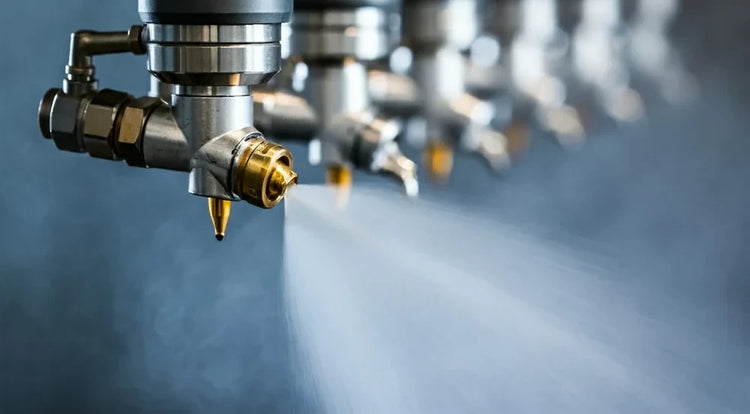
Conveyor production lines use fixed spray nozzle manifolds to apply water, cleaning solution, lubricant, coating, or cooling spray to parts or products as they move continuously through the spray zone. Unlike robotic arm systems that move around a stationary part, conveyor spray systems keep the nozzles fixed and let the moving line do the work — every part receives the same spray exposure on every cycle, at production throughput rates that manual or batch processes cannot match. The critical design parameter is coverage at line speed: the nozzle spacing, spray angle, flow rate, and zone length must together deliver adequate treatment to every part surface during its transit time through the spray zone. NozzlePro supplies flat fan and full cone nozzles in stainless steel and PVDF for every conveyor spray application in industrial production.
A conveyor spray system that works perfectly at 50% line speed may fail to deliver adequate treatment at full production throughput. The exposure time each part receives in the spray zone is directly proportional to zone length and inversely proportional to line speed — double the line speed and each part spends half as long in the spray zone. If the nozzle manifold was designed for coverage at a particular throughput rate and line speed is increased during production ramp-up, the system may no longer deliver adequate wash time, coating weight, or cooling to meet process requirements.
NozzlePro's approach to conveyor spray nozzle specification starts with the line speed and the required treatment result, then works backward to nozzle spacing, orifice size, operating pressure, and zone length. This ensures the system is designed to perform at the production rate it will actually run at — not just at a nominal design condition that may not reflect the operating reality.
Four Production Conveyor Spray Applications
Conveyor spray manifolds are used for washing, cooling, lubrication, and coating — each with different nozzle requirements, flow rates, and material specifications.
Nozzle Spacing, Overlap, and Manifold Layout for Complete Coverage
Calculating Nozzle Spacing on a Conveyor Manifold
The spacing between adjacent nozzles on a conveyor spray manifold is determined by the spray fan width at the part surface and the required overlap percentage. For a flat fan nozzle at a 12-inch standoff producing a 14-inch wide spray band, adjacent nozzles spaced at 10 inches produce a 30% overlap at the part surface — adequate for most washing, cooling, and coating applications. Nozzle spacing at 12 inches produces zero overlap at the centerlines and leaves a gap between adjacent fans. The overlap requirement is higher for coating applications (40–50%) than for washing applications (20–30%) because coating uniformity is more sensitive to coverage gaps than washing, where the part dwell time in the wash zone provides additional cleaning opportunity.
Side manifold nozzles present an additional complexity — the spray fan width at the part surface changes with nozzle height and the lateral distance from the manifold arm to the conveyor centerline. Nozzles positioned close to the conveyor produce a narrower coverage band on the part than nozzles positioned farther away. Calculating side manifold spacing requires accounting for the actual spray geometry at each nozzle position, not a simple rule-of-thumb spacing figure.
Design for maximum line speed, not nominal line speed
Conveyor systems are almost always run faster than their nominal design speed during production pressure periods. A tunnel washer designed for a nominal 10 parts per minute will frequently be pushed to 12 or 14 parts per minute. The spray manifold nozzle count, zone length, and flow rate should be sized to provide adequate treatment at the maximum anticipated line speed — which is typically 20–30% above the nominal design rate. Under-designing for nominal speed creates a system that works in commissioning and fails under production pressure.
Nozzle Material for Continuous Wet Service
Conveyor spray nozzles in continuous production environments spend the majority of their service life wetted by the spray liquid — even when the line is stopped, residual liquid remains in the manifold and around the nozzle. Material selection must account for continuous exposure, not just spray-on time. Brass nozzles in alkaline wash or acidic rinse environments corrode progressively from continuous liquid contact even at low concentrations that would be acceptable for intermittent exposure. Stainless steel nozzles with appropriate seal material are the baseline specification for any conveyor spray application using aqueous chemistry.
Strainer installation is mandatory on conveyor spray manifolds
Conveyor spray manifolds often run recirculated process water containing cleaning chemistry residue, fine particulate from washed parts, and mineral scale. Even municipal water supply contains sufficient mineral content to progressively clog small-orifice nozzles over weeks of continuous operation. Install a mesh strainer — 50 to 100 mesh depending on nozzle orifice size — immediately upstream of each manifold zone. Inspect and clean strainers on a scheduled maintenance interval rather than waiting for flow reduction symptoms.
What to Provide When Specifying Conveyor Spray Nozzles
- Conveyor line speed — nominal and maximum — The line speed at which the manifold must perform. Size for maximum anticipated speed, not nominal. Provide both values so NozzlePro can confirm the system meets process requirements across the operating range.
- Part dimensions and profile — Width, height, and complexity of the part as it sits on the conveyor. A wide, flat part requires a different manifold width and nozzle count than a tall, narrow part. Complex geometry with recesses or overhangs may require side spray positions in addition to top.
- Application type and process requirement — Washing (what contamination, what cleanliness standard), cooling (entry and exit temperature, heat load), lubrication (lubricant type, application rate), or coating (material, target film weight). The process requirement determines the required nozzle flow rate and zone length at line speed.
- Spray liquid chemistry, concentration, and temperature — Determines nozzle body and seal material. Operating temperature is especially important for conveyor washers with hot wash zones — confirm EPDM seal temperature rating for your wash temperature.
- Available zone length — The physical space available for the spray zone on the conveyor line. This constrains the nozzle count per zone and the maximum dwell time available. If zone length is fixed, the nozzle flow rate must be higher to deliver adequate treatment in the available length at line speed.
- Supply pressure at the manifold inlet — Pressure after all upstream losses. Provide pump output pressure and estimated line losses (distance, pipe diameter, number of fittings) if the manifold inlet pressure is not known; NozzlePro can estimate manifold inlet pressure from this data.
- Nozzle standoff distance — top and side — Distance from nozzle tip to part surface for each manifold position. Top manifold standoff is typically set by the tunnel height; side manifold standoff depends on the lateral clearance between the manifold arm and the widest part on the conveyor.
Conveyor Spray Nozzle Selection by Application and Position
| Application / Position | Pattern | Angle | Pressure | Material | Key Consideration |
|---|---|---|---|---|---|
| Tunnel wash — top manifold | Flat fan | 65°–80° | 30–100 PSI | 316 SS / EPDM | 20–30% overlap; size for max line speed |
| Tunnel wash — side manifold | Flat fan or full cone | 65°–80° | 30–100 PSI | 316 SS / EPDM | Multiple heights for tall parts; confirm spray geometry |
| Acidic rinse / passivation zone | Flat fan | 65°–80° | 20–80 PSI | PVDF / PTFE | PVDF required in acid zones; confirm pH range with NozzlePro |
| Cooling — overhead manifold | Full cone or flat fan | 60°–90° | 30–100 PSI | 316 SS / EPDM | Flow rate from heat load calculation; full cone for complex parts |
| Cooling — side spray | Full cone | 60°–90° | 30–80 PSI | 316 SS / EPDM | Overlap with overhead coverage; confirm no spray interference |
| Chain / belt lubrication | Flat fan or full cone | 30°–60° | 10–30 PSI | 316 SS / Buna-N | Timed burst activation; very low flow; compact body for chain guard |
| Rust inhibitor coating | Flat fan | 65°–80° | 30–80 PSI | 316 SS / EPDM | 40–50% overlap; zone length from required film weight at line speed |
| Pre-paint surface treatment | Flat fan | 65°–80° | 20–60 PSI | PVDF / PTFE | PVDF for conversion coating chemistry; confirm film weight at line speed |
Designing a Conveyor Spray System?
Share your line speed, part dimensions, application type, spray chemistry, zone length, and supply pressure. NozzlePro will specify the right nozzle pattern, orifice size, spacing, and material for every zone in your conveyor spray system.