
Spray Pattern Guide:
Every Pattern Explained
Five fundamental spray patterns cover the full range of industrial spray applications. This guide explains what each pattern looks like, what it is used for, how it differs from similar patterns, and when not to use it.
The spray pattern determines the geometry of the spray footprint — the shape and distribution of liquid at the target surface. Choosing the wrong pattern for the application produces inconsistent results regardless of how well the pressure, flow, and material are specified. A full cone nozzle covering a circular area cannot replace a flat fan nozzle sweeping a linear path efficiently. A solid stream with high impact energy cannot humidify a room. An air-atomizing mist cannot remove scale from a metal surface.
Pattern selection is Step 2 in the seven-step nozzle selection process. It follows the application goal (Step 1) because the goal determines which spray geometry is needed. Work through the five patterns below to identify which one matches your application before moving to angle, pressure, and flow.
The flat fan nozzle produces a wide, thin spray band — like a fan blade laid on its side. Looking at the spray from above, the coverage footprint is a long narrow ellipse. This geometry is uniquely well-suited to cleaning surfaces in a linear direction, because a single nozzle covers a wide swath with each pass, and multiple nozzles spaced along a manifold pipe provide complete, uniform coverage of any flat area with properly calculated overlap.
The flat fan concentrates all the flow into the band, which means impact energy per unit area is higher than a full cone covering the same total width at the same flow rate. This makes the flat fan the preferred cleaning pattern for most washdown, conveyor washing, and parts cleaning applications.
Best for: Any application where cleaning or coating needs to cover a large flat surface uniformly. The flat fan is the correct choice when you are running multiple nozzles in a line — on a conveyor wash tunnel, a spray bar above a flat surface, or a manifold pipe cleaning the interior of a tunnel or enclosure.
The full cone nozzle fills the interior of the cone with liquid — the coverage footprint at the target surface is a filled circle with liquid distributed across the entire area, not just at the edges. This is the correct pattern when you need a single nozzle to cover a circular area uniformly, or when the target is a three-dimensional object that needs spray coverage from multiple angles simultaneously.
Full cone nozzles are the standard for tank cleaning spray balls, cooling applications requiring complete area wetting, and any application where a circular coverage footprint from a single point is needed. Because the liquid is distributed across the entire cone cross-section, impact energy per unit area is lower than a flat fan at the same total flow — which is acceptable for most cooling and rinsing applications where mechanical impact is less important than coverage completeness.
Best for: Applications where one nozzle must cover a circular or roughly symmetrical area — tank interior wetting from a central spray ball position, cooling a component from above, filling a circular treatment zone. Also the standard pattern for general-purpose rinsing when the exact coverage geometry is less critical.
The hollow cone nozzle concentrates all the liquid at the outer edge of the cone, producing a ring-shaped coverage footprint with no liquid in the center. The internal swirl chamber design that creates this pattern also produces smaller, finer droplets than a full cone at equivalent pressure — because the swirling action adds energy to the atomization process beyond the basic hydraulic pressure alone.
This combination of ring-shaped coverage and finer droplets makes the hollow cone the correct choice for gas cooling, evaporative cooling in ducts, dust suppression, and foam control — applications where the droplets need to remain airborne long enough to interact with the target (gas stream, dust cloud, or foam surface) rather than immediately wetting a solid surface. The ring pattern also allows a gas stream to pass through the center of the cone while being cooled by the outer ring of fine spray.
Best for: Applications where finer droplets are needed than a full cone provides, where the target is a gas stream or airborne particle cloud rather than a solid surface, and where the ring pattern provides geometric advantages such as surrounding a gas flow with spray without blocking the center passage.
The solid stream nozzle produces a coherent, undivided jet of liquid — the entire flow exits the nozzle as a single column rather than being distributed across a spray pattern. All the kinetic energy is concentrated in one point, which gives the solid stream the highest impact force per unit flow rate of any spray pattern. The jet remains coherent over a significantly longer throw distance than a spray pattern, making it the correct choice when the nozzle must be positioned far from the target.
Solid stream nozzles are used in high-pressure cleaning applications involving heavy or adherent soil, tank agitation where liquid momentum is needed to keep settled solids in suspension, drain and gutter flushing where flow velocity through a channel is the goal, and any application where maximum concentrated impact at a specific point is the priority.
Best for: Heavy soil removal requiring maximum mechanical impact, long-distance applications where spray patterns would lose velocity before reaching the target, drain and gutter flushing, and tank agitation. The solid stream is the most powerful pattern — use it when impact force is the primary requirement.
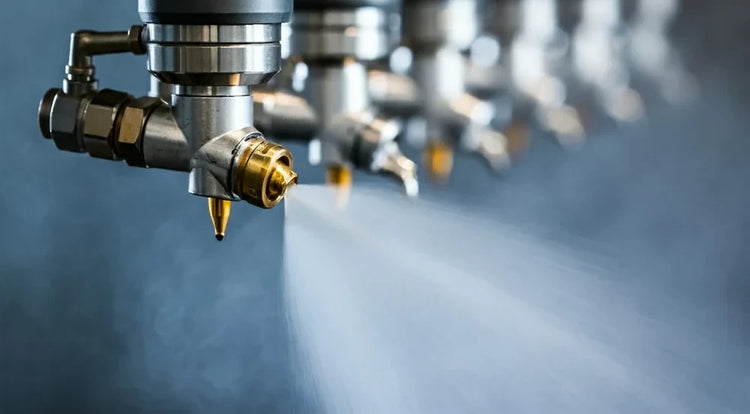
Air-atomizing nozzles use a separate compressed air supply to break the liquid stream into very fine droplets — far finer than any hydraulic nozzle can produce at equivalent pressures. The compressed air and liquid meet at the nozzle tip, where the high-velocity air shears the liquid into droplets typically in the 10–100 µm range. This makes air-atomizing nozzles the correct choice for any application where droplet size is the critical variable — humidification, evaporative cooling, fine coating, and dust suppression in environments where droplets must remain airborne.
The key tradeoff is that air-atomizing nozzles require both a compressed air supply and a liquid supply — two separate utility connections versus one for hydraulic nozzles. They also produce lower flow rates per nozzle than hydraulic patterns at equivalent liquid pressures. For applications requiring fine droplets at low to moderate flow rates, this is the right choice. For high-volume applications, the compressed air cost and infrastructure must be considered.
Best for: Humidification where droplets must evaporate before reaching any surface, evaporative cooling in ducts or rooms, fine chemical or agricultural coating applications requiring precisely sized droplets, and dust suppression in indoor environments. The air-atomizing pattern produces droplets significantly finer than any hydraulic nozzle at typical industrial pressures.
Five Patterns Side by Side
Use this table to compare patterns on the variables most relevant to your application.
| Pattern | Footprint Shape | Droplet Size | Impact Energy | Best Application | Not Suited For |
|---|---|---|---|---|---|
| Flat Fan | Wide elliptical band | Medium–coarse | High per unit area | Surface cleaning, conveyor washing, coating lines | Tank interiors, fine droplet applications |
| Full Cone | Filled circle | Medium–coarse | Medium | Tank cleaning, cooling, area wetting, rinsing | Long linear surfaces, fine mist applications |
| Hollow Cone | Ring (no center) | Fine | Low–medium | Gas cooling, dust suppression, evaporative cooling | Surface cleaning, filled circular coverage |
| Solid Stream | Point / jet | N/A — jet | Maximum | Heavy cleaning, tank agitation, long throw | Area coverage, coating, humidification |
| Air-Atomizing | Cone or fan | Very fine (10–100 µm) | Very low | Humidification, fine coating, evaporative cooling | High-volume cleaning, no air supply available |
Still not sure which pattern fits?
Go back to Step 1 of the Choosing a Spray Nozzle guide and confirm your application goal — the goal determines the pattern. If you have confirmed the goal but the pattern choice is still unclear, contact NozzlePro's application team with your application details and we will identify the correct pattern.
Know Your Pattern.
Ready to Choose a Nozzle?
Continue to the next step — confirm your spray angle and distance to target, or contact NozzlePro with your application parameters and we will identify the right product.