
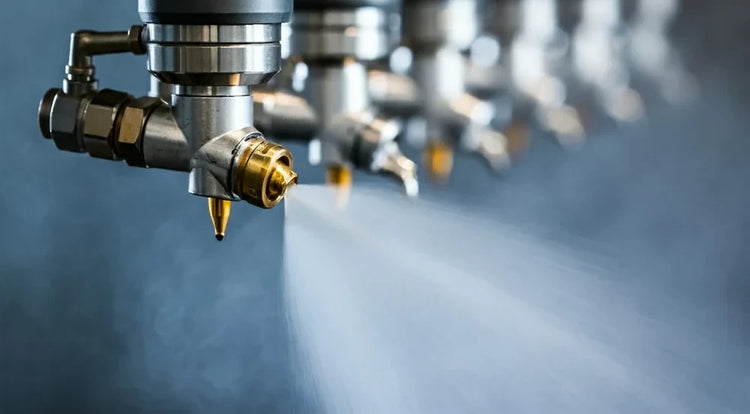
Industrial Part Drying Spray & Air Nozzles
High-pressure and flat-fan nozzles for post-wash drying of machined parts, castings, stampings, and assemblies before painting, powder coat, plating, and inspection — full-cone air nozzles for blind holes and recesses, and precision air jets for electronics and ESD-sensitive assemblies
Part drying is a precision quality step, not just moisture removal. Residual water in a machined part's blind holes, threaded bores, and interior cavities after aqueous washing creates three distinct downstream failure modes that cannot be fixed after the fact: flash rust that begins forming on bare steel within minutes of water contact at ambient temperature; adhesion failure beneath paint, powder coat, or plating applied over a wet surface; and assembly contamination where water trapped in threaded connections or bearings causes corrosion at the contact interface after assembly. Standard conveyor blow-off — the same nozzles used for bottle drying — does not address these failures because it dries external surfaces without reaching interior features.
Effective industrial part drying requires nozzle specification matched to the specific part geometry: flat-fan nozzles for broad flat surface drying on stampings and sheet metal; full-cone nozzles for three-dimensional coverage of castings and forgings from multiple approach angles; concentrated high-pressure air jets for blind holes, threaded bores, and deep recesses where air must have sufficient velocity and directional accuracy to displace water from confined spaces; and precision air nozzles for electronics and delicate assemblies where excess impact pressure would damage components. NozzlePro supplies all of these — specified from your part geometry and downstream coating or assembly specification, not from a generic part drying catalog.
What nozzle is best for drying machined parts after washing? Full-cone air nozzles on adjustable manifold bars above, below, and on both sides of the conveyor provide three-dimensional coverage for castings and complex machined parts that flat-fan cannot reach from a single direction. High-pressure concentrated air jets (60–100 PSI) for blind holes, threaded bores, and recesses — air must enter at sufficient velocity to displace water from confined spaces where gravity drainage is ineffective. Flat-fan nozzles for stampings, sheet metal, and flat machined surfaces where uniform coverage across the part width is the primary requirement. For electronics and ESD-sensitive assemblies: precision low-pressure air nozzles (20–40 PSI) with ESD-safe grounding to prevent static buildup. Dryness verification for coating pre-treatment: moisture meter at blind holes and recesses, not just external flat surfaces — external dryness does not confirm blind hole dryness. Nozzle material: 316L SS for stainless or corrosion-resistant environment; carbon steel or anodized aluminum for dry indoor industrial part drying not subject to washdown or food regulation.
Why Part Drying Is Different from Conveyor Blow-Off — The Blind Hole Problem
Why the dryness specification for machined parts and castings requires different nozzle types than surface blow-off
Blind Holes, Threaded Bores, and Interior Cavities — Where Part Drying Systems Fail
A conveyor blow-off system designed for bottle drying dries external surfaces effectively. A machined part with blind holes, cross-bores, counterbores, and threaded connections presents a fundamentally different challenge: gravity drains some of the water from through-holes and features open to the bottom; but blind holes oriented horizontally or upward retain water by surface tension and capillary action that gravity cannot overcome. The water in a 10 mm blind hole will remain there indefinitely if only external surface blow-off is applied — and flash rust forms on the steel wall of that blind hole within minutes.
Effective blind hole drying requires concentrated high-pressure air directed into the hole at sufficient velocity to create turbulent airflow that displaces the trapped water outward. The minimum air jet velocity at the hole entrance for water displacement depends on the hole diameter and depth: deeper, narrower holes require higher inlet velocity. At 80–100 PSI supply pressure from a 1/8" diameter precision air nozzle at 50–100 mm standoff: the exit velocity is typically 200–300 m/s — sufficient for holes above approximately 6 mm diameter to 100 mm depth in most orientations. For holes smaller than 6 mm or deeper than 150 mm: the air jet must be inserted to within 10–20 mm of the bottom using an extended nozzle tip, as the air jet velocity decays with the square of distance and loses effectiveness before reaching the bottom of deep blind holes from external standoff.
The verification test that confirms part drying is complete for coating pre-treatment is not visual inspection of the external surface — it is a white cotton glove test (or moisture meter test) inserted into each blind hole and recess after drying. Any moisture transfer from the part interior to the test medium indicates drying is incomplete regardless of how dry the external surface appears. Document this test result as part of the pre-treatment quality record for coating operations with adhesion or corrosion protection specifications.
Part Drying Applications by Part Type
Seven part categories — each with distinct geometry, dryness requirement, and nozzle specification
CNC Machined Components, Housings, and Blocks
Engine blocks, transmission housings, hydraulic manifolds, and precision machined components with multiple blind holes, cross-bores, threaded bores, counterbores, and O-ring grooves. Each internal feature must be dried individually because standard external blow-off cannot reach them. Concentrated high-pressure air jets at 60–100 PSI directed individually at each blind hole; robotic or programmable manifold for complex parts with many features; drying cycle time determined by hole count and orientation; conveyor part dryers with multiple nozzle positions and rotational or tumbling fixtures for complete internal access.
Nozzle: High-pressure precision air jets at 60–100 PSI; 1/8"–1/4" orifice; standoff 50–100 mm per hole; extended tips for holes deeper than 100 mm; 316L SS for washdown environments; verify dryness with moisture meter at each blind hole after cycle.
High-Pressure Nozzles →Stampings, Sheet Metal, and Formed Parts
Automotive stampings, brackets, panels, and sheet metal blanks after aqueous degreasing and phosphating pre-treatment — dried before e-coat or powder coat application. Flat-fan nozzles above and below the conveyor for uniform coverage across the full part width; both faces must be dry for even e-coat adhesion. Water pools in formed features, flanges, and hemmed areas — these zones require specific nozzle positioning. Throughput demand on stamping lines is high — drying systems must handle 200–600 parts/hour with consistent dryness at each part position.
Nozzle: Flat-fan above and below; high-pressure directed jets for hemmed flanges and formed pockets; 60–80 PSI; 316L SS for phosphate pre-treatment washdown zone; part-specific manifold positioning for flanges and water-trap features.
Flat-Fan Nozzles →Die Castings, Sand Castings, and Forgings
Aluminum and iron castings with complex external geometry, internal cavities, cored passages, and rough surface texture that retains water in pockets and surface voids. Full-cone nozzle arrays on all four sides of the conveyor for volumetric coverage from multiple directions simultaneously; multiple nozzle positions reach the irregular surfaces that flat-fan misses from a fixed direction. Sand casting surfaces are particularly water-retentive — the rough, porous texture holds water films tenaciously against standard blow-off pressure. High-pressure nozzles for aggressive water removal from rough sand casting surfaces.
Nozzle: Full-cone air nozzle arrays all four sides; high-pressure for sand casting rough surfaces; 60–100 PSI; adjustable nozzle positioning for variable casting geometry; 316L SS or carbon steel per environment; longer drying cycle time than stamped parts due to surface texture water retention.
Full-Cone Nozzles →PCBs, Electronic Assemblies, and Precision Components
Printed circuit boards, populated assemblies, sensors, and precision components after aqueous cleaning — dried before conformal coating, functional testing, or assembly. Low-pressure precision air nozzles prevent component damage from excessive impact force; ESD-safe nozzle positioning and manifold grounding prevent electrostatic charge buildup from high-velocity air over insulating substrates. DI water rinse preceding blow-off eliminates mineral deposit risk on board surfaces. No galvanized or zinc-plated manifold components in ESD-sensitive areas. Ionic cleanliness verification after drying where required by IPC/J-STD-001 specifications.
Nozzle: Precision low-pressure air nozzles at 20–40 PSI; ESD-safe manifold bonding and grounding; no galvanized or zinc parts; 316L SS or anodized aluminum body; DI water rinse before blow-off; verify ionic cleanliness specification compliance after drying.
Air Nozzles →Automotive Components Pre-Coating and Pre-Assembly
Engine components, transmission parts, suspension components, and structural parts after aqueous washing and phosphate or zirconate pre-treatment — dried before e-coat, powder coat, or paint application. Flash rust on bare steel initiates within 3 minutes of water exposure at ambient temperature — transfer time from dryer to coating system must be within this window. Both external surface dryness and blind hole dryness required: e-coat applied over residual water in blind holes blisters and delaminates in service. Automotive OEM and Tier 1 specifications typically require documented dryness verification for each batch before coating process begins.
Nozzle: Combination of flat-fan (external surfaces), full-cone (3D coverage), and high-pressure precision jets (blind holes); 60–100 PSI; 316L SS for pre-treatment washdown environment; documented dryness verification protocol required for OEM-regulated coating operations.
High-Pressure Nozzles →Steel Coil, Strip, and Sheet Drying After Pickling or Rinse
Continuous drying of steel strip, coil, and cut sheet after pickling, acid rinse, or passivation treatment — before oiling, recoiling, or downstream processing. Flat-fan nozzle banks above and below the strip for both-sides simultaneous drying across the full strip width as the steel travels at line speed. Water flux on steel strip after pickling is higher than after aqueous cleaning — higher-pressure nozzles (80–120 PSI) or heated air supply may be needed for complete drying at high line speeds. TC orifice inserts for any nozzle position on pickling lines where acid mist and pickling sludge contaminate the air supply.
Nozzle: Flat-fan banks both sides; 80–120 PSI for aggressive strip drying at high line speeds; heated air supply for complete moisture removal at 200+ m/min line speeds; 316L SS for acid pickling environment; TC inserts for contaminated air supply environments.
Flat-Fan Nozzles →Batch Part Drying — Bulk Fasteners, Bearings, and Small Components
Batch drying of bulk small parts — fasteners, bearings, springs, clips, stampings — after aqueous wash in basket or drum washers. Tumbling or rotating drum drying with air blow-off nozzles directed at the tumbling mass from multiple positions. Full-cone nozzle rings inside the drum or directed at the drum outlet deliver air to all part surfaces as they tumble through the airstream. High-pressure air for small parts with blind features (threaded fasteners, socket head caps) that retain water in threads and socket recesses. Heated air supply for complete drying of bulk small parts that tend to retain water in contact zones between parts in the bulk mass.
Nozzle: Full-cone nozzle rings for drum or tumbler drying; high-pressure jets for threaded fastener drying; heated air supply for bulk mass moisture removal; 316L SS or carbon steel per environment; continuous duty rated for production batch rates.
Full-Cone Nozzles →Part Drying Nozzle Selection Reference
Part type, nozzle type, air pressure, dryness requirement, body material, and key configuration notes
| Part Type | Nozzle Type | Air Pressure | Dryness Spec | Body Material | Key Configuration Notes |
|---|---|---|---|---|---|
| Machined Parts (Blind Holes) | High-Pressure Precision Air Jets | 60–100 PSI | Blind hole verified moisture-free | 316L SS | Individual nozzle directed at each blind hole; standoff 50–100 mm per hole; extended tips for holes deeper than 100 mm; verify dryness with moisture meter or cotton glove test at each bore after cycle; robotic or programmable manifold for complex parts with many features; cycle time from hole count and orientation |
| Stampings and Sheet Metal | Flat-Fan above/below + directed jets | 60–80 PSI | Both faces dry; no flash rust within transfer time | 316L SS (pre-treatment zone) | Both faces simultaneously; high-pressure directed jets for hemmed flanges and water-trap features; both-sides matched flux for equal drying; transfer to coating within flash rust window (under 3 min for bare steel); documented dryness record for OEM-regulated operations |
| Die Castings and Forgings | Full-Cone arrays all four sides | 60–100 PSI | All surfaces dry; internal passages verified | 316L SS or carbon steel | Full-cone on all four sides for 3D coverage; higher pressure for rough sand casting surfaces; adjustable nozzle positions for variable casting geometry; extended drying time vs. stampings due to surface texture retention; cored passages treated same as blind holes — dedicated directed jets |
| Electronics and PCBs | Precision Air Nozzles low pressure | 20–40 PSI | Ionic cleanliness per IPC/J-STD-001 | 316L SS or anodized Al; no galvanized | ESD-safe manifold bonding and grounding; DI water rinse prior to blow-off; no zinc or galvanized parts in ESD zone; verify ionic cleanliness after drying where IPC specification applies; low-profile nozzle mounting to prevent component impact from nozzle hardware if boards tilt on conveyor |
| Automotive Pre-Coating (Steel) | Combination: Flat-Fan + Full-Cone + High-Pressure Jets | 60–100 PSI | Flash rust-free transfer to coating within 3 min | 316L SS (pre-treatment zone) | External surface: flat-fan; 3D coverage: full-cone; blind holes: high-pressure jets; documented dryness verification required for automotive OEM and Tier 1 coating specifications; transfer from dryer to e-coat or powder coat within defined window; record drying parameters in batch production traveler |
| Steel Strip and Sheet (Post-Pickle) | Flat-Fan both-sides banks | 80–120 PSI | Visually dry both faces; no acid carryover | 316L SS; TC inserts for acid/fume environment | Both-sides simultaneous; heated air supply for complete drying at high line speeds; TC orifice inserts for acid mist and pickling fume environments; 100-mesh strainer; strip width tracking for edge masking at variable width; drain provision under drying zone |
| Bulk Small Parts (Fasteners, Bearings) | Full-Cone drum/tumbler nozzle rings | 60–100 PSI | No residual moisture; no flash rust | 316L SS or carbon steel | Heated air supply for bulk mass moisture removal; full-cone rings at drum or tumbler exit; high-pressure jets for threaded fasteners; continuous duty rated; part contact prevention — nozzle geometry must not trap small parts; inspection of basket or drum interior for accumulated residue at scheduled intervals |
| Post-Plating Rinse Drying | Flat-Fan or Full-Cone | 40–80 PSI | No visible water; no water spots on plated surface | 316L SS; PVDF for chrome or acid plating zone | DI water final rinse before blow-off to prevent mineral water spots on plated surfaces; low pressure at final blow-off to prevent droplet impact marking on soft plated finishes (gold, silver, decorative chrome); PVDF nozzle bodies for chrome or acid plating environment where SS is attacked |
Nozzle Types for Industrial Part Drying
Four categories matched to part geometry, dryness specification, and production environment
High-Pressure Precision Air Jets
The correct tool for blind holes, threaded bores, deep recesses, and any interior feature that standard blow-off cannot reach. High-pressure air jets at 60–100 PSI from 1/8"–1/4" orifice nozzles produce 200–350 m/s exit velocity at 50–100 mm standoff — sufficient to create turbulent airflow inside a blind hole that displaces trapped water outward. Extended nozzle tips available for holes deeper than 100 mm where external standoff cannot deliver adequate velocity to the hole bottom. Standard for automotive part drying where blind holes in engine and transmission components are the critical moisture retention points before coating or assembly. Also for threaded fastener drying where the thread helix retains water by capillary action against standard blow-off.
Shop High-Pressure NozzlesFlat-Fan Air Nozzles
For stampings, sheet metal parts, and strip drying where uniform air coverage across the full part width from both faces simultaneously is the primary requirement. The linear air sheet from flat-fan nozzles at 15°–25° impingement angle sweeps water tangentially across flat and gently curved part surfaces — more efficient for broad flat coverage than round jets at equivalent air pressure. Manifold bars above and below the conveyor with matched-flow nozzle sets deliver equal drying intensity to both part faces — essential for sheet metal where one-sided drying creates residual moisture on the sheltered face that causes rust under subsequently applied coating. Standard specification for steel service center coil oiling lines, automotive stamping pre-coating drying, and strip-form part drying.
Shop Flat-Fan NozzlesFull-Cone Air Nozzles
For castings, forgings, and complex three-dimensional parts where the surface geometry cannot be dried from any single nozzle approach direction. Full-cone nozzle arrays on all four sides of the conveyor provide simultaneous coverage of all surface orientations — reaching surfaces that face away from any individual flat-fan nozzle position. For batch tumbler and drum drying of bulk small parts: full-cone nozzle rings at the drum exit deliver air to all parts as they cascade out of the tumbling mass. The volumetric circular coverage area also makes full-cone nozzles effective for complex assembled components where individual sub-components face in all directions and a single-direction blow-off would leave sheltered surfaces wet.
Shop Full-Cone NozzlesPrecision Low-Pressure Air Nozzles
For electronics assemblies, precision optical components, and ESD-sensitive parts where standard blow-off pressure would damage components or create hazardous electrostatic discharge. Precision air nozzles at 20–40 PSI deliver controlled, low-impact airflow that removes moisture from board surfaces and component gaps without the force that can dislodge surface-mount components, bend fine-pitch leads, or crack ceramic capacitors. ESD-safe nozzle body materials and manifold grounding prevent charge buildup from high-velocity air over insulating PCB substrates. Directed precision air streams also enable targeted drying of specific board areas (connector pins, IC socket contacts, solder joints) without general flooding of the entire assembly.
Shop Air NozzlesPart Drying System Design Principles
Five parameters that determine whether a part drying system achieves the dryness required for the downstream coating, plating, or assembly process
- The Dryness Specification Must Come from the Downstream Process, Not from Visual Inspection of the Part — Visual dryness of the external surface is insufficient for most industrial part drying applications. The correct dryness specification is determined by the downstream process requirement: for e-coat and powder coat, the specification is typically zero moisture at any point on any surface — including blind holes and recesses — because water under coating causes adhesion failure and blistering. For assembly operations, the specification is no moisture in threaded connections, bearing seats, or press-fit interfaces — residual water at these points causes corrosion at the mating interface in service. For inspection operations, the specification depends on whether moisture affects the inspection method (CMM measurement: moisture does not affect most measurements; vision inspection: surface moisture creates reflection artifacts that affect results). Establish the dryness specification from the downstream process requirement before designing the drying system — it defines which features must be dried, what verification method confirms dryness, and what constitutes a drying failure that must be reworked before the part proceeds.
- Flash Rust Window Defines the Maximum Acceptable Time from Dryer Exit to Coating Entry for Bare Steel Parts — Flash rust (initial surface oxidation) begins on bare low-alloy steel within 1–5 minutes of water contact depending on ambient temperature, humidity, and steel grade. After the part exits the dryer dry, the clock starts for flash rust onset from residual atmospheric moisture condensation and any micro-moisture remaining on the part. For most automotive and industrial coating operations, the window from dryer exit to coating entry must be under 3 minutes for bare steel to prevent flash rust. This window drives system layout decisions: dryer location relative to the coating line, part accumulation buffer capacity, and emergency rework protocols for parts that spend too long between drying and coating. Measure and document actual transfer time at commissioning and compare against the specification flash rust window — if actual transfer time exceeds the window, either move the dryer closer to the coating line or add an intermediate protective step (flash inhibitor application or nitrogen purge storage) between drying and coating.
- Heated Air Supply Significantly Improves Drying Efficiency for Blind Holes and Bulk Parts — Calculate the Break-Even vs. Extended Cycle Time — Compressed air at ambient temperature carries moisture at the ambient relative humidity. When this air enters a warm blind hole after washing, it can absorb additional moisture by evaporation — but if the air is already near saturation at ambient temperature, its moisture-absorbing capacity is limited. Heated air (40–80°C above ambient) has dramatically higher moisture absorption capacity: air at 60°C can absorb approximately 5× as much water vapor as air at 20°C at equivalent relative humidity. For blind holes and bulk small parts where repeated air passes are required to evaporate rather than just displace water: heated air supply reduces the cycle time required to achieve complete dryness by 50–70% compared to ambient temperature air at the same pressure. Calculate the break-even between heated air system capital cost and the cycle time reduction: if heated air reduces the required drying conveyor length by 30%, the capital cost of the heating system may be offset by the reduced conveyor installation cost. For existing installations where cycle time is the bottleneck: adding heated air supply is typically the lowest-capital upgrade path to improve drying throughput.
- ESD Protection Is Required for Any Part Drying System Near Electronic Assemblies or Components — High-velocity compressed air flowing over insulating surfaces (plastic housings, PCB substrates, ceramic components) generates triboelectric charge — electrostatic charge that accumulates on the insulating surface because it cannot conduct away through the plastic or ceramic. Electrostatic discharge (ESD) events from accumulated charge can destroy sensitive ICs, microprocessors, MOSFET transistors, and CMOS logic through dielectric breakdown at voltages far below the visible sparking threshold. The ESD protection requirements for part drying systems near electronics: nozzle bodies and manifold hardware must be connected to facility ESD ground (typically <1 MΩ resistance to ground); no insulating nozzle body materials (acetal, polypropylene, standard polymer) in ESD-sensitive areas — use conductive/dissipative materials or grounded metal; ionized air supply can be used to neutralize charge as air is delivered to the part. Document the ESD grounding of the drying system in the facility ESD control plan; include in periodic ESD resistance testing protocol.
- Compressed Air Quality for Pre-Coating Part Drying Must Prevent Oil Contamination of the Pre-Treated Surface — Oil contamination from compressed air on a pre-treated metal surface immediately before coating causes adhesion failure — the oil prevents the coating from bonding to the conversion coating (phosphate, zirconate) on the metal surface, creating a weak boundary layer that allows the coating to delaminate in service. Even very low oil concentrations (above 0.1 mg/m³) are detectable by contact angle measurement on phosphate-treated steel — an oil-contaminated phosphate surface shows higher water contact angle (poor wettability) than a clean surface. Compressed air quality for pre-coating part drying: ISO 8573 Class 2 as minimum (oil below 0.1 mg/m³; dew point below 3°C); ISO 8573 Class 1 (oil below 0.01 mg/m³) for automotive OEM and other specifications with zero-oil-contamination requirements. Install coalescing filter and activated carbon filter downstream of the main compressor room dryer, within 2 meters of the part drying manifold — long compressed air distribution lines accumulate condensate and pipe scale that can contaminate the air stream even when the compressor room treatment is adequate.
Part Drying Applications by Industry
Six industries with distinct part geometry, dryness specifications, and downstream coating or assembly requirements
Automotive Manufacturing
Engine blocks, transmission housings, suspension components, and body stampings before e-coat, powder coat, and assembly. Flash rust window drives layout. Blind holes in castings require individual high-pressure jets. OEM-documented dryness verification per batch. 316L SS for phosphate/zirconate pre-treatment environment. Combination nozzle systems (flat-fan + full-cone + precision jets) for complex powertrain components.
Aerospace & Defense
Machined aluminum and titanium structural components, precision gears, and assemblies before anodizing, conversion coating, or primer application. Traceability required — drying parameters documented in manufacturing records. No oil contamination on conversion-coated surfaces. Blind hole dryness verified and recorded for each part. 316L SS; ISO 8573 Class 1 compressed air for surface-critical applications.
Electronics Manufacturing
PCBs and assemblies after aqueous flux cleaning before conformal coating, functional test, and assembly. ESD-safe low-pressure nozzles. DI water rinse prior. Ionic cleanliness verification (IPC/J-STD-001). No galvanized or zinc parts in ESD zone. Anodized aluminum or 316L SS manifolds. Drying parameters in process specification for ISO 9001 or AS9100 traceability.
Metal Fabrication & Service Centers
Fabricated steel structures, tanks, and vessels after aqueous surface preparation before painting. Steel strip and sheet drying on pickling lines and cut-to-length lines. Flash rust prevention critical for outdoor or field-applied coating. High-pressure flat-fan for strip lines. TC inserts for pickling acid environment. Heated air for complete drying at high line speeds.
Medical Device Manufacturing
Surgical instruments, implants, and precision medical components after ultrasonic cleaning and DI water rinse before inspection, packaging, or sterilization. DI water rinse required — mineral deposits on medical device surfaces are a regulatory compliance issue. Precision low-pressure nozzles for delicate instruments. 316L SS; ISO 8573 Class 1 air. Drying process validated and documented per FDA 21 CFR quality system regulations.
General Industrial & Job Shop
Diverse machined parts, assemblies, and components across multiple industries. Variable part geometry requires adjustable nozzle mounting. Mixed lot sizes from single prototypes to production batches. Full-cone air nozzle arrays for maximum coverage flexibility. High-pressure jets for any blind hole features. Carbon steel or 316L SS per facility environment. Portable manifold systems for job shop part variety.
Nozzle Material Selection for Part Drying Systems
Operating environment, pre-treatment chemistry, and ESD requirements drive material selection
316L SS Body
Standard for part drying in pre-treatment zones (phosphating, zirconate, chromating), pickling environments, and any application subject to periodic washdown. Corrosion resistant in acid, alkali, and humid environments. No lead, copper, or zinc — safe for food-contact adjacent applications.
Use for: Pre-coating drying zones; post-phosphate drying; pickling line drying; any environment subject to chemical splash or washdown; automotive and aerospace coating pre-treatment zonesAnodized Aluminum
For non-chemical industrial part drying in clean, non-corrosive environments where 316L SS cost is not warranted. Lighter for long manifold bars spanning wide conveyors. Electrically conductive when grounded — suitable for ESD-safe applications when properly bonded. Not suitable for acid, alkali, or chloride-containing environments.
Use for: Electronics PCB blow-off (when grounded for ESD); indoor non-chemical industrial part drying; wide-conveyor manifold bars where weight matters; non-regulated general industrial applicationsPVDF (Kynar) Body
For chrome plating lines, aggressive acid post-treatment environments, and applications where metallic contamination from nozzle body material would affect the plated or coated surface quality. Maximum 150 PSI — verify against system operating pressure. Resists HCl, HF, chromic acid, and most organic solvents.
Use for: Chrome plating post-treatment drying; HF and HCl acid environments; zero metallic contamination applications; decorative plating where nozzle body material touching parts would mark surfacesCarbon Steel / Standard
For dry indoor industrial part drying in clean, non-corrosive, non-washdown environments where 316L SS cost is not warranted. Lowest cost option for non-critical indoor applications. Not acceptable for chemical environments, outdoor applications, food or pharmaceutical adjacent zones, or any application subject to corrosive atmosphere or periodic cleaning with water or chemicals.
Use for: Dry indoor non-chemical general industrial part drying; non-regulated applications in fully controlled indoor environments; cost-driven specifications where environment is confirmed non-corrosivePart Drying System Troubleshooting
Four common failures in industrial part drying systems
Flash Rust on Parts After Drying
Symptom: Rust spots visible on bare steel parts within minutes of exiting the dryer; rust concentrated at specific part locations; corrosion failures under coating detected after paint Likely cause: Residual moisture at specific locations not reached by current nozzle arrangement; or transfer time from dryer to coating exceeding flash rust windowIdentify flash rust location precisely — is it at blind holes, recesses, hemmed flanges, or on flat surfaces? Blind hole and recess rust indicates those features are not being reached by current nozzle arrangement; add high-pressure precision jets directed at these features. Flat surface rust on a part that passes visual dryness inspection indicates micro-moisture below visual threshold that is sufficient to initiate corrosion — increase air pressure and drying time, or add heated air supply. If flash rust appears on externally dry parts: measure transfer time from dryer exit to coating entry; if over 3 minutes for bare steel, reduce transfer time by moving the dryer or adding buffer capacity closer to the coating line. Check compressed air oil content — oil contamination on phosphate-treated surfaces causes rust under coating that appears after service rather than immediately after coating.
Residual Water in Blind Holes After Drying Cycle
Symptom: Cotton glove or moisture meter test detects water in blind holes after drying cycle completes; blistering or rust at blind hole locations in coated parts after service Likely cause: Air jet not reaching blind hole due to incorrect nozzle position or standoff; insufficient air pressure for water displacement from the hole depth and diameter; or part orientation preventing drainage of displaced waterVerify nozzle position: the air jet centerline must be aligned with the blind hole axis to within approximately ±10° for effective water displacement — off-axis air jet creates turbulence at the hole entrance but does not penetrate to the hole bottom. Measure standoff distance from nozzle tip to hole entrance; should be 50–100 mm for 1/8" precision air nozzle at 80 PSI. For holes deeper than 100 mm: the external air jet loses velocity before reaching the bottom — add extended nozzle tips that enter the hole to within 20 mm of the bottom. Verify part orientation during drying: a blind hole oriented vertically downward during drying lets displaced water fall out by gravity; a blind hole oriented horizontally or upward requires the air jet to create sufficient turbulent velocity to carry water out against gravity — harder to achieve and requires higher pressure. Design drying fixtures to orient blind holes with opening facing downward where possible.
Coating Adhesion Failure Attributed to Pre-Coat Drying
Symptom: Paint or powder coat delaminating from parts after service; blistering pattern corresponds to specific surface zones; cross-cut adhesion test failures at specific part locations Likely cause: Either residual moisture at affected locations at time of coating (water under coating), or oil contamination from compressed air on pre-treated surface (oil prevents coating bonding to conversion coating)Distinguish between water and oil cause: moisture failure pattern typically shows circular blister formation with rust at center; oil contamination failure typically shows coating lifting at large areas without rust at center. Test the compressed air supply for oil content with an oil indicator tube at the drying nozzle inlet — if above 0.1 mg/m³, oil is a confirmed contributor. For moisture cause: perform dryness mapping (moisture meter at grid of points on the part surface including all recesses and blind holes) immediately before coating; identify which specific features are wet; add nozzles targeting those features. For both causes: install coalescing filter and activated carbon filter within 2 meters of drying manifold supply; add dryer exit to coating entry transfer time measurement to batch quality record.
ESD Damage to Electronic Components During Post-Clean Drying
Symptom: Increased test failure rate after post-clean blow-off step; IC functional failures not present before cleaning; latent ESD damage detected in reliability testing Likely cause: Electrostatic charge buildup on PCB or component surfaces from high-velocity air; inadequate grounding of nozzle manifold; insulating nozzle body materials generating chargeMeasure surface voltage on PCB after blow-off using an electrostatic voltmeter — readings above 100V indicate ESD risk for sensitive components; above 1,000V indicates a serious ESD hazard. Verify manifold grounding: resistance from nozzle body to facility ESD ground should be below 1 MΩ — measure with ESD resistance tester at each manifold position. Replace any insulating polymer nozzle bodies (acetal, polypropylene) with conductive metal or grounded ESD-safe materials. Add ionized air supply to the blow-off manifold — air ionizers neutralize triboelectric charge as air is delivered to the part, preventing charge accumulation. Reduce air pressure to minimum required for drying — lower velocity reduces charge generation rate. Review nozzle standoff distance — closer standoff at lower pressure produces equivalent drying force at lower velocity and lower charge generation.
Why Specify NozzlePro for Industrial Part Drying?
Blind hole-specific nozzle selection, coating process dryness specification support, and documentation for OEM-regulated operations
Part Drying Specified from Downstream Coating and Assembly Requirements
Industrial part drying systems specified without reference to downstream coating or assembly dryness requirements produce either over-specified systems (excess compressed air cost from unnecessary drying intensity) or under-specified systems (coating adhesion failures, flash rust, or assembly corrosion that trace back to inadequate drying). NozzlePro application engineers specify part drying systems from your part geometry (external surfaces, blind holes, internal features), downstream process dryness requirement (coating type, assembly specification), and production rate — not from a generic catalog selection.
Blind Hole Coverage: High-pressure precision air jet specifications for blind holes and threaded bores — individual nozzle positioning, standoff distance, and air pressure calculated for each feature type in the part. Extended tips for deep holes available. Verification protocol included in system specification.
OEM Documentation: Drying system specifications with air pressure, nozzle count, layout, and compressed air quality for inclusion in automotive OEM and Tier 1 coating process records. ISO 8573 compressed air quality confirmation. Flash rust window calculation included for bare steel coating operations.
Frequently Asked Questions
Common questions about part drying nozzle specification
How do I dry blind holes in machined parts after washing?
Blind holes require concentrated high-pressure air jets directed individually at each hole entrance — standard conveyor blow-off that dries external surfaces cannot reach inside blind holes. The nozzle specification for blind hole drying: precision air nozzle with 1/8"–1/4" orifice diameter at 60–100 PSI supply pressure; standoff distance 50–100 mm from the hole entrance; air jet centerline aligned with the hole axis to within ±10°. At this specification, the air jet creates turbulent airflow inside the hole that displaces trapped water outward. For holes deeper than 100 mm diameter: the external air jet velocity decays with distance squared and loses effectiveness before reaching the hole bottom. Use extended nozzle tips that enter the hole to within 20–30 mm of the bottom — these are available in 50–150 mm extension lengths for standard precision air nozzle body threads. Part orientation matters: blind holes oriented with the opening facing downward during drying have gravity assisting water drainage; holes facing horizontally or upward require higher air pressure to overcome gravity and surface tension. Design drying fixtures to orient as many blind holes downward as possible. Verify dryness after drying cycle with a cotton glove or moisture meter inserted into each critical blind hole — external surface dryness does not confirm blind hole dryness. For parts with many blind holes (engine blocks, hydraulic manifolds): programmable or robotic nozzle positioning systems that sequence through each hole position reduce cycle time vs. a fixed manifold that must address all holes simultaneously at reduced individual coverage.
How quickly does flash rust form on steel parts after washing, and how does this affect the drying system design?
Flash rust (initial iron oxide formation) begins on bare low-carbon steel surfaces within 1–5 minutes of water exposure at ambient temperature and humidity — the exact onset time depends on steel grade (higher carbon and alloy content slightly delays onset), ambient relative humidity (higher humidity accelerates rust onset), surface contamination from the wash water (dissolved salts and acids accelerate flash rust), and surface temperature (warmer parts rust faster). For design purposes: use a 3-minute flash rust window as the maximum acceptable time from dryer exit to coating process entry for bare steel. This window drives several system design decisions: (1) Physical layout — the dryer must be located close enough to the coating line that transfer time is under 3 minutes at the production handling rate, including any part accumulation queue between dryer and coater. (2) Buffer capacity — any accumulation conveyor between dryer and coater must hold no more than 3 minutes of production at maximum throughput rate. (3) Emergency protocol — if the coating line goes down, parts already in the dryer or the transfer buffer must either be re-washed (if on the conveyor beyond the flash rust window) or protected with flash inhibitor application before the window expires. (4) Flash inhibitor option — for production lines where the layout cannot achieve under-3-minute transfer, a dilute flash inhibitor (typically 0.1–0.5% sodium nitrite or organic inhibitor) can be applied as a final spray step before drying to extend the rust-free window to 30–60 minutes. Confirm inhibitor compatibility with the downstream coating adhesion specification before use — some coating systems require zero inhibitor residue on the part surface.
What compressed air quality is required for part drying before painting or powder coating?
Compressed air quality for pre-coating part drying must prevent two types of contamination: oil and moisture. Oil from lubricated compressors in the compressed air supply contacts the pre-treated metal surface (phosphate, zirconate, iron oxide conversion coating) and interferes with coating adhesion by forming a weak boundary layer between the conversion coating and the applied paint or powder coat. Moisture in the compressed air supply can re-wet already-dried part surfaces and introduce dissolved minerals from the air system condensate. ISO 8573 Class 2 is the minimum acceptable specification for pre-coating part drying: oil below 0.1 mg/m³; dew point below +3°C at line pressure; particles below 1 µm at 1 mg/m³. This requires: lubricated compressor with two-stage coalescing filtration; refrigerated compressed air dryer. ISO 8573 Class 1 (oil below 0.01 mg/m³; dew point below −70°C) is required for automotive OEM and aerospace specifications with zero-tolerance oil contamination requirements. Achieving Class 1 requires oil-free compressor or Class 2 system plus activated carbon oil vapor filter. Install point-of-use coalescing filters within 2 meters of each part drying manifold — long compressed air distribution lines accumulate condensate and pipe scale that can contaminate the air stream after the main treatment system. Test compressed air oil content with indicator tubes at each drying manifold quarterly; record results in the coating process quality record. A Class 2 specification with coalescing filter but no activated carbon filter can still fail at elevated inlet temperature in summer — the coalescing filter is less effective at removing oil aerosol above 40°C inlet temperature; add activated carbon filter if compressor room ambient temperature exceeds 35°C seasonally.
What is the correct nozzle and air pressure for drying automotive castings and machined components?
Automotive castings and machined components require a combination of three nozzle types addressing three distinct drying challenges simultaneously. For external casting surfaces (irregular 3D geometry): full-cone air nozzle arrays on all four sides of the conveyor at 60–80 PSI provide volumetric coverage from multiple directions that reaches the irregular surface contours, parting lines, and external recesses that flat-fan misses from a fixed angle. For blind holes, threaded bores, and cored passages (the critical moisture retention features): high-pressure precision air jets at 80–100 PSI directed individually at each feature entrance; standoff 50–100 mm; extended tips for features deeper than 100 mm. For large flat machined surfaces (bearing bores, sealing flanges, gasket surfaces): flat-fan nozzles at 60–80 PSI provide efficient coverage of these precision surfaces. The air pressure range of 60–100 PSI is calibrated from the feature size and depth: engine block oil gallery bores (8–12 mm diameter, 150–200 mm deep) require 80–100 PSI with extended nozzle tips; shallow counterbores and O-ring grooves (5–20 mm deep) are addressed at 60–80 PSI from external standoff. For automotive OEM and Tier 1 suppliers: the complete drying system specification (nozzle positions, pressures, cycle time, compressed air quality) must be documented in the coating pre-treatment process control plan and validated by a dryness verification test at each critical feature location before the process enters production. Provide the part drawing or 3D model with all blind hole and internal feature locations identified to NozzlePro for a complete position-by-position nozzle specification with air pressure and standoff distance for each feature.
How do I prevent ESD damage when blow-drying electronic assemblies?
ESD prevention in electronic assembly blow-drying requires four concurrent controls: grounding, materials, ionization, and pressure management. Grounding: all nozzle bodies, manifold bars, mounting brackets, and air supply tubing must be electrically connected to the facility ESD ground system (typically 1 MΩ to ground). Measure the resistance from each nozzle body to facility ESD ground with a calibrated ESD resistance tester at installation and include in annual ESD audit. Materials: replace any insulating polymer nozzle bodies (acetal, polypropylene, nylon — standard materials in many catalog air nozzles) with conductive metal (316L SS, anodized aluminum) or ESD-dissipative materials. Insulating polymer nozzle bodies charge triboelectrically when high-velocity air flows through them and become charge sources in addition to the board surface. Ionization: add an inline ionizing air bar or ionizing nozzles to the blow-off manifold — ionized air neutralizes triboelectric charge on board surfaces as air is delivered, preventing accumulation. Ionizing equipment is available as drop-in additions to standard air manifold systems and is the most reliable ESD protection upgrade for existing systems that cannot be fully re-grounded quickly. Pressure management: reduce air supply pressure to the minimum required for effective moisture removal. Triboelectric charge generation rate increases with air velocity — reducing pressure from 60 PSI to 30 PSI approximately halves the charge generation rate. For delicate assemblies where pressure cannot be reduced without compromising drying: use heated air at lower pressure — heated air carries more moisture per SCFM, achieving equivalent drying at lower velocity and lower charge generation.
Should I use heated air for part drying, and when is the investment justified?
Heated air supply for part drying is justified in three specific situations: blind holes and recesses where evaporation (not just displacement) is required for complete dryness; bulk small parts where the mass of parts in contact with each other retards moisture removal from contact zones; and high-throughput lines where reducing cycle time by 40–60% offsets the capital cost of the heating system. The thermodynamic rationale: compressed air at 20°C has a moisture absorption capacity of approximately 17 g/m³ at 100% RH. At 60°C, the capacity rises to approximately 130 g/m³ — 7.5× higher. This means a given volume of 60°C air can carry away 7.5× as much evaporated water as the same volume at ambient temperature. For a blind hole where water evaporation (not displacement) is the primary removal mechanism: heated air reduces the number of air passes required to evaporate the residual water film from 50–100 passes to 5–15 passes — a 70–80% reduction in cycle time or conveyor length. The break-even calculation: if heated air reduces the required drying oven conveyor length by 30%, the capital cost of the heater may be less than the capital cost of the additional conveyor length and space. For existing installations: if throughput is limited by drying cycle time and adding conveyor length is impractical, adding a compressed air heater (typically $3,000–15,000 for industrial electric in-line heaters for 50–200 SCFM air supply) provides the highest ROI path to cycle time improvement. Confirm compatibility of the part material and any pre-treatment with the air temperature — most metal parts and conversion coatings tolerate 80–100°C air without issue, but plastic components and temperature-sensitive pre-treatment chemicals may set an upper limit.
Get Part Drying Nozzle Specifications for Your Part and Process
Provide your part type (casting, stamping, machined component, electronics), blind hole and internal feature details, downstream process (paint type, coating specification, assembly requirement), production rate, and available compressed air supply — our application engineers specify nozzle type, position, air pressure, and cycle time with dryness verification protocol for your specific part and coating system.