
Humidification & Conditioning:
Spray Nozzle Selection Guide
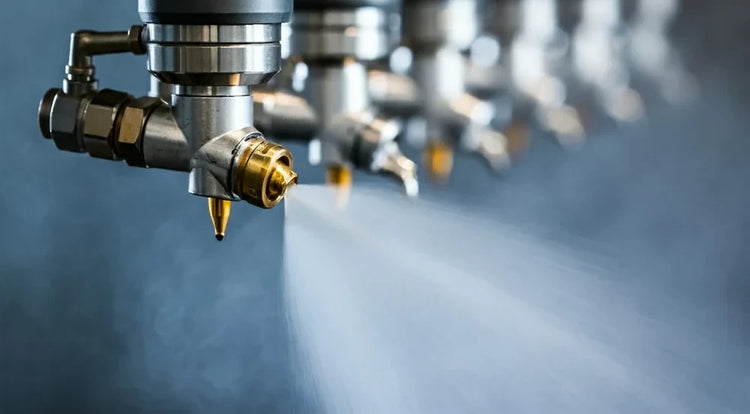
Humidification spray adds controlled moisture to air without wetting any surface — every droplet must evaporate completely before it settles. This requirement makes droplet size the critical variable, water quality the most common failure cause, and nozzle selection more nuanced than most other spray applications.
How Spray Humidification Works — and Why Droplet Size Is Everything
Spray humidification works by introducing fine water droplets into an air space where they evaporate, adding water vapor to the air and raising the relative humidity. The defining requirement is that every droplet must evaporate completely before contacting any surface — walls, floors, equipment, product, people, or electrical components.
A droplet that reaches a surface before evaporating deposits liquid water at that location — wetting the surface, potentially causing corrosion, electrical shorts, product damage, or slip hazards. The rate at which a droplet evaporates depends on its size (smaller droplets evaporate faster because of their higher surface-area-to-volume ratio), the air temperature (hotter air evaporates droplets faster), the current relative humidity of the air (drier air evaporates droplets faster), and the airflow velocity (moving air carries away water vapor from around the droplet, accelerating evaporation).
This means the correct nozzle for humidification must produce droplets fine enough to evaporate completely within the available air space at the specific conditions of the installation. A nozzle that works perfectly in a 100°F, 20% RH warehouse may produce wet floors in a 65°F, 60% RH textile mill with the same flow rate — because the cooler, already-humid air evaporates droplets far more slowly. The droplet size must be matched to the conditions, not selected from a generic catalog without checking the specific installation parameters.
Droplet Size and Evaporation — Three Regimes
Choosing Between Air-Atomizing and Hydraulic Nozzles
The Evaporation Distance Test — the only reliable commissioning check
The only reliable way to confirm that a humidification nozzle installation will not wet surfaces is to commission it at the most challenging expected conditions — lowest room temperature, highest starting relative humidity — and observe whether any surface wetting occurs after 30 minutes of continuous operation. A paper towel placed on the floor directly below each nozzle and at several floor zones throughout the space will show any surface moisture. If wetting is observed, the options are: switch to finer-droplet nozzles, reduce the flow rate, increase the air mixing before droplets settle, or raise the room temperature before activating the system.
Static Electricity Dissipation in Manufacturing Environments
Electrostatic discharge (ESD) incidents in printing, packaging, electronics assembly, and textile operations are caused or worsened by low relative humidity. Maintaining RH above 45–50% dissipates static charge naturally through moisture in the air and on surfaces.
Static control humidification in electronics assembly and printing facilities has the most stringent requirements of any humidification application. Droplets that settle on circuit boards, electronic assemblies, or sensitive optical surfaces cause immediate damage. The nozzle arrangement must be designed so that no droplet path from any nozzle can intersect with any product, work surface, or electrical component at any stage of its travel — before or after evaporation.
The target relative humidity range for ESD control is typically 45–60%. Below 45% RH, static charge accumulates rapidly on non-conductive surfaces. Above 60% RH, personnel comfort and corrosion risk on exposed metal surfaces become concerns. A well-calibrated RH control system — sensor near the work area, setpoint at 50% RH, on/off tolerance band of ±5% — maintains the right range without overcorrection or oscillation.
In Class 1 and Class 2 ESD-sensitive environments, verify the humidification system design with your ESD program coordinator before installation. The nozzle arrangement, nozzle-to-product distances, and commissioning test results should be documented as part of the ESD control program. A system that performs well at initial commissioning may create problems after facility layout changes — re-verify after any significant production line reconfiguration.
Evaporative Cooling for Industrial & Outdoor Spaces
Cooling large industrial spaces, loading docks, outdoor work areas, and livestock facilities by introducing fine water spray that evaporates and removes sensible heat from the air — lowering the effective temperature by 5–20°F depending on starting conditions.
Evaporative cooling works by converting sensible heat (temperature) to latent heat (water vapor) — the evaporating water absorbs energy from the surrounding air, lowering its temperature. The maximum possible temperature reduction is the difference between the dry-bulb temperature and the wet-bulb temperature of the incoming air. At 95°F dry bulb / 30% RH, the wet-bulb is approximately 68°F — a potential 27°F of cooling if the spray evaporates completely. At 95°F / 65% RH, the wet-bulb is approximately 84°F — only 11°F of potential cooling, and more of the spray will reach surfaces before evaporating.
Evaporative cooling is most effective in hot, dry conditions and becomes progressively less effective as humidity rises. Above approximately 65% relative humidity, the latent heat potential is insufficient to provide meaningful cooling — the air is already nearly saturated and cannot accept much more water vapor. In humid climates, evaporative cooling supplements rather than replaces air conditioning; in arid climates it can replace it entirely in non-critical environments.
Textile, Paper, Wood & Tobacco Conditioning
Maintaining the moisture content of hygroscopic materials — textiles, paper, wood products, tobacco, and other organic materials that absorb or release moisture from the surrounding air — to preserve strength, dimensional stability, weight, and workability.
Product conditioning humidification must maintain a specific RH setpoint, typically within ±3–5% of target, uniformly throughout the conditioning zone. Humidity gradients across the conditioning space — higher RH near nozzles, lower RH away from them — produce non-uniform moisture content in the product. Textile operations experience broken threads and static buildup in dry zones; paper operations experience curl and brittleness; wood products experience warping in zones that receive too little moisture.
Achieving uniform RH distribution requires designing the nozzle layout for even moisture delivery throughout the full space volume — not just at nozzle locations. Air circulation within the space is essential: nozzles distributed the moisture and air movement distributes the water vapor. In large conditioning rooms, a distributed nozzle layout combined with overhead ceiling fans at moderate speed is more effective than a concentrated nozzle bank in one area.
Greenhouse Humidification & Propagation Misting
Maintaining high relative humidity in propagation zones and greenhouses for cutting establishment, tropicals, and humidity-sensitive crops — where surface wetting of foliage is acceptable or even beneficial for cuttings, but evaporative cooling and humidity maintenance are the primary objectives.
Greenhouse misting for propagation differs from other humidification applications in that direct foliage wetting is acceptable — and in cutting propagation, is often desirable to maintain turgor pressure in the cutting while roots develop. The nozzle's goal in propagation misting is to maintain very high RH (85–95%) in the propagation zone while periodically refreshing the leaf surface moisture on cuttings. This allows the use of hydraulic hollow cone nozzles at low pressure, which produce larger droplets than air-atomizing but are simpler and less expensive to install and maintain.
For general greenhouse humidity maintenance where foliage wetting would encourage disease (fungal diseases, botrytis), the same rules as indoor industrial humidification apply — droplets must evaporate before reaching plants. In this case, air-atomizing nozzles positioned above the crop canopy with enough clearance for complete evaporation are the correct specification.
Water Quality — the Most Common Humidification Failure Cause
More humidification system failures are caused by water quality than by any other factor. Hard water, high TDS, biological contamination, and excessive chlorine each cause distinct failure modes that degrade nozzle performance and may damage product or create health hazards.
When a water droplet evaporates, the water itself evaporates but the dissolved minerals and solids in the water do not — they remain behind as fine particles that settle on whatever surface the droplet was traveling toward. In hard water, this manifests as white calcium/magnesium carbonate dust on surfaces, product, equipment, and inside the nozzle orifice. In high-TDS water, the mineral deposits accumulate inside the fine orifice passages of air-atomizing nozzles, progressively restricting flow and distorting the spray pattern until the nozzle stops functioning entirely.
| Water Parameter | Acceptable Range | Effect on Nozzles | Effect on Environment/Product | Treatment |
|---|---|---|---|---|
| Hardness (as CaCO₃) | <50 ppm preferred | Calcium deposits block fine orifices; nozzle life reduced dramatically above 200 ppm | White mineral dust on surfaces and product — visible deposits on electronics, fabric, paper | Water softener (ion exchange) or RO system |
| Total dissolved solids (TDS) | <100 ppm for air-atomizing | High TDS deposits in orifice channels — progressive clogging over days to weeks | White residue on all contacted surfaces; product contamination in sensitive applications | Reverse osmosis (RO) — reduces TDS to <20 ppm |
| Chlorine (free) | <0.5 ppm preferred | Accelerates corrosion of stainless steel orifice components above 1 ppm at elevated temperature | Chlorine odor in conditioned air — health/comfort issue in occupied spaces | Carbon filter or dechlorination dosing upstream of system |
| Iron / manganese | <0.1 ppm | Iron deposits stain orifice surfaces and surrounding nozzle body — difficult to remove | Brown/orange staining on product, surfaces, and walls — serious quality issue in textile and paper | Iron filter or oxidation + filtration before system |
| Biological (bacteria, Legionella) | No detectable pathogens | Biofilm in water lines — clogging and corrosion over time | Aerosolized bacteria in occupied spaces — serious health hazard, especially Legionella | UV treatment or biocide dosing; regular system flush and drain; annual tank/line cleaning |
| pH | 6.5 – 8.5 | Low pH (acidic) accelerates corrosion of metallic components; high pH accelerates scaling | Acidic mist causes surface etching; basic mist leaves alkaline deposits | pH adjustment dosing if outside range |
Any water system that produces fine aerosol droplets in an occupied space carries a potential Legionella risk if the water is not properly managed. Legionella bacteria thrive in water held at 68–122°F (20–50°C) — exactly the temperature range of typical humidification water supply lines. Fine aerosol droplets from humidification nozzles can carry Legionella deep into the respiratory tract if bacteria are present. A Legionella risk assessment and water management plan should be completed before commissioning any new humidification system in an occupied building. Consult a water hygiene specialist for system-specific guidance.
Humidification & Conditioning — Parameter Summary
Quick reference across all four humidification sub-applications.
| Sub-Application | Nozzle Type | Droplet Size | Target RH | Water Quality | Key Notes |
|---|---|---|---|---|---|
| ESD / Static control | Air-atomizing | 10–40 µm | 45–60% | RO or softened — mandatory | No droplets near electronics; RH sensor at work level; Legionella plan |
| Evaporative cooling — industrial | Hollow cone or air-atomizing | 50–150 µm | Not RH-limited | Municipal acceptable | Ineffective above 65% RH; maximize ceiling height; air circulation |
| Product conditioning — textile/paper | Air-atomizing | 10–40 µm | 55–75% (material-specific) | Softened or RO — no white dust on product | Distributed nozzles; RH sensor at product level; uniform distribution |
| Greenhouse — propagation misting | Hollow cone | 80–200 µm | 85–95% | Low EC; no high salinity | Foliage wetting acceptable; timer cycles 5–10 s on/2–5 min off |
| Greenhouse — general RH maintenance | Air-atomizing | 10–60 µm | 65–80% | Softened preferred | Above canopy; complete evaporation before foliage contact; RH sensor |
Humidification & Conditioning Specification Checklist
Confirm these before specifying humidification nozzles for any indoor application.
- Confirm the worst-case ambient conditions — lowest room temperature and highest starting RH — that will occur during humidification system operation. Nozzle selection must work at worst-case, not at average conditions.
- Test the supply water for hardness, TDS, pH, iron, chlorine, and biological contamination before specifying nozzle type. For any indoor occupied space, a Legionella risk assessment should be completed before system design is finalized.
- For electronics, textile, paper, and food-adjacent applications, specify softened or RO water — mineral deposits from hard water are a product quality issue, not just a nozzle maintenance issue.
- Select air-atomizing nozzles for all indoor occupied spaces where surface wetting is not acceptable. Hydraulic hollow cone nozzles are appropriate for industrial and outdoor spaces, greenhouses, and propagation zones where some surface wetting is tolerable.
- Mount nozzles at ceiling level aimed horizontally or slightly upward — never aimed downward toward occupied floor areas, product, or electrical equipment. The nozzle position should maximize the evaporation distance before any droplet could contact a surface.
- Position the RH control sensor at the zone level where humidity control matters — work surface height for ESD applications, product level for conditioning applications — not at ceiling level near the nozzles.
- Commission the system at worst-case conditions and verify no surface wetting occurs after 30 minutes of continuous operation before accepting the installation.
Ready to Specify Humidification Nozzles?
Share your space dimensions, typical and worst-case temperature and RH conditions, water quality data, and target RH setpoint — NozzlePro's application team will recommend the right nozzle type, flow rate, and layout for your humidification application.