
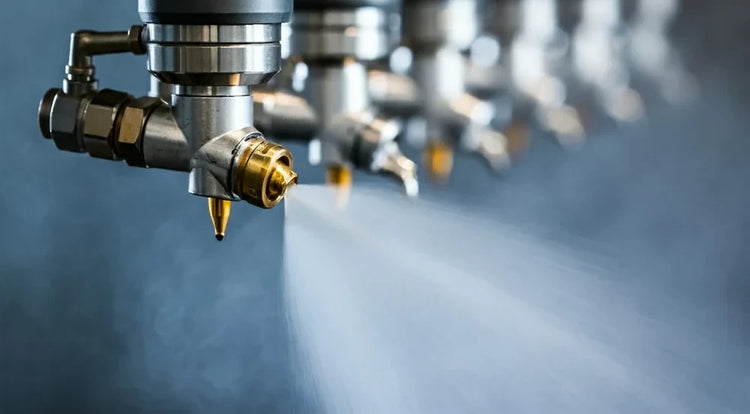
Beverage Bottling & Packaging Spray Nozzles
Precision spray solutions for pre-fill bottle rinsing, interior and exterior sterilization, conveyor chain and roller lubrication, label moisture conditioning, top carton moisture control, CIP equipment sanitation, and facility washdown — consistent high-speed performance for soft drinks, water, juice, beer, and specialty beverage lines
Beverage bottling spray systems run at speeds where milliseconds determine coverage quality. A rinse nozzle providing complete internal bottle coverage at 600 BPM does not automatically provide the same coverage at 1,200 BPM — the bottle spends half the time in the rinse zone, and the spray pattern must be designed for the actual operating speed, not the rated maximum. Conveyor lubrication at 0.5–2 mL per hour per nozzle is precisely engineered: over-lubrication causes product contamination and environmental compliance problems; under-lubrication causes friction-induced wear that accumulates into unplanned stoppages on a line where one hour down costs more than the entire lubrication system.
NozzlePro supplies spray nozzles for every beverage bottling and packaging position — full-cone interior rinse nozzles for pre-fill bottle cleaning, flat-fan nozzles for exterior sterilization and facility washdown, air-atomizing nozzles for label moisture conditioning, hollow-cone nozzles for carton moisture control, oil mist nozzles for conveyor lubrication, and CIP rotary spray balls for tank and equipment sanitation. 316L stainless steel and NSF/FDA-compliant food-safe construction throughout. ISO 9001 certified manufacturing ensures consistent orifice dimensions and spray pattern — a replacement nozzle set on a 1,200 BPM line performs identically to the validated original.
Beverage bottling and packaging facilities use spray nozzles across seven applications: pre-fill bottle rinsing uses full-cone interior rinse nozzles (30–80 PSI, 3–8 GPM per station) removing dust, debris, and manufacturing residues from empty containers before filling; interior bottle sterilization uses full-cone mist nozzles (20–60 PSI) applying hydrogen peroxide, peracetic acid, or ozone at validated concentration, temperature, and contact time for aseptic and shelf-stable production; exterior bottle and package sanitizing uses flat-fan nozzles (15–40 PSI) preventing mold and environmental contamination on wet bottle exteriors; conveyor chain and roller lubrication uses oil mist nozzles (10–30 PSI, 0.5–2 mL/hr per nozzle) with NSF H1 food-grade lubricant — over-lubrication contaminates product; under-lubrication causes chain wear; label moisture conditioning uses air-atomizing fine mist nozzles (40–80 PSI spray, 20–40 PSI air) achieving 60–80% surface RH for adhesive activation; top carton and case moisture control uses hollow-cone fine mist nozzles (5–20 PSI) maintaining 50–70% RH on package surfaces; and CIP and facility washdown uses rotary spray balls and flat-fan washdown nozzles (200–500 PSI, 140–160°F) for equipment cleaning and product changeover. All food-contact nozzles in 316L SS or NSF/FDA-compliant construction.
Beverage Bottling & Packaging Nozzle Collections
Shop by application or nozzle type
Beverage Bottling & Packaging Spray Applications
Application-specific nozzle recommendations for every bottling and packaging position
Pre-Fill Bottle Rinsing & Cleaning
Full-cone interior rinse nozzles (30–80 PSI, 3–8 GPM per rinse station) deliver targeted spray inside inverted bottles removing dust, glass chips, manufacturing residues, and environmental debris before filling. Bottle rinsing nozzle design must match the specific bottle geometry — narrow-neck glass requires different nozzle throw distance and spray angle than wide-mouth PET to achieve complete interior wall coverage. Residence time in the rinse zone decreases as line speed increases: a nozzle array designed for 600 BPM must be verified at 900 BPM that reduced residence time still meets the cleanliness specification. Exterior rinse spray (100–300 PSI) removes manufacturing dust and handling debris. Rinse water quality matters — high TDS water leaves mineral deposits on glass interiors that create haze in clear beverages and affect the taste profile of still water products. Low TDS rinse water (reverse osmosis or deionized, below 50 ppm) is standard for water and premium juice bottling lines.
Full-Cone NozzlesInterior Bottle Sterilization
Full-cone mist sterilization nozzles (20–60 PSI, 1–3 GPM per bottle position) apply hydrogen peroxide (50–200 ppm), peracetic acid, or ozone at validated concentration, temperature, and contact time achieving required log reduction for aseptic and shelf-stable beverage production. Sterilization efficacy requires three conditions met simultaneously: sterilant concentration at the container surface (not in the bulk supply — concentration is diluted by carry-over rinse water on the incoming bottle), contact time at that concentration (determined by residence time at operating BPM), and temperature (H₂O₂ efficacy increases significantly at 50–65°C). A system validated at 600 BPM run at 900 BPM without revalidation has reduced contact time and may not achieve the stated log reduction. NozzlePro supplies nozzle hardware and flow performance data; your food safety team executes sterilization validation and maintains FDA 21 CFR Part 113 records for aseptic low-acid beverage production.
Sanitization NozzlesExterior Bottle & Package Sanitizing
Flat-fan nozzles (15–40 PSI, 1–5 GPM per manifold) apply sanitizer uniformly to exterior bottle and package surfaces preventing mold growth on wet bottles in cold storage, algae formation on glass surfaces in humid environments, and pathogenic transfer from packaging exteriors during handling. Exterior sanitization is critical for cold-chain products — a wet glass bottle surface with residual organic material from the filling area atmosphere is an effective mold substrate during refrigerated distribution. For multi-pack and secondary packaging, sanitizer applied to assembled multi-packs before shrink-wrap application prevents mold colonization inside the wrap during transit. Flat-fan spray pattern provides linear coverage across the full conveyor width without gaps at line speed, with nozzle spacing calculated for the specific conveyor width and operating BPM.
Flat-Fan NozzlesConveyor Chain & Roller Lubrication
Oil mist nozzles (10–30 PSI, 0.5–2 mL/hr per nozzle, NSF H1 food-grade lubricant) apply controlled, uniform lubrication to conveyor chains, rollers, and bearings on bottling lines running 24/7 at 600–2,000 BPM. The 0.5–2 mL/hr rate is not a rough range — it is a precision specification. Under-lubrication allows metal-to-metal contact generating fine metal particles, accelerating chain elongation, and eventually causing link failure that stops the line. Over-lubrication above 2 mL/hr creates lubricant pooling that falls onto bottle exteriors, generates floor slip hazards, and risks contaminating open product containers. NSF H1 registration (incidental food contact) is required for any lubrication position adjacent to open product — verify current H1 registration with your lubricant supplier, as this certification requires periodic renewal. Oil mist application distributes lubricant far more uniformly along the chain length than periodic drip or brush application, reducing total consumption while improving coverage consistency.
Full-Cone NozzlesLabel Moisture Conditioning
Air-atomizing fine mist nozzles (40–80 PSI spray pressure, 20–40 PSI atomizing air, 0.1–0.5 mL/sec) apply precise moisture to label adhesive surfaces or container surfaces before labeling, activating water-based adhesives and conditioning surfaces for consistent bond strength. The 60–80% RH target on the label surface is bounded by failure modes: below 55–60% RH, water-based adhesive does not fully activate and labels peel within hours; above 85% RH, excess moisture causes label paper to swell unevenly, distorting printed graphics and in severe cases causing face-from-backing delamination. For cold-fill operations, monitor actual bottle surface temperature at the labeling point — the surface RH of a cold bottle in warm ambient air can be 80–95% due to the temperature differential, making additional moisture conditioning counterproductive. Measure label peel force through the production run as the primary indicator of adhesive performance, not ambient RH readings.
Air-Atomizing NozzlesTop Carton & Case Moisture Control
Hollow-cone fine mist nozzles (5–20 PSI, 0.5–2 GPM per carton position) maintain 50–70% RH on carton tops and corrugated case surfaces, managing the two competing moisture failure modes in beverage secondary packaging: condensation from cold-fill products in warm humid environments (which wets corrugated structure, reducing compressive strength and causing case collapse under pallet load) and excessive dryness in climate-controlled warehouses (which makes corrugated brittle and prone to corner damage). For cold-fill operations, product at 35–38°F in 70–75°F ambient air condenses moisture from the air onto the bottle exterior continuously during production and early distribution — the moisture control spray is managing the total moisture budget of the finished pack, not just a surface appearance concern. Above 70% RH structural moisture absorption risk increases; below 40% brittleness and static charge issues appear.
Hollow-Cone NozzlesCIP Equipment Sanitation & Facility Washdown
Rotary CIP spray balls and fixed manifolds (20–60 PSI, 1–10 GPM per nozzle, 140–165°F alkaline wash, acid rinse, sanitizer cycle) for filler bowls, blending tanks, syrup systems, and product contact vessels; flat-fan washdown nozzles (200–500 PSI, 5–20 GPM, 140–160°F with alkaline detergent) for line equipment, conveyors, packaging machinery, floors, and drains. Product changeover in multi-product facilities producing allergen-containing beverages (milk-based drinks, nut milks, soy beverages) requires allergen-specific verification per FSMA 21 CFR Part 117: ATP swab confirming total organic residue removal plus allergen-specific immunoassay swab for the prior run allergen, before the first containers of the next product are filled. Washdown drainage must direct contaminated water away from the fill zone — aerosol from high-pressure washdown re-contaminates equipment cleaned earlier in the changeover sequence.
Cleaning & WashingNozzle Configuration Reference — Beverage Bottling & Packaging
Recommended nozzle type, operating parameters, and key notes for each application
| Application | Nozzle Type | Pressure / Flow | Key Note |
|---|---|---|---|
| Pre-Fill Bottle Rinsing (Interior) | Full-Cone Interior Rinse | 30–80 PSI, 3–8 GPM/station; exterior 100–300 PSI | Design for specific bottle geometry and actual operating BPM — verify coverage at each production speed; low TDS rinse water (RO or DI, below 50 ppm) for glass and still water products to prevent mineral haze deposits |
| Interior Bottle Sterilization | Full-Cone Mist Sterilization | 20–60 PSI, 1–3 GPM/bottle, H₂O₂ 50–200 ppm or PAA | Validated at specific BPM — higher speed reduces contact time below validated minimum; concentration at container surface not supply tank (carry-over dilution); NozzlePro supplies hardware; customer food safety team validates and maintains 21 CFR Part 113 records |
| Exterior Bottle & Package Sanitizing | Flat-Fan Sanitizing Manifold | 15–40 PSI, 1–5 GPM/manifold, chlorine or QAC | Flat-fan provides seamless linear coverage at line speed; critical for cold-chain products — wet glass + organic material = mold substrate; apply to multi-packs before shrink-wrap to prevent mold inside the wrap during distribution |
| Conveyor Chain Lubrication | Oil Mist — Full-Cone Fine | 10–30 PSI, 0.5–2 mL/hr/nozzle, NSF H1 food-grade lubricant | NSF H1 (incidental food contact) required near open product — verify current registration with supplier; over-lubrication above 2 mL/hr contaminates product and creates slip hazard; verify actual chain friction with pull gauge, not just nozzle flow spec |
| Label Moisture Conditioning | Air-Atomizing Fine Mist | 40–80 PSI spray, 20–40 PSI air, 0.1–0.5 mL/sec | Target 60–80% RH at label surface — below 55% adhesive under-activates; above 85% paper swells and delaminates; for cold-fill: surface RH on cold bottles may already be 80–95% due to temperature differential — measure peel force, not ambient RH |
| Top Carton / Case Moisture Control | Hollow-Cone Fine Mist | 5–20 PSI, 0.5–2 GPM/position, 50–70% RH target | Cold-fill products condense continuously — moisture control manages total pack moisture budget; above 70% RH corrugated compressive strength drops; below 40% brittleness and static increase handling damage |
| Filler Bowl / Tank CIP | 3-A Rotary Spray Ball | 20–60 PSI, 1–10 GPM/nozzle, 140–165°F alkaline + acid + sanitizer | 316L SS, self-draining, tri-clamp connections; coverage verification before CIP validation; allergen changeover requires ATP + allergen-specific swab (ELISA or lateral flow) before first containers of next product; document as Preventive Controls records |
| Line Equipment & Facility Washdown | Flat-Fan Washdown Nozzles | 200–500 PSI, 5–20 GPM, 140–160°F + alkaline detergent | Washdown sequence from fill zone outward — high-pressure aerosol re-contaminates equipment cleaned earlier; floor slope must direct wash water away from fill zone; allergen swab verification required after changeover before next fill run |
Beverage Bottling & Packaging Facility Types Served
Spray solutions for every beverage category and production scale
Craft & Specialty Beverage
Precision bottle rinsing and sterilization for premium product quality, label moisture control for professional appearance, equipment sanitation for multi-product food safety, and conveyor lubrication for smaller-scale continuous operations.
Soft Drink & CSD Bottling
High-speed bottle rinsing (1,200–2,000 BPM), automated exterior sterilization, precision conveyor lubrication for ultra-high-speed equipment, label moisture control on high-humidity carbonated beverage lines.
Water & Mineral Water Bottling
Low TDS interior rinse (RO or DI water) for haze-free glass, pharmaceutical-grade sterilization per NSF/ANSI standards, biofilm prevention in rinse water storage, UV sterilization support spray systems.
Juice & Aseptic Beverage Filling
Validated aseptic sterilization per 21 CFR Part 113, temperature-controlled rinsing, rapid cooling spray for hot-fill operations, label moisture control on humidity-sensitive juice bottles, cross-contamination prevention sanitation.
Beer & Alcoholic Beverage
Exterior bottle sterilization preventing cold-chain mold, CO2 sterile rinse systems, conveyor lubrication for capping alignment precision on high-speed lines, multi-pack sanitation before shrink-wrap, facility CIP for bright beer tanks.
Energy Drink & Functional Beverage
Ultra-high-speed sterilization and rinsing, specialty label moisture control for complex label constructions, allergen changeover sanitation between protein-containing formulations, conveyor optimization for extreme-throughput operations.
Beverage Bottling & Packaging Nozzle Selection Principles
What determines correct specification across bottling line applications
- Rinse and Sterilization Nozzle Design Must Match Actual Operating BPM — Not Rated Line Speed — Beverage bottling lines are frequently run above their original design speed after productivity improvements. A rinse or sterilization nozzle array designed for 600 BPM provides bottles with a specific residence time in the spray zone; at 900 BPM that residence time drops 33% and rinse volume or sterilant contact time per bottle decreases proportionally. For sterilization, reduced contact time at concentration may fall below the validated minimum for the specified log reduction — the sterilization record becomes non-conforming even though spray is being applied and the system appears to be functioning normally. Revalidate rinsing coverage and sterilization efficacy every time line speed increases. The minimum validation data set for bottle sterilization includes contact time at validated sterilant concentration at the maximum planned operating BPM, not just at commissioning speed.
- Conveyor Lubrication Rate Must Be Verified by Chain Friction Measurement — Not Estimated From Nozzle Flow Specification — A lubrication nozzle delivering the specified mL/hr flow rate does not automatically produce the required lubricant film thickness on the chain surface — the outcome depends on chain speed, chain geometry, nozzle standoff, and lubricant viscosity at operating temperature. Verify actual chain lubrication adequacy by measuring coefficient of friction with a chain pull gauge at the head and tail of each conveyor section, comparing to the target range (typically 0.10–0.20 for wet-running chains). Adjust flow rate up or down based on measured friction, not on the original specification. Very high-speed conveyors (1,200–2,000 BPM equivalent chain speed) may require higher flow rates than the original specification because lubricant contact time per chain link is extremely brief and more lubricant must be delivered per unit time to build an adequate film.
- Interior Bottle Sterilization Validation Must Cover Each Bottle Geometry Run on the System — A sterilization nozzle position validated for 500 mL round PET may leave uncovered zones in a 1 L narrow-neck glass — the sterilant spray cannot reach the shoulder area at the same angle. A spray angle optimized for narrow-neck glass may produce complete coverage of the shoulder but sub-optimal base coverage in a wide-mouth HDPE bottle. Validate sterilization coverage for each bottle geometry using indicator strips, UV fluorescent tracer, or biological indicator testing — not just for the primary bottle format. Maintain a separate sterilization validation record for each bottle geometry run on the system, and re-check validation status before introducing any new bottle size or shape.
- Label Adhesion Problems on Cold-Fill Lines Are Usually Caused by Bottle Surface Temperature — Not Insufficient Moisture Conditioning — Beverage bottles filled with cold product (35–45°F) entering a room-temperature labeling area have bottle exteriors that are significantly colder than ambient air. The relative humidity at the bottle surface is determined by the moisture in ambient air relative to the saturation moisture content at the bottle surface temperature — a labeling area with 55% ambient RH may have 80–95% actual surface RH on cold bottles. Additional moisture conditioning on these bottles pushes the bottle surface past the adhesive working window (above 85% RH), causing label swelling and adhesion failure. For cold-fill operations, measure label peel force through the production run as the primary diagnostic — if adhesion is poor at the start of a run (coldest bottles) but improves as bottles warm up, the problem is bottle surface temperature, not insufficient moisture. Reducing or eliminating moisture conditioning, or installing a warming stage before the labeler, addresses the root cause.
- Multi-Product Changeover Washdown Must Proceed From Fill Zone Outward — Aerosol Re-Contamination Is the Primary Failure Mode — High-pressure washdown (300–500 PSI) generates aerosol droplets that remain airborne 15–30 minutes and travel 15–25 feet from the spray impact point. In a beverage filling area, aerosol from washdown of floor drains or conveyor frames re-deposits on filler bowl interiors and rinse nozzles that were sanitized in an earlier changeover step. The washdown sequence must proceed from the fill zone and product-contact equipment outward to floors and drains — not from convenient access points that generate upstream aerosol contamination. For allergen-containing product changeover, aerosol from washdown of a filler that ran a nut milk or soy beverage can contaminate the rinser and conveyor areas — conduct allergen-specific surface swab verification after the complete washdown sequence, sequenced from fill zone outward, before the first containers of the next allergen-free product run.
Why Choose NozzlePro for Beverage Bottling & Packaging?
Food-safe construction, ISO 9001 certified supply, and application engineering for every bottling line position
Consistent High-Speed Spray Hardware & Application Support — ISO 9001 Certified
NozzlePro supplies spray nozzles for beverage bottling and packaging in 316L stainless steel and NSF/FDA-compliant food-safe construction with documented flow performance data. ISO 9001 certified manufacturing ensures replacement nozzle sets for high-speed rinse and sterilization systems deliver identical flow rates and spray patterns to the validated originals — the prerequisite for maintaining sterilization log reduction and rinsing coverage performance at production speed.
High-Speed Line Nozzle Sets: Matched-flow rinse and sterilization nozzle replacement sets, all verified at operating pressure before shipment. We supply the nozzle hardware and flow performance data; your food safety team executes sterilization validation, maintains regulatory records (21 CFR Part 113 for aseptic low-acid beverage production), and manages product changeover verification procedures. NozzlePro does not conduct sterilization validation studies or issue FDA compliance documentation.
Conveyor Lubrication Hardware: Oil mist nozzles in NSF H1-rated configurations for food-grade lubricant application, with flow rate documentation supporting your conveyor maintenance records. Chain friction measurement and lubrication frequency optimization are plant-specific — we provide the hardware and flow data to support your maintenance team's lubrication program design.
Full-Line Coverage: Every spray position from pre-fill rinse through facility washdown — supplied from the same ISO 9001 certified source with consistent food-safe construction and application engineering support across the full beverage bottling and packaging process.
Frequently Asked Questions
Common questions about spray nozzles for beverage bottling and packaging operations
How does increasing bottling line speed affect pre-fill rinsing and sterilization performance?
Increasing line speed is the most common way beverage bottling operations improve throughput — and the most common way existing spray systems are pushed outside their validated operating range without realizing it. The effect is direct and proportional: a 50% increase in BPM reduces each bottle's residence time in the rinse or sterilization spray zone by 33%, reducing the volume of rinse water or sterilant applied per bottle at constant nozzle flow rate. For rinsing, the practical consequence is reduced flush volume per bottle — at some line speed, the flush volume falls below the minimum needed to carry away glass chips or manufacturing dust, and those particles remain in the bottle to be found in the filled product. For sterilization, the consequence is more serious and less visible: reduced contact time at sterilant concentration may fall below the validated minimum for the specified log reduction. The product leaves the sterilization zone looking exactly the same as properly sterilized product, but the log reduction stated in the validation record was not achieved at the higher speed. This discrepancy between apparent and actual sterilization is invisible until a spoilage event or regulatory inspection that examines the relationship between the current operating BPM and the BPM at which the validation was conducted. The required action for any line speed increase is revalidation of rinsing coverage and sterilization efficacy at the new maximum operating speed before resuming production at that speed.
What conveyor lubricant specifications are required for beverage bottling lines near open product?
Conveyor lubricants in beverage bottling positions where incidental contact with open product containers is possible require NSF H1 registration — the "incidental food contact" category under NSF International's white-listed lubricant program. NSF H1 means the lubricant formulation has been reviewed and found acceptable for use in food processing environments where incidental contact with food may occur. It does not mean the lubricant is food itself or that unlimited exposure to product is acceptable — it means the formulation does not contain ingredients that pose an unacceptable health risk at the trace levels that would result from incidental contact. NSF H1 registration is granted to the specific lubricant formulation as manufactured by a specific supplier, and it requires periodic re-evaluation — a lubricant that was NSF H1 registered in 2020 may not still be registered if the supplier changed a formulation ingredient or allowed the registration to lapse. Verify current NSF H1 registration status with your lubricant supplier before placing each order, not just at the initial product qualification. For lubricant positions that are not adjacent to open product (closed conveyor systems, end-of-line case conveyor), standard food-equipment lubricants (NSF H2 or 3H) may be acceptable depending on your facility's food safety plan and FSMA Preventive Controls assessment — consult your food safety team on the hazard analysis for each lubrication position.
What are the FDA regulatory requirements for spray sterilization in aseptic beverage production?
Aseptic beverage production in the US is primarily regulated under FDA 21 CFR Part 113 for thermally processed low-acid canned foods (which includes aseptically packaged low-acid beverages like milk-based drinks and non-acidified juices with pH above 4.6). The regulatory framework addresses spray sterilization systems in terms of performance requirements, not specific nozzle specifications. Key requirements: the scheduled process must be established by a qualified process authority (a person with expert knowledge of thermal or chemical sterilization of low-acid foods) and filed with FDA. The scheduled process must achieve commercial sterility in the container under the worst-case production conditions — minimum sterilant concentration, minimum contact time, minimum temperature, and maximum line speed. For hydrogen peroxide sterilization specifically, FDA guidelines require that residual H₂O₂ in the finished product be reduced to 0.5 ppm or less through validated post-sterilization removal (sterile air blow-off plus hot water rinse). The spray nozzle system must be designed to achieve this residual removal — not just the initial sterilization. Equipment used for aseptic processing must be inspected and approved by FDA before operation (notification required per 21 CFR Part 113.40). NozzlePro supplies the spray hardware that your process authority and food safety team incorporate into the scheduled process documentation — the regulatory filing, validation execution, and ongoing process monitoring are the responsibility of your operations and quality team.
How should label adhesion problems be diagnosed differently on cold-fill versus ambient-fill beverage lines?
Cold-fill and ambient-fill label adhesion problems have different root causes and require different diagnostic approaches even when the symptoms look identical. For ambient-fill lines (filling at room temperature or above), label adhesion problems are most commonly caused by: insufficient moisture conditioning (below 55–60% RH at label surface, especially in air-conditioned facilities with low ambient RH), incorrect adhesive for the substrate (adhesive not rated for the bottle surface material), or application pressure problems (insufficient nip pressure on the label applying roller). For cold-fill lines (filling product at 35–45°F), the dominant cause of label adhesion problems is bottle surface temperature — not insufficient moisture. Cold bottles in ambient air condense moisture from the air, creating actual surface RH of 80–95% at the bottle surface even when ambient RH reads 55%. Additional moisture conditioning in this situation creates over-saturation (above 85% RH) that swells the paper label face and causes adhesion failure. Diagnosis: measure bottle surface temperature at the labeler, calculate actual surface RH from the psychrometric chart, and compare to the adhesive manufacturer's working range. Measure label peel force at 5-minute intervals from the start of the production run as bottles warm up from storage temperature toward ambient — if adhesion improves progressively as bottles warm, the problem is surface temperature, not moisture conditioning. The solution for temperature-related adhesion problems is not increasing moisture conditioning — it is warming the bottle before the labeler (a short section of conveyor out of refrigeration before the labeler, or a gentle air heater) to bring the surface above the adhesive's minimum application temperature.
How do beverage bottling facilities manage allergen cross-contact risk during product changeover?
Allergen cross-contact in multi-product beverage bottling facilities — particularly those alternating between allergen-containing products (milk-based beverages, nut milks, oat milk, soy beverages, coconut water with tree nut allergen designation) and allergen-free products — is regulated under FDA FSMA Preventive Controls for Human Food (21 CFR Part 117). The written allergen control preventive control must demonstrate cleaning effectiveness, not just completion. Four areas in beverage bottling require allergen changeover attention that are often overlooked: filler bowl and product piping CIP (this is the obvious one); the rinser nozzles and rinse water supply lines (liquid protein from the prior product run can contaminate the rinse water supply through the filler bowl overflow path, meaning each new bottle receives a trace allergen carry-over in the rinse water); conveyor surfaces that contact wet bottle exteriors after filling (product spill from the filler creates an allergen residue that dries and adheres to conveyor surfaces); and filling area air handling (high-speed filling aerosolizes liquid protein from allergen-containing beverages, which deposits on equipment throughout the fill zone — filler bowl, capper head, labeler feed conveyor). Allergen changeover verification sequence: complete CIP of filler bowl and product piping, flush rinse water supply lines separately, clean conveyor surfaces, allow airborne protein to settle (typically 30 minutes minimum after the last allergen-containing fill with air handling running), then conduct ATP swab plus allergen-specific immunoassay swab (ELISA or lateral flow) at each critical surface before the first containers of the next product are filled. Document all verification results as Preventive Controls records with retention for 2 years per 21 CFR Part 117. Action limits for positive allergen swabs must be defined in the written procedure, and re-cleaning plus re-testing is required before any allergen-free production begins following a positive.
Talk with a NozzlePro Beverage Bottling & Packaging Specialist
Share your beverage type, container format, line speed, and sanitation requirements — we'll supply ISO 9001 certified food-safe spray nozzles with application engineering support for every spray position on your bottling line.