
Automated 360° Cleaning for
Tanks, Reactors & Vessels
From food-grade spray balls to high-impact rotary jet cleaners for large industrial tanks — sized to your tank geometry, soil load, and pump capacity, not pulled from a generic catalog page.

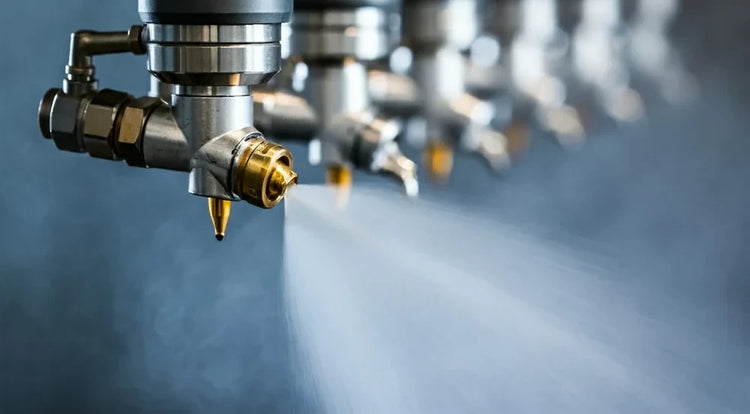
Tank and vessel cleaning uses three main nozzle categories based on tank size and soil load. Static spray balls provide simple, reliable full-coverage wetting for small tanks, IBCs, and food and beverage vessels using low-pressure flooding action. Rotary spray heads (fluid-driven) use the CIP pump pressure to rotate and deliver more thorough coverage with greater impact for medium tanks and moderate soils. High-impact rotary jet cleaners use mechanical or fluid-driven rotation combined with concentrated high-pressure jets for large tanks, reactors, and heavy soil loads — achieving complete internal coverage without manual entry. Selection depends on tank diameter, vessel geometry (baffles, agitators, coils), soil type, available pump flow and pressure, and required cleaning cycle time.
Tank Cleaning Applications by Industry
Device recommendations matched to industry cleaning requirements — every collection link goes directly to the relevant NozzlePro products.
Breweries, Wineries & Distilleries
Fermentation tanks, bright beer tanks, wine storage, and spirit aging vessels Recommended Nozzles- Fermenters & Bright Tanks (up to ~10,000 BBL): Rotary spray heads
- Smaller Vessels: Static spray balls for secondary storage
- 316L stainless with electropolished finishes for hygienic service
- Cylindroconical geometry and internal fittings require coverage verified from device position
Dairy Processing
Raw milk silos, pasteurization tanks, cream separators, and cheese vats Recommended Nozzles- Large Silo Cleanout: High-impact rotary spray heads
- Smaller Receiving/Processing Tanks: Static spray balls
- Designs can align with 3-A sanitary design principles where required by customer spec
- Milk fat and protein residues are highly adherent at CIP temperatures — impact and coverage must match validated cleaning protocols
Pharmaceutical & Biotech
Bioreactors, buffer preparation tanks, media vessels, and formulation tanks Recommended Nozzles- Bioreactors & Prep Vessels: Rotary and orbital jet cleaners
- Designs can align with ASME BPE hygienic design principles where specified
- Spray coverage mapping and flow rate data can be shared for your own IQ/OQ/PQ validation work
- Drip-free designs prevent contamination during valve-closed states
Chemical & Petrochemical Processing
Chemical reactors, storage tanks, and process vessels Recommended Nozzles- Large Reactors & Storage Vessels: High-impact rotary jet cleaners
- Hastelloy, duplex stainless, and specialty alloy options for corrosive service
- Abrasive Slurry & Catalyst Tanks: TC wear inserts
- Materials and designs can be selected to suit ATEX/IECEx hazardous area installation requirements
Petroleum & Energy Storage
Above-ground storage tanks, fuel vessels, and oil/water separators Recommended Nozzles- Large Storage Tanks: High-impact rotary jet cleaners
- Flexible Deployment: Portable lance-mounted devices
- Scale & Mineral Deposits: TC-tipped jets
- Designs can be specified for flammable atmosphere service where required
Wastewater & Water Treatment
Equalization tanks, digester vessels, sludge holding tanks, and dosing tanks Recommended Nozzles- Digester & Equalization Tanks: High-impact rotary jet cleaners
- Sludge Mobilization: High-flow devices for large holding tanks
- Corrosion-resistant alloys for H₂S and high-chloride environments
- Portable units for flexible deployment across multiple tank locations
Tank Cleaning Device Selection Guide
Match device type to tank volume, soil load, available pump pressure, and required cleaning standard.
| Device Type | Tank Size | Soil Load | Operating Pressure | Best Applications | Shop |
|---|---|---|---|---|---|
| Static Spray Ball | Up to ~5,000 gal | Light–Moderate | 15–60 PSI | Dairy, brewery, beverage, food processing tanks, IBCs | Shop → |
| Rotary Spray Head (fluid-driven) | 500–20,000 gal | Moderate | 30–90 PSI | Dairy, pharma, chemical, wine/spirits fermenters and storage tanks | Shop → |
| High-Impact Rotary Jet Cleaner | 5,000–500,000+ gal | Heavy | 60–180 PSI | Chemical reactors, petroleum storage, wastewater tanks, mining slurry tanks | Shop → |
| Orbital / 3D Jet Cleaner | All sizes | Moderate–Heavy | 40–120 PSI | Tanks with internal baffles, agitators, coils, or complex geometry | Shop → |
| Portable Tank Jet (lance-mounted) | IBCs, drums, totes | Variable | 30–100 PSI | IBC totes, drums, containers, marine tanks, remote-site vessels | Shop → |
| TC Wear-Resistant Rotary Jet | Any large vessel | Very Heavy / Abrasive | 60–200 PSI | Mining slurry tanks, cement/mineral processing, petrochemical reactors | Shop → |
How to Size a Tank Cleaning Nozzle
Five parameters that determine the correct device for any tank cleaning application.
- Tank Diameter and Volume — Tank diameter determines the minimum impact coverage radius required from the cleaning device. As a rule of thumb: static spray balls suit tanks up to approximately 6 ft (2 m) diameter; rotary spray heads cover tanks up to 15 ft (4.5 m); high-impact rotary jet cleaners are required for larger vessels. Tank volume affects the required cycle time and total water and chemical consumption per cycle.
- Soil Type and Adhesion — Light aqueous residues and low-solids products clean readily with static spray balls at moderate pressure. Dairy proteins, yeast slurries, and starch-based residues require higher impact from rotary spray heads. Heavy petroleum sludge, polymerized resins, bitumen, and mineral scale demand high-impact rotary jet cleaners with concentrated jet action to mechanically displace the soil before chemical dissolution.
- Available Pump Flow and Pressure — Static spray balls operate effectively at 15–60 PSI and relatively low flow rates. Rotary spray heads need 25–80 PSI and higher flow to drive the rotation mechanism. High-impact rotary jet cleaners require 60–180 PSI and significant pump capacity to maintain jet velocity throughout the cleaning cycle. Always verify the existing CIP pump can deliver the required flow at the device's minimum operating pressure before specifying a cleaning device.
- Internal Vessel Geometry — Tanks with internal baffles, heating/cooling coils, agitators, or unusual geometry (conical bottoms, dished heads, off-center nozzle locations) may require orbital or 3D jet cleaners that rotate in multiple axes to guarantee coverage around obstructions. Shadow areas behind baffles and agitator blades are a common source of cleaning failures when standard spray balls or single-axis rotating devices are used.
- Hygiene and Validation Requirements — Food, beverage, dairy, and pharmaceutical applications often require documented cleaning validation, including spray coverage maps and flow rate data at specified pressure. Devices must be selected from materials compatible with both the CIP chemicals (caustic, acid, sanitant) and the product, and designed for drainage to prevent pooling that creates biofilm harborage sites.
Application Engineering for Every Vessel
From 50-Gallon Totes to 500,000-Gallon Storage Tanks — Sized to Your Process
Tank cleaning device selection is not a one-size-fits-all decision. The wrong device — an undersized spray ball in a large tank, or a high-impact jet in a small sanitary vessel — either fails to clean completely or damages tank internals. NozzlePro application engineers work with your tank drawings, CIP system parameters, and soil characterization to specify the correct device type, connection size, and materials.
Automated Closed-Tank Cleaning: Eliminating confined space entry from routine cleaning operations is one of the most significant safety improvements available in industrial facilities. Every CIP application that previously required manual entry can be replaced with an automated spray device — reducing confined space permit requirements, cleaning cycle time, and labor cost simultaneously.
Water and Chemical Savings: Automated tank cleaning nozzles routinely reduce water consumption by 30–40% versus manual cleaning cycles by eliminating the overspray and extended rinse times associated with hose-in-hand cleaning. Chemical concentration and contact time can be precisely controlled in closed CIP systems, further reducing usage.
Hygienic Construction: 316L stainless steel with electropolished finishes and crevice-free designs for food, beverage, dairy, and pharmaceutical service. Spray coverage data can be shared to support your own validation work.
ISO 9001 Manufacturing: Consistent dimensional tolerances across every production run.
Tank & Vessel Cleaning Specification at a Glance
Key Parameters by Application
Frequently Asked Questions
Common questions about tank and vessel cleaning spray nozzles.
Static spray balls produce a fixed spray pattern through multiple small holes in a spherical or elongated body, providing full 360° coverage via flooding action at relatively low pressure (15–60 PSI). They are simple, reliable, and appropriate for smaller tanks up to approximately 6 ft diameter with light to moderate soil loads. Rotary jet cleaners use the CIP pump pressure to mechanically rotate concentrated jets around the tank interior, delivering significantly higher impact force for larger vessels and heavier soils. Rotary devices clean more effectively with less water but require higher minimum operating pressure and flow to function correctly.
Tank cleaning device sizing starts with tank diameter and volume, soil type and adhesion, and available CIP pump flow rate and pressure. As a general guide: static spray balls for tanks up to ~5,000 gallons with light soils; rotary spray heads for 500–20,000 gallon tanks with moderate soils; high-impact rotary jet cleaners for large tanks and heavy soils. Device connection size must match your tank manway or nozzle size. NozzlePro application engineers size devices from your tank drawings and CIP system parameters — sharing tank diameter, internal geometry, pump GPM at operating PSI, and target soil type gives us everything needed for an accurate recommendation.
Yes, significantly. Automated tank cleaning nozzles routinely reduce water consumption by 30–40% versus manual hose-in-hand cleaning by eliminating overspray, reducing rinse cycles, and allowing precise control of CIP chemical concentration and contact time. Static spray balls are more water-efficient than manual cleaning; rotary jet cleaners achieve the same or better cleaning performance at even lower water volumes by concentrating high-impact jets rather than flooding the entire tank surface. The closed-tank operation of automated devices also allows caustic and acid solutions to be recirculated and reused across multiple cycles.
For food, beverage, dairy, and pharmaceutical applications, cleaning validation typically requires spray coverage mapping, flow rate versus pressure data, and dimensional and material specifications for the device selected. NozzlePro application engineers can work with your team to provide the spray coverage and flow performance data needed to support your own IQ/OQ/PQ documentation process — your quality team determines the specific certifications, mill test reports, or compliance documentation required for your facility's regulatory submissions.
316L stainless steel handles most industrial CIP cleaning chemistries (sodium hydroxide, phosphoric acid, peracetic acid, sodium hypochlorite at normal concentrations) and is standard for food, beverage, dairy, and pharmaceutical applications. For aggressive chemistries — concentrated mineral acids, high-chloride environments, or H₂S-bearing services — Hastelloy C-276 or duplex stainless steel bodies are required. For abrasive applications (slurry tanks, mineral processing vessels, crude oil tanks with scale), tungsten carbide jet orifice inserts extend service life 5–10× versus standard stainless. Seal materials should be PTFE or Viton for broad chemical resistance in aggressive CIP environments.
Internal obstructions — baffles, heating/cooling coils, agitator shafts and blades — create shadow areas that single-axis rotating spray devices may miss. For tanks with significant internal geometry, orbital or 3D rotating jet cleaners that rotate in multiple axes are recommended. These devices sweep the cleaning jets through full 3-dimensional coverage paths, reaching behind baffles and under coils that would otherwise block a standard rotary spray head. In some cases, multiple spray devices positioned at different locations on the tank may be more practical than a single device. NozzlePro application engineers review your vessel drawings to identify shadow risk areas and specify the appropriate device configuration.
Ready to Automate Your Tank Cleaning?
Share your tank diameter, internal geometry, soil type, and CIP pump specifications — we'll size the right device and recommend materials for your cleaning requirement.