
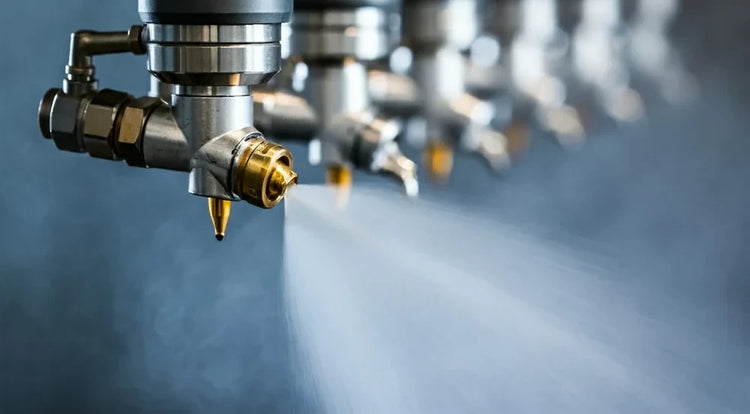
Cooling Spray Nozzles for
Steel & Metal Industry
Precision cooling for continuous casting, hot and cold rolling, and heat treatment — engineered to hold cooling rate and uniformity within the narrow band that separates the target microstructure from a cracked, warped, or off-spec product.
Steel and metal cooling uses different nozzle types depending on the stage and required cooling rate. Flat-fan nozzles handle continuous casting mold cooling, inter-stand cooling between rolling mill stands, and work roll cooling — anywhere a linear header needs to deliver uniform coverage across a strip or roll surface. Full-cone nozzles handle secondary casting zones and plate quench arrays where volumetric coverage matters more than a linear sheet. High-pressure flat-fan headers combine cooling with descaling at hot mill entry points, operating at 150–250 bar. Air-atomizing nozzles see use on run-out table cooling where finer droplet control helps manage the Leidenfrost transition during rapid quenching. This page covers cooling-specific applications; for the full range of steel and metal nozzles including descaling and coating, see our Steel & Metal Applications page, and for cooling and quenching across other industries, see Cooling & Quenching.
Cooling Applications in Steel & Metal Production
Each stage of the process has a different cooling objective — from preventing a cracked slab to hitting a precise transformation temperature.
Continuous Casting Cooling
Primary, secondary, and tertiary spray zones below the mold Recommended Nozzles- Narrow-Angle Mold Cooling: Flat-Fan, 3–8 bar
- Cools solidifying slabs, billets, and blooms to controlled withdrawal temperatures
- Uniform distribution prevents surface reheating, corner cracking, and internal porosity
- Coverage must hold at casting speeds up to 6 m/min without creating cold or hot spots
Hot Rolling Mill Cooling
Inter-stand and run-out table cooling Recommended Nozzles- Rapid-Rate Headers: Flat-Fan, 40–100 bar inter-stand
- Regulates strip temperature profile and controls austenite grain size
- 100–300°C/second cooling rates required for advanced high-strength steel (AHSS)
- Run-out table often pairs flat-fan with air-atomizing for finer control near the Leidenfrost transition
Roll Cooling & Lubrication
Work roll and backup roll thermal crown management Recommended Nozzles- Fine Spray Control: Flat-Fan, 10–40 bar
- Maintains thermal crown control and prevents roll fire cracking
- Extends roll campaign life from roughly 5,000 to 15,000+ tons
- Combination spray/emulsion systems provide simultaneous cooling and friction reduction
Quench & Heat Treatment
Plate quenching, normalizing, and accelerated cooling Recommended Nozzles- Volumetric Quench Coverage: Full-Cone arrays, 8–30 bar
- Programmable zones deliver precise cooling rates for target hardness and transformation temperature
- Serves API 5L pipeline steel, ASTM A514 structural grades, and specialty alloys
- Rate control here is a metallurgical spec, not just a temperature target
Descaling Operations
High-impact scale removal ahead of hot rolling Recommended Nozzles- High-Impact Headers: High-Pressure, 150–250 bar
- Removes mill scale before hot rolling, exposing clean metal surface
- Prevents roll scratching and enables tighter downstream dimensional tolerances
- Full detail on descaling-specific engineering is covered on our dedicated Descaling page
Equipment Protection Cooling
Pinch rolls, side guides, coil boxes, shears, support structures Recommended Nozzles- Auxiliary Cooling: Full-Cone
- Protects critical mill components operating in 800–1,200°C ambient environments
- Reduces unplanned equipment failure and maintenance frequency
- Often the most overlooked cooling application until a support structure fails
Cooling Parameters by Application
Nozzle type, pressure, and flow vary widely by stage — every recommendation reflects standard practice for that cooling zone.
| Application | Nozzle Type | Pressure Range | Flow Rate | Shop Collection |
|---|---|---|---|---|
| Continuous Casting Mold | Flat-fan (narrow angle) | 3–8 bar | 10–40 L/min per nozzle | Flat-Fan |
| Secondary Cooling Zones | Full-cone / flat-fan | 4–10 bar | 20–100 L/min per nozzle | Full-Cone |
| Hot Mill Descaling | High-pressure flat-fan | 150–250 bar | 30–150 L/min per nozzle | High-Pressure |
| Inter-Stand Cooling | Flat-fan headers | 40–100 bar | 50–200 L/min per header | Flat-Fan |
| Run-Out Table Cooling | Flat-fan / air-atomizing | 5–50 bar | 100–500 L/min per zone | Flat-Fan |
| Work Roll Cooling | Flat-fan (fine spray) | 10–40 bar | 15–60 L/min per roll | Flat-Fan |
| Plate Quench Cooling | Full-cone arrays | 8–30 bar | 200–800 L/min per array | Full-Cone |
Steel Grades & Product Forms
Cooling requirements shift substantially depending on the grade and product form being processed.
- Carbon & Low-Alloy Steels — Cooling systems for structural steels (ASTM A36, A572), pipeline grades (API 5L X60–X80), pressure vessel steels (ASTM A516), and automotive grades. Controlled cooling achieves ferrite-pearlite, bainite, or tempered martensite microstructures meeting mechanical property requirements.
- Advanced High-Strength Steels (AHSS) — Rapid cooling systems for dual-phase (DP), transformation-induced plasticity (TRIP), complex-phase (CP), and martensitic steels used in automotive lightweighting. Ultra-fast cooling rates (200–300°C/second) and precise temperature control achieve target strength-ductility combinations.
- Stainless & Special Alloys — Specialized cooling for austenitic (304, 316), ferritic (430), and duplex stainless steels. Temperature control prevents sensitization, maintains corrosion resistance, and achieves target phase balance in duplex grades.
- Long Products — Cooling systems for bars, rods, wire rod, structural shapes, and rails. Multi-zone cooling beds deliver controlled transformation cooling for normalized, quenched-and-tempered, or direct-quenched products.
Engineering Precision for Extreme Conditions
Thermal Management System Design
NozzlePro engineers cooling systems using heat transfer analysis and spray impact testing to optimize cooling uniformity, minimize water consumption, and achieve required cooling rates across the full width of slabs, strips, and structural products.
Critical Design Parameters:
- Spray Coverage Uniformity — Overlapping spray patterns hold ±5% temperature uniformity across product width, preventing differential cooling and warping
- Impact Force Control — Pressure and nozzle selection deliver 5–50 N/cm² impact forces appropriate for scale removal, surface cooling, or gentle quenching without surface damage
- Droplet Size Optimization — Controlled droplet distribution (D50: 200–2,000 µm) balances heat transfer efficiency, Leidenfrost management, and water conservation
- Material Selection — 316/316L stainless steel, Inconel, or ceramic inserts withstand high ambient temperatures and resist scale buildup for extended service life
- Thermal Shock Resistance — Adjustable cooling rate control (10–300°C/second) prevents crack formation in medium-carbon, high-strength, and tool steels
- Flow Distribution — Manifold design ensures uniform flow to each nozzle, maintaining consistent cooling even during pressure fluctuations or partial system operation
Cooling Specification at a Glance
Key Parameters by Application
Frequently Asked Questions
Common questions about cooling spray nozzles for steel and metal production.
Cooling rate directly determines the microstructure that forms as steel transforms from austenite — the phase mix of ferrite, pearlite, bainite, or martensite that results sets the final mechanical properties: strength, ductility, hardness, and toughness. Too-fast cooling in the wrong location can induce thermal stress and cracking; too-slow cooling can allow segregation or an undesired soft microstructure. Advanced high-strength steel grades specifically require ultra-fast, precisely controlled cooling rates (200–300°C/second) to achieve the dual-phase or TRIP microstructures that give them their strength-to-weight advantage — a cooling system that can't hit that rate simply can't produce that grade.
The Leidenfrost effect occurs when a hot surface is so far above the boiling point of the cooling water that a vapor layer forms between the surface and the liquid, insulating the surface and dramatically reducing heat transfer efficiency — the water essentially skitters across the surface rather than making effective contact. On a run-out table, the steel surface passes through this transition as it cools, and cooling system design has to account for the abrupt change in heat transfer behavior on either side of it. Droplet size and impact velocity both influence where and how sharply this transition occurs, which is part of why run-out table cooling often uses a combination of nozzle types rather than a single uniform pattern along the table length.
Steel contracts as it cools, and if one region of a strip or plate cools faster than an adjacent region, the two areas contract at different rates and different times — this differential contraction is exactly what produces warping, camber, and flatness defects. The ±5% temperature uniformity target across product width exists specifically to keep this differential small enough that it doesn't show up as a shape defect. Sources of non-uniformity include header flow variation from nozzle to nozzle, edge effects where cooling water behaves differently than in the center of the strip, and worn or clogged nozzles creating localized hot spots.
Inspection frequency depends on water quality and the specific cooling zone's service conditions. Descaling and other high-pressure positions with scale-contaminated water wear fastest and warrant the most frequent flow verification. Lower-pressure cooling zones with treated water wear more slowly, but orifice erosion and mineral scaling still gradually change flow rate and spray pattern before it's visible on casual inspection. Because cooling uniformity is a quality specification and not just a maintenance concern, a periodic flow-verification schedule — not just visual inspection — is the more reliable way to catch degradation before it shows up as a metallurgical or dimensional defect.
Yes, in many cases. Casting speed and rolling line speed are often limited by how quickly the process can remove heat while still meeting metallurgical and dimensional requirements — if the cooling system can't keep up, the line has to slow down. A cooling system upgrade that improves heat transfer efficiency (through better droplet size control, higher impact force where needed, or more uniform coverage) can allow the same product to be produced at a higher casting or rolling speed without compromising quality, directly increasing throughput. Whether this is achievable depends on where the current bottleneck actually is — a thermal analysis of the specific line is the way to confirm cooling is the limiting factor before investing in an upgrade.
316 or 316L stainless steel is the standard choice for most steel mill cooling positions, offering good corrosion resistance and adequate temperature tolerance for typical ambient conditions near the process. For positions closer to extreme heat sources or with more aggressive water chemistry, Inconel or ceramic orifice inserts extend service life significantly. Material selection should also account for scale buildup resistance — a nozzle that's otherwise well-suited to the temperature but prone to internal scaling will still need more frequent cleaning or replacement than one specified with scale resistance in mind from the start.
Ready to Optimize Your Cooling System?
Share your product dimensions, steel grade, production speed, and cooling rate targets — we'll provide header layouts, flow calculations, and cooling curve predictions for your mill.