
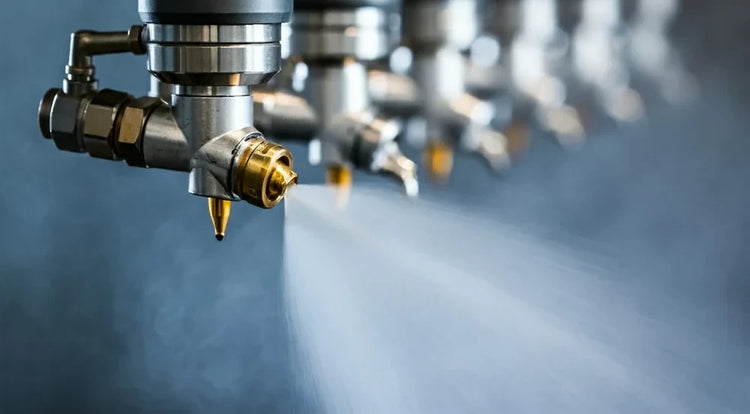
Industrial Spray Nozzles for Can Washing
Stage-optimized nozzles for high-speed can manufacturing wash systems — pre-wash, main wash, rinse, and DI rinse — in flat-fan, full-cone, hollow-cone, and tungsten carbide configurations
Can manufacturing wash systems run at high speeds with little tolerance for nozzle performance variation. A spray nozzle that delivers 10% more flow than rated wets the inside of the can inadequately, creating surface defects downstream. A worn orifice that distorts the spray pattern creates uneven coverage across the can header, generating quality escapes at the decoration or lacquering stage. In high-speed can lines running millions of units per shift, spray nozzle consistency is a production quality parameter — not just a maintenance item.
NozzlePro supplies flat-fan, full-cone, hollow-cone, and high-pressure spray nozzles for all stages of the can wash system, sized to the header configuration, pump pressure, chemical concentration, and line speed of your specific equipment. Tungsten carbide orifice inserts are available for all high-wear positions where standard stainless orifices require frequent replacement.
Can washing systems use different spray nozzles at each stage of the wash sequence: flat-fan nozzles for pre-wash coolant and oil removal — delivering high-impact sheeted spray to flush lubricants and metal fines from can bodies at the entry stage; full-cone nozzles for the main wash detergent and caustic stage — providing volumetric coverage that ensures uniform chemical contact time across all can surfaces; hollow-cone and flat-fan nozzles for intermediate and final rinse stages — uniform wetting with reduced carryover and effective edge and bead coverage; and tungsten carbide tipped nozzles in high-wear positions across all stages where abrasive media, high pressures, or continuous high-speed operation require extended orifice service life. All can wash nozzles must maintain tight flow rate tolerances at operating pressure — orifice variation directly affects coverage uniformity and product quality in high-speed manufacturing.
Can Wash System Nozzle Technologies
Shop by spray pattern — each matched to a specific can wash stage and chemical requirement
Can Wash Stage Nozzle Guide
Recommended nozzle type, operating conditions, and key performance requirement at each wash stage
| Wash Stage | Objective | Recommended Nozzle | Key Requirement | Shop |
|---|---|---|---|---|
| Pre-Wash | Remove coolant, lubricant, and metal fines from can bodies at line entry | Flat-Fan, High-Pressure | High-impact sheeted spray; chemical resistance to alkaline cleaners and heated media | Flat-Fan → |
| Main Wash | Detergent or caustic cleaning for complete soil removal from all can surfaces | Full-Cone, TC-Tipped | Volumetric coverage for uniform dwell time; TC orifices for extended service life | Full-Cone → |
| Intermediate Rinse | Remove detergent and loosened soil before final rinse stage | Flat-Fan, Hollow-Cone | Uniform wetting with low carryover; effective coverage of bead and edge geometry | Hollow-Cone → |
| Final DI Rinse | Deionized water final rinse for surface cleanliness before decoration or lacquer | Flat-Fan, Hollow-Cone | Minimal carryover; even film coverage; tight flow tolerance to conserve DI water | Flat-Fan → |
| Conveyor & Equipment Washdown | Clean conveyor belts, transfer points, and equipment between production runs | Flat-Fan, Full-Cone | Consistent belt-width coverage; chemical resistance for sanitation cycles | Cleaning & Washing → |
Can Wash Stage Application Guide
Detailed nozzle recommendations and failure mode analysis for each stage
Pre-Wash — Coolant & Oil Removal
Can bodies enter the wash system carrying drawing lubricants, coolant residue, and aluminum fines from the forming process. The pre-wash stage must flush these contaminants aggressively before the main wash chemical stage — residual lubricant in the main wash inhibits detergent contact with the can surface and reduces soil removal efficiency. High impact is the priority at this stage, not coverage uniformity.
- Flat-fan nozzles for high-impact sheeted coverage across the can body
- High-pressure nozzles for targeted oil and fines removal at concentrated soil areas
- 316L stainless or TC tips for heated alkaline pre-wash chemical resistance
- Spray angle and standoff matched to header geometry and conveyor width
Main Wash — Detergent & Caustic
The main wash stage applies heated detergent or caustic solution to all can surfaces — inside, outside, and the dome — to chemically remove oils, buffing compounds, and surface oxides. Coverage uniformity is critical at this stage: dry spots or inconsistent dwell time create surface contamination that passes through the rinse stages and causes adhesion failures in the decoration or lacquer coating applied downstream.
- Full-cone nozzles for volumetric coverage ensuring uniform chemical contact time
- TC-tipped nozzles for extended service intervals in continuous high-speed operation
- Stable droplet size spectrum for consistent soil release and chemical efficiency
- Flow-matched across all header positions for uniform coverage at line speed
Intermediate & Final DI Rinse
Rinse stage nozzles must remove detergent and chemical residue completely while minimizing water carryover from stage to stage. The final DI rinse is the last step before the can enters the decorator or bodymaker — any mineral spotting, chemical streaking, or residue at this point becomes a permanent surface defect in the finished can. DI water is expensive to produce; tight orifice tolerances and correct flow selection minimize consumption while maintaining coverage.
- Flat-fan for sheeted uniform rinse coverage with minimal overspray
- Hollow-cone for effective bead, neck, and edge coverage in final rinse
- Low-flow options to reduce DI water consumption at final rinse stage
- Tight flow tolerance critical — orifice wear increases DI consumption significantly
Tungsten Carbide Wear Positions
High-speed can wash systems run continuously — often 24 hours per day, 7 days per week. Standard stainless steel orifices wear measurably over days to weeks in this service, gradually enlarging the orifice and increasing flow rate above design value. On a 200-nozzle header system, even a 5% average orifice wear across all positions represents significant excess water and chemical consumption. TC-tipped nozzles eliminate scheduled orifice replacement as a routine maintenance activity.
- TC orifice inserts in standard body configurations for any wash stage
- 5–10× orifice service life versus standard stainless in continuous service
- Consistent flow rate maintained over extended service intervals
- Reduces orifice replacement labor on large multi-header can wash systems
Header Alignment & Coverage Uniformity
Can wash system headers position dozens to hundreds of nozzles in precise geometric arrays — the combined spray patterns must produce complete, uniform coverage of every can surface at line speed with no gaps or double-coverage zones. Nozzle selection must account for spray angle, standoff distance, nozzle spacing, and pattern overlap to achieve the required coverage uniformity index (CUI) across the full header width.
- Flat-fan nozzles with defined edge taper for predictable overlap calculation
- Matched flow rates across all positions in each header
- Consistent spray angles ±1° for repeatable header alignment
- NozzlePro can provide header layout recommendations from your conveyor width and nozzle spacing
Conveyor & Equipment Washdown
Can manufacturing lines require scheduled and triggered washdown of conveyor belts, transfer points, star wheels, and process equipment to prevent aluminum fines and lubricant accumulation that causes jams and quality issues. Washdown nozzles must deliver consistent coverage at the belt and transfer widths used in the facility, with chemical resistance to the alkaline and acid cleaning agents used in can plant sanitation programs.
- Flat-fan manifold bars for full conveyor width coverage
- Full-cone for equipment area washdown with complex geometry
- 316L stainless for chemical resistance in aluminum plant sanitation
- Wide-angle options for tight header clearances in compact line layouts
Nozzle Selection Factors for Can Wash Systems
What determines the right nozzle specification for each position in a can wash header
- Line Speed and Dwell Time — The dwell time a can spends in each wash stage is determined by line speed and the physical length of the wash zone. Dwell time sets the minimum spray coverage and chemical contact time requirements at each stage. At high line speeds, nozzle coverage must be sufficient to wet the full can body in a single pass — there is no opportunity for multiple passes or re-exposure within the wash zone.
- Header Geometry and Nozzle Spacing — The spray angle and standoff distance of each nozzle, combined with the nozzle spacing in the header, determine coverage overlap. Insufficient overlap creates dry strips; excessive overlap wastes water and chemical. Flat-fan nozzle selection at each header position should be calculated from spray angle, standoff, and spacing to achieve the target coverage uniformity index (CUI ≥ 85% is typical for can wash applications).
- Chemical Compatibility at Operating Temperature — Can wash chemistries are typically heated alkaline detergents (60–80°C, pH 10–13) for the main wash stage and dilute acid or neutral rinse solutions for later stages. Nozzle body and seal materials must be verified compatible with the specific chemicals at the operating temperature — elevated temperature significantly accelerates corrosion of incompatible materials. 316L stainless handles most can wash chemistries; EPDM or Viton seals depending on chemistry.
- Orifice Wear Rate and Service Interval Planning — In high-speed continuous can manufacturing, nozzle orifice wear rate determines the inspection and replacement interval. Standard stainless steel orifices may require inspection every 2–4 weeks in continuous service. TC orifice inserts extend service intervals to 3–6 months in the same service. The decision between stainless and TC is a cost calculation: TC premium versus labor and downtime for more frequent stainless replacement across potentially hundreds of nozzle positions.
- Flow Rate Matching Across the Header — All nozzles in a wash header must deliver equal flow at equal pressure — any variation creates coverage non-uniformity across the can width. Select nozzles from the same production lot where possible. Verify flow rates at incoming inspection for critical header positions. Replace the full header set simultaneously rather than mixing worn and new nozzles, which creates flow imbalance within the header.
Why Choose NozzlePro for Can Wash Systems?
Stage-specific solutions, tight tolerances, and wear-resistant options for high-speed can manufacturing
Application Engineering for High-Speed Can Lines
Can wash system nozzle performance is a production quality variable — not just a utility cost. NozzlePro application engineers work with your header dimensions, pump specifications, line speed, and chemical program to recommend the correct nozzle type, spray angle, flow rate, and material for each position in every wash stage header.
Tight Orifice Tolerances: ISO 9001-certified manufacturing ensures consistent orifice dimensions across every production run — critical for maintaining coverage uniformity across large multi-nozzle headers. Flow rate data available at incoming inspection for critical quality applications.
Tungsten Carbide Options: TC orifice inserts available in standard body configurations across our flat-fan, full-cone, and hollow-cone ranges. In continuous high-speed can manufacturing, TC tips pay for themselves within the first replacement cycle by eliminating scheduled orifice replacement labor across large header systems.
Complete Stage Coverage: A single source for nozzles across all can wash stages — pre-wash, main wash, intermediate rinse, DI rinse, and equipment washdown — simplifies procurement and ensures consistent performance specifications throughout the system.
Related Applications & Industries
Adjacent cleaning and washing applications using the same nozzle technologies
Food & Beverage
Wash system nozzles for food processing, bottling lines, and beverage can filling.
Food & Beverage →Cleaning & Washing
Industrial cleaning and parts washing nozzles for manufacturing environments.
Cleaning & Washing →Steel & Metals
Descaling, pickling, and surface treatment nozzles for metal manufacturing.
Steel & Metals →Tungsten Carbide Nozzles
TC-tipped nozzles for all high-wear continuous manufacturing applications.
Tungsten Carbide →Frequently Asked Questions
Common questions about spray nozzles for can washing systems
What spray nozzles are used in can wash systems?
Can wash systems typically use four nozzle types across the wash stages: flat-fan nozzles in the pre-wash stage for high-impact oil and coolant removal; full-cone nozzles in the main wash stage for uniform volumetric coverage and consistent detergent dwell time; hollow-cone and flat-fan nozzles in intermediate and final DI rinse stages for uniform wetting with minimal carryover; and tungsten carbide tipped nozzles in any high-wear position across all stages where continuous high-speed operation requires extended orifice service life.
Why does nozzle orifice wear matter in can manufacturing?
Nozzle orifice wear enlarges the spray opening over time, increasing flow rate above the design value and distorting the spray pattern. In can manufacturing, flow rate deviation affects coverage uniformity across the can body — a worn nozzle that delivers 10–15% more flow than rated creates over-wetting at that position and relative under-coverage in adjacent positions. The result is inconsistent surface cleanliness that shows up as adhesion failures in lacquer or decoration applied downstream. Replace nozzles when flow rate at operating pressure deviates more than 10% from the rated specification — check by measuring flow output from a sample of nozzles at each scheduled maintenance interval.
When should I use tungsten carbide nozzles in a can wash system?
Tungsten carbide tipped nozzles are justified in can wash systems when standard stainless steel orifices require replacement more frequently than once per month — the TC premium is recovered quickly when stainless orifice replacement labor on large multi-nozzle headers is eliminated. TC nozzles are most cost-effective in the pre-wash and main wash stages where nozzles operate at the highest pressures and temperatures, and in any position using abrasive or high-velocity media. For final DI rinse stages operating at lower pressures with clean water, stainless nozzles often provide adequate service life.
How do I calculate nozzle spacing for a can wash header?
Flat-fan nozzle header spacing is calculated from the spray angle and standoff distance to achieve the target overlap between adjacent spray patterns. At a given standoff (S) and spray angle (θ), the spray width at the target surface = 2 × S × tan(θ/2). Nozzle spacing should be set so adjacent patterns overlap by 20–30% at the target surface — this provides coverage uniformity index (CUI) above 85% across the header width. Too little overlap creates dry strips; too much wastes water and reduces impact energy. NozzlePro application engineers can calculate recommended header spacing from your standoff distance, required conveyor width, and target CUI.
What nozzle materials are compatible with heated alkaline can wash chemistries?
316L stainless steel nozzle bodies are compatible with the heated alkaline detergent solutions (typically NaOH or proprietary alkaline blends at pH 10–13, 60–80°C) used in can manufacturing main wash stages. EPDM seals are compatible with most alkaline can wash chemistries at elevated temperatures. For acid-based stages (phosphoric or fluoboric acid conversion coating or rinse steps), Hastelloy C-276 or PTFE-bodied nozzles with Viton seals are required — 316L stainless has limited resistance to fluoride-containing acid solutions. Verify seal material selection against the specific chemistry used at each stage, as formulations vary significantly between can plant chemical suppliers.
How often should can wash system nozzles be inspected and replaced?
In continuous can manufacturing, inspect and flow-verify nozzles at minimum every 2–4 weeks for standard stainless orifices, and every 3–6 months for TC-tipped nozzles. The most efficient method is to pull a sample of 5–10% of the nozzles from each header position and measure flow rate at operating pressure — if the sample average exceeds the rated flow by more than 10%, replace the full header set. Mixing worn and new nozzles in the same header creates flow imbalance that is worse for coverage uniformity than a uniformly worn header. Keep a full replacement header set staged and ready for rapid header swap during scheduled maintenance windows.
Ready to Optimize Your Can Wash System?
Share your header configuration, pump PSI and GPM, line speed, wash chemistry, and conveyor width — we'll specify the right nozzle type, flow rate, and material for every stage.