
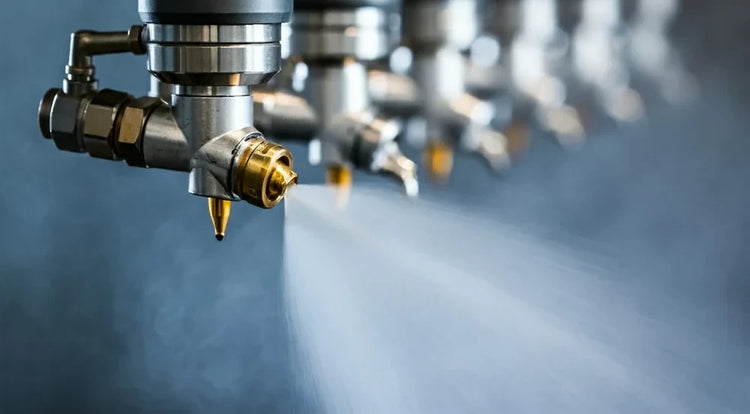
Industrial Spray Nozzles for Evaporation & Cooling
Fine-droplet evaporative cooling for cooling towers, adiabatic pre-cooling, outdoor industrial heat relief, data center supplemental cooling, NOx reduction pre-conditioning, turbine inlet air cooling, and humidification — governed by the wet-bulb temperature limit and psychrometric capacity of the ambient air
Evaporative cooling works by converting liquid water into water vapor, absorbing 2,257 kJ per kilogram of water evaporated as latent heat — removing heat from the air or surface without any refrigeration equipment. The practical limit of evaporative cooling is the wet-bulb temperature of the ambient air: a perfect evaporative cooler can reduce dry-bulb temperature to the wet-bulb temperature, but no further. In typical hot-dry climates where evaporative cooling is most effective, the wet-bulb depression (dry-bulb minus wet-bulb) is 10–20°C — meaning well-designed spray evaporative cooling can reduce ambient air temperature by 8–18°C. In humid climates, the wet-bulb depression shrinks to 3–8°C, limiting the achievable cooling.
This psychrometric limit is the most important concept for industrial evaporative cooling system design: nozzle specification, water injection rate, and system layout must all be designed around the available wet-bulb depression at the design ambient condition, not around an arbitrary target temperature. A system designed for a dry-climate installation will significantly underperform if relocated to a humid site without redesign. NozzlePro supplies fog/mist, hydraulic atomizing, hollow-cone, and full-cone nozzles for the full range of evaporative cooling applications — sized from the psychrometric available cooling duty, the required droplet evaporation rate in the available air residence time, and the water quality requirements of each application environment. ISO 9001 certified manufacturing.
Industrial evaporative cooling spray nozzles are selected based on the application, target air temperature reduction, and available ambient air conditions. Outdoor industrial heat relief and adiabatic pre-cooling (inlet air coolers, process air cooling): fog/mist nozzles at 15–100 PSI producing 10–50 µm droplets that evaporate completely in the ambient air without wetting surfaces or equipment downstream — complete evaporation before the cooled air reaches the protected equipment is essential. Cooling tower fill and drift eliminators: full-cone and hollow-cone nozzles for water distribution across tower fill media. Gas turbine inlet air cooling: hydraulic atomizing nozzles producing 10–30 µm droplets for inlet fogging — droplets must evaporate completely in the inlet duct before reaching the compressor to prevent blade erosion. Data center and server room supplemental cooling: fog/mist nozzles at 10–40 µm for adiabatic air cooling in precision cooling applications. NOx reduction water injection (SNCR pre-conditioning): air-atomizing for fine water mist into combustion gas to reduce gas temperature before NOx reduction reagent injection. Governing design rule: maximum water injection rate for complete evaporation = air mass flow rate × Cp_air × (T_drybulb − T_wetbulb) ÷ Latent heat of vaporization.
Psychrometrics and Evaporation Physics — The Governing Framework for Evaporative Cooling Design
Why the wet-bulb temperature and ambient humidity determine every specification decision in evaporative cooling systems
The Wet-Bulb Temperature and Maximum Achievable Cooling
Evaporative cooling is not simply "spraying water into air." The amount of cooling achievable is strictly limited by the air's current moisture content — specifically, by the wet-bulb depression (dry-bulb temperature minus wet-bulb temperature at the same location and time). The wet-bulb temperature represents the temperature to which air can be cooled at constant enthalpy by evaporating water into it — adding more water beyond saturation just creates fog that cannot evaporate, not additional cooling. The maximum water injection rate for complete evaporation: Q_water_max (kg/hr) = Air mass flow rate (kg/hr) × (Humidity ratio at saturation − Current humidity ratio) at the target outlet temperature, read from a psychrometric chart for the specific ambient conditions.
Practical evaporative cooling systems achieve 75–90% of the theoretical maximum cooling (wet-bulb depression) depending on contact time, droplet size, and system design. Droplet size is the key nozzle specification variable: smaller droplets have greater surface area per unit volume and evaporate faster, approaching closer to the wet-bulb temperature in a given air contact time. A 10 µm droplet evaporates approximately 100× faster than a 100 µm droplet in the same airstream — which is why fog/mist nozzles producing 10–50 µm droplets achieve near-complete evaporation in 1–3 seconds of air contact, while coarser sprays at 200+ µm may produce significant carryover of unevaporated water that wets surfaces and equipment.
For industrial evaporative cooling design: obtain the design ambient dry-bulb and wet-bulb temperatures for the installation location (use the ASHRAE design conditions for the site at the appropriate percentile — 0.4% or 1% dry-bulb for most industrial cooling applications). Calculate the wet-bulb depression at design conditions. This determines the maximum achievable cooling, which then drives the water injection rate, the nozzle selection, and the system layout. A system designed without a psychrometric analysis for the specific site will either be over-designed (wasting capital and water) or under-designed (failing to meet cooling targets on the hottest days when cooling is most needed).
Evaporative Cooling Applications
Seven applications — each using evaporative cooling for a distinct purpose with different performance requirements and nozzle specifications
Outdoor Industrial Heat Relief & Worker Safety Cooling
High-pressure fog systems in outdoor manufacturing yards, foundry and steel plant work areas, loading docks, and outdoor processing areas where reducing ambient air temperature by 8–15°C significantly reduces heat stress risk for outdoor workers. High-pressure fog nozzles at 40–100 bar (580–1,450 PSI) produce 10–20 µm droplets that flash-evaporate in the ambient air, cooling and humidifying without wetting workers or surfaces — the defining characteristic of high-pressure fog vs. standard misting systems. Standard low-pressure misting (below 10 bar) produces coarser droplets (50–200 µm) that create a wet mist sensation rather than true evaporative cooling. Systems must be sized for the design ambient wet-bulb depression — ineffective in high-humidity climates above approximately 80% RH where wet-bulb depression is insufficient.
Nozzle: High-pressure fog nozzles at 40–100 bar for true flash evaporation; 10–20 µm Dv50; 316L SS or brass body at food-grade or industrial specifications. Water filtration to 5-micron required to protect fine high-pressure orifices from mineral scale blockage.
Fog & Mist Nozzles →Gas Turbine Inlet Air Fogging
Evaporative cooling of gas turbine compressor inlet air to increase mass flow through the compressor and recover power output lost to high ambient temperature. Gas turbines lose approximately 0.5–0.8% of rated output per degree Celsius of compressor inlet temperature above the ISO reference condition (15°C). Inlet fogging recovers this power by cooling the inlet air toward the wet-bulb temperature before it enters the compressor. Critical design constraint: all water droplets must evaporate completely before reaching the first stage compressor blades — unevaporated water droplet impingement causes erosion of compressor blades and can cause surge in extreme cases. Droplet size must be below approximately 20 µm Dv90 for complete evaporation in the typical 2–5 second inlet duct residence time.
Nozzle: High-pressure hydraulic atomizing or fog nozzles producing less than 20 µm Dv90; demineralized water supply mandatory (mineral deposits on compressor blades from evaporation of hard water); water injection rate controlled to below 1% of compressor airflow mass; automated interlock prevents injection at ambient humidity above 95% RH.
Hydraulic Atomizing →Cooling Tower Water Distribution
Water distribution nozzles in mechanical draft, natural draft, and hybrid cooling towers — distributing hot process cooling water uniformly across the tower fill media for maximum air-water contact surface area and heat transfer efficiency. Cooling tower nozzles must distribute water evenly across the fill cross-section, produce the correct droplet size for the specific fill type, and resist the scaling and biological fouling that accumulates in recirculated cooling water. Drift eliminators above the distribution deck capture large droplets before they leave with the exhaust air. Nozzle plugging from calcium carbonate scale in hard cooling tower water is the primary operational maintenance challenge.
Nozzle: Full-cone or hollow-cone for uniform fill coverage; 316L SS for standard cooling tower water; PVC or polypropylene for chemically aggressive water or low-cost commodity replacement schedules. Nozzle spacing and flow rate calculated from tower cell area and design water loading (L/min/m²). Rotating deflector nozzles available for large-cell coverage from single nozzle positions.
Full-Cone Nozzles →Adiabatic Pre-Cooling for Air Compressors & Process Air Intakes
Evaporative pre-cooling of compressor inlet air reduces the specific power consumption of air compression — cooler inlet air is denser, so the compressor moves more mass per revolution, and cooler air requires less compression work per unit mass. A 10°C reduction in inlet air temperature reduces specific power consumption by approximately 3–5%. Adiabatic coolers (evaporative media or direct fog injection before the compressor intake) achieve this temperature reduction without refrigeration capital cost or operating power. Complete evaporation before the compressor intake is critical — water droplet ingestion causes corrosion, erosion, and valve damage in reciprocating compressors, and blade erosion in rotary screw and centrifugal compressors.
Nozzle: Fog/mist for direct injection systems; 10–30 µm Dv50 for complete evaporation before compressor intake; demineralized or softened water supply to prevent mineral deposits in compressor air passages; automated humidity interlock to prevent injection above design wet-bulb conditions.
Fog & Mist Nozzles →Process Humidification & Textile / Paper Conditioning
Controlled humidity addition to manufacturing environments — textile weaving operations where fiber strength and breakage depend on relative humidity (cotton: optimal 60–70% RH; wool: 65–75% RH), paper and printing where dimensional stability depends on moisture content, and pharmaceutical and electronics manufacturing clean rooms with humidity specification requirements. Unlike outdoor evaporative cooling, process humidification adds moisture to air without primarily targeting temperature reduction — though adiabatic saturation always produces some cooling. Hydraulic atomizing nozzles or air-atomizing nozzles supply fine water mist at controlled flow rates tied to humidity sensor feedback.
Nozzle: Hydraulic atomizing or air-atomizing for controlled fine mist; 20–60 µm Dv50 for complete evaporation before product contact; demineralized water supply mandatory — mineral residue from evaporation deposits on fabric, paper, or sensitive products. Automated flow control from humidity sensor feedback maintains target RH ±2–3%.
Hydraulic Atomizing →Combustion NOx Reduction Water Injection
Water injection into combustion air or combustion gas to reduce NOx formation — either as direct in-combustion injection that reduces peak flame temperature (thermal NOx reduction) or as pre-conditioning water injection before an SCR or SNCR system to bring gas temperature into the reagent injection window. Thermal NOx formation increases exponentially with peak flame temperature above approximately 1,400°C — fine water mist injection into the combustion air absorbs heat during evaporation, reducing peak flame temperature and suppressing thermal NOx formation by 30–70% depending on water-to-fuel ratio. Water-to-fuel ratio must be controlled precisely — too much water reduces combustion efficiency and increases CO emissions; too little provides insufficient NOx reduction.
Nozzle: Air-atomizing or high-pressure hydraulic atomizing for fine mist injection into combustion air; Hastelloy C-276 for contact with acid combustion gas; automated flow control from NOx analyzer feedback; deionized or demineralized water to prevent mineral deposits in combustion zone.
Fog & Mist Nozzles →Data Center & Server Room Supplemental Evaporative Cooling
Supplemental evaporative cooling for data center cooling systems during peak load or peak ambient temperature periods — reducing the inlet temperature of air-side economizer systems or supplementing mechanical cooling with adiabatic cooling to reduce chiller energy consumption. Indirect evaporative cooling using water spray on the heat exchanger water-side or direct fog injection into the economizer airstream. Precision water control is essential — data center electrical equipment is intolerant of any moisture ingestion, and the nozzle system must be designed with positive safeguards against water carryover under all operating conditions including nozzle system startup, humidity sensor failure, and unexpected ambient humidity increase.
Nozzle: High-pressure fog nozzles at 40–100 bar for true sub-20 µm flash evaporation; no carryover failsafe design required; 316L SS; demineralized water only; multiple humidity interlocks with conservative setpoints; redundant temperature monitoring at economizer exit to detect any wetbulb approach failure.
Fog & Mist Nozzles →Evaporative Cooling Nozzle Selection Reference
Application, nozzle type, ambient limit, droplet size target, body material, and key configuration notes
| Application | Nozzle Type | Operating Limit | Droplet Dv50 Target | Body Material | Key Configuration Notes |
|---|---|---|---|---|---|
| Outdoor Heat Relief / Area Cooling | High-Pressure Fog | Below ~80% RH for effective cooling | 10–20 µm | 316L SS or brass; high-pressure rated (40–100 bar) | Psychrometric sizing from design ambient dry-bulb and wet-bulb; 5-micron water filtration mandatory for orifice protection; nozzle spacing for uniform air coverage; automated shutoff above 85% RH when evaporation is insufficient for complete absorption; demineralized or softened water strongly recommended to prevent orifice scale |
| Gas Turbine Inlet Fogging | High-Pressure Hydraulic Atomizing | Dv90 below 20 µm mandatory | 8–15 µm | 316L SS; high-pressure rated to 140 bar | Demineralized water mandatory — mineral residue on compressor blades; injection rate below 1% of compressor air mass flow; automated shutdown at ambient RH above 95% and on compressor surge detection; droplet size verification required at commissioning; inlet manifold positioning upstream of inlet filter eliminates carryover risk |
| Cooling Tower Distribution | Full-Cone or Hollow-Cone | Continuous duty year-round | 500–2,000 µm (fill wetting) | 316L SS; PVC/PP for commodity replacement | Water loading (L/min/m²) and nozzle spacing calculated from tower cell area; rotating deflector available for large cell coverage; scale and biological fouling maintenance schedule; drift eliminator performance must meet local regulatory limit for PM2.5 from cooling tower drift; Legionella management program required for any open recirculating cooling tower |
| Compressor Inlet Adiabatic Pre-Cooling | Fog/Mist | Complete evaporation required before intake | 10–30 µm | 316L SS; high-pressure rated | Demineralized or softened water to prevent compressor passage deposits; water injection rate from psychrometric calculation at design ambient conditions; evaporation verification distance from injection point to intake; humidity interlock prevents injection above design wet-bulb; 3–5% specific power reduction per 10°C inlet temperature reduction achievable |
| Process Humidification (Textile / Paper) | Hydraulic Atomizing or Air-Atomizing | Target RH ± 2–3% | 20–60 µm | 316L SS; PVDF where chemistry requires | Demineralized water mandatory — mineral deposits on product; automated flow control from RH sensor feedback; nozzle positioning for complete evaporation before product zone; avoid direct spray on product surfaces; zoned control for large spaces with separate humidity setpoints per production zone; calibrated RH sensors at product level (not ceiling level) |
| NOx Reduction Water Injection | Air-Atomizing or High-Pressure Hydraulic | Water/fuel ratio 0.3–1.0 by mass | 20–60 µm | Hastelloy C-276 for acid combustion gas contact; 316L SS for clean combustion air injection | NOx reduction efficiency improves with finer droplet size and more complete evaporation before combustion zone; water/fuel ratio controlled from NOx analyzer output; excess water injection reduces combustion efficiency — monitor CO and combustion efficiency alongside NOx; deionized water to prevent mineral deposits in combustion zone; explosion-proof actuation where required by combustion system classification |
| Data Center Supplemental Cooling | High-Pressure Fog | Zero carryover tolerance | 8–15 µm | 316L SS; high-pressure rated to 100 bar | Zero carryover design with multiple independent safeguards; redundant humidity sensors; conservative humidity shutoff at 75–80% RH; air velocity monitoring to confirm evaporation before economizer exit; demineralized water (below 1 µS/cm conductivity) mandatory; nozzle system failsafe shutoff on any humidity sensor failure; documented verification testing before commissioning in proximity to electrical equipment |
| Industrial Greenhouse / Horticultural Cooling | Fog/Mist or Hollow-Cone | Leaf wetness limit per crop | 15–40 µm | 316L SS; UV-stabilized polymer for outdoor | Cooling target 3–8°C in greenhouse environment; droplets fine enough to remain airborne and not wet plant foliage directly (leaf wetness encourages fungal disease); zoned control per greenhouse section and crop type; fog system must cycle on and off to prevent humidity buildup to saturation; automated control from temperature and humidity sensors inside the crop zone |
Nozzle Types for Evaporative Cooling Applications
Four nozzle categories matched to required droplet size, operating pressure, and application constraints
High-Pressure Fog & Mist Nozzles
For true evaporative cooling applications requiring complete flash evaporation in ambient air — gas turbine inlet fogging, outdoor heat relief, data center supplemental cooling, and adiabatic compressor pre-cooling. High-pressure fog nozzles at 40–100 bar (580–1,450 PSI) produce 8–20 µm droplets that evaporate in 0.5–2 seconds in dry-bulb air above approximately 25°C. The extremely fine droplet size is the key specification parameter — at 10 µm Dv50, virtually all droplets evaporate completely before reaching surfaces; at 50 µm Dv50, a significant fraction of the water volume is in droplets that may not evaporate and will wet downstream surfaces. Water filtration to 5 microns and water quality (DI or softened) are non-negotiable for high-pressure fog systems because orifice plugging from mineral scale is the primary operational failure mode at these fine orifice diameters.
Shop Fog & Mist NozzlesHydraulic Atomizing Nozzles
For controlled-environment evaporative cooling at moderate pressure (40–200 PSI) — process humidification, indoor cooling zones, and applications where compressed air is not available but finer droplets than standard fog/mist at low pressure are needed. Hydraulic atomizing nozzles produce 30–80 µm Dv50 at standard pressures — coarser than high-pressure fog but finer than hollow-cone at equivalent pressure, and with no compressed air requirement. For gas turbine inlet fogging at very fine droplet specifications: high-pressure hydraulic atomizing at 100–140 bar produces sub-20 µm Dv50 required for compressor blade protection. The consistent droplet size distribution from hydraulic atomizing nozzles provides repeatable evaporation performance across the full operating pressure range, making them appropriate for humidity-controlled applications where ±2–3% RH accuracy is required.
Shop Hydraulic AtomizingFull-Cone & Hollow-Cone Nozzles
For cooling tower water distribution, evaporative condenser coverage, and large-area water distribution applications where complete evaporation of all water is not the design goal — instead, the water contacts fill media or a heat exchanger surface and falls to the tower sump. These coarser-droplet nozzles (500–2,000 µm for fill wetting) are appropriate where the spray is directed at fill media, heat exchanger coils, or another surface rather than into free air where fine evaporation is required. Full-cone for uniform circular fill coverage; hollow-cone where the ring pattern provides superior fill surface wetting coverage at the tower periphery. Rotating deflector designs for large-cell cooling towers from single nozzle positions without the complex manifold required by fixed multi-nozzle headers.
Shop Full-Cone NozzlesAir-Atomizing Nozzles
For NOx reduction water injection into combustion air or gas, and for process humidification where precisely controlled very fine droplets (20–50 µm) are needed without the high-pressure pump infrastructure of high-pressure fog systems. Air-atomizing nozzles use compressed air (2–6 bar) to produce fine droplets at low water supply pressure — useful where process air is available and high-pressure pump installation is impractical. Also used in process humidification for aggressive chemistry environments (pH-adjusted water, acid mist suppression by alkali atomization) where PVDF body construction is required. The air-water ratio is adjustable to tune droplet size across a range — increasing air-to-water ratio produces finer droplets at the same flow rate.
Shop Fog & Mist NozzlesEvaporative Cooling System Design Principles
Five parameters that determine whether an evaporative cooling system achieves target temperature reduction without wetting downstream equipment
- Always Design from the Psychrometric Chart — The Wet-Bulb Temperature Is the Absolute Upper Bound on Achievable Cooling — Evaporative cooling cannot reduce air temperature below the wet-bulb temperature regardless of water quantity, droplet size, or contact time — additional water beyond the saturation point simply creates fog carryover without additional cooling. The design process for any evaporative cooling installation: (1) obtain the 0.4% or 1% design dry-bulb temperature for the site (ASHRAE Fundamentals, Table 2 for the nearest weather station); (2) obtain the concurrent wet-bulb temperature at the design dry-bulb condition; (3) calculate wet-bulb depression = dry-bulb minus wet-bulb; (4) multiply by 0.80–0.85 (achievable fraction of theoretical maximum) to estimate achievable temperature reduction; (5) calculate the water injection rate for this temperature reduction from the air mass flow rate and psychrometric data. Systems installed without this site-specific analysis frequently either fail to meet performance expectations at design conditions or inject excess water that creates carryover and wetting failures.
- Water Quality Is the Single Most Frequent Operational Failure Cause in Fine-Orifice Evaporative Cooling Systems — High-pressure fog nozzles producing 10–20 µm droplets have orifice diameters in the range of 0.1–0.3 mm — small enough that even 10 ppm of dissolved calcium carbonate in the water supply will deposit visible scale on the orifice face within days of operation in a hot, dry environment where evaporation concentration is high. The mineral deposit narrows the orifice, increases flow resistance, changes the spray angle, and increases droplet size — all of which degrade cooling performance. Water treatment requirements for fine fog systems: deionized water (below 5 µS/cm conductivity) or reverse-osmosis water for gas turbine inlet fogging and data center cooling; softened water (below 50 ppm CaCO₃ hardness) for outdoor industrial cooling systems where DI water cost is prohibitive; upstream filtration to 5 microns minimum for all high-pressure fog systems regardless of water quality. Document the water quality specification in the system commissioning record and test incoming supply water quality at installation and monthly thereafter.
- The Evaporation Distance from Nozzle to Protected Equipment Must Be Calculated, Not Assumed — Evaporative cooling system designers frequently position nozzles based on aesthetic or mechanical convenience rather than the evaporation distance calculation for their specific droplet size and ambient conditions. A 20 µm droplet in 35°C, 30% RH air evaporates completely in approximately 0.5–1.0 seconds; at an air velocity of 3 m/s, this corresponds to 1.5–3.0 meters of travel before complete evaporation. Any surface or protected equipment within this distance of a nozzle will be wetted by incompletely evaporated droplets — including compressor inlets, electrical cabinets, control panels, and motor enclosures. Minimum evaporation distance must be calculated for the specific droplet size at the site's design conditions, with a safety margin for calm air conditions where droplet residence time in the spray zone is longer than at design air velocity. The most common high-pressure fog system installation failure: fog nozzles positioned too close to wall-mounted electrical equipment within the building or outdoor area being cooled.
- Humidity Interlocks Are Required on All Evaporative Cooling Systems Near Electrical Equipment or Sensitive Processes — When ambient relative humidity rises above approximately 80–85%, the wet-bulb depression shrinks to the point where injected water cannot fully evaporate in the available air residence time at design spray rate. Continuing to inject water at the standard rate under these conditions creates carryover — wet fog that wets surfaces, equipment, and products instead of cooling the air. Humidity interlocks automatically shut off water injection when ambient RH exceeds a set threshold (typically 80–85% for outdoor systems, 75% for systems near sensitive equipment). The interlock must respond to actual ambient conditions at the nozzle array location, not at a remote weather station — local microclimatic humidity can vary significantly from regional measurements. For data center and electrical equipment applications: the interlock threshold should be set conservatively at 75% RH with a minimum 15-minute delay before re-enabling after humidity drops below threshold to avoid cycling that produces intermittent wetting.
- Cooling Tower Legionella Management Is a Regulatory and Public Health Obligation, Not a Maintenance Preference — Open recirculating cooling towers create conditions favorable for Legionella pneumophila growth — warm water (25–45°C), organic nutrients from system corrosion and biological growth, and aerosol generation from tower drift. Legionnaires' disease outbreaks have been directly traced to cooling tower drift in multiple high-profile industrial and commercial incidents. Legionella management programs for cooling towers include: maintenance of cooling water biocide concentrations (typically oxidizing biocide: free chlorine 1–3 ppm, or bromine equivalent); pH control at 7.5–8.0; regular physical cleaning and inspection of tower internals; drift eliminator maintenance to meet regulatory drift emission limits; and documented water quality testing at minimum monthly frequency. NozzlePro supplies cooling tower distribution nozzles and drift eliminator nozzle assemblies as hardware components — Legionella management is a water treatment and operational program that must be managed by a qualified water treatment professional on a continuous basis. Nozzle replacement and maintenance are part of the physical inspection program.
Evaporative Cooling Applications by Industry
Six industries using spray evaporative cooling for air temperature reduction, humidity control, and process conditioning
Power Generation
Gas turbine inlet fogging for peak power recovery; cooling tower water distribution for condenser cooling; steam condenser vacuum improvement with evaporative pre-cooling; dry cooling tower fog augmentation during peak ambient temperatures. Sub-20 µm droplets for compressor blade protection; demineralized water supply mandatory for turbine applications.
Chemical & Petrochemical
Process air compressor inlet cooling for energy savings; heat exchanger evaporative pre-cooling to extend cooling capacity without additional heat exchanger area; cooling tower operations for process heat rejection; NOx reduction water injection in process furnaces. Site psychrometric analysis required for design basis.
Textile & Paper Manufacturing
Controlled humidity addition to maintain fiber moisture content for strength and processing characteristics; paper moisture conditioning for dimensional stability; printing press humidity control for substrate registration. Demineralized water mandatory for product-adjacent humidification. Automated RH sensor control for ±2–3% accuracy.
Food Production & Agriculture
Greenhouse temperature and humidity control for crop growth; outdoor livestock cooling; post-harvest cold room pre-cooling; food processing facility ambient temperature control. Food-contact nozzle materials where spray contacts product or product-contact surfaces. Legionella management for any recirculating cooling water system.
Data Centers & Technology
Air-side economizer supplemental cooling; adiabatic cooling to reduce mechanical chiller operating hours; server room ambient temperature control during peak load. Zero carryover design with redundant safety interlocks. Demineralized water below 1 µS/cm. Conservative humidity shutoff setpoints for electrical equipment protection.
Steel & Heavy Industry
Outdoor worker heat stress reduction in rolling mills, foundries, and steel yards; equipment cooling for outdoor motors and transformers; scrap yard and bulk handling area heat relief. Standard outdoor fog systems at 40–100 bar; 316L SS for industrial durability; automated shutoff at high humidity or high wind that disrupts spray pattern.
Nozzle Material Selection for Evaporative Cooling Applications
Water quality, operating pressure, and environment determine the correct body and seal materials
316L SS — High-Pressure Body
Standard for high-pressure fog systems (40–100 bar), cooling tower distribution, and outdoor industrial evaporative cooling. Superior corrosion resistance in outdoor environments including coastal and industrial atmospheres. Pressure-rated construction for high-pressure fog service. NSF 61 listed grades available for potable water and food-adjacent applications.
Use for: Outdoor heat relief fog, gas turbine inlet fogging, cooling tower distribution, process humidification with DI or softened water supplyBrass / Bronze
Traditional material for low-to-medium pressure outdoor misting systems (below 10 bar) where cost and corrosion resistance in potable water are acceptable. Not suitable for demineralized water contact — DI water leaches zinc and copper from brass alloys, creating metallic contamination of the spray and gradual dezincification of the nozzle body. Not appropriate for food-adjacent or potable water applications due to lead content in some brass alloys.
Use for: Standard outdoor misting systems with municipal water supply; low-pressure landscape and outdoor comfort cooling; verify lead-free brass where required by NSF 61 or local codesPVDF (Kynar) Body
For evaporative cooling applications where the spray medium is chemically aggressive — acid mist suppression (alkali water spray in acid environments), aggressive cleaning chemistry humidification, or applications requiring zero metallic contamination of the spray. Maximum pressure rating approximately 150 PSI — verify against system operating pressure before specifying for high-pressure applications.
Use for: Acid environment humidification; chemically aggressive spray media; zero metallic contamination applications; food-grade requirements where metallic body leaching is a concernHastelloy C-276
For NOx reduction water injection into acid combustion gas; any evaporative cooling application where the spray medium or surrounding gas contains HCl, SO₂, HF, or other corrosive acids that attack 316L SS. Higher cost than 316L but required where corrosive gas surrounds the nozzle injection point even if the injected water itself is clean.
Required for: NOx reduction injection in acid flue gas environments; any injection lance positioned in acid-containing combustion or process gas regardless of injected water qualityEvaporative Cooling System Troubleshooting
Four common performance and operational failures in industrial evaporative cooling spray systems
System Failing to Achieve Target Temperature Reduction
Symptom: Measured air temperature at cooling target zone is consistently above the design temperature reduction target; performance degraded from initial commissioning values Likely cause: Ambient humidity higher than design basis; nozzle orifice scale reducing flow and increasing droplet size; or water injection rate below design from supply pressure dropFirst check: measure ambient wet-bulb temperature during poor performance episodes — if the wet-bulb depression at the time of poor performance is below the design wet-bulb depression, the system is performing correctly at the ambient conditions and the limitation is psychrometric rather than mechanical. If wet-bulb depression is adequate: check nozzle flow rates individually by collecting flow from each nozzle at operating pressure. Orifice scale from hard water reduces flow 10–30% before visible blockage is detectable. Clean or replace scaled nozzle orifices; upgrade water treatment to prevent recurrence. If flow is correct: verify water injection rate against psychrometric calculation for current ambient conditions and adjust flow control setpoint. Systems sized for extreme design conditions may underperform at moderate temperatures because they are not injecting the full design water rate — verify that the control system is commanding maximum injection during the performance shortfall events.
Water Wetting Downstream Equipment or Surfaces
Symptom: Water droplets or wet streaks visible on equipment, walls, or products in the cooling zone; moisture damage to electrical equipment; wet product or surfaces Likely cause: Ambient humidity above effective evaporation threshold; nozzle orifice scale producing coarser droplets that fail to evaporate; or injection rate above evaporative capacity at current conditionsImmediately reduce injection rate and check ambient RH — if humidity is above 80%, the humidity interlock should have shut the system off. If interlock failed to activate: check humidity sensor calibration and verify interlock setpoint is appropriately conservative. If humidity is below 80%: check nozzle droplet size by inspection — scaled orifices produce a visible streaky spray pattern instead of uniform fine fog. Clean or replace scaled nozzles with freshly cleaned sets. If both humidity and nozzle condition are correct: reduce total injection rate to 75% of previous setting and monitor for recurrence — the system may have been running at the boundary of evaporative capacity without a sufficient safety margin for operating condition variability.
Rapid Nozzle Orifice Scaling in Hard Water Service
Symptom: Performance degradation within days to weeks of installation or cleaning; white mineral deposits visible on nozzle orifice faces; nozzle flow rate declining progressively Likely cause: Elevated dissolved calcium or magnesium in water supply (above 50–100 ppm CaCO₃ equivalent); elevated water temperature concentrating mineral precipitation at nozzle tip during operationMeasure water hardness with test kit — if above 50 ppm CaCO₃, mineral scale is the confirmed cause. Short-term: clean scaled nozzles by soaking in 10% citric acid solution for 20–30 minutes, then flush with clean water. Long-term: install a water softener upstream (for outdoor systems where DI cost is prohibitive) or upgrade to RO/DI supply (for precision systems). For outdoor systems operating at high temperatures: the concentration factor effect is most severe in extremely hot, dry conditions where the nozzle tip temperature allows some mineral precipitation even at softened water concentrations — increase cleaning frequency during peak season and install 5-micron filtration if not already present. Document nozzle cleaning dates and compare to water quality data to quantify the relationship between water hardness and cleaning interval for the specific site conditions.
Uneven Cooling — Hot Spots Within Cooling Zone
Symptom: Some areas within the cooling zone are achieving target temperature reduction; other areas remain at near-ambient temperature; uneven cooling performance across the coverage area Likely cause: Uneven nozzle spacing leaving coverage gaps; individual blocked nozzles creating uncooled zones; or airflow patterns carrying cooled air away from hot-spot locations before it reaches workers or equipmentMap cooling performance by measuring dry-bulb temperature at a grid of points across the cooling zone simultaneously — identify specific hot-spot locations relative to nozzle positions. If hot spots correspond to blocked nozzle positions: clean or replace the affected nozzles. If hot spots are in areas between nozzle positions: reduce nozzle spacing or add nozzle positions to eliminate coverage gaps. If hot spots do not correlate with nozzle arrangement: the issue is airflow-driven — prevailing wind or mechanical ventilation is carrying cooled air away before it reaches the hot-spot zone. Reposition nozzles upwind of the hot spot or install an enclosure or directional baffle that keeps cooled air within the target zone. For worker cooling in large open areas: cooled air rises as it warms from ground-level body heat — position nozzles at worker breathing zone height (1.5–2 m) rather than at ceiling level where cooled air pools without reaching workers.
Why Specify NozzlePro for Evaporative Cooling?
Psychrometric-based sizing, high-pressure fog options, and consistent replacement droplet size
Sized from Psychrometrics and Site Conditions — Not from Catalog Flow Rate
Evaporative cooling systems sized without a psychrometric analysis for the installation site fail predictably: either insufficient cooling on the hottest days when performance matters most, or excess water injection that creates wetting at moderate humidity conditions. NozzlePro application engineers calculate the design water injection rate from your site's ASHRAE design dry-bulb and wet-bulb temperatures, your air flow rate, and the target temperature reduction — then specify the nozzle type, orifice size, operating pressure, nozzle spacing, and humidity interlock setpoint for a system that achieves the design performance while staying below the evaporative capacity limit at all ambient conditions.
High-Pressure Fog Options: High-pressure fog nozzles at 40–100 bar in 316L SS and Hastelloy C-276 for gas turbine inlet fogging, outdoor industrial heat relief, and data center supplemental cooling. Available in standard manifold configurations for multi-nozzle fog arrays.
Consistent Replacement Droplet Size: ISO 9001 certified manufacturing maintains orifice geometry within specification — replacement nozzle sets produce the same droplet size distribution as the commissioned system, preserving the evaporation performance and carryover safety margin validated at installation.
Frequently Asked Questions
Common questions about spray nozzle selection for evaporation and cooling applications
How much cooling can I expect from an evaporative cooling system?
Achievable cooling depends entirely on the ambient conditions at your specific location and time — specifically, the wet-bulb depression (dry-bulb temperature minus wet-bulb temperature) at the design ambient condition. A high-quality evaporative cooling system achieves 80–90% of the theoretical maximum, which is the wet-bulb depression. In Phoenix, Arizona at summer design conditions (43°C dry-bulb, 21°C wet-bulb): wet-bulb depression = 22°C; achievable cooling = 0.85 × 22 = ~19°C. In Houston, Texas at summer design conditions (35°C dry-bulb, 27°C wet-bulb): wet-bulb depression = 8°C; achievable cooling = 0.85 × 8 = ~7°C. In Miami, Florida at summer design conditions (33°C dry-bulb, 28°C wet-bulb): wet-bulb depression = 5°C; achievable cooling = 0.85 × 5 = ~4°C. This explains why evaporative cooling is standard in the US Southwest and Middle East, effective but limited in the US Southeast, and ineffective in tropical humid climates. Always obtain ASHRAE design conditions (0.4% summer dry-bulb and coincident wet-bulb) for your specific city and installation before designing or purchasing an evaporative cooling system — vendor claims of specific temperature reductions without reference to ambient conditions are not design specifications.
Why does gas turbine inlet fogging require demineralized water?
Gas turbine inlet fogging injects water as a fine mist (8–20 µm droplets) into the compressor inlet airstream. When these droplets evaporate in the inlet duct and inside the compressor, the dissolved minerals they carry are deposited on the compressor inlet guide vanes, first-stage compressor blades, and inlet filter elements as a thin mineral film. Even at very low dissolved solids concentrations — 50 ppm CaCO₃, typical of moderately soft municipal water — continuous fog injection at a 200 MW turbine's design fog rate (approximately 3,000–8,000 L/hour) deposits several kilograms of mineral scale per week on the compressor internals. Mineral scale on compressor blades increases blade surface roughness and reduces compressor efficiency — partially or fully negating the power recovery benefit of inlet cooling. At more severe scale buildup, scale deposits can detach as particles that cause erosion of downstream blades. Demineralized water (RO/DI water, below 1–5 µS/cm conductivity and below 0.5 ppm TDS) prevents mineral deposition entirely — the water evaporates without leaving any solid residue. For large gas turbines: the demineralized water system capital cost (RO membrane system for a major peaking plant) is typically recovered in less than 2 years from the additional power revenue enabled by inlet fogging. Municipal tap water or cooling tower makeup water is not acceptable for gas turbine inlet fogging regardless of softener treatment — softened water still contains sodium ions that can cause sodium sulfate hot corrosion of turbine hot section components if carried through to the combustion zone.
What is the difference between high-pressure fog and standard misting?
The fundamental difference is droplet size, which determines whether the system produces true evaporative cooling or a cooling-by-wetting sensation. High-pressure fog systems operate at 40–100 bar (580–1,450 PSI) and produce 8–20 µm droplets that flash-evaporate completely in the ambient air within 0.5–2 seconds — you walk through the fog and feel cool air, not wet skin. Standard low-pressure misting systems operate at 3–10 bar (45–145 PSI) and produce 50–200 µm droplets that evaporate much more slowly — you feel cooled by the water evaporating from your skin and clothing rather than by pre-cooled air reaching you. For industrial applications: high-pressure fog is required when wetting of equipment, product, or surfaces is unacceptable — gas turbine inlets, data centers, textile manufacturing, outdoor electrical equipment cooling. Standard misting is acceptable for outdoor worker comfort, livestock cooling, and dust suppression where surface wetting is tolerable or even beneficial. The capital cost difference is significant: high-pressure fog systems require a high-pressure pump (40–100 bar rated) and stainless steel high-pressure tubing, compared to standard misting systems that use a household-pressure pump or municipal supply pressure. For applications requiring true evaporative cooling (temperature reduction of air rather than cooling by contact wetness), high-pressure fog is the correct specification — standard misting cannot achieve complete droplet evaporation in ambient air and will wet surfaces in the spray zone.
How do I calculate the water injection rate for an evaporative cooling system?
The water injection rate for complete evaporation is calculated from the psychrometric properties of the air being cooled: Water injection rate (kg/hr) = Air mass flow rate (kg/hr) × (Humidity ratio at target outlet state − Humidity ratio at inlet state). The humidity ratio values are read from a psychrometric chart for the inlet dry-bulb temperature and wet-bulb temperature (or relative humidity), and for the target outlet dry-bulb temperature. For a simplified approximation: Water rate (kg/hr) ≈ Air mass flow rate (kg/hr) × Cp_air (1.006 kJ/kg·K) × ΔT (°C) ÷ Latent heat (2,257 kJ/kg) × Efficiency factor (0.85). Example: 50,000 kg/hr air flow, 10°C target temperature reduction, 85% system efficiency: Water rate = 50,000 × 1.006 × 10 ÷ 2,257 ÷ 0.85 = 262 kg/hr (about 262 L/hr). This must not exceed the maximum evaporable quantity at the design ambient conditions — operating above this rate creates carryover. For air volume in m³/hr: convert to mass flow by multiplying by air density (approximately 1.16 kg/m³ at 30°C). The exact calculation requires psychrometric chart analysis for the specific inlet conditions — NozzlePro provides a complete psychrometric-based sizing from your site design ambient conditions, target temperature reduction, and air flow rate or volume to cool.
Why does an evaporative cooling system need a humidity interlock?
When ambient relative humidity rises above approximately 80–85%, the air is already close to saturation — there is little remaining capacity to absorb additional water vapor. Water injected into near-saturated air cannot evaporate rapidly enough to remain as fine droplets; instead, the injected water persists as liquid droplets that are carried by the airstream and deposit on surfaces, equipment, and people downwind of the spray. This is the opposite of the intended effect: instead of cooling the air by evaporation, the system is now wetting surfaces with fine water. For systems near electrical equipment (motors, panels, switchgear), this wetting creates shock and short-circuit hazards. For systems near sensitive products (textiles, electronics, paper), it creates moisture damage. For gas turbine inlet fogging: unevaporated water at the compressor inlet causes compressor blade erosion. The humidity interlock automatically shuts off water injection when ambient RH exceeds the setpoint (typically 80% for outdoor systems, 75% for systems near sensitive equipment) — preventing injection under conditions where complete evaporation cannot occur. Interlock response time must be fast relative to humidity changes — industrial humidity sensors typically have 10–30 second response time; the interlock setpoint should include a 5–10% RH safety margin below the true carryover threshold to allow sensor response time without overshoot into the wetting range.
What water quality is required for process humidification in textile manufacturing?
Process humidification in textile manufacturing requires demineralized or deionized water for any fog or mist system that injects water into the air in the manufacturing zone. The reason: as the fine mist droplets evaporate in the mill air, dissolved minerals in the water are deposited on the fabric, fiber, machinery, and flooring as a fine white mineral dust. In weaving and knitting operations, mineral deposits on the fiber surface alter the fiber's coefficient of friction against the loom reed, heddles, and yarn guides — causing increased thread breakage rates and loom stops that reduce productivity. Mineral deposits on the machinery accumulate and cause bearing wear and corrosion over time. The mineral deposition rate is directly proportional to water hardness: water at 200 ppm CaCO₃ hardness deposits 200 mg of mineral solids per liter of water evaporated. A textile mill requiring 500 L/hr of humidification with 200 ppm hard water deposits 100 grams per hour of mineral dust continuously throughout the mill — visible on machinery and fabric within weeks. RO or DI water (below 5 µS/cm conductivity) eliminates mineral deposition entirely. Water softening reduces hardness to 0–20 ppm CaCO₃, significantly reducing but not eliminating deposition — RO or DI is the correct specification for product-quality-critical textile applications. Verify with your yarn or fiber supplier whether any specific conductivity limit applies to the humidification water chemistry for your specific product certification requirements.
Get Evaporative Cooling Nozzle Specifications from Your Site Conditions
Provide your site location (or ASHRAE design dry-bulb and wet-bulb temperatures), air flow rate or volume to cool, target temperature reduction, application type, and any carryover sensitivity constraints — our application engineers calculate water injection rate, nozzle type, droplet size, spacing, operating pressure, and humidity interlock setpoint for your specific installation.