
Spray Systems for Dairy
Bottling, Capping & Conveyor Lubrication
High-speed dairy bottling lines running at 400–1,200 bottles per minute require spray precision that general-purpose industrial nozzles cannot provide — peroxyacetic acid sanitizing mist applied to packaging film in exactly 50–150 µm droplets (fine enough to wet the film without pooling that dilutes the sanitizer), conveyor chain lubrication at 0.5–2 mL/min per nozzle position (enough to prevent chain wear without the wet floor that causes bottle tipping and worker slip hazards), and cap-top rinsing that removes the residual dairy film from HDPE bottle caps without carrying liquid into the capper mechanism. Each of these requires a different nozzle type, flow rate, and activation timing — which is why dairy bottling lines typically require four to six different nozzle specifications across the line.
Dairy bottling and packaging lines use three primary nozzle types for three distinct functions: air-atomizing nozzles for producing fine sanitizing mist from peroxyacetic acid (PAA) or sodium hypochlorite on packaging film and conveyor surfaces; flat-fan or full-cone low-flow nozzles for conveyor chain and slat lubrication; and flat-fan rinsing nozzles for cap-top and bottle exterior washing. Each application requires a different droplet size, flow rate, and activation logic — and all nozzles on the line must be fabricated from 316L SS or materials approved under FDA 21 CFR Part 178 for indirect food contact.
The air-atomizing nozzle is the most critical device on the line for food safety: it applies the PAA sanitizing agent to packaging film in droplets fine enough (Dv90 50–150 µm) to provide complete film wetting without liquid pooling that would dilute the effective sanitizer concentration. PAA at 100–200 ppm is an FDA 21 CFR 178.1010 approved no-rinse sanitizer for indirect food contact surfaces — but only when applied at the correct droplet size, concentration, and contact time. An atomizing nozzle that produces droplets larger than 200 µm fails to wet the film surface uniformly; one that produces droplets smaller than 30 µm has insufficient mass to make consistent contact with the film before the airflow around the line carries them away.
Air-Atomizing Mist, Chain Lube, and Cap Rinse: Three Different Nozzle Problems
PAA Sanitizing Mist — Packaging Film & Conveyors
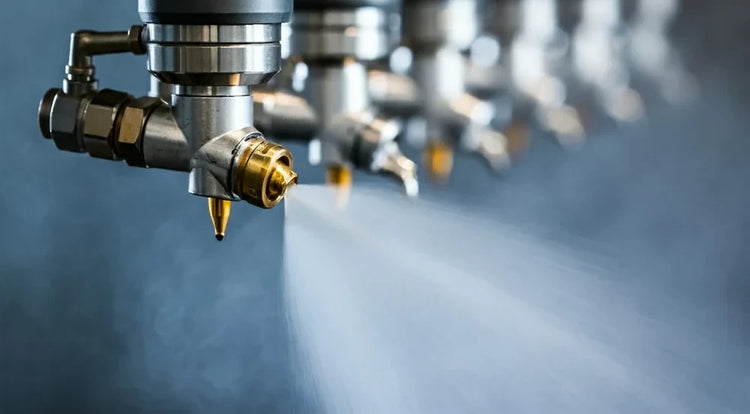
Air-atomizing nozzles — 50–150 µm Dv90 — 100–200 ppm PAAAir-atomizing nozzles apply a fine, even mist of peroxyacetic acid sanitizer to packaging film, HDPE bottle preforms, conveyor belt surfaces, and cap-handling equipment at the correct droplet size for complete surface wetting without liquid pooling.
Conveyor Chain Lubrication — Wet-Lube or Dry-Lube Application
Low-flow flat-fan — 0.5–2 mL/min — prevents bottle tippingDairy bottling conveyors running at 400–1,200 BPM develop significant chain wear without lubrication, and the lubricant application rate directly controls whether the conveyor surface is slippery enough to prevent bottle tipping (too dry) or wet enough to create a fall hazard for workers and a slip condition for bottles (too wet).
Key Parameters for Dairy Bottling and Packaging Spray Systems
High-Speed Lines Need Spray Precision Tighter Than the Bottle Pitch.
Contact NozzlePro with your line speed, conveyor type, PAA system design, and nozzle position layout. We specify the complete bottling line spray system — mist, lube, and rinse positions.