
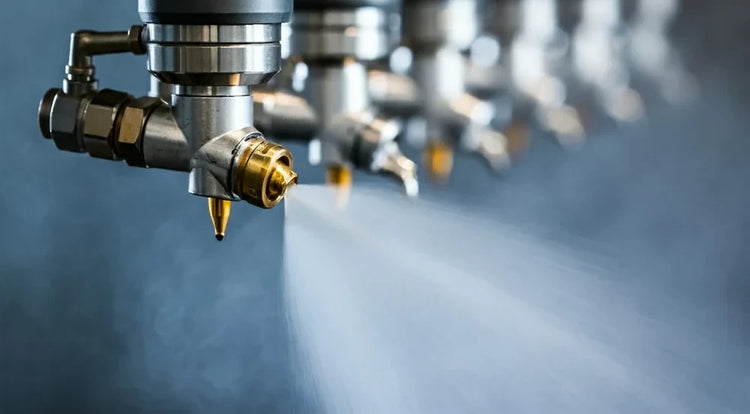
Spray Nozzles for
Pulp, Paper & Tissue Manufacturing
Precision spray solutions for pulp preparation, forming and press sections, dryer moisture profiling, coating and sizing, tissue converting, and mill utilities — engineered for continuous operation at 200–1,200 m/min machine speeds in the high-abrasion, high-corrosion environments of modern paper mills.

Pulp, paper, and tissue manufacturing uses spray nozzles across six major application areas. Pulp preparation uses flat-fan shower bars for screen and disc filter washing, rotary jet cleaners for chest and vessel CIP, and full-cone nozzles for chemical dosing and mixing. Forming and press sections uses flat-fan nozzles for wire showers and sheet edge control, high-pressure impact nozzles (40–80 bar) for felt conditioning and roll cleaning, and oscillating shower systems for uniform felt coverage. Dryer section and moisture control uses fog/mist nozzles for rewet and moisture profiling, full-cone for cylinder cooling, and humidification systems for sheet property stabilization. Coating and sizing uses flat-fan for starch and size press application, hydraulic atomizing for functional coating, and hollow-cone for release agent laydown on Yankee cylinders. Tissue converting uses hydraulic atomizing for laminating adhesive, fine mist for dust control at cutters and winders, and high-pressure flat-fan for conveyor washdown. Utilities and wear-resistant service uses tungsten carbide or ceramic orifice inserts in all abrasive white water positions — standard stainless orifices require replacement every 2–4 weeks in stock prep service versus 3–6 months for TC inserts.
Paper Mill Spray Applications
Nozzle recommendations by application area — matched to machine position, media characteristics, and operating conditions.
Pulp Preparation
- Chest & Vessel CIP: Rotary jet devices for pulp chests, towers, and storage tanks
- Screen & Disc Filter Showers: Flat-Fan bars for uniform washing of screen baskets and disc filter sectors
- Chemical Dosing & Mixing: Full-Cone for volumetric distribution of bleaching chemicals and additives
- Debarking & Log Prep: High-Pressure for bark and debris removal
- TC or ceramic inserts required in abrasive stock and white water contact positions
Forming (Wire) & Press Section
- Wire Showers & Edge Control: Flat-Fan shower bars for uniform sheet formation and wire cleaning
- Felt Conditioning & Cleaning: High-Pressure oscillating jets at 40–80 bar for felt permeability restoration
- Roll Cleaning: High-pressure flat-fan for press roll and suction box cleaning
- Lubrication & Conditioning: Low-flow dosing nozzles for roll surface lubrication
- Spray angle 25°–50° for oscillating showers; 65°–80° for stationary bars with full overlap
Dryer Section & Moisture Profiling
- Moisture Profiling & Rewet: Fog & Mist for fine-droplet controlled rewet across the CD profile
- Cylinder & Frame Cooling: Full-Cone for uniform temperature management across dryer cans
- Dryer Room Humidification: Humidification systems to stabilize sheet RH and reduce tension breaks
- Trim Squirt & Edge Moistening: Narrow-angle flat-fan (15°–25°) for precise edge moisture control
Coating, Sizing & Surface Treatment
- Starch & Size Press: Flat-Fan for uniform film and controlled edge build
- Barrier & Functional Coatings: Hydraulic Atomizing for tight droplet spectrum and controlled coat weight
- Release Agents & Anti-Stick: Hollow-Cone for light, even laydown on Yankee cylinders
- Coating Headers: Flow-matched flat-fan headers for ±2% coat weight uniformity across machine width
Tissue Converting & Packaging
- Emboss & Laminate Adhesives: Hydraulic Atomizing for precise, low-waste glue pattern application
- Dust Control at Cutters & Winders: Fine Mist to agglomerate airborne tissue dust at slitter stations
- Fragrance / Lotion Application: Hydraulic Atomizing for fine, even application without over-wetting the sheet
- Conveyor & Frame Washdown: High-Impact Flat-Fan for belt and equipment sanitation between runs
- Sanitation: Disinfection nozzles for hygienic zones in packaging areas
Utilities, Sumps & Wear-Resistant Service
- Sump & Tank Cleaning: Rotary jet devices sized for vessel diameter and white water soil load
- Abrasive White Water: Tungsten Carbide and ceramic inserts — stainless orifices wear in weeks in stock prep service
- Bleaching Chemical Service: PTFE or PVDF bodies with Hastelloy or titanium internals for ClO₂, H₂O₂, and caustic environments
- Foam Knockdown: Full-Cone at low pressure for gentle foam collapse without re-aerating stock

Paper Machine Shower Bar Nozzle Reference
Recommended nozzle type, spray angle range, and key design constraint by shower bar position — matched to machine-specific operating parameters.
| Shower Position | Nozzle Type | Typical Spray Angle | Key Design Constraint |
|---|---|---|---|
| Wire / Forming Fabric — Top Shower | Flat-Fan | 25°–40° (oscillating) | Full wire width coverage; 100–150% overlap at wire surface; oscillation frequency matched to machine speed |
| Wire — High-Pressure Cleaning Shower | Flat-Fan HP | 15°–25° (oscillating) | 40–80 bar operating pressure; TC tips required for long service intervals; oscillate across full wire width |
| Felt — Conditioning Shower | Flat-Fan | 40°–65° (stationary) | Uniform coverage across felt width; match flow to felt permeability requirements; avoid over-wetting press nip zones |
| Felt — High-Pressure Cleaning | HP Oscillating | 15° (oscillating) | 40–80 bar; TC orifice inserts mandatory; oscillation speed determines cleaning band overlap — too slow creates groove wear tracks on felt |
| Moisture Profiling (Rewet) | Fog & Mist | Array — zoned across CD width | Individual zone control for cross-direction moisture profile correction; droplet size for controlled surface rewet without sheet disturbance |
| Starch / Size Press Application | Flat-Fan | 65°–110° (stationary header) | Flow-matched across header length to ±2%; uniform film at size press nip; starch concentration and temperature affect viscosity and nozzle selection |
| Trim Squirt / Edge Moistening | Flat-Fan narrow | 15°–25° | Positioned close to sheet edge; precise flow control to moisten edges without pooling onto the dry sheet surface |
| Yankee / Dryer Can — Release Agent | Hollow-Cone | 60°–80° | Even, thin laydown of creping adhesive or release agent across full Yankee width; verify nozzle flow vs. viscosity at operating temperature |
Paper Mill Nozzle Selection Principles
Five engineering factors that determine correct nozzle specification for paper machine and mill applications — each one accounts for a failure mode that catalog selection misses.
- Felt Cleaner Oscillation Speed Is a Critical Variable — Not Just Nozzle Selection — High-pressure felt cleaning nozzle performance depends as much on the oscillation system as on the nozzle itself. If the oscillator traverses too slowly, the concentrated high-pressure jet creates groove wear tracks in the felt needling — permanently damaging felt structure and reducing service life. If it oscillates too quickly, the cleaning band doesn't fully overlap and dry strips form across the felt width, reducing felt permeability. The correct oscillation speed is calculated from the nozzle spray angle, standoff distance, and required overlap ratio at the felt surface — and must be re-verified when machine speed changes.
- White Water Abrasion Makes TC Inserts Mandatory in Many Positions — Paper mill white water carries filler particles (calcium carbonate, kaolin, titanium dioxide) in constant circulation through the short loop. These fillers are highly abrasive at the velocities found in shower bar nozzle orifices. Standard 316L stainless orifices in continuous white water service can require replacement every 2–4 weeks; TC inserts in the same positions typically last 3–6 months or longer. Given that a paper machine shower bar may contain 50–200 nozzle positions, the labor cost of stainless orifice replacement alone justifies the TC premium across most shower bar applications.
- Moisture Profiling Resolution Depends on Nozzle Zone Width and Response Time — Cross-direction (CD) moisture profile control in the dryer section requires fog/mist nozzle manifolds divided into individually controlled zones across the machine width. Profile correction resolution is determined by the width of each spray zone and the degree of spray overlap between adjacent zones. Narrower zones provide better resolution but require more nozzle positions and control valves. Fog droplet size must produce surface rewet without sheet disturbance — droplets that are too coarse add visible water spots; droplets that are too fine evaporate before reaching the sheet at typical dryer hood standoff distances.
- Bleaching Chemical Service Requires Material Specification Beyond Stainless — Pulp bleaching sequences use chlorine dioxide (ClO₂), hydrogen peroxide (H₂O₂), sodium hydroxide, and other compounds that attack 316L stainless by different corrosion mechanisms. ClO₂ and concentrated H₂O₂ cause oxidative corrosion that pits stainless surfaces; caustic at high temperatures can cause stress corrosion cracking. Nozzle body and seal materials for bleach plant service require PTFE or PVDF body nozzles with Hastelloy C-276 or titanium internals. Verify material selection against both the bleaching chemical and the wash water chemistry at each stage.
- Coating Header Flow-Matching Is a Product Quality Specification — In starch size press and coating application headers, nozzle-to-nozzle flow variation directly produces coat weight variation in the cross-direction profile of the finished sheet. Coat weight CV above ±2–3% typically falls outside specification for printing and writing grades. Flow-matching all nozzles in a coating header to within ±1% of the design flow rate at operating pressure is a product quality requirement. Replace the full header set simultaneously — installing a mix of worn and new nozzles creates worse CD profile variation than a uniformly worn set.
Paper Machine Application Engineering
Machine-Specific Specification. Flow-Matched Sets. Mill-Grade Materials.
Paper machine spray systems are process equipment — nozzle performance directly affects sheet quality, felt service life, moisture profile uniformity, and coating coat weight distribution. NozzlePro application engineers specify shower bar nozzles with the machine-specific parameters required: machine width, operating speed, standoff distances, oscillation system specifications, and white water chemistry. Generic catalog selection produces generic results on a machine where every specification matters.
Wear-Resistant for Mill Conditions: Tungsten carbide orifice inserts in flat-fan, high-pressure, and full-cone configurations for all white water and stock prep positions. PTFE/PVDF body nozzles with Hastelloy or titanium internals for bleach plant service. Complete material specification based on the specific white water chemistry, filler content, and cleaning chemical program at your mill.
Flow-Matched Shower Bar Sets: All orifices in a replacement shower bar set verified to within ±1% of design flow at operating pressure before shipment. Replace full bars simultaneously with matched sets rather than individual positions — mixed worn and new nozzles create flow imbalance across the shower width that produces CD profile variation.
ISO 9001 Manufacturing: Consistent orifice dimensions, verified material grades, and batch traceability on every order.
Paper Mill Spray Specification at a Glance
Key Parameters by Machine Position
Frequently Asked Questions
Common questions about spray nozzles for pulp, paper, and tissue manufacturing.
Wire and felt shower bar clogging is caused by two distinct mechanisms requiring different solutions. Fiber and filler buildup in the nozzle orifice requires upstream inline strainers at each bar connection point — 40–80 mesh depending on the filler particle size in your white water — combined with a periodic back-flush cycle during grade changes or machine stops. Scale buildup from hard white water requires periodic acid cleaning — frequency determined by your white water calcium hardness. For abrasive carryover that accelerates orifice wear and changes the spray pattern over time, specify tungsten carbide orifice inserts rather than stainless — TC maintains consistent spray pattern and flow rate through the full maintenance interval rather than drifting as the orifice enlarges.
For oscillating shower bars, spray angles of 25°–50° are standard — narrower angles provide more focused cleaning impact; wider angles provide more coverage per pass but reduce impact energy. The critical parameter is achieving 100–150% overlap at the wire or felt surface across the full oscillation sweep. For stationary shower bars, wider angles of 65°–110° are typical to cover the full machine width with fewer nozzle positions — calculate nozzle spacing from spray angle and standoff to achieve consistent overlap without gaps or double-coverage zones. For trim squirt and edge moistening applications, narrow angles of 15°–25° positioned close to the sheet edge provide precise application without splashing onto the dry sheet surface.
Fog/mist nozzles in individually controlled cross-direction (CD) zones are standard for moisture profiling rewet systems. The nozzle produces fine droplets that add moisture to the sheet surface without mechanical disturbance — droplet size must be matched to the standoff distance and hood airflow to ensure droplets reach the sheet surface before evaporating, without being coarse enough to create visible water marks. Each CD zone is controlled by an individual valve responding to the sheet moisture scanner — zone width determines profile resolution. For humidity control of the dryer room air, humidification nozzle systems maintain the relative humidity set point in the dryer hood and machine room, reducing tension breaks associated with RH fluctuation during weather changes.
Bleach plant nozzle material selection depends on the specific stage chemistry. For chlorine dioxide (ClO₂) and concentrated hydrogen peroxide (H₂O₂) stages, PTFE or PVDF body nozzles with Hastelloy C-276 or titanium internals are required — both chemicals cause oxidative corrosion that attacks 316L stainless rapidly. For caustic extraction stages at elevated temperatures, 316L stainless is adequate at moderate temperatures; Hastelloy or duplex stainless for high-temperature caustic service. PTFE seals throughout the bleach plant — standard EPDM seals degrade rapidly in oxidizing bleach environments. Always verify both the body material and the seal material against the specific chemical at the operating concentration and temperature; bleach plant conditions vary significantly between mills.
Three changes reduce water and chemical consumption in size press and coating application: switch to hydraulic atomizing nozzles if not already using them — hydraulic atomizing produces a tighter droplet spectrum that deposits more precisely on the sheet surface with less overspray and bounce-off; flow-match the full header set to within ±1% so every nozzle position applies the design coat weight — CD profile variation from mismatched nozzles forces the average coat weight above target to eliminate undercoated zones, wasting chemical; and verify operating pressure at the nozzle manifold inlet is at the design value — pressure drop across supply piping often causes operators to compensate by increasing pump pressure and flow rate rather than fixing the piping system.
Inspect shower bar nozzles monthly in high-wear abrasive stock prep and white water positions; replace when measured flow at operating pressure increases more than 10% above the rated value, or when the spray pattern shows visible distortion, streaking, or dry strips. In high-pressure felt cleaning positions operating at 40–80 bar, inspect more frequently — nozzle condition at this pressure has a larger impact on felt service life than at low-pressure positions. Replace the full bar set simultaneously rather than individual nozzles — mixed worn and new nozzles create flow imbalance across the bar that produces felt coverage variation. Tungsten carbide orifice inserts extend inspection intervals 5–10× versus stainless and are cost-effective in virtually all paper machine shower positions given the labor cost of frequent stainless replacement across large multi-nozzle bars.
Talk with a NozzlePro Paper Mill Specialist.
Share your machine width, shower position, white water chemistry, operating pressure, and current nozzle type — we'll specify the right shower bar nozzle with flow-matched sets and material verification for your mill conditions.