
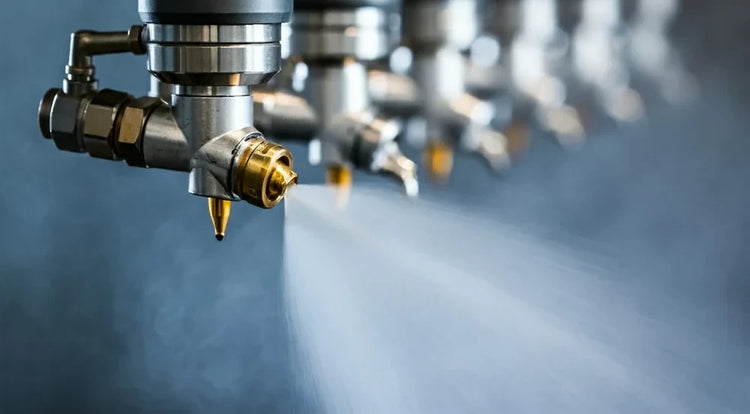
Spray Nozzles for
Coating & Surface Treatment
Precision nozzles for uniform film application — oils, resins, glazes, lubricants, release agents, and protective coatings across steel, food, engineered wood, automotive, and building materials — sized to your viscosity, target coat weight, and line speed, not pulled from a generic catalog page.

Industrial coating and surface treatment applications use different spray nozzle types depending on the fluid and required film characteristics. Flat-fan nozzles handle uniform edge-to-edge film application on strip, sheet, and conveyor lines. Hydraulic atomizing nozzles control fine droplet size at low coat weights and thin films. Air-atomizing nozzles use compressed air to atomize viscous coatings, resins, and adhesives across a wide viscosity range. Full-cone nozzles provide volumetric coverage of 3D components and complex profiles. Hollow-cone nozzles apply release agents and other low coat weight films with minimal impingement. Fog and mist nozzles handle humidity conditioning and surface moisture before coating. Selection depends on fluid viscosity, target coat weight, line speed, stand-off distance, and chemical compatibility.
Coating & Surface Treatment Applications
Application-specific nozzle recommendations matched to your coating material and process objective — every collection link goes directly to the relevant NozzlePro products.
Steel Strip & Metal Oiling
Rolling mills, stamping lines, and coil coating operations Recommended Nozzles- Edge-to-Edge Coverage: Flat-Fan headers for full strip width
- Thin-Film Applications: Hydraulic Atomizing for low coat weight lubrication
- Stainless or tungsten carbide orifices for abrasive emulsions
- Consistent film thickness across full width is the critical constraint for corrosion protection and forming performance
Food Coating
Bakery, confectionery, and packaged food production lines Recommended Nozzles- Glaze & Egg Wash Bars: Flat-Fan for uniform surface coverage
- Fine Oil Misting: Hydraulic Atomizing at low flow rates
- Proofing Conditioning: Fog & Mist for humidity control
- 316L stainless with crevice-free design and FDA-compliant elastomers for food-contact-adjacent service
Engineered Wood — Resins & Release Agents
MDF, OSB, particleboard, and plywood manufacturing Recommended Nozzles- Resin Distribution: Flat-Fan bars for uniform coverage across mats
- Release Agent Misting: Hollow-Cone or Air-Atomizing
- Tungsten Carbide and ceramic orifice inserts for abrasion resistance in resin-laden, dusty environments
- Coat weight control directly affects panel bond strength and press cycle efficiency
Automotive — Forming Lube & Protective Coatings
Stamping lines, underbody protection, and part coating Recommended Nozzles- Stamping Lube: Flat-Fan and Hydraulic Atomizing
- 3D Body Components: Full-Cone for volumetric coverage
- Underbody Sealants: Air-Atomizing for viscous materials
- Precise, repeatable delivery protects tooling without over-application that contaminates downstream operations
Building Materials — Protective & Functional Coatings
Roofing, insulation boards, concrete products, and building panels Recommended Nozzles- Membranes & Sealers: Flat-Fan for uniform application
- Fire Retardant Coatings: Air-Atomizing for viscous formulations
- Concrete Forming Release Agents: Hollow-Cone
- Applications span light waterproofing films to multi-layer protective systems
Chemical & Industrial Protective Coatings
Barrier coatings and functional surface treatment for equipment, piping, and structures Recommended Nozzles- Multi-Component Coatings: Air-Atomizing for reactive systems
- High-Solids Systems: Paint & Viscous nozzles
- Chemically resistant body and orifice materials matched to primer, epoxy, or polyurethane chemistry
- Applications range from light corrosion inhibitor films to multi-layer coating systems
Nozzle Selection & Material Reference Guide
Match coating material and film requirement to nozzle type — every recommendation carries a verified engineering rationale, not a catalog default.
| Nozzle Type | Best Coating Applications | Material Considerations | Key Advantage |
|---|---|---|---|
| Flat-Fan | Steel strip oiling, bakery glaze and egg wash bars, adhesive application, conveyor coating lines | 316L SS standard; brass for general industrial | Precise edge control; overlapping headers deliver uniform film across full width |
| Hydraulic Atomizing | Thin films and low coat weights, MQL lubrication, primer application, fine oil misting | 316L SS or brass body | Controlled droplet size at low flow rates; precise coat weight with minimal overspray |
| Air-Atomizing | Viscous coatings, resins, adhesives, and release agents requiring fine atomization | Stainless body; PTFE seals for solvent exposure | Greatest droplet size control across a wide viscosity range; adjustable via air/liquid ratio |
| Full-Cone | 3D component coating, complex profiles, volumetric coverage applications | 316L SS or engineered polymer | Even liquid distribution across a circular area; good for irregular geometries |
| Hollow-Cone | Release agents, anti-stick coatings, low coat weight applications | 316L SS or PVDF for chemical exposure | Light, even droplet ring pattern; minimizes impingement on sensitive surfaces |
| Fog & Mist | Humidity conditioning in baking environments, surface moisture before coating, mold release misting | 316L SS standard | Ultra-fine droplets for surface conditioning without visible liquid accumulation |
| Paint & Viscous | High-viscosity paints, adhesives, sealants, and specialty coatings | Hardened orifice inserts for filled or pigmented systems | Designed orifice geometry handles elevated viscosities without pulsing or clogging |
Coating manifold sizing starts with three numbers: target coat weight in grams per square meter, line speed in meters per minute, and web or surface width. Together these define the total fluid flow rate your manifold needs to deliver — everything else follows from that figure.
Divide total flow by nozzle count to get the flow rate each nozzle must deliver, then select an orifice size that produces that flow at a pressure appropriate for your fluid's viscosity. Stand-off distance sets spray width per nozzle; nozzle spacing is set so adjacent spray widths overlap by 10–30%, depending on how flat the individual nozzle's distribution curve is. Getting the overlap wrong is the most common cause of visible coat weight banding across a web.
NozzlePro application engineers work through this calculation from your coat weight, line speed, and web width before recommending a nozzle model and manifold configuration — this is not a catalog selection exercise.
Nozzle Selection Principles for Coating & Surface Treatment
Six process variables that determine correct nozzle type and sizing — each one accounts for a failure mode that catalog selection ignores.
- Fluid Viscosity Drives Nozzle Type — Water-thin fluids (1–10 cP) work with most hydraulic nozzles. Medium viscosity (10–500 cP) often needs hydraulic atomizing or flat-fan with a larger orifice. High-viscosity materials (above 500 cP) typically require air-atomizing nozzles or dedicated viscous material nozzles, sometimes with heated fluid systems to bring viscosity into a workable range.
- Target Coat Weight Sets Required Flow Rate — Coat weight in grams per square meter sets the flow rate needed per unit area at your line speed. Orifice size and operating pressure are then selected to match that flow rate at the correct spray width and stand-off distance. Under- or over-sized orifices are the most common cause of coat weight variation across a run.
- Line Speed Reduces Available Dwell Time — Higher line speeds reduce the time a nozzle has to deposit material on each unit area of surface. At high speeds, flow rate must increase proportionally or additional nozzle zones must be added. Stand-off distance and spray angle interact with line speed to determine effective spray width per nozzle.
- Stand-Off Distance Shapes Spray Width and Impact — The distance between nozzle tip and target affects spray width, impact force, droplet velocity at impact, and evaporation. Reducing stand-off narrows the spray and increases impact; increasing it widens coverage but risks drift and evaporation losses, especially with fine droplets in air-atomizing systems.
- Coverage Overlap Determines Manifold Uniformity — For manifold coating systems, individual nozzle spray widths must overlap correctly to achieve uniform coat weight across the full web or surface. Overlap typically runs 10–30% of nozzle spacing, depending on how flat the nozzle's distribution curve is. Flat-fan nozzles are the easiest pattern to array for uniform coverage.
- Chemical and Temperature Compatibility Determines Material — Nozzle body, orifice, and seal materials must be compatible with your coating fluid and any solvents, catalysts, or cleaning agents used in the process. High-temperature applications require metal body nozzles; abrasive pigments or fillers require hardened orifice materials such as ceramic or tungsten carbide.
Application Engineering — Not Just a Catalog
Verified Sizing. Calculated Coat Weight. Line-Ready Configuration.
Coating nozzle selection requires understanding the interaction between fluid properties, line parameters, and spray characteristics — not just picking a catalog item. NozzlePro application engineers work through your coating parameters and provide flow rate data and spray distribution guidance to support your line commissioning and quality validation.
Broad Nozzle Range: Flat-fan, hydraulic atomizing, air-atomizing, full-cone, hollow-cone, fog/mist, and dedicated paint and viscous material nozzles — all available for coating applications across food, industrial, and specialty environments.
Material Expertise: 316L stainless steel with electropolished finishes for food-contact-adjacent coating lines, brass and engineered polymer options for general industrial use, and tungsten carbide or ceramic orifice inserts for abrasive coatings and high-wear applications — specified based on verified compatibility with your fluid, not default recommendations.
ISO 9001 Manufacturing: Consistent orifice dimensions and verified material grades on every order.
Coating & Surface Treatment Spray Specification at a Glance
Key Parameters by Application
Frequently Asked Questions
Common questions about spray nozzles for coating and surface treatment.
Flat-fan nozzles arrayed in a manifold header are the standard choice for uniform film coating on moving webs, strip, and conveyor lines. They produce a controlled fan-shaped spray with a relatively flat distribution curve, which makes them easy to overlap for full-width coverage. Nozzle spacing, stand-off distance, operating pressure, spray angle, and orifice size all need to be matched to your target coat weight and line speed. Hydraulic atomizing nozzles are preferred when coat weights are very low or when fine droplet size is needed to minimize impingement effects.
Overspray reduction comes from several levers: right-sizing orifice diameter to the required flow rate at the lowest pressure that maintains pattern integrity, minimizing stand-off distance to reduce drift (especially with fine droplets), and synchronizing nozzle on/off gating with line start and stop events. Hydraulic atomizing nozzles at minimum operating pressure produce larger droplets with less drift tendency than higher-pressure operation. Air-atomizing nozzles offer the most droplet size control and can meaningfully reduce overspray compared to hydraulic nozzles for viscous materials.
In many cases, yes — provided the nozzle body and seal materials are chemically compatible with both coating systems. 316L stainless steel bodies are compatible with most water-based and many solvent-based coatings. The critical check is the seal: EPDM and silicone have limited resistance to aromatic and ketone solvents, while PTFE and Viton offer broader solvent resistance. Verify seal compatibility against your specific solvent chemistry before switching fluid types on the same nozzle.
For coating fluids containing abrasive particles, fillers, or pigments, hardened orifice materials are essential to maintain accurate flow rates and pattern quality over time. Tungsten carbide orifice inserts provide the highest wear resistance and are preferred for heavily loaded abrasive systems. Ceramic inserts offer good wear resistance at lower cost for moderate abrasion levels. Standard stainless orifices enlarge progressively in abrasive service, causing flow rate creep and pattern distortion — the orifice, not the body material, is what matters most for abrasion resistance.
Start with your required coat weight in grams per square meter, line speed in meters per minute, and web or surface width. These define the total fluid flow rate needed per meter of width. Divide by nozzle count per meter to get individual nozzle flow rate, then select an orifice size that delivers that flow at an appropriate pressure for your fluid viscosity. Stand-off distance sets spray width per nozzle; spacing is then set so adjacent spray widths overlap 10–30%. NozzlePro application engineers can work through this calculation with your specific parameters.
Hydraulic atomizing nozzles use fluid pressure alone to break the liquid into droplets — simpler, no compressed air needed, and effective for low-to-medium viscosity fluids at moderate coat weights. Air-atomizing nozzles use compressed air to atomize the liquid, giving much greater control over droplet size across a wider viscosity range and allowing very low coat weights with fine, consistent droplets. Air-atomizing is preferred for high-viscosity coatings or applications where droplet uniformity is critical, though it requires a compressed air supply and runs at higher operating cost.
Ready to Optimize Your Coating Process?
Share your fluid viscosity, target coat weight, line speed, stand-off distance, and coverage width — we'll size the nozzle, calculate flow rates, and recommend materials.