
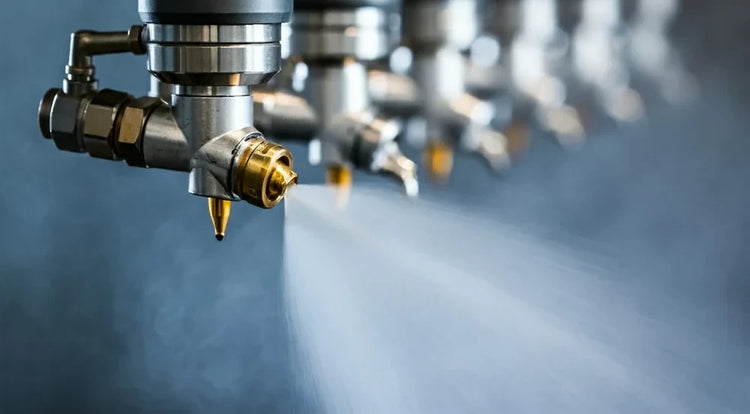
Spray Nozzles for
Mining Operations
Durable, high-performance spray solutions for dust suppression, ore washing, slurry handling, equipment cooling, wastewater evaporation, and conveyor maintenance in surface and underground mining operations — with wear-resistant TC and ceramic orifice options for abrasive mineral slurry service.

Mining operations use spray nozzles across five major application categories. Dust suppression at crushers, transfer points, haul roads, and stockpiles uses fog/mist nozzles producing 10–100 µm droplets that agglomerate with airborne PM10 and PM2.5 particles, with full-cone nozzles for higher-volume suppression at open areas. Ore washing and screening uses high-impact flat-fan nozzles across screen decks and trommel apertures to remove clays and fines, with full-cone for wash box coverage. Cooling and evaporation uses full-cone for ore and slag cooling, fog/mist for evaporative equipment cooling in hot zones, and air-atomizing nozzles for wastewater pond evaporation. Conveyor and belt cleaning uses flat-fan nozzle manifolds for edge-to-edge belt washing plus high-pressure jets for stubborn carryback. Abrasive slurry service requires tungsten carbide or ceramic orifice inserts in all positions — standard stainless steel orifices wear within days to weeks in continuous mineral slurry contact.
Dust Suppression
Crushers, transfer points, haul roads, stockpiles, and underground headings

Fog & Mist Nozzles for PM10 and PM2.5 Control
Effective airborne dust agglomeration in mining requires droplets sized to collide with and capture airborne mineral particles — typically 10–100 µm for fine respirable dust. Droplets above 200 µm fall to the floor before contacting the dust cloud. Fog/mist arrays positioned at the dust generation point — not aimed directly at the source — create a suspended droplet curtain that airborne particles pass through and agglomerate with before settling.
At crushers and impact points where coarser dust is also generated, a two-nozzle strategy is effective: fog/mist for fine PM10 agglomeration plus full-cone for wetting coarser particles and suppressing dust from the material pile below the impact zone. Haul road dust suppression uses full-cone or flat-fan nozzles on water trucks or fixed manifolds sized to the road width and vehicle speed.
- Fog/mist nozzles for fine (PM10/PM2.5) airborne particle agglomeration
- Full-cone for volumetric suppression at high-throughput transfer and crushing points
- Strainers required upstream of all fog nozzles — orifices 0.3–0.8 mm clog rapidly without filtration
- Wind speed is the primary sizing constraint — fog systems ineffective above 10–15 km/h without enclosure
Ore Washing & Slurry Handling
Screens, trommels, wash boxes, and slurry transfer — high-impact washing with wear-resistant orifices
High-Impact Flat-Fan for Screens and Trommels
Ore washing on vibrating screens and trommels removes clays, fines, and gangue that reduce recovery rates and blind screen apertures. High-impact flat-fan nozzles mounted in manifold bars across the full deck width deliver the energy needed to break clay bonds and displace fine material through the apertures — lower-impact nozzles wet the ore surface without dislodging adhered fines.
Abrasive mineral slurry in washing circuits destroys standard stainless steel orifices within days. Tungsten carbide orifice inserts in standard flat-fan or high-pressure body configurations provide 5–10× longer service life in the same abrasive ore washing service. Size orifices to minimize jet velocity while maintaining required impact — abrasive wear scales with velocity squared.
- Flat-fan manifold bars for full-width screen deck coverage
- High-pressure jets for stubborn clay layers on coarse ore fractions
- TC or ceramic orifice inserts required in abrasive ore slurry service
- Full-cone for wash box and trough coverage where uniform wetting is the objective

Cooling & Wastewater Evaporation
Ore and slag cooling, equipment thermal management, and tailings pond evaporation

Full-Cone for Ore Cooling, Air-Atomizing for Evaporation
Ore and slag cooling after processing uses full-cone nozzles for uniform volumetric water application across the material pile or conveyor load. The full-cone pattern ensures complete surface wetting at the required application rate without excessive localized water addition that would increase downstream handling burden.
Tailings pond and process wastewater evaporation uses air-atomizing nozzles to produce ultra-fine droplets (10–50 µm) that maximize the water surface area exposed to the atmosphere and accelerate evaporative loss. Mine wastewater frequently contains high dissolved mineral solids (TDS) and may be acidic — both accelerate nozzle orifice scaling and corrosion. Establish maintenance intervals based on measured flow rate deviation at operating pressure; replace or descale nozzles before orifice restriction reduces evaporation performance below the permitted pond management rate.
- Full-cone for ore, slag, and conveyor load cooling
- Fog/mist for equipment ambient cooling in hot zones
- Air-atomizing for wastewater evaporation — ultra-fine droplets maximize evaporation rate
- 316L SS or alloy material for high-TDS mining wastewater service
Belt & Conveyor Cleaning
Carryback removal, belt washing, and equipment cleaning across material handling systems
Edge-to-Edge Coverage for Belt Washing
Conveyor carryback — ore, coal, or mineral fines adhering to the return side of the belt — accumulates under conveyors, damages rollers, creates slip hazards, and represents real product loss. Flat-fan nozzle manifold bars positioned at the head pulley on the return strand provide full-width belt coverage; the water dislodges surface fines and lubricates the belt-scraper interface to improve mechanical scraper performance.
High-pressure jets are added ahead of the wash bar for stubborn carryback — cohesive clay-mineral mixtures that washing alone cannot dislodge. Equipment cleaning at conveyor transfer chutes, hoppers, and crusher housings uses high-pressure flat-fan or solid-stream nozzles to blast buildup without requiring manual confined-space access.
- Flat-fan manifold bars for full belt-width carryback washing
- High-pressure jets for cohesive clay and sticky mineral carryback
- Nozzle positions and angles calculated from belt width and standoff
- TC tips where abrasive wash water contains returned mineral fines

Water Conservation & Operational Efficiency
Right-sizing nozzle flow, pressure, and droplet size to reduce water and operating costs

Nozzle Selection Is Water Management
In large mining operations, dust suppression and ore washing systems can consume millions of liters of water per day. Nozzle selection directly determines water consumption — an oversized orifice that delivers 20% more flow than the application requires wastes that water continuously, 24 hours a day, 365 days a year. Across a large operation with hundreds of nozzle positions, this margin compounds into significant water and pumping cost.
Right-sizing starts with the application requirement: what droplet size, what impact energy, what coverage area, and what application rate does the objective actually require? The nozzle is then selected to meet that requirement at operating pressure — not oversized for margin. Fog systems for dust suppression in particular are frequently oversized, delivering droplets that fall immediately rather than remaining suspended, wasting water without improving dust capture.
Mining Spray Nozzle Selection Reference
Match application to nozzle type, orifice material, and key design constraint — all in one reference.
| Application | Recommended Nozzle | Orifice Material | Key Design Constraint |
|---|---|---|---|
| Crusher Dust Suppression | Fog & Mist + Full-Cone | 316L SS; filtration required upstream | Droplets 10–100 µm for PM10 agglomeration; wind speed limits fog effectiveness above 10–15 km/h |
| Transfer Point Suppression | Fog & Mist | 316L SS with 40–80 mesh upstream strainer | Position nozzle curtain in dust travel path — not aimed directly at the source; enclose where possible |
| Haul Road Suppression | Full-Cone, Flat-Fan | 316L SS; TC tips for high-sediment water | Application rate sized to road surface material and vehicle speed; avoid over-wetting that causes mud |
| Ore Screen Washing | Flat-Fan high-impact | Tungsten carbide required for abrasive ore | Full deck-width coverage; nozzle spacing from spray angle and standoff to cover every aperture row |
| Wash Box / Trough | Full-Cone | TC or ceramic for mineral slurry contact | Uniform volumetric coverage; avoid dead zones at edges and corners |
| Ore / Slag Cooling | Full-Cone | 316L SS; alloy if water is acidic or high-TDS | Uniform application rate across conveyor width; avoid localized over-wetting |
| Wastewater / Tailings Evaporation | Air-Atomizing | 316L SS or Hastelloy for high-TDS / acidic mine water | Ultra-fine droplets (10–50 µm) for maximum surface area; scale buildup management for high-mineral water |
| Belt & Conveyor Washing | Flat-Fan + High-Pressure | TC tips where wash water carries mineral fines | Full belt-width coverage; position on return strand at head pulley; HP jets for stubborn carryback |
Mining Spray Nozzle Selection Principles
Five engineering factors that determine correct nozzle specification in mining environments — each describes a failure mode with direct consequences for dust compliance, process efficiency, or operating cost.
- Abrasive Orifice Wear Is the Primary Failure Mode — TC Is Required — Mining spray systems handle mineral-laden water, ore washing slurry, and dust-laden air that contains fine abrasive particles. Standard 316L stainless steel orifices in ore washing and slurry contact positions wear measurably within days in continuous service, enlarging the orifice, increasing flow rate above design, and distorting the spray pattern. Tungsten carbide orifice inserts are required in all positions where the spray water contains suspended mineral particles above approximately 100 ppm solids by weight. Ceramic inserts offer similar hardness with additional corrosion resistance for acid mine drainage service. Both reduce wear rate 5–10× relative to stainless in equivalent abrasive service.
- Dust Suppression Droplet Sizing Is the Governing Design Variable — The effectiveness of a fog dust suppression system is almost entirely determined by droplet size relative to the dust particle size. Droplets much larger than the dust particles settle before intercepting the dust cloud — they wet the floor, not the air. For mineral mining dust (PM10, particle diameter 1–10 µm), fog droplets in the 10–100 µm range provide the best capture efficiency. Wind speed above 10–15 km/h disperses fog droplets and renders fixed fog systems ineffective without enclosures — this is the primary site constraint for fog dust suppression design.
- Conveyor Wash Bar Design Determines Carryback Removal Effectiveness — Belt carryback removal depends on three factors: adequate water volume and impact energy to dislodge the adhered material, correct nozzle positioning on the return strand before the mechanical scraper, and full belt-width coverage without gaps at the edges. Flat-fan nozzles in a manifold bar spaced for 20–30% overlap at the belt surface provide the uniform coverage required. Gaps create unwashed lanes that bypass the scraper and accumulate under the conveyor. High-pressure supplementary jets at the belt edges, where carryback accumulates preferentially, improve edge zone cleaning.
- Wastewater Evaporation Requires Ultra-Fine Droplets and Scale Management — Tailings pond and process wastewater evaporation efficiency is proportional to the total water surface area created by the nozzle spray. Air-atomizing nozzles producing 10–50 µm droplets create orders of magnitude more surface area per unit volume than hydraulic nozzles at equivalent flow rate, proportionally increasing evaporation rate. Mine wastewater frequently contains high dissolved mineral solids and may be acidic — both accelerate nozzle orifice scaling and corrosion. Establish maintenance intervals based on measured flow rate deviation at operating pressure; replace or descale nozzles before orifice restriction reduces evaporation performance below the permitted pond management rate.
- Filtration Is Not Optional for Fog and Fine-Mist Systems — Fog/mist nozzles for dust suppression have orifice diameters of 0.3–0.8 mm — far smaller than the particle sizes present in typical mining site water supplies (bore water, recycled process water, pond water). A single passage of unfiltered water can permanently clog a fog nozzle orifice. 40–80 mesh inline strainers are required on every fog and fine-mist nozzle position. Strainer maintenance schedule should be based on the observed plugging rate from initial operation — in high-turbidity water supplies, daily strainer cleaning may be required. Without adequate filtration, fog dust suppression systems fail within hours of commissioning and never achieve designed performance.
From Pit to Plant — One Source for All Mining Spray Applications
Abrasion-Resistant Options. Application Engineering. Maintenance Planning Support.
Mining spray systems span multiple disciplines — environmental compliance (dust emissions), process efficiency (ore washing), safety (equipment cooling and fire suppression), and water management (wastewater evaporation). NozzlePro supplies nozzles for all these applications from a single source, simplifying procurement and ensuring consistent engineering support across the operation.
Wear-Resistant for Mining Service: Tungsten carbide orifice inserts in flat-fan, full-cone, and high-pressure body configurations for all abrasive mineral slurry positions. Ceramic inserts for high-abrasion plus corrosive acid mine drainage service. Every material recommendation is based on the specific ore type, water chemistry, and operating pressure.
Dust Suppression Engineering: Fog system nozzle sizing with droplet spectrum selection matched to your specific dust particle size distribution, site wind conditions, and enclosure geometry. Application engineers familiar with PM10/PM2.5 regulatory compliance requirements and the specific design constraints of underground versus open-pit dust suppression environments.
Maintenance Planning Support: Wear rate data and replacement interval guidance for TC and ceramic orifice inserts in your specific ore washing and slurry service, to support predictive maintenance scheduling and spare parts inventory planning.
ISO 9001 Manufacturing: Consistent orifice dimensions, material grade verification, and batch traceability — critical for large multi-nozzle mining arrays where replacing nozzles one at a time creates flow imbalance across the header.
Mining Spray Specification at a Glance
Key Parameters by Application
Frequently Asked Questions
Common questions about spray nozzles for mining dust suppression, ore washing, and equipment maintenance.
A two-pattern strategy works best at crushers and high-energy transfer points: fog/mist nozzles (10–100 µm droplets) positioned to create a suspended droplet curtain in the dust travel path for fine PM10 agglomeration, combined with full-cone nozzles below the impact zone to wet coarser particles and suppress dust from the material pile. The fog nozzle positions should be on the downstream side of the dust generation point — the curtain intercepts dust as it travels away from the source, not at the source where turbulence would disperse the fog. Enclose the area as much as the operation allows — enclosures dramatically improve fog system effectiveness by preventing wind dispersal and extending droplet residence time.
Ore screen washing efficiency depends on two factors: covering every square centimeter of screen aperture with adequate water volume, and delivering enough impact energy to break clay-mineral bonds and physically displace fines through the apertures. High-impact flat-fan nozzles in manifold bars across the full deck width are the standard approach — calculate nozzle spacing from spray angle and standoff so patterns overlap by 20–30% without gaps. Add high-pressure supplementary jets at clay-rich material zones where flat-fan impact is insufficient. Replace all nozzles in the manifold set simultaneously as TC orifices wear — mixing worn and new nozzles creates flow imbalance that produces uneven deck coverage and blinded aperture zones.
Tungsten carbide orifice inserts in standard stainless body configurations provide 5–10× longer service life than stainless steel in mineral slurry washing service. Ceramic inserts (silicon carbide or alumina) offer comparable hardness to TC with additional corrosion resistance for acidic ore washing water — preferred for applications combining abrasive slurry with pH below 4 (acid mine drainage or acidic ore leach circuits). Both TC and ceramic are significantly harder than any mineral commonly encountered in mining — the wear mechanism is micro-particle impact, not dissolution, so hardness is the primary selection criterion. Reduce jet velocity by selecting a larger orifice at lower pressure — abrasive wear scales with velocity squared, so reducing jet velocity by 30% reduces the wear rate by approximately 50%.
Fog nozzle clogging in mining is almost always a filtration failure — the water supply contains sediment or mineral particles larger than the fog nozzle orifice (typically 0.3–0.8 mm). A single unfiltered particle passage can permanently block a fog nozzle. Solutions in order of priority: install 40–80 mesh inline strainers immediately upstream of every fog nozzle or manifold branch; verify water supply turbidity and establish a strainer cleaning schedule based on actual plugging frequency; consider a sand media filter on the supply line if bore water or recycled pond water is used. Secondary causes include mineral scale buildup from hard water — implement a periodic acid flush cycle if hardness is above 200 mg/L as CaCO₃. Never use sharp tools to clean blocked fog orifices — they enlarge and distort the orifice, permanently changing the spray pattern.
Wastewater evaporation system sizing requires three inputs: the required evaporation rate (liters/day or ML/year from your water balance model), the site's evaporation capacity (determined by temperature, humidity, solar radiation, and wind speed from local meteorological data), and the nozzle system coverage area and operating hours. Air-atomizing nozzles producing 10–50 µm droplets maximize evaporation rate per unit of water applied by maximizing the air-water surface area. The system total flow rate must deliver the required evaporation volume after accounting for system uptime percentage and seasonal evaporation rate variation. High-TDS mine water builds scale on nozzle orifices and internal passages — specify 316L stainless or Hastelloy bodies depending on water chemistry, and establish a descaling maintenance interval based on measured flow rate deviation from design.
Partner with NozzlePro — From Pit to Plant.
Share your application, ore type, water supply chemistry, site wind conditions, and operating pressure — we'll specify the right nozzle, orifice material, and manifold configuration for every stage of your operation.