
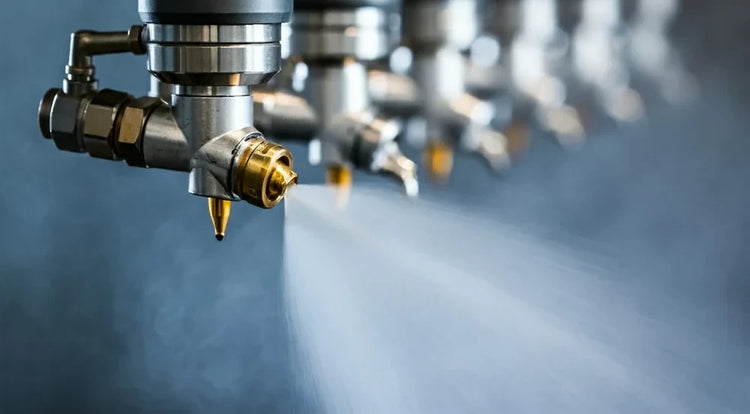
Mining Dust Suppression Nozzles
Source-capture misting systems for crushers, haul roads, conveyor transfers, and mill discharge — intercept airborne particles at the point of generation, reduce worker exposure 70–90%, and cut water consumption 30–50% vs. flooding methods
Dust in mining operations is not primarily a nuisance — it is a mass-loading problem at specific point sources. Crushers generate dust at the discharge chute and in the breakage chamber. Conveyor transfers generate dust at the drop point and in the impact zone. Haul roads generate it as a continuous resuspension problem under tire contact. Each source has a different airflow geometry, a different particle size distribution, and a different nozzle configuration requirement. A full-cone nozzle bank positioned correctly at a primary crusher discharge can suppress 70–90% of visible dust from that source. The same nozzles positioned incorrectly by even 15–20 degrees miss the plume entirely and waste both water and system capacity.
NozzlePro supplies spray nozzles for mining dust suppression applications across all source types — full-cone for crusher and haul road coverage, hollow-cone for transfer point enclosures, air-atomizing for fine mist in confined mill areas, and flat-fan for targeted perimeter applications. All in 316L stainless steel, Hastelloy C-276, or ceramic orifice configurations matched to the abrasive and corrosive service conditions typical of mining operations. ISO 9001 certified manufacturing with consistent orifice geometry across replacement sets.
Mining dust suppression nozzles work by producing fine water droplets that intercept and agglomerate airborne dust particles — when a water droplet and a dust particle collide, surface tension and electrostatic forces bind them together, making the combined particle heavy enough to settle out of the airstream. The droplet size range that captures dust most efficiently is 10–100 µm Dv50 — droplets in this range have sufficient mass to collide effectively with respirable dust particles (0.5–10 µm) without being too large to remain airborne long enough to intercept the dust plume. Standard applications by source: primary crusher discharge uses full-cone nozzles (40–80 PSI, 1–3 GPM per nozzle) directed into the discharge chute and breakage chamber; conveyor transfer points use hollow-cone nozzles (25–50 PSI, 0.5–2 GPM) positioned in the drop zone enclosure; haul roads use full-cone manifold bars (20–40 PSI, 2–5 GPM per bar) for surface moisture conditioning; and secondary mill areas use air-atomizing nozzles (30–60 PSI liquid / 40–80 PSI air, 0.5–2 GPM) for ultra-fine mist in enclosed spaces. Material selection for abrasive mining service: 316L stainless steel orifices for most applications; ceramic inserts where abrasive particle entrainment into the spray causes accelerated wear; Hastelloy C-276 where acid mine drainage or process chemistry creates corrosive conditions.
The Physics of Dust Capture — Why Droplet Size Determines System Effectiveness
The nozzle specification follows from the particle size distribution at each dust source — not a generic "dust suppression" recommendation
Droplet-Particle Collision Efficiency — The Governing Variable
A water droplet captures a dust particle through three mechanisms: direct inertial impaction (the droplet hits the particle), diffusion (fine particles diffuse onto the droplet surface through Brownian motion), and interception (the particle's streamline carries it close enough to the droplet surface for surface forces to act). The efficiency of each mechanism depends on the ratio of droplet diameter to particle diameter. For inertial impaction — the dominant mechanism for mining dust in the 1–100 µm particle size range — maximum collection efficiency occurs when droplet Dv50 is approximately 5–20× the particle diameter being targeted. For PM10 (particles below 10 µm), optimal droplet Dv50 is 50–200 µm. For PM2.5 (particles below 2.5 µm), diffusion becomes more important and droplet Dv50 below 50 µm is more effective.
Practical implication: a full-cone nozzle producing 300 µm Dv50 droplets is an inefficient dust suppression tool because the droplets are too large relative to the respirable particle size range — they fall to the ground before intercepting fine particles in the plume. An air-atomizing nozzle producing 20–50 µm Dv50 is an effective fine dust suppressor but may not provide adequate visible dust (coarse fraction, 100–500 µm) suppression. Most mining applications require a Dv50 of 50–150 µm — achievable from hollow-cone nozzles and medium-pressure full-cone nozzles that produce fine-to-medium droplets at their rated operating pressure. This is the technical basis for nozzle selection at each source type.
Dust Suppression Applications by Source Type
Six distinct source types — each with different airflow geometry, particle size distribution, and nozzle configuration
Primary Crusher Discharge
The primary crusher generates the highest-energy dust event in the circuit — rock fracture at the discharge chute releases a dust plume with wide particle size distribution (fine respirable dust to visible coarse fraction). Full-cone nozzles directed into the chute entry and discharge zone intercept the plume at its generation point. Nozzle positioning must account for the oscillating chute geometry and variable feed rate — adjustable mounting brackets allow angle correction after installation to track the actual dust plume trajectory under operating conditions.
Full-Cone NozzlesSecondary & Tertiary Crushers
Secondary and tertiary crushing generates finer particle size distribution than primary crushing — higher proportion of respirable fraction (PM10 and PM2.5) relative to coarse dust. Air-atomizing nozzles producing 20–80 µm Dv50 are more effective at capturing the fine fraction than full-cone nozzles at equivalent water consumption. Enclosed secondary crusher buildings concentrate the dust plume and allow air-atomizing systems to operate in recirculating mode — the enclosed volume increases droplet-particle contact time and overall collection efficiency.
Air-Atomizing NozzlesConveyor Transfer Points
Transfer points generate dust at the impact zone where material drops from one belt to the receiving belt. The drop height determines the air velocity entering the impact zone — higher drops create more turbulent airflow and more dust. Hollow-cone nozzles positioned in the transfer chute enclosure create a curtain of fine droplets that the entrained air must pass through, maximizing collision probability. Critical: the nozzle must not add enough moisture to cause material bridging in the chute — flow rate calibration to moisture content of the ore stream is required.
Hollow-Cone NozzlesHaul Road Conditioning
Haul road dust is a resuspension problem — tires and wind detach surface fines and return them to the airstream. Unlike point-source suppression, haul road treatment requires maintaining a moisture-conditioned road surface throughout the operating shift. Fixed manifold bars at intervals along the road or at fixed spray stations apply water to the road surface; the key design variable is the moisture application rate needed to maintain surface cohesion for the operating cycle between applications under the ambient evaporation rate and traffic intensity at the site.
Full-Cone Manifold NozzlesMill Discharge & Grinding Circuits
Ball mills, SAG mills, and rod mills generate fine dust at the discharge trunnion and in the trommel screen area. The confined geometry of mill buildings concentrates dust but also limits nozzle placement options — air-atomizing nozzles with compact body dimensions are preferred where clearance is restricted. Wet grinding circuits have lower dust generation but still require misting at dry feed entry points. The high-humidity environment in enclosed mill buildings requires stainless steel nozzle bodies — carbon steel corrodes rapidly in the moisture-chemical environment of wet grinding circuits.
Air-Atomizing NozzlesStockpile & Reclaim Areas
Open stockpiles generate wind-driven dust that is difficult to suppress at the source — the entire stockpile surface is a potential dust source under high-wind conditions. Fixed perimeter misting systems along the upwind face reduce dust lift-off from exposed surfaces. Reclaim tunnels and aprons below stockpiles generate dust at the feeder discharge points — similar to conveyor transfer point suppression. Water cannon systems for open stockpile surfaces require larger droplets (200–500 µm) that have sufficient momentum to reach the stockpile surface against wind rather than fine misting droplets that drift.
Fog & Mist NozzlesDust Suppression Application Parameter Reference
Nozzle type, pressure, flow rate, optimal droplet size, and key configuration notes by application
| Application | Nozzle Type | Pressure Range | Flow Rate | Droplet Dv50 | Key Configuration Notes |
|---|---|---|---|---|---|
| Primary Crusher Discharge | Full-Cone | 40–80 PSI | 1–3 GPM/nozzle | 100–200 µm | Position nozzles at chute entry and discharge zone; adjustable mounting to track plume trajectory; automated control tied to crusher throughput; 316L SS or ceramic orifice |
| Secondary/Tertiary Crusher | Air-Atomizing | 30–60 PSI liquid / 40–80 PSI air | 0.5–2 GPM/nozzle | 20–80 µm | Fine fraction capture requires fine droplets; enclosed building allows recirculating system; air supply line requires filtration to prevent orifice contamination; interlock with crusher start/stop |
| Conveyor Transfer Points | Hollow-Cone | 25–50 PSI | 0.5–2 GPM/nozzle | 80–150 µm | Position in chute enclosure to create droplet curtain in airstream path; flow rate calibrated to avoid over-wetting and bridging; proportional control to belt speed; chute inspection port required for flow verification |
| Haul Road Conditioning | Full-Cone manifold bars | 20–40 PSI | 2–5 GPM/bar | 300–600 µm | Surface moisture application — coarser droplets for road penetration vs. airborne misting; spacing between application points depends on evaporation rate and traffic cycle; chemical dust suppressants can be injected into water supply for extended effectiveness |
| Mill Discharge / Grinding | Air-Atomizing | 30–60 PSI liquid / 40–80 PSI air | 0.3–1.5 GPM/nozzle | 15–60 µm | Compact body for restricted clearance; stainless steel body required for humid chemical environment; maintain air supply pressure ±5 PSI for consistent droplet size; automated shutdown on process upset to prevent excess moisture in mill feed |
| Stockpile / Reclaim Tunnel | Fog / Fine Mist or Full-Cone | 40–80 PSI (fog); 20–40 PSI (FC) | 0.3–1 GPM (fog); 1–4 GPM (FC) | 50–150 µm (fog); 200–400 µm (FC) | Fog for enclosed reclaim tunnels; full-cone for open stockpile perimeter; wind-speed interlock recommended — fine mist is ineffective and potentially counterproductive above 15 mph; water quality filtration critical for fine fog orifices |
Spray Pattern Selection for Mining Dust Suppression
Each pattern provides different coverage geometry — matched to the airflow and enclosure geometry at each source
Full-Cone
Uniform circular coverage with droplets distributed across the full cone diameter — the standard for crusher discharge, haul road bars, and any application where complete area coverage of a defined zone is required. Most available in wide pressure range (20–100 PSI) with easily adjustable orifice sizing for flow rate tuning.
Shop Full-ConeHollow-Cone
Ring-shaped spray pattern concentrates droplets around the perimeter of the cone — creates a curtain of spray in enclosed chute spaces that the dust-laden airstream must pass through. More efficient droplet-particle contact than full-cone in confined geometries because the spray perimeter intercepts more of the cross-sectional airflow path.
Shop Hollow-ConeAir-Atomizing
Uses compressed air to break liquid into ultra-fine droplets (10–80 µm Dv50) at low liquid flow rate — produces the finest droplet size available for high-efficiency capture of respirable dust particles below 10 µm. Requires a compressed air supply in addition to water, but achieves dust capture efficiency at liquid flow rates that standard hydraulic nozzles cannot match.
Shop Air-AtomizingFlat-Fan
Linear coverage pattern for perimeter suppression zones, targeted application along conveyor belt edges, and equipment cooling applications where the spray target is a defined linear surface rather than a volume. Lower droplet count per unit volume than hollow-cone at equivalent pressure — used where directional coverage is more important than maximum droplet-particle collision probability.
Shop Flat-FanNozzle Material Selection for Mining Service Conditions
Abrasion, corrosion, and chemical exposure require matched material selection — wrong material is the primary cause of premature nozzle failure in mining applications
316L Stainless Steel
Standard specification for most mining dust suppression applications. Superior corrosion resistance vs. 304 SS in chloride-containing environments, humid mill buildings, and spray water containing dissolved minerals. Good wear resistance in applications where spray water is clean and dust particle entrainment into the nozzle body is minimal.
Use for: Crusher discharge, conveyor transfers, haul road bars, mill buildings, wet environmentsCeramic Orifice Inserts
Tungsten carbide or alumina ceramic orifice inserts in a stainless body — correct specification where abrasive particles (fine silica, iron ore fines, abrasive mineral processing chemicals) are entrained into the spray at the nozzle inlet. Ceramic orifices achieve 5–10× the service life of stainless orifices in abrasive service. Higher initial cost is consistently offset by reduced replacement frequency.
Use for: Dry ore dust applications, silica-bearing ores, abrasive mineral processing, high-particle-load environmentsHastelloy C-276
Nickel-molybdenum-chromium alloy with superior resistance to oxidizing and reducing acids, chlorides, and sulfur compounds. Required for acid mine drainage environments, sulfide ore processing circuits, and applications where spray water pH is below 5 or above 10. More expensive than 316L SS but the only viable specification in highly corrosive mining chemistry.
Use for: Acid mine drainage, sulfide processing, pH extremes, high chloride environments, oxidizing acid circuitsPVDF (Kynar) Body
Polyvinylidene fluoride — chemical resistance to acids, bases, oxidizers, and organic solvents that attack stainless steel alloys. Used where chemical compatibility with the spray liquid requires non-metallic wetted parts. Lower pressure rating than metal bodies (typically 150 PSI maximum). Not recommended where physical abrasion or impact is a service concern.
Use for: Aggressive chemical compatibility requirements, bleach solutions, strong acid/base applications where metal corrosion is the governing constraintDust Suppression System Design Principles
Five engineering principles that determine whether a mining dust suppression system achieves its design performance
- Source Capture Is 5–10× More Effective Than Ambient Suppression — Intercepting dust at the point where it becomes airborne requires 5–10× less water and energy than attempting to suppress a dust plume that has already dispersed into the ambient air of the work area. A nozzle bank positioned correctly at a crusher discharge chute treats a dust plume that is concentrated, directional, and predictable. A misting system attempting to suppress the same dust after it has dispersed through the crusher building treats a diluted, omnidirectional problem that requires blanketing the entire building volume. Source capture is the first design principle — all other parameters (nozzle type, flow rate, droplet size) are secondary to capturing the dust before it disperses.
- Droplet Size Must Match Particle Size Distribution — Not Generic "Mist" Specifications — The ore type and crushing stage determine the particle size distribution of the dust at each source. Fine grinding operations produce predominantly submicron to 10 µm particles; primary crushing produces a wider distribution including 50–500 µm coarse fraction. A system specified for generic "dust suppression" without knowledge of the particle size distribution at each source will be over-specified for coarse fraction capture (using fine nozzles that get carried away by airflow without impacting large particles) or under-specified for fine fraction capture (using coarse droplet nozzles that fall to the ground before intercepting respirable particles). Specify droplet Dv50 based on the dominant dust particle size at each source, not based on a catalog "mining nozzle" category.
- Water Quality Is the Most Common Cause of System Performance Degradation — Mining process water and recycled water commonly contain dissolved solids (calcium carbonates, iron oxides, process chemicals) that deposit on nozzle orifice faces as water evaporates between spray cycles. On fine orifice nozzles (below 1 mm orifice diameter) used for air-atomizing and fog systems, scale deposits can reduce effective orifice area by 20–30% within 50–100 hours of operation in high-hardness water — increasing droplet size and reducing capture efficiency without any external indication of blockage. Specify 100-mesh inline strainers at nozzle manifold inlets. Install automatic flushing on system shutdown. Use treated water where supply water hardness exceeds 200 ppm CaCO₃ for fine orifice applications.
- Automated Interlocks to Process Equipment Eliminate Wasted Water and Over-Wetting — Manual spray systems operated independently of process equipment consistently result in two failure modes: under-operation (operators don't turn on suppression before starting dust-generating equipment, exposing workers during the initial high-dust period) or continuous operation regardless of whether the dust source is active (wasting water, adding excessive moisture to material, creating mud and material handling problems). Automated interlocks — starting spray systems 30–60 seconds before crusher start and shutting down 2–3 minutes after crusher stop — eliminate both failure modes and typically reduce water consumption 40–60% vs. continuously operated systems with no process interlocking.
- Wind Speed Monitoring Is Required for Open-Area Applications — Haul road misting, open stockpile suppression, and any outdoor suppression system effectiveness degrades rapidly with increasing wind speed. Fine droplets (below 100 µm Dv50) have terminal settling velocities below 0.3 m/s — in 15 mph (6.7 m/s) wind, these droplets travel horizontally 20 meters for every meter they fall. At this wind speed, fine mist systems applied to an open haul road are producing airborne drift rather than road surface conditioning. Wind speed interlocks that switch from fine mist to coarser full-cone nozzles above 10 mph, and suspend outdoor fine misting entirely above 20 mph, maintain system effectiveness and prevent the water waste that makes fine misting systems economically unviable in exposed outdoor applications.
Dust Suppression System Troubleshooting
Diagnose the four most common performance failures in mining dust suppression nozzle systems
Visible Dust Plume Despite System Running
Symptom: Suppression system is operating but visible dust escapes from crusher or transfer point Likely cause: Nozzle angle misalignment, orifice wear changing spray pattern, or droplet size too coarse for fine fraction captureShut system down and physically inspect each nozzle spray pattern individually at operating pressure — look for pattern distortion, uneven distribution, or asymmetric spraying indicating orifice wear. Confirm nozzle angles are directed into the actual dust generation zone (this shifts over time as equipment wears). If patterns are uniform and angles are correct, specify finer orifice nozzles or air-atomizing for the fine particle fraction that full-cone nozzles cannot capture efficiently.
Rapid Nozzle Wear / Short Service Life
Symptom: Nozzles require replacement every 2–4 weeks; orifice faces show erosion or asymmetric wear Likely cause: Abrasive particles in spray water, inadequate inlet strainer, or wrong orifice material for abrasive ore typeCheck inline strainer screens — if visibly clogged with ore fines, the strainer is working but the supply water is carrying abrasive particles. Replace strainer screens and upgrade from 50-mesh to 100-mesh. If strainer is clean and wear continues, upgrade orifice material from 316L SS to ceramic inserts — ceramic service life is 5–10× longer in abrasive mining service. For crusher discharge applications where ore fines can backtrack into the nozzle inlet, add check valves to prevent backflow during system pressure cycles.
Material Bridging at Transfer Point
Symptom: Material accumulating and bridging in transfer chute after dust suppression system installation or increased water use Likely cause: Flow rate too high for ore moisture content, ore cohesion increases with moisture above critical saturation levelReduce per-nozzle flow rate by replacing orifice with next smaller size — reduce flow in 20% decrements and monitor bridging frequency. Most ores have a critical moisture content above which cohesion increases rapidly (typically 8–15% by weight for fine ore streams). Verify current surface moisture of ore feed and target spray addition that brings moisture to just below the bridging threshold, not above it. For hygroscopic ores (potash, salt), any surface moisture addition may be unacceptable — air-only curtain dust suppression or physical enclosure is the correct approach.
Scale Buildup Blocking Fine Orifices
Symptom: Air-atomizing or fog nozzles progressively losing flow; spray pattern becomes asymmetric or absent Likely cause: Hard water mineral scale (calcium carbonate, iron oxide) depositing on orifice face during shutdown periods when water evaporatesImplement automatic flush cycle at system shutdown — flush with clean water for 3–5 minutes before shutting off to clear mineral-laden water from orifice faces. For existing scale: soak nozzle sets in dilute citric acid (1 tablespoon per quart water) for 1–2 hours; for iron oxide scale, dilute phosphoric acid solution is more effective. For systems with persistent scale problems at above 300 ppm CaCO₃ water hardness: install water softener or antiscalant injection on supply line. Inspect fine orifices (below 0.5 mm) monthly by holding up to a light source — scale blockage in small orifices is not visible until flow has reduced 30–40% below rated.
Why Choose NozzlePro for Mining Dust Suppression?
Application-specific engineering, abrasive service material options, and ISO 9001 certified manufacturing
Engineering Support for Mining Dust Suppression Systems
Mining dust suppression is not a catalog specification exercise — the correct nozzle specification depends on the ore type, crusher model and stage, belt width, drop height, building geometry, water supply quality, and local climate conditions. NozzlePro application engineers work from your site parameters to specify nozzle type, orifice size, spray angle, mounting position, operating pressure, and flow rate for each suppression point.
Material Selection Guidance: 316L stainless steel, ceramic orifice inserts, Hastelloy C-276, and PVDF body options matched to your water chemistry, ore abrasivity, and service environment. We confirm material compatibility with your specific process chemistry before order.
Replacement Set Consistency: ISO 9001 certified manufacturing ensures each replacement nozzle set matches the orifice geometry and flow rate of the originally specified nozzles — critical for maintaining calibrated system performance over multiple replacement cycles.
System Integration Support: Automated control interlocks, PLC integration, pressure regulation, and inline strainer specifications for complete system integration — not just nozzle supply.
Frequently Asked Questions
Common questions about nozzle selection and system design for mining dust suppression
What droplet size is most effective for capturing respirable mining dust?
Respirable mining dust (PM10 and PM2.5 — particles below 10 µm and 2.5 µm respectively) is most effectively captured by water droplets in the 10–100 µm Dv50 range. The physics of droplet-particle collision favor droplets approximately 5–20× the diameter of the target particle — for PM10 capture, optimal droplet Dv50 is 50–200 µm; for PM2.5, diffusion becomes the dominant capture mechanism and droplets below 50 µm are more efficient. Standard full-cone nozzles at 40–80 PSI typically produce 100–250 µm Dv50 — adequate for PM10 capture at crusher discharge points but not for the finer fraction from secondary grinding. Air-atomizing nozzles producing 15–60 µm Dv50 are significantly more effective at capturing PM2.5 and submicron particles but require a compressed air supply. For MSHA compliance where respirable dust monitoring drives the specification, air-atomizing systems at secondary crushing and grinding are the correct specification. For visible dust management at primary crushers where the coarse fraction dominates, medium-pressure full-cone nozzles provide effective and economical suppression.
How do I prevent dust suppression nozzles from over-wetting the ore and causing material handling problems?
Over-wetting at conveyor transfers and crusher discharge is the most common installation problem with mining dust suppression systems. Prevention requires two steps: flow rate calibration and process interlocking. Flow rate calibration: measure the moisture content of ore entering the treatment point, determine the maximum allowable additional moisture before bridging, slippage, or process problems occur (typically 2–5% additional moisture by mass), calculate the total spray water addition required at maximum throughput, and divide by nozzle count to determine maximum per-nozzle flow rate. Select nozzle orifice size to deliver this calculated flow at your operating pressure — do not install nozzles at catalog flow rates and adjust pressure, as this changes droplet size along with flow rate. Process interlocking: the spray system should be proportionally controlled to belt speed or crusher throughput — flow rate should reduce proportionally as throughput reduces. A fixed-rate system running at crusher idle throughput may apply 3–5× the water per ton of ore that is acceptable at full throughput. NozzlePro can provide flow rate calculations for your specific ore moisture and throughput conditions before system specification.
What is the difference between fog systems and standard dust suppression nozzles for mining?
Fog systems (also called fogging or ultra-fine misting) produce droplets in the 5–50 µm range — significantly finer than standard pressure nozzles. The advantage is superior PM2.5 and PM10 capture efficiency through diffusion-dominated particle interception that coarser droplets cannot achieve. The disadvantages in mining applications are significant: fog droplets (below 30 µm Dv50) have terminal settling velocities below 0.08 m/s and are effectively suspended in still air — in any cross-draft or moving air above 0.5 m/s (which describes virtually every outdoor and many indoor mining application), fine fog droplets become airborne drift rather than useful dust suppression spray. Fog systems are effective in: enclosed rooms or enclosures with controlled air movement, very low-velocity environments like underground workings with minimal ventilation airflow, and applications where the dust source and suppression zone are both enclosed. Fog systems are ineffective or counterproductive at: open crusher discharge points, outdoor haul roads in any measurable wind, and open conveyor transfer areas where cross-drafts exist. Standard full-cone or hollow-cone nozzles producing 80–200 µm Dv50 provide better real-world performance than fog systems in most open-area mining dust suppression applications.
How often should mining dust suppression nozzles be replaced?
Service life for mining dust suppression nozzles depends heavily on water quality and abrasive particle exposure — the two variables most distinct in mining vs. industrial applications. In clean supply water (below 100 ppm hardness, no abrasive particles): 316L SS nozzles typically achieve 2,000–4,000 hours service life before 10% flow deviation from rated performance. In typical mining process water (200–500 ppm hardness, moderate suspended solids): 316L SS orifices may show significant wear in 500–1,000 hours of operation; ceramic inserts in the same conditions achieve 2,500–5,000+ hours. Replace nozzle sets (not individual positions) when flow rate measurement at operating pressure shows any position deviating more than 10% from rated flow, when visible spray pattern distortion is observed, or when MSHA respirable dust monitoring shows deteriorating results that correlate with suppression system spray pattern changes. For abrasive service (silica-bearing ores, iron ore, copper porphyry), ceramic orifice inserts are the economically correct specification regardless of initial cost differential — the reduction in replacement frequency and production downtime for nozzle maintenance consistently yields positive ROI vs. standard stainless orifices over 12–18 months of operation.
What automation and controls are recommended for mining dust suppression systems?
Minimum recommended control specification for a production mining dust suppression system: PLC-based process interlock that starts the spray system 30–60 seconds before crusher or conveyor start and continues operation for 2–3 minutes after stop (allowing residual dust from the shutdown surge to be suppressed before system shutdown). Proportional flow control tied to throughput sensor (belt scale or crusher amperage) that reduces spray flow rate proportionally with reduced throughput — prevents over-wetting at low throughput and maintains calibrated water-per-ton ratios across the full operating range. Pressure monitoring at the manifold with low-pressure alarm — most spray system failures manifest as pump or supply pressure loss before individual nozzle wear is detectable; pressure monitoring catches these failures immediately. Wind speed interlock for outdoor applications — automatic switch from fine mist to coarser nozzles above 10 mph, system shutdown above 20 mph for fine mist applications. Flow totalization for water consumption reporting — increasingly required for water use reporting under environmental permits at major mining operations. The marginal cost of adding these control features to a new system installation is typically 10–15% of total system cost, while the water savings from process interlocking alone (40–60% reduction vs. non-interlocked systems) typically provide payback within 6–12 months at operating water costs.
Can the same nozzles be used for both dust suppression and equipment cooling in mining?
The same nozzle body can be used for both applications in some cases, but the operating parameters for dust suppression and equipment cooling are different enough that a shared specification frequently compromises both. Dust suppression requires droplets in the 50–200 µm range that remain airborne long enough to intercept dust particles — fine enough to maintain suspension in the air for several seconds. Equipment cooling requires droplets that contact the hot metal surface, evaporate, and remove latent heat — which favors medium to fine droplets (100–300 µm) with good surface impingement momentum. The overlap in the 100–200 µm range makes a shared flat-fan or full-cone nozzle viable for crusher and mill cooling when the same water supply point serves both functions. However, the flow rates differ significantly: dust suppression typically uses 0.5–3 GPM per nozzle; equipment cooling may require 3–10 GPM per nozzle for adequate heat removal. Sharing a single nozzle at a flow rate optimized for one function will under-serve the other. Where dust suppression and equipment cooling are co-located at a crusher discharge point, the correct specification is separate nozzle circuits with independently sized orifices for each function — sharing a header is acceptable; sharing a nozzle specification is not.
Request a Mining Dust Suppression System Review
Share your site application — crusher type and stage, conveyor belt widths, transfer drop heights, ore type, water supply quality, and compliance requirements — and our application engineers will specify nozzle type, orifice size, material, and mounting configuration for each suppression point with flow rate and water consumption calculations.