
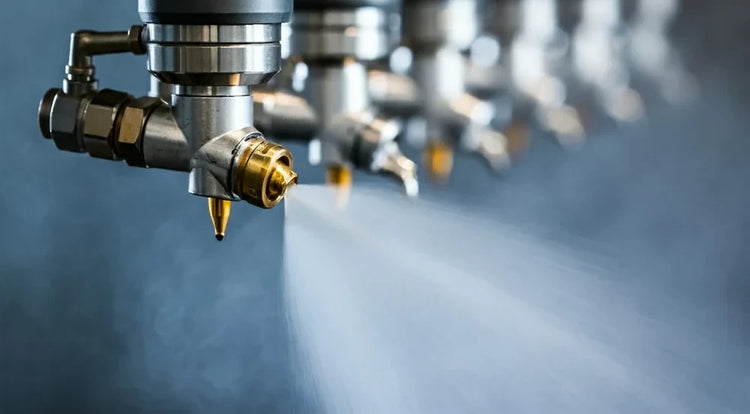
Spray Nozzles for
Dust Suppression & Pollution Control
Precision nozzles for dust suppression, odor control, and gas scrubbing — matched to particle size, gas conditions, and environmental compliance requirements, not pulled from a generic catalog page.

Dust suppression and pollution control applications use different nozzle types depending on particle size, environment, and required capture efficiency. Fog and mist nozzles (10–100 µm droplets) handle fine respirable dust (PM2.5/PM10) suppression in enclosed or semi-enclosed areas. Full-cone nozzles with coarser droplets suit open-air suppression at stockpiles, transfer points, and roadways where drift must be minimized. Flat-fan nozzles provide targeted spray bars at conveyor drops and loading zones. Hollow-cone nozzles serve gas scrubber absorbers and conditioning towers where high surface-area droplets maximize gas-liquid contact. Hydraulic atomizing nozzles deliver consistent fine-droplet dosing in odor control and gas conditioning without requiring compressed air. Selection starts with target particle size — droplets should be 1–5× the diameter of the dust particles being captured for maximum collision efficiency.
Dust & Pollution Control Applications
Application-specific nozzle recommendations matched to your particle size and control objective — every collection link goes directly to the relevant NozzlePro products.
Mining Dust Suppression
Coal mines, hard rock mines, and aggregate quarries Recommended Nozzles- Crusher & Conveyor Enclosures: Fog & Mist at discharge points
- Haul Roads & Stockpiles: Full-Cone for open-air suppression
- Transfer Points: Flat-Fan spray bars
- Specialty alloy and ceramic nozzles for abrasive slurry service
Cement & Aggregate Dust Control
Kilns, clinker coolers, mills, classifiers, and material handling Recommended Nozzles- Gas Conditioning Towers: Hollow-Cone and Hydraulic Atomizing
- Clinker Cooling: Full-Cone
- Transfer Point Suppression: Fog & Mist
- Dust suppression and baghouse pre-conditioning are both critical to meeting PM emission permit limits
Energy & Power — Gas Scrubbing
Wet scrubbers, FGD systems, and gas conditioning towers Recommended Nozzles- Absorber & Quench Zones: Hollow-Cone injection
- Packed Tower Distribution: Full-Cone re-circulation headers
- Precision Reagent Dosing: Hydraulic Atomizing
- Alloy and PTFE materials required for acid gas and reagent slurry service
Wastewater & Odor Control
Headworks, clarifiers, digesters, and sludge handling areas Recommended Nozzles- Reagent Application: Fog & Mist over headworks and clarifiers
- Low-Flow Chemical Dosing: Hydraulic Atomizing
- H₂S-resistant materials required: stainless, PTFE, Hastelloy
- Coverage designed to minimize chemical drift beyond target zones
Bulk Material Handling & Transfer Points
Conveyor transfer points, loading spouts, and bucket elevators Recommended Nozzles- Drop Zone Suppression: Flat-Fan spray bars
- Enclosed Chutes: Fog & Mist nozzles
- General Stockpile Suppression: Full-Cone
- Automated on/off control synchronized with conveyor operation
Chemical Processing — Wet Scrubbers
Packed towers, venturi scrubbers, and spray absorbers Recommended Nozzles- Absorber Vessels: Hollow-Cone for maximum surface area
- Packed Section Distribution: Full-Cone headers
- PTFE, Hastelloy, and high-alloy options for aggressive chemistries
- Clog-resistant open-geometry orifice designs for slurry reagents
Droplet Size vs. Dust Capture Efficiency
The single most important variable in spray dust suppression — match droplets to your particle size distribution.
| Droplet Size (µm) | Capture Effectiveness | Target Particle Type | Recommended Nozzle |
|---|---|---|---|
| 10–50 | Very High | Respirable dust (PM2.5), fine coal dust, silica, cement fines | Fog & Mist, Air-Atomizing |
| 50–100 | High | General PM10 dust, mineral fines, construction dust | Hydraulic Atomizing, Fog & Mist |
| 100–300 | Moderate | Coarser dust at transfer points, aggregate, road dust | Hollow-Cone, Full-Cone |
| 300–1000+ | Lower / Wetting | Open-air suppression, stockpile wetting, road suppression | Full-Cone, Flat-Fan |
Nozzle Selection Guide for Dust & Pollution Control
Match nozzle type to your application environment and control objective — every recommendation carries a verified engineering rationale, not a catalog default.
| Nozzle Type | Best Applications | Key Advantage |
|---|---|---|
| Fog & Mist | Enclosed and semi-enclosed dust suppression at crushers, hoppers, and conveyor enclosures; respirable dust capture | Ultra-fine droplets match PM2.5/PM10 particle size for maximum agglomeration efficiency |
| Hydraulic Atomizing | Gas conditioning towers, odor control dosing, enclosed dust suppression without compressed air | Consistent fine-droplet spectrum at low flow rates; no compressed air supply required |
| Air-Atomizing | Ultra-fine respirable dust suppression, chemical reagent misting for odor neutralization | Finest achievable droplets; greatest control over droplet size distribution via air/liquid ratio |
| Hollow-Cone | Gas scrubber absorbers, wet scrubbers, SO₂ and acid gas absorption, conditioning towers | Ring-pattern maximizes gas-liquid interfacial area for absorption and heat transfer |
| Full-Cone | Open-air dust suppression at stockpiles and haul roads; packed scrubber distribution; clinker cooling | Coarser droplets minimize drift in open-air and windy environments; high volumetric wetting |
| Flat-Fan | Conveyor transfer points, loading zones, targeted spray bars across belt width | Sheeted spray across a defined width; effective at drop points where dust is most concentrated |
| High-Pressure | Duct and chute cleaning to restore suppression system performance; scale and buildup removal | High-impact cleaning of suppression system infrastructure between maintenance cycles |
- Enclosure Changes the Droplet Size That Works — Hoods, skirting, and enclosures around transfer points and crushers dramatically improve dust capture by containing the dust cloud for longer, which lets a finer, lower-flow-rate mist replace a coarser open-air spray at the same suppression performance. Even partial enclosure reduces water consumption significantly.
- Open-Air Suppression Requires Coarser Droplets — Wind currents carry fine mist away from the target before it ever reaches the dust. Open-air applications at stockpiles, haul roads, and loading areas need 300 µm+ droplets to resist drift, even though those droplets have lower per-droplet capture efficiency than the fine mist used indoors.
- Target the Generation Point, Not the Dispersed Cloud — Flat-fan bars aimed at the falling material stream, or opposing nozzle arrangements that create a collision zone right at the drop point, intercept dust at its highest concentration — before it has a chance to disperse into a larger, harder-to-capture cloud.
Dust Suppression Best Practices
Six engineering principles for maximum capture efficiency and minimum water consumption.
- Match Droplet Size to Particle Size Distribution — The collision efficiency between a water droplet and a dust particle is maximized when the droplet diameter is 1–5× the particle diameter. Use sub-100 µm droplets for PM10 and PM2.5 capture; step up to 200–500 µm for coarser bulk material handling dust to avoid drift in open-air environments.
- Enclose the Source When Possible — Hoods, skirting, and enclosures around transfer points and crushers dramatically improve dust capture by containing the dust cloud for longer, reducing the spray volume required to achieve the same suppression efficiency.
- Optimize Spray Angle and Overlap — Opposing fan nozzles or counter-flow cone arrangements create collision zones that increase the probability of droplet-particle contact. Flat-fan bars aimed at the falling material stream intercept dust at the highest-concentration point rather than trying to suppress it after it disperses.
- Account for Wind and Air Currents — Open-air applications must use coarser droplets (300 µm+) to resist wind drift that carries fine mist away from the target area. Indoor and enclosed suppression systems can use finer droplets effectively because there is no wind to carry them off-target.
- Maintain Nozzles and Strainers Systematically — Clogged or worn nozzles drift from their specified flow rate and pattern, creating unsuppressed zones. Install strainers upstream of all suppression nozzles, schedule periodic nozzle inspection and replacement, and log system pressure and flow to catch performance degradation before it becomes a compliance issue.
- Validate Against Actual Dust Measurements — Suppression system design should be validated with before/after dust concentration measurements (personal or area sampling for PM2.5/PM10) rather than relying solely on visual assessment. Airborne dust levels may remain elevated even when visible dust appears suppressed.
Application Engineering — Not Just a Catalog
We Size the Nozzle to Your Particle, Not Just Your Pipe Thread
Effective dust and pollution control system design requires knowing the target particle size distribution, dust generation rate, enclosure geometry, airflow patterns, and available water pressure and flow. NozzlePro application engineers work with your process parameters to recommend nozzle type, orifice size, placement, and system configuration.
What to Share: Dust particle size distribution or material type, application environment (enclosed vs. open-air, gas temperature, wind conditions), available supply pressure and flow, chemical composition of any reagents or additives, and current compliance status or target emission limits.
Material Options for Harsh Environments: 316L stainless steel for general industrial and mining service; Hastelloy C-276 and duplex stainless for H₂S, chloride, and acid gas environments; PTFE-lined and ceramic orifice options for aggressive reagent slurries; tungsten carbide inserts for abrasive slurry service in wet scrubbers.
ISO 9001 Manufacturing: Consistent dimensional tolerances across all nozzle production runs — critical for maintaining calibrated flow rates in suppression systems.
Dust & Pollution Control Specification at a Glance
Key Parameters by Application
Frequently Asked Questions
Common questions about dust suppression and pollution control spray nozzles.
The most effective droplet size for dust suppression is 1–5 times the diameter of the dust particles being captured. For respirable dust (PM2.5, particle diameter under 2.5 µm), droplets in the 10–50 µm range provide the highest collision efficiency. For general PM10 dust (up to 10 µm), 50–100 µm droplets work well. For coarser bulk material dust at transfer points and haul roads, 200–500 µm droplets are preferred because they resist wind drift in open-air environments, where fine mist would be carried away before reaching the dust source.
For open-air outdoor dust suppression, full-cone nozzles are the standard choice because they produce coarser, heavier droplets that resist wind drift and provide high-volume wetting of stockpile faces, haul roads, and material drop zones. At enclosed or semi-enclosed points like conveyor transfers and crusher discharges, fog and mist nozzles with finer droplets are more effective because the enclosure prevents drift and allows longer droplet-dust contact time. Many mine suppression systems use a combination: full-cone for open areas and fog/mist inside enclosures.
Hollow-cone nozzles are the standard choice for wet scrubber absorber vessels and gas quench zones because they produce a ring-shaped spray pattern with high surface area per unit of liquid volume, maximizing gas-liquid contact for SO₂, HCl, and other acid gas absorption. Full-cone nozzles are used in packed tower distribution headers to provide uniform wetting across the packing cross-section. Hydraulic atomizing nozzles are used where precise droplet size control is needed in conditioning towers to ensure complete evaporation within the vessel residence time. Nozzle materials must be compatible with the scrubbing reagent (lime slurry, caustic, sodium bisulfite) and the gas phase chemistry.
Water reduction in dust suppression systems starts with matching droplet size more precisely to the dust particle size distribution — oversized droplets have poor capture efficiency and wet the material unnecessarily. Enclosing dust source points increases suppression efficiency and allows finer, lower-flow-rate misting systems to replace higher-flow coarse spray. Automated on/off control synchronized to material flow (conveyor belts, crusher operation) prevents continuous spraying when no dust is being generated. Dust control additives (surfactants, hygroscopic salts) can reduce water consumption by 30–50% by improving droplet-particle adhesion.
Nozzles in H₂S odor control applications at wastewater treatment plants must resist both the corrosive H₂S atmosphere and the chemical odor-neutralizing reagents being sprayed. 316L stainless steel provides adequate corrosion resistance for most wastewater odor control environments. For higher H₂S concentrations or chloride-containing reagents, Hastelloy C-276 or duplex stainless steel are preferred. PTFE-bodied nozzles offer broad chemical resistance where metallic corrosion is a concern. Seals and gaskets should be PTFE or Viton for chemical resistance. Nozzle design should also minimize crevices where corrosive condensate can accumulate.
Inspection frequency depends on service conditions — abrasive slurry and high-solids water supplies cause faster wear than clean water systems. At minimum, nozzles in mining and cement applications should be visually inspected monthly and flow-verified quarterly. Worn orifices enlarge over time, increasing flow rate above the design value and distorting spray patterns. Installing strainers upstream of all suppression nozzles is essential to prevent clogging from scale, debris, and suspended solids. Nozzles showing more than 10–15% deviation from rated flow rate at design pressure should be replaced.
Ready to Improve Your Dust or Emissions Control?
Share your particle size distribution, gas conditions, enclosure details, and compliance targets — we'll size the nozzles and recommend materials for your duty cycle.