
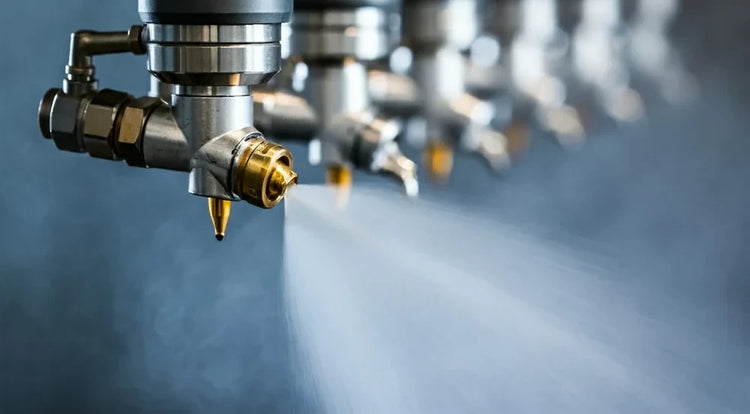
Industrial Spray Nozzles for Protective Coatings
Flat-fan nozzles for uniform film-weight coating on flat substrates, hydraulic atomizing for fine droplet anti-corrosion oil and wax application, full-cone for three-dimensional surface coverage — matched to coating viscosity, target film weight, substrate geometry, and chemistry compatibility
Protective coating nozzle selection is fundamentally a fluid mechanics problem, not a hardware catalog exercise. The governing variable is viscosity — and protective coatings span a viscosity range from thin anti-corrosion oils (5–50 cP) to heavy rust-preventive greases and underbody coatings (500–5,000 cP) that require fundamentally different atomization mechanisms to produce the target droplet size and film weight. A hydraulic atomizing nozzle that produces a fine, uniform mist with a 10 cP rust inhibitor oil will produce an irregular, streaky pattern with a 500 cP wax-based coating at the same operating pressure. An air-atomizing nozzle that handles both viscosity ranges correctly requires a compressed air supply that a hydraulic-only installation cannot provide.
NozzlePro supplies flat-fan nozzles for uniform film-weight coating on flat and web substrates; hydraulic atomizing nozzles for fine droplet corrosion inhibitor and thin-film oil application; full-cone and hollow-cone for three-dimensional part coverage in spray booths and coating tunnels; and air-atomizing nozzles for high-viscosity coatings where hydraulic atomization alone cannot produce adequate droplet fineness at acceptable operating pressure. Material options in 316L stainless steel, Hastelloy C-276, PVDF, and acetal (for solvent-free aqueous systems) matched to your coating chemistry and temperature. ISO 9001 certified manufacturing for consistent orifice geometry and repeatable film weight across production shifts.
Protective coating spray nozzles are selected based on three variables: coating viscosity, target film weight, and substrate geometry. Thin anti-corrosion oils and rust inhibitors (5–50 cP): hydraulic atomizing nozzles at 40–150 PSI produce fine droplets (50–150 µm Dv50) for thin, uniform film application on metal parts. Moderate viscosity coatings — primers, adhesives, release agents (50–500 cP): flat-fan nozzles for flat substrate coverage; full-cone for three-dimensional part surfaces in coating tunnels; operating pressure 60–200 PSI depending on viscosity. High-viscosity coatings — sealants, underbody coatings, wax-based rust preventives (500–5,000 cP): air-atomizing nozzles (4–8 bar compressed air + heated supply line) for adequate atomization at high viscosity; or heated nozzle systems that reduce viscosity at the orifice for hydraulic atomization. Film weight calculation: film weight (g/m²) = nozzle flow rate (g/min) ÷ (spray width (m) × substrate speed (m/min)). Match orifice size to this calculation, not to a default "standard" size for the coating type.
Why Viscosity Determines Nozzle Type — Atomization Physics for Protective Coatings
The nozzle specification follows directly from the coating's rheology — not from the coating category name
Atomization Mechanism and Viscosity — The Governing Relationship
Hydraulic atomization — the mechanism used in standard flat-fan and full-cone nozzles — works by accelerating the liquid through the orifice at high velocity and then allowing aerodynamic instabilities to break the resulting liquid sheet or jet into droplets. The energy required to form droplets from a liquid sheet is proportional to the liquid's viscosity and surface tension. For thin, low-viscosity coatings (below approximately 100 cP), hydraulic atomization at 40–200 PSI produces adequate droplet fineness (50–200 µm Dv50). Above approximately 200–500 cP, hydraulic atomization at standard pressures produces large, irregular droplets and a coarse spray pattern that delivers poor film uniformity — increasing pressure alone does not resolve this because the relationship between pressure and droplet size at high viscosity is much weaker than at low viscosity.
Air atomization — the mechanism in air-atomizing nozzles — uses compressed air to shear the liquid into droplets at the nozzle orifice. The air shear force supplements or replaces the hydraulic energy requirement, making air atomization effective across a much wider viscosity range (up to 2,000–5,000 cP with appropriate nozzle design and heated supply). For high-viscosity protective coatings (wax-based rust preventives, heavy underbody sealants, viscous release agents), air atomization at 2–6 bar air pressure produces significantly finer, more uniform droplets than hydraulic atomization at any practical pressure.
A third approach for very high viscosity coatings: heated nozzle systems that reduce coating viscosity at the spray point through controlled heating. Heating a wax-based coating from 20°C to 60°C may reduce its viscosity by 80–90% — making hydraulic atomization viable at standard pressures for a coating that would be unsprayable at ambient temperature with any hydraulic nozzle. Specify based on whether plant infrastructure (heated coating supply, compressed air) is available, and whether the coating chemistry is stable at the required elevated temperature.
Nozzle Selection by Protective Coating Type
Five coating categories — each with different viscosity, film weight target, and substrate geometry requirements
Anti-Corrosion Oils & Rust Inhibitors
Thin-film rust preventive oils, water-displacing corrosion inhibitors, and penetrating rust treatments applied to steel parts, stampings, and fabricated components. The governing requirement is uniform film coverage at very low film weight (typically 1–5 g/m²) — enough to provide a complete corrosion barrier without excess that drips, accumulates in recesses, or causes downstream process problems. Hydraulic atomizing nozzles at 40–100 PSI produce fine droplets (50–120 µm) that deposit uniformly at these thin film weights.
Nozzle: Hydraulic atomizing or flat-fan at 40–100 PSI. Film weight uniformity ±3–5% achievable at rated pressure. 316L SS body standard; confirm O-ring compatibility with specific oil or inhibitor chemistry.
Hydraulic Atomizing →Release Agents
Mold release agents for rubber, composite, concrete, and metal forming operations — applied to mold or die surfaces before each production cycle to prevent part adhesion. The governing requirements are: complete, uniform coverage of the mold surface (no missed spots that cause sticking), minimum film weight that prevents adhesion (excess release agent transfers to the molded part and may affect bonding or coating in subsequent operations), and compatibility with the mold material and release chemistry. Flat-fan for flat mold surfaces; full-cone for complex cavity geometry.
Nozzle: Flat-fan 25°–65° for flat mold surfaces; full-cone for complex cavity geometry. Operating pressure 60–150 PSI for water-based release agents; 40–100 PSI for solvent-based. 316L SS for water-based and mild solvent systems; PVDF for aggressive solvent release agents.
Flat-Fan Nozzles →Resins & Adhesives (Engineered Wood, Composites)
Phenol-formaldehyde, urea-formaldehyde, MDI, and polyurethane resins applied to wood fiber, veneer, or composite mat before hot pressing — the most precision-critical application in this category, where film weight uniformity directly determines bond strength uniformity, product density, and press performance. Flat-fan nozzles on closely spaced manifold bars produce uniform resin coverage across the full mat width. Film weight is precisely calculated from nozzle flow rate, bar spacing, and mat speed — variation in any of these produces measurable variation in panel density and internal bond.
Nozzle: Flat-fan 65°–80° on manifold bars at 150–400 mm centers for engineered wood mat coverage. Operating pressure 80–200 PSI. Heated supply lines for high-viscosity resin systems. 316L SS or PVDF; resist formaldehyde chemistry. Heated nozzle bodies available for viscous resin systems above 300 cP.
Flat-Fan Nozzles →Corrosion-Preventive Primers & Phosphates
Zinc phosphate pretreatment, iron phosphate conversion coating, and rust-preventive primer application to steel and aluminum parts before powder coat or liquid paint. Phosphating nozzles must cover all part surfaces uniformly — inadequate coverage creates unphosphated bare metal areas that rust under the topcoat. Full-cone nozzles in spray booth arrays cover complex three-dimensional automotive and fabricated parts from multiple directions; flat-fan for uniform panel and sheet coverage in continuous coil applications.
Nozzle: Full-cone for three-dimensional parts in spray tunnels; flat-fan for coil and sheet applications. Operating pressure 20–60 PSI for phosphating (low pressure preserves coating chemistry). 316L SS; Hastelloy C-276 for high-acid phosphate chemistry. Nozzle material compatibility with phosphoric, nitric, or hydrofluoric acid content must be confirmed per product formulation.
Full-Cone Nozzles →Wax, Sealants & Underbody Coatings
Hot-melt wax cavity injection for vehicle rustproofing, underbody rubberized sealant application, and high-viscosity corrosion-preventive wax for agricultural and industrial equipment. These coatings cannot be hydraulically atomized at standard temperature and pressure — they require either heated supply lines and nozzle bodies (reducing viscosity to the sprayable range) or air atomization where compressed air shear supplements insufficient hydraulic energy. Application temperature control is critical — most hot-melt wax systems operate at 60–120°C and require temperature-rated nozzle seals.
Nozzle: Air-atomizing nozzles at 2–6 bar air pressure for ambient-temperature high-viscosity coatings; hydraulic nozzles with heated supply for hot-melt systems at 60–120°C. Nozzle seals must be rated for operating temperature — PTFE standard for high-temperature coating service. Heated nozzle bodies available for wax cavity injection.
Fog & Mist Nozzles →Protective Coating Nozzle Selection Reference
Nozzle type, pressure, viscosity range, material, and key configuration notes by coating category
| Coating Type | Nozzle Type | Pressure Range | Viscosity Range | Body Material | Key Configuration Notes |
|---|---|---|---|---|---|
| Anti-Corrosion Oil / Rust Inhibitor | Hydraulic Atomizing or Flat-Fan | 40–100 PSI | 5–50 cP | 316L SS; confirm O-ring compatibility with oil chemistry | Film weight calculation required before orifice selection — 1–5 g/m² target typical; heated supply line if oil viscosity increases significantly below 15°C; inline 100-mesh strainer mandatory; confirm coating does not contain abrasive additives that would require TC orifice inserts |
| Release Agent (Water-Based) | Flat-Fan or Full-Cone | 60–150 PSI | 50–300 cP | 316L SS; Viton seals for elevated temperature service | Minimum effective film weight test recommended — apply decreasing coverage levels and check release; excess release agent transfers to part and affects downstream processes; automated spray tied to press cycle prevents over-application between cycles; nozzle flush cycle at shift-end prevents release agent from drying in orifice |
| Release Agent (Solvent-Based) | Flat-Fan or Hollow-Cone | 40–100 PSI | 20–200 cP | PVDF or 316L SS; PTFE seals; no acetal/nylon wetted parts | Solvent chemical compatibility mandatory — confirm nozzle body and seal material against specific solvent type (MEK, toluene, IPA, etc.); explosion-proof actuators required in solvent spray environments; extraction ventilation required; heated nozzle bodies available for room-temperature wax-based release agents |
| Resin / Adhesive (Wood / Composites) | Flat-Fan 65°–80° | 80–200 PSI | 100–500 cP | 316L SS or PVDF; resist formaldehyde; heated body available | Film weight uniformity ±5% target — calculate nozzle spacing, bar height, and orifice size from mat speed and target g/m²; heated supply line for high-viscosity resin above 200 cP; pot life of catalyzed resin systems requires flush cycle on shutdown to prevent orifice curing; confirm material compatibility with specific resin chemistry including hardeners and additives |
| Phosphate Pretreatment / Conversion Coating | Full-Cone | 15–60 PSI | 1–20 cP (dilute aqueous) | 316L SS standard; Hastelloy C-276 for high-acid stages; PVDF for HF-containing chemistry | Low pressure preserves bath chemistry and prevents excessive foaming; multiple spray zones in tunnel (spray, drain, rinse, neutralize, DI rinse); nozzle clogging from scale precipitation requires frequent inspection and acid soak cleaning; spray coverage must reach all part surfaces including recesses for complete conversion |
| Corrosion-Preventive Wax / Underbody Sealant | Air-Atomizing or Heated Hydraulic | 2–6 bar (air) or 60–200 PSI (heated hydraulic) | 500–5,000 cP | 316L SS; PTFE seals for high-temperature hot-melt service | Air atomization for ambient-temperature viscous coatings where compressed air is available; heated supply (60–120°C) for hot-melt wax to reduce to sprayable viscosity range; temperature rating of nozzle seals is critical — standard Viton FKM degrades above approximately 200°C; PTFE seals required for hot-melt wax service at 120°C+ |
| Lubricant / Stamping / Drawing Compound | Flat-Fan or Hydraulic Atomizing | 30–100 PSI | 10–200 cP | 316L SS; confirm O-ring compatibility with lubricant base chemistry | Blank lubrication in stamping requires uniform film at precise mg/m² — over-lubricating causes wrinkling; under-lubricating causes galling. Film weight calculation from measured orifice flow rate and blank speed is required for press qualification. Both-sides simultaneous application with matched-flow nozzle sets on upper and lower bars; inline 100-mesh strainers; automated shut-off tied to press stroke to prevent off-stroke over-application |
Nozzle Types for Protective Coating Applications
Five nozzle categories — each matched to specific viscosity ranges, film weight targets, and substrate geometries
Flat-Fan Nozzles
For uniform film-weight coating on flat substrates — engineered wood mat, steel coil, stamping blanks, flat mold surfaces, and any application where film weight uniformity across the substrate width is the primary performance criterion. Flat-fan nozzles produce a linear spray pattern with the highest coverage density at the center and progressively lower density at the edges — correct overlap (15–25% center-section overlap between adjacent nozzle spray footprints) is required for uniform film weight. The most precisely calibratable nozzle type for film weight control: orifice size determines flow rate at operating pressure, and flow rate directly determines film weight at known substrate speed and spray width. Wide angle (65°–80°) for mat coverage applications; narrow angle (15°–25°) for high-impact primer and adhesive application where penetration into porous substrate is required.
Shop Flat-Fan NozzlesHydraulic Atomizing Nozzles
For thin-film coating applications where fine droplet size (50–150 µm Dv50) and gentle, uniform deposition are more important than high-impact coverage — anti-corrosion oil application, thin-film rust inhibitor, and light lubricant application on formed parts. Hydraulic atomizing nozzles operate at relatively low pressure (40–100 PSI) and produce fine droplets through internal vane geometry that creates a swirling liquid sheet that breaks into fine droplets. Effective for coatings below approximately 100 cP — above this viscosity the droplet spectrum becomes coarse and non-uniform. The most precise nozzle type for thin-film oil application where 1–5 g/m² film weight uniformity is required for consistent corrosion protection without excess that causes downstream problems.
Shop Hydraulic AtomizingFull-Cone Nozzles
For three-dimensional part coating in spray tunnels and booths where the substrate surface is curved, has features in multiple orientations, or moves through the spray zone on a conveyor with varying surface angles. Full-cone nozzles distribute coating uniformly across a circular area, providing volumetric coverage from a single nozzle position that reaches multiple surface orientations simultaneously. Standard for phosphate pretreatment tunnels where complete conversion coating on all part surfaces — including undersides, recesses, and holes — is required. Also used for full-coverage wax and sealant application on assembled components where flat-fan coverage from a fixed angle would leave shadow zones on surfaces facing away from the spray direction.
Shop Full-Cone NozzlesHollow-Cone Nozzles
For applications where the spray pattern's ring geometry provides superior coverage of enclosed cavity interiors, complex mold surface geometries, and applications where the hollow-cone ring directs coating toward the periphery of the target area. Used for mold release agent application where the ring pattern coats the mold cavity walls more uniformly than a full-cone in certain cavity geometries. Also for anti-corrosion oil application inside hollow structural sections (box beams, door cavities) where the ring pattern reaches the cavity walls more effectively than full-cone from a single entry point. Produces finer droplet size than full-cone at equivalent pressure — beneficial for low-film-weight applications where fine droplet deposition reduces drip and run-off.
Shop Hollow-Cone NozzlesAir-Atomizing & Fog Nozzles
For high-viscosity coatings (above approximately 200–500 cP) where hydraulic atomization at any practical pressure produces inadequate droplet fineness. Air-atomizing nozzles use compressed air (2–8 bar) to shear the coating into fine droplets — extending the effective viscosity range from the ~100 cP hydraulic limit up to 2,000–5,000 cP for specialized designs. Required for wax-based rust preventives, underbody sealants, viscous release agents, and any coating where ambient-temperature viscosity exceeds the hydraulic atomization limit. Also used where very fine droplet size (5–30 µm Dv50) is needed for surface-thin application of lubricants and corrosion inhibitors where the coverage area is large relative to the coating volume target.
Shop Fog & Mist NozzlesFilm Weight Calculation and Orifice Sizing for Protective Coatings
The governing engineering calculation that connects nozzle orifice size, operating pressure, and coating film weight
- Film Weight Is the Governing Specification — Not Spray Pressure or Nozzle Type Alone — The correct starting point for protective coating nozzle specification is the required film weight in grams per square meter (g/m²) for the intended protection level. A rust-preventive oil film sufficient for 12-month indoor storage requires a different film weight than protection for outdoor yard storage or maritime shipping environments. Anti-corrosion oil suppliers specify minimum effective film weights in their technical data sheets. Film weight uniformity ±10% is a typical minimum requirement — ±5% is achievable with correctly specified flat-fan nozzles at rated operating pressure. Before selecting nozzle type, operating pressure, or orifice size: confirm the target film weight and uniformity specification from the coating supplier's technical documentation or internal quality standard.
- Film Weight Calculation Connects All System Variables — Orifice Size, Pressure, Substrate Speed, and Bar Spacing — Film weight (g/m²) = nozzle flow rate (g/min) ÷ (effective spray width per nozzle (m) × substrate speed (m/min)). This equation directly links the nozzle orifice size selection (which determines flow rate at operating pressure), the conveyor speed, and the target film weight in a single calculable relationship. If target film weight is 3 g/m², substrate speed is 20 m/min, and effective spray width per nozzle is 0.3 m: required flow rate = 3 × 0.3 × 20 = 18 g/min per nozzle. Select the nozzle orifice size that delivers this flow at the target operating pressure from the nozzle flow curve. This calculation is not an approximation — it is the design equation, and deviations from design conditions (substrate speed variation, pressure fluctuation) produce proportional film weight variation.
- Pressure Regulation at Each Nozzle Bar Is Required for Film Weight Uniformity Across the Machine Width — Film weight uniformity across the substrate width depends on equal flow rate from each nozzle position on the spray bar. Flow rate varies with the square root of pressure — a 10% pressure drop from the supply header to the far end of a long manifold bar produces approximately a 5% flow rate reduction and 5% film weight reduction at the far end of the bar. In wide-web coating applications (over 2 meters), pressure drop across the manifold bar can be significant enough to produce measurable film weight variation from edge to center. Install pressure gauges at both ends of each manifold bar and verify that supply pressure drop across the bar length is below 5% of operating pressure. For very wide applications: supply the manifold bar from both ends simultaneously to halve the pressure drop.
- Coating Pot Life and Cure Schedule Require Automated Flush on System Shutdown — Many protective coating formulations — catalyzed resins, two-component adhesives, hot-melt waxes, and aqueous release agents — change viscosity or begin to cure when static in the nozzle orifice during system shutdown. A catalyzed resin with a 30-minute pot life that is left in the nozzle orifice during a 15-minute machine stop may partially cure in the orifice and produce a blocked or restricted flow condition on restart. Implement automated flush cycles: at scheduled stops, flush the nozzle bar with solvent (for solvent-based systems) or water (for aqueous systems) for 2–3 minutes before the coating in the lines begins to cure or gel. Document flush cycle timing relative to coating pot life specifications. For hot-melt wax systems: drain the supply lines and nozzle bodies during shutdown to prevent wax solidification at nozzle operating temperature that takes significant time to remelt on restart.
- Nozzle Material Compatibility Must Be Confirmed for Both the Coating Chemistry and Any Flush or Cleaning Solvent — Protective coating nozzles are exposed to two different chemistry environments: the coating itself during production, and the flush or cleaning solvent during shutdown cleaning cycles. A nozzle body that is compatible with an aqueous release agent may be attacked by the acetone or MEK used to clean the manifold between production runs. Conversely, a nozzle body selected for solvent resistance to the production coating may be degraded by the alkali cleaner used for deep cleaning on weekly maintenance. Specify nozzle body and seal materials that are compatible with the complete set of chemicals that will contact the nozzle wetted surfaces — coating, flush solvent, and cleaning chemicals — not just the production coating alone. For systems where cleaning and production chemistry compatibility are difficult to achieve with a single material: specify quick-disconnect nozzle bodies that can be removed and cleaned in a separate soak tank using aggressive chemistry that would not be acceptable for in-place manifold cleaning.
Protective Coating Applications by Industry
Six industries with distinct coating types, film weight requirements, and nozzle specifications
Engineered Wood & Panels
Resin and adhesive application to OSB, MDF, particleboard, and laminated veneer lumber production lines. Film weight uniformity directly determines internal bond strength and density uniformity in the pressed panel. Flat-fan manifold bars with closely spaced nozzles for mat coverage; heated supply for viscous formaldehyde-based resins; flush cycle required at line stops to prevent resin curing in orifices.
Automotive Stamping & Body
Blank lubrication for deep-draw stamping, anti-corrosion oil for formed parts, and phosphate pretreatment for paint adhesion. Film weight precision critical in stamping (galling vs. wrinkling is a narrow window). Both-sides simultaneous lubrication on blanking lines. 316L SS for oil systems; Hastelloy or PVDF for phosphate pretreatment acid stages.
Metal Service Centers & Steel Processing
Coil oiling for corrosion protection during storage and transit, rust-preventive oil application on cut-to-length and slit product, and metalworking lubricant application on temper mills and skin-pass mills. Hydraulic atomizing nozzles for thin-film (1–5 g/m²) oil application on coil coating lines. Film weight uniformity monitored by gravimetric or radiometric oil film measurement systems.
Industrial Manufacturing & Fabrication
Release agent application for rubber molding, concrete forming, and plastics processing. Part cleaning and phosphate pretreatment before powder coat. Corrosion-preventive coating for finished fabricated structures before shipment. Full-cone for tunnel pretreatment; flat-fan for flat substrate coating; material selection matched to specific release agent or pretreatment chemistry.
Agricultural & Off-Road Equipment
Underbody wax and sealant application on tractors, implements, and construction equipment. Cavity wax injection for corrosion protection of hollow structural sections. High-viscosity wax requires air atomization or heated hydraulic systems. Long maintenance intervals for equipment operating in corrosive field environments demand high-film-weight application (20–50 g/m²) that low-viscosity oil systems cannot deliver.
Aerospace & Defense
Corrosion-preventive compound (CPC) application to aircraft structure, MIL-PRF specification materials. Precision film weight to specification tolerance — gravimetric measurement of applied film weight is standard for many aerospace coating operations. Material traceability from nozzle specification through coating lot to application record. 316L SS or PVDF body with traceable material certifications for regulated applications.
Nozzle Material Selection for Protective Coating Chemistry
Coating chemistry compatibility governs nozzle body and seal material — production coating, flush solvent, and cleaning chemistry must all be considered
316L Stainless Steel
Standard for aqueous coating systems (water-based release agents, aqueous rust inhibitors, aqueous adhesives), most petroleum-based oils and lubricants, and mild aqueous acid pretreatment stages at standard temperatures.
Use for: Water-based coatings, petroleum oils, mild acid pretreatment (pH above 3), rust inhibitors, stamping lubricantsPVDF (Kynar)
For solvent-based coating systems — ketones, esters, alcohols, aromatic solvents, and aggressive organic chemistries that attack 316L SS or cause stress cracking in standard polymers. Non-leaching in coating systems where metallic contamination is unacceptable. Maximum 150 PSI operating pressure.
Use for: Solvent-based release agents, solvent-based adhesives, ketone and ester solvents, aggressive organic chemistry, zero-metallic-contamination applicationsHastelloy C-276
For highly acidic conversion coating stages — phosphoric acid, hydrofluoric acid-containing pretreatments, chromate conversion, and any acid stage where 316L SS shows measurable pitting or corrosion. Higher cost justified where acid concentration and temperature exceed 316L SS service limits.
Use for: Zinc phosphate (high-acid stages), HF-containing pretreatments, chromate conversion, acid descaling, pH below 2–3 at elevated temperaturePTFE & Viton Seals
Nozzle O-rings and gaskets for coating applications: Viton (FKM) for most oils, aqueous systems, and mild solvents at up to 200°C. PTFE for aggressive organic solvents, highly oxidizing chemistry, and elevated temperature hot-melt applications above Viton service range. Acetal nozzle bodies for aqueous, non-oxidizing, non-solvent systems at ambient temperature.
Viton FKM: oils, aqueous, mild solvents, 40–200°C. PTFE: aggressive solvents, hot-melt wax, oxidizing chemistry. Avoid: NBR rubber in ketones, aromatics, and chlorinated solventsProtective Coating Nozzle System Troubleshooting
Four common performance failures in protective coating spray systems
Non-Uniform Film Weight — Streaks or Heavy/Light Bands Across Substrate
Symptom: Measurable film weight variation across substrate width; visible streaks or color variation in coating after application; corrosion detected preferentially at low-film-weight zones Likely cause: Incorrect flat-fan nozzle overlap; pressure variation across manifold bar width; or individual nozzle orifice variation from wear or partial blockagePerform a film weight map across the full substrate width using gravimetric sampling (weighed substrate sections before and after coating) or coating thickness gauge measurement. If the heavy/light pattern corresponds to nozzle pitch spacing, the cause is edge-overlap insufficiency — reduce nozzle spacing by 15–20% to increase center-section overlap. If heavy/light pattern is non-uniform, measure pressure at each end of the manifold bar — if pressure differential exceeds 5%, fix supply piping sizing before adjusting nozzle spacing. If pattern is isolated to specific positions regardless of adjacent nozzles, the affected nozzle has a blocked internal passage or worn orifice — clean with appropriate solvent soak and measure flow rate individually at operating pressure.
Orifice Plugging During or After Shutdown
Symptom: Zero or greatly reduced flow from nozzle at startup; nozzle produces distorted pattern or no spray; plug of solidified coating material in orifice Likely cause: Coating with limited pot life or elevated solidification temperature left in orifice during shutdown without flush; or evaporative concentration of solvent-based coating at idleFor catalyzed resin systems: implement automatic flush cycle at all planned stops — flush with carrier solvent or water for 2–3 minutes before coating in the orifice exceeds its pot life. For hot-melt wax: drain nozzle bodies completely at shutdown; solidified wax requires reheating to melt rather than solvent flushing. For solvent-based coatings that thicken at the orifice: flush with clean carrier solvent at shutdown and seal orifice face with a solvent-wetted cover cap during extended idle periods. For unblocking without nozzle removal: soak the nozzle body in appropriate solvent (match solvent to coating chemistry) for 15–30 minutes; never use sharp tools to clear orifices — any mechanical probing permanently deforms the precise orifice geometry.
Coating Drip and Run-Off From Part Surfaces
Symptom: Coating accumulates and drips from part edges and low points; pooling in recesses; unacceptable cosmetic appearance; excess coating in drainage sumps Likely cause: Film weight too high for coating viscosity and surface geometry; droplet size too large for adequate adhesion to vertical surfaces; coating applied to cold substrate reducing initial tackCalculate applied film weight from nozzle flow rate, substrate speed, and spray width — compare against the coating supplier's maximum application weight for the substrate geometry. If over-specified: reduce orifice size by one increment and verify film weight with gravimetric measurement. If film weight is correct but run-off still occurs: the coating's rheology may require a different spray approach — fine droplet air-atomizing application at lower film weight per pass with multiple passes is more effective for vertical surface adhesion than single-pass hydraulic at high film weight. Substrate temperature below coating minimum application temperature increases run-off significantly — confirm substrate temperature at the spray point meets the coating supplier's minimum substrate temperature specification.
Nozzle Corrosion or Seal Failure in Coating Service
Symptom: Nozzle body showing visible corrosion pitting, staining, or dimensional changes; seal swelling causing flow restriction or leakage; shortened service life vs. specification Likely cause: Coating chemistry, flush solvent, or cleaning agent attacking nozzle body or seal material beyond specification; or operating temperature exceeding seal material service rangeIdentify which chemistry is causing the attack — perform a controlled soak test: place failed nozzle body and seal samples in each chemistry present in the system (coating, flush solvent, cleaning agent) at operating temperature for 24 hours, and examine for corrosion, swelling, or dimensional change. For seal swelling in solvents: upgrade from Viton FKM to PTFE seals — PTFE has near-universal solvent resistance. For body corrosion from coating chemistry: upgrade from 316L SS to PVDF (for solvent attack) or Hastelloy C-276 (for acid attack). For temperature-related seal failure: verify operating temperature vs. seal material continuous service temperature — Viton rated to ~200°C, PTFE to ~260°C; standard NBR rubber fails above ~100°C. Provide NozzlePro with the complete chemistry list (coating, flush solvent, cleaning agent, temperature) for material compatibility confirmation before replacement order.
Why Specify NozzlePro for Protective Coating Applications?
Viscosity-matched nozzle specification, film weight calculation support, and consistent orifice geometry for production calibration
Film Weight Precision and Chemistry Compatibility Confirmation
Protective coating applications require nozzle specifications that are calibrated to a specific film weight target — not specified as a generic "corrosion protection nozzle." NozzlePro application engineers perform the film weight calculation (flow rate ÷ (spray width × substrate speed)) from your substrate speed, target film weight, and operating pressure to specify the correct orifice size for each nozzle position. This produces a commissioning-ready specification that delivers the target film weight on the first production trial.
Consistent Replacement Orifice Geometry: Protective coating systems calibrated to a specific film weight at commissioning depend on replacement nozzle sets delivering the same flow rate as the originally installed nozzles. ISO 9001 certified manufacturing at NozzlePro maintains orifice geometry within specified tolerance across production batches — replacement nozzle sets deliver the same flow rate and film weight as the commissioned system without recalibration.
Chemistry Compatibility Confirmation: Provide your coating chemistry (product name, key active components, pH, solvent type), flush solvent, cleaning agent, and operating temperature range — we confirm nozzle body and seal material compatibility with the complete chemistry set before order, including flush and cleaning chemistry that is often overlooked in initial nozzle specification.
Frequently Asked Questions
Common questions about spray nozzle selection for protective coating applications
How do I calculate the correct nozzle orifice size for a target coating film weight?
Film weight calculation connects four variables in a single equation: Film weight (g/m²) = nozzle flow rate (g/min) ÷ (effective spray width per nozzle (m) × substrate speed (m/min)). To find the required flow rate: rearrange to Flow rate (g/min) = Film weight × Spray width × Substrate speed. Example: target film weight 3 g/m², spray width per nozzle 0.25 m, substrate speed 30 m/min: required flow rate = 3 × 0.25 × 30 = 22.5 g/min per nozzle. Convert to volumetric flow using coating density (water-based at ~1.0 g/mL: 22.5 mL/min; petroleum oil at ~0.85 g/mL: 26.5 mL/min). Select the nozzle orifice size from the manufacturer's flow curve that delivers this volumetric flow rate at your target operating pressure. If the flow curve shows that 22.5 mL/min requires a pressure outside your available range, adjust either the number of nozzles (affecting spray width per nozzle) or the target substrate speed to bring the required flow rate into the achievable range. NozzlePro performs this calculation as part of application specification support — provide target film weight, substrate speed, substrate width, and operating pressure and we calculate the orifice size and nozzle count for your system.
What nozzle is best for applying release agent to molds and dies?
Release agent nozzle selection depends on three variables: the mold geometry, the release agent viscosity and chemistry (water-based vs. solvent-based), and the required film weight uniformity. For flat mold surfaces and platen presses: flat-fan nozzles at 65°–80° spray angle provide uniform coverage across the mold face in a single pass from a fixed automated spray bar — preferable to wand-applied release agent because automated application delivers consistent film weight at each press cycle rather than operator-variable application. For complex cavity molds (injection molds, compression molds with undercuts): full-cone nozzles on a rotating or multi-position manifold provide complete coverage of complex cavity geometry that flat-fan misses on surfaces facing away from the spray direction. For water-based release agents: 316L SS body with Viton FKM seals is standard. For solvent-based release agents: PVDF body with PTFE seals is required — verify specific solvent compatibility before installation. The minimum effective film weight must be determined by trial rather than assumed: apply decreasing amounts of release agent and check separation to find the minimum viable coverage — this minimizes release agent transfer to the part surface, which can affect bonding, printing, and subsequent coating operations on the molded part. Automated application interlocked to the press cycle prevents over-application between cycles that occurs with operator-applied release agents.
Can standard hydraulic nozzles spray high-viscosity wax-based rust preventives?
Standard hydraulic nozzles (flat-fan, full-cone) cannot effectively atomize wax-based rust preventive coatings at ambient temperature when viscosity is above approximately 200–500 cP. At these viscosities, hydraulic atomization produces large, irregular droplets (above 500 µm Dv50) and a coarse, non-uniform spray pattern that deposits unevenly and may not wet all substrate surfaces adequately. Increasing hydraulic pressure does not resolve this — at high viscosity, the relationship between pressure and droplet size is much weaker than at low viscosity, and excessively high pressure causes coating to break into irregularly shaped streams rather than fine droplets. The correct approaches for high-viscosity wax coatings: (1) Air atomization — use air-atomizing nozzles at 2–6 bar compressed air pressure; air shear force supplements the insufficient hydraulic energy and produces acceptable droplet size even at 500–2,000 cP. (2) Heated hydraulic — heat the coating supply to 60–120°C to reduce viscosity to the sprayable range (most wax-based rust preventives have viscosity below 50 cP at 80°C); requires temperature-rated nozzle seals (PTFE) and heated supply lines. The choice between air atomization and heated hydraulic depends on whether compressed air is available at the application point and whether the coating chemistry is thermally stable at the required temperature.
What nozzle material should I use for phosphate pretreatment nozzles?
Phosphate pretreatment systems typically have multiple spray stages with different chemistry at each stage, requiring different nozzle material specifications. Iron phosphate (single-stage, pH 3–5): 316L SS is generally adequate for most iron phosphate products at standard application temperatures (35–55°C). Zinc phosphate (multi-stage, with acid activation and accelerators): the accelerated zinc phosphate stage may contain nitric acid, hydrofluoric acid (as fluoride accelerators), or reducing agents at concentrations that attack 316L SS — verify with the specific product chemistry data sheet. For any zinc phosphate stage containing HF or high-acid concentrations: Hastelloy C-276 or PVDF body nozzles. For acid activation stages (pH 1–2): Hastelloy C-276 is the standard specification. Chrome rinse and chromate conversion: hexavalent chromium chemistry attacks 316L SS — PVDF or Hastelloy C-276 for these stages. DI water final rinse after phosphating: 316L SS is adequate; PVDF where zero metallic contamination of the rinse water is required. A practical approach for a multi-stage tunnel: specify PVDF body nozzles across all stages — the material cost increment is justified by the simplification of stocking a single material for the full system and eliminating stage-by-stage compatibility uncertainty. Confirm PVDF pressure rating (typically 150 PSI maximum) is adequate for all stages before standardizing on PVDF across the system.
How do I prevent resin or adhesive nozzles from plugging during line stops?
Resin and adhesive nozzle plugging during line stops is the most common operational problem in engineered wood and composites production — catalyzed resin with a 20–40 minute pot life that is left in the orifice during a 15-minute production stop begins to increase in viscosity and gel before the line restarts. Three process controls prevent this: automatic flush sequence, minimum flow circulation, and nozzle design selection. Automatic flush sequence: program the coating system control to initiate a flush cycle automatically when the conveyor stops — flush with water (for aqueous resins) or carrier solvent (for solvent-based adhesives) for 2–3 minutes to clear active resin from orifices before it exceeds pot life. The flush must reach the orifice — a short flush that only clears the header but leaves resin in the nozzle bodies is ineffective. Minimum flow circulation: for extended stops, maintain a low-flow circulation of uncatalyzed resin component (without hardener) through the nozzle manifold — this prevents buildup while avoiding pot life issues since the uncatalyzed resin has indefinite working life. Nozzle design selection: specify quick-disconnect nozzle bodies that can be removed individually in 15–30 seconds for manual cleaning when automated flush fails — a single plugged nozzle that requires wrench removal on a live production line takes significantly longer and may require resin-contaminated manifold disassembly. Clean blocked resin nozzles by soaking in warm water (for aqueous) or appropriate solvent for 15–30 minutes — never use sharp tools or mechanical probing that deforms the orifice geometry.
How do I verify film weight uniformity after installing protective coating nozzles?
Film weight verification for protective coating systems uses one of three methods depending on the coating type and application precision required. Gravimetric method (most accurate, applicable to all coating types): weigh pre-cut substrate samples (100 mm × 100 mm or larger) before coating application, run through the spray system at production speed, immediately weigh the coated samples, and calculate film weight (g/m²) from the mass difference and sample area. Take samples from five or more positions across the substrate width at two or more positions along the machine direction to map film weight distribution. Measure within 60 seconds of coating for volatile solvents. This method directly measures applied mass per area — the most relevant metric for protection level. Wet film thickness gauge (for viscous coatings with measurable film build): a comb-style or wheel-style wet film gauge measures the coating film thickness immediately after application. Multiply by coating density to convert to g/m². Less accurate than gravimetric for thin films below 10 µm but practical for rapid in-process monitoring without sample cutting. Fluorescent or UV tracer addition (for production monitoring): add a small concentration of UV-fluorescent tracer to the coating formulation, apply to substrate, and photograph the coated substrate under UV illumination. Film weight variations appear as brightness differences in the UV image. This method provides a visual map of coverage uniformity and is useful for identifying shadow zones and nozzle blockages during production without stopping to cut samples. For regulated applications (aerospace, automotive OEM) where film weight is a documented quality parameter: gravimetric verification with calibrated balance is the standard method; UV imaging is supplementary. Document the verification results against the film weight specification tolerance and nozzle system configuration at commissioning for the baseline record.
Get Film Weight-Calibrated Nozzle Specifications for Your Coating System
Provide your coating type, viscosity, target film weight (g/m²), substrate speed, substrate width, operating pressure, and coating chemistry — our application engineers calculate the orifice size, nozzle type, bar spacing, and operating pressure for your system with film weight uniformity analysis.