
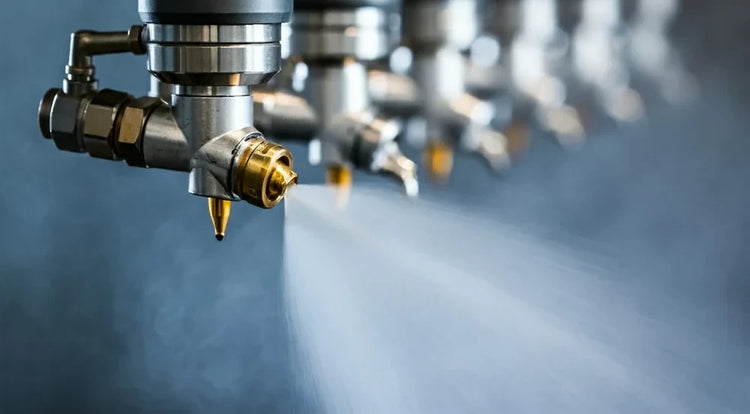
Spray Nozzles for Automotive Service & Maintenance Shops
High-performance spray nozzles for parts washing, engine degreasing, bay floor cleaning, equipment cooling, and general shop maintenance — built for the chemical demands and duty cycles of professional repair facilities

Automotive service and maintenance shops run spray systems that are in contact with some of the most chemically aggressive fluids in any industrial environment — concentrated alkaline degreasers for engine and transmission cleaning, brake cleaner solvents, cutting fluids, hydraulic oil, gear oil, and acid-based wheel cleaners, often at elevated temperatures and high pressures. A flat-fan nozzle that delivers inconsistent coverage across a parts washer basket leaves greasy residue on components that comes back as a comeback repair. A high-pressure nozzle tip that wears prematurely from abrasive coolant particulate wastes water and reduces cleaning impact on heavily soiled bay floors.
NozzlePro supplies spray nozzles for all service shop applications — flat-fan for parts washers and degreasing cabinets, high-pressure for bay floor and undercarriage cleaning, full-cone for rinse stages and chemical application, air nozzles for blow-off and drying, and rotary jet devices for tank and sump cleaning. Material selection verified against the specific cleaning chemistry at each station — from heated alkaline degreaser to solvent-based brake cleaner.
Automotive service and maintenance shops use spray nozzles across four main application areas: parts washing and degreasing uses flat-fan nozzles in spray cabinet and conveyor washer systems for uniform alkaline detergent coverage on engine components, transmissions, and brake parts; bay and floor cleaning uses high-pressure flat-fan or solid-stream nozzles for oil, grease, and coolant removal from workshop floors and service bays; equipment and component cooling uses full-cone or fog/mist nozzles for temperature management on brake lathes, welding equipment, and machining stations; and general washdown and rinsing uses flat-fan and full-cone for detergent rinse, parts rinse, and general equipment cleaning. Material requirements vary by station — nozzles in alkaline degreaser service require EPDM seals; solvent-based cleaning stations require Viton or PTFE seals; high-pressure bay washing benefits from TC orifice inserts where grit-laden floor wash water accelerates standard stainless wear.
Service Shop Nozzle Collections
Shop by application or nozzle type
Service & Maintenance Shop Applications
Nozzle recommendations for each service station — matched to chemistry, pressure, and soil type
Parts Washing & Degreasing
- Spray Cabinet Washers: Flat-Fan for uniform alkaline detergent coverage across engine blocks, transmission cases, and brake components
- Conveyor Parts Washers: Flat-fan arrays matched to conveyor width and line speed — flow-matched across all header positions
- Immersion Tank Agitation: Full-Cone submerged jets for bath agitation and soak enhancement
- Hot Alkaline Service: 316L SS body with EPDM seals for most alkaline degreasers; Viton seals for petroleum solvent or ester-based cleaners
Bay Floor & Facility Cleaning
- High-Pressure Floor Washing: High-Pressure flat-fan for oil, grease, coolant, and brake dust removal from concrete floors
- Undercarriage & Lift Cleaning: Solid Stream for targeted impact in tight access areas under vehicles on lifts
- Wide-Area Bay Washdown: Wide Flat-Fan (40°–65°) for efficient floor coverage during end-of-shift washdown
- Grit Environments: TC Orifice Inserts where floor wash water carries sand, grit, and metal swarf
Equipment & Component Cooling
- Brake Lathe & Machining Cooling: Full-Cone for coolant delivery to cutting tools and rotating components
- Welding Station Cooling: Fog & Mist for ambient temperature reduction around MIG/TIG welding stations
- Battery & Electrical Testing: Fine mist for controlled ambient cooling during dyno and load testing of hybrid and EV systems
- Tyre Inflation Cooling: Targeted air nozzle blow-off after high-heat tyre mounting operations
Blow-Off & Air Drying
- Parts Blow-Off After Washing: Air Nozzles for targeted water and debris removal from washed components before assembly
- Electrical Component Drying: Controlled air nozzle drying of sensors, connectors, and modules after cleaning
- Chip and Swarf Clearance: High-velocity air jets for machining chip removal from brake lathes and drill presses
- Pre-Paint Blow-Off: Clean, dry air stream across panel surfaces before body shop primer application
Fluid & Chemical Application
- Brake Cleaner Application: Directed spray for targeted solvent application to brake callipers, rotors, and drums — Viton or PTFE seals required
- Rust Inhibitor & Undercoating: Hydraulic Atomizing for even film application of underbody rust preventive and cavity wax
- Tyre Bead Lubricant: Directed flat-fan for precise lubricant application to tyre bead seating surfaces
- Coolant System Flush: Full-Cone for radiator and cooling system flush chemical distribution
Tank, Sump & Waste Oil Cleaning
- Parts Washer Tank Cleaning: Rotary Jet Devices for solvent tank and parts washer basin cleaning between fluid changes
- Waste Oil Collection Sumps: High-impact rotary jets for sump cleanout at oil change intervals
- Coolant Recovery Tanks: Full-cone or rotary jet for coolant recycling tank cleaning before fluid replacement
- Chemical Storage Drum Rinsing: Rotary jet devices sized for drum diameter for complete internal rinse coverage

Nozzle Selection Reference — Service Shop Applications
Recommended nozzle type, material, and operating notes by application station
| Application | Nozzle Type | Body / Seal Material | Key Note |
|---|---|---|---|
| Spray Cabinet Parts Washer | Flat-Fan | 316L SS / EPDM | Flow-match all positions; Viton seals for petroleum solvent cleaners; 40–80 mesh strainer upstream |
| High-Pressure Bay Floor Washing | High-Pressure Flat-Fan | 316L SS / TC Insert | TC orifice inserts for grit-contaminated floor water; standard stainless wears rapidly in abrasive wash service |
| Engine & Transmission Degreasing | Flat-Fan | 316L SS / EPDM or Viton | EPDM for alkaline water-based degreasers; Viton for solvent or ester-based cleaning chemistries |
| Brake Lathe / Machining Coolant | Full-Cone | 316L SS / EPDM | Full-cone for uniform tool and workpiece coverage; verify coolant additive compatibility with seal material |
| Parts Blow-Off After Wash | Air Nozzles | 316L SS or polymer | No liquid atomisation — directed air stream only; OSHA 29 CFR 1910.242 limits dead-end air pressure to 30 PSI for chip clearance |
| Undercoating & Rust Preventive | Hydraulic Atomizing | 316L SS / Viton | Viton seals for oil-based rust preventive and wax-based underbody coatings; verify viscosity at application temperature |
| Bay Ambient Cooling / Welding | Fog & Mist | 316L SS / EPDM | 10–100 µm droplets for evaporative cooling; avoid direct spray on electrical components and open vehicles |
| Tank & Sump Cleaning | Rotary Jet Device | 316L SS / EPDM or Viton | Select static or rotary based on tank volume and soil load; size from vessel diameter and available supply pressure |
Service Shop Nozzle Selection Principles
What determines correct specification in automotive service and maintenance environments
- Parts Washer Nozzle Flow-Matching Determines Cleaning Uniformity — In a spray cabinet parts washer, all nozzles in the rotating arm or stationary header must deliver equal flow at operating pressure to ensure every surface of the component receives the same detergent coverage and impact energy. A single worn nozzle in a parts washer arm delivers 15–20% more flow than its rated value — the resulting flow imbalance reduces system pressure and degrades cleaning impact at the remaining positions. Replace all nozzles in a parts washer arm simultaneously rather than individual worn tips. Install 40–80 mesh inline strainers upstream of the washer manifold to prevent chip and debris from accelerating orifice wear — machined metal swarf in parts washer tanks is highly abrasive to precision nozzle orifices.
- Seal Material Is the Most Common Failure Point in Service Shop Nozzles — Automotive service shops use the widest chemistry range of any single industrial spray application — hot alkaline degreaser (pH 11–13), petroleum-based brake cleaner, glycol-based coolant with corrosion inhibitor additives, gear oil, hydraulic fluid, and acid-based descalers may all be present in the same facility. Standard EPDM seals perform well in alkaline water-based degreasers and coolant systems but degrade rapidly in petroleum solvent, ester-based, and oil-based service. Specify Viton seals for any nozzle in contact with solvent-based brake cleaner, engine flush, penetrating oil, or petroleum-based undercoating — EPDM swells and fails within days in hydrocarbon solvent contact. Never assume a single seal material is adequate across all stations in the same shop.
- High-Pressure Bay Washing Requires TC Tips in Shops with Grit-Contaminated Floor Water — Workshop floor wash water collects metal swarf from brake lathes, sand and grit tracked in from the yard, machining chips from drill presses, and abrasive particles from disc grinding. This contaminated water passes through high-pressure wash nozzle orifices at 50–150 bar, wearing standard stainless orifices at a rate that requires replacement every 2–4 weeks in a busy shop. TC orifice inserts in high-pressure flat-fan bodies last 3–6 months in the same conditions and are cost-effective in any shop doing significant floor washing or undercarriage cleaning at pressure.
- Air Nozzle Pressure Must Comply with OSHA 29 CFR 1910.242(b) — OSHA regulations limit air nozzle dead-end pressure to 30 PSI for chip clearing and parts blow-off applications in workshops. High-pressure compressed air directed at skin can cause air embolism — a serious and potentially fatal injury. Specify air nozzles with chip guards or baffled outlets that prevent dead-end pressure above 30 PSI while maintaining adequate velocity for chip and water clearance. This is particularly relevant for brake lathe chip clearance and parts blow-off after washing where technicians frequently use compressed air wands in close proximity to their hands.
- Heated Parts Washer Temperature Affects Seal Life and Nozzle Performance — Spray cabinet parts washers typically operate at 60–80°C with alkaline detergent. At elevated temperatures, seal material degradation rates increase significantly — EPDM that would last 12 months at ambient temperature may require replacement every 4–6 months at continuous 70°C service. Nozzle orifice flow also increases with temperature as the wash solution viscosity decreases — a nozzle rated at a specific flow at 20°C delivers approximately 5–8% more flow at 70°C, slightly reducing system pressure. Both effects are manageable with the correct seal material selection and periodic flow verification at operating temperature. Never use PTFE seals in heated rotary parts washer applications — PTFE creeps at elevated temperatures under compression, causing seal leakage at the nozzle connection.
Why Choose NozzlePro for Service & Maintenance Shops?
Chemical compatibility across the full service shop chemistry range — from heated degreaser to solvent brake cleaner
Full Chemistry Range Coverage — One Source for Every Station
Service and maintenance shops present a broader chemistry range in a single facility than most industrial operations — alkaline degreaser, petroleum solvent, glycol coolant, gear oil, hydraulic fluid, and brake cleaner may all require spray nozzles within 20 metres of each other. Each requires independent material verification. NozzlePro specifies nozzle body and seal material for each station's specific chemistry rather than supplying a single "shop nozzle" that fails in solvent service or corrodes in acid descaler.
Parts Washer Support: Complete nozzle sets for spray cabinet and conveyor parts washers — all positions flow-matched and verified at operating temperature and pressure. Replacement sets staged for scheduled maintenance without extended washer downtime.
Application Sizing: Parts washer arm nozzle spacing from basket size and rotation speed. Bay floor high-pressure nozzle selection from pump specifications, standoff distance, and soil description. Contact our application team with your specific equipment and chemistry — we'll specify the right nozzle for each station.
Frequently Asked Questions
Common questions about spray nozzles for automotive service and maintenance shops
What nozzles are best for a spray cabinet parts washer in an automotive service shop?
Flat-fan nozzles are standard for spray cabinet parts washers — they deliver a defined spray pattern that can be positioned to cover the component surfaces in the basket with uniform detergent impact. In rotating-arm cabinet washers, nozzle spacing on the arm is calculated to ensure complete basket coverage through the full rotation cycle without gaps or excessive overlap that wastes detergent. All nozzles in the arm must be flow-matched within ±5% of the rated flow at operating pressure to ensure uniform coverage. Install 40–80 mesh inline strainers upstream of the manifold — parts washer solution accumulates metal swarf and chips that block or wear nozzle orifices rapidly. For heated parts washers operating at 60–80°C, specify EPDM seals for alkaline water-based cleaning solutions and Viton seals for petroleum solvent or ester-based cleaning chemistries.
What nozzle material is compatible with solvent-based brake cleaner and parts cleaner?
Solvent-based brake cleaner and aerosol-style parts cleaner contain chlorinated solvents (perchloroethylene, trichloroethylene), petroleum naphthas, acetone, or isopropanol — depending on the formulation. All of these degrade EPDM seals rapidly. For brake cleaner application nozzles and spray wands, specify Viton (FKM) seals for most chlorinated solvent and petroleum-based formulations; PTFE seals for ketone-based formulations (acetone, MEK) that attack Viton. The nozzle body — 316L SS — is adequate for most brake cleaner chemistries at ambient temperature. If applying at elevated temperature or concentration, verify the specific solvent against stainless compatibility. For water-based aerosol brake cleaners (the "VOC-compliant" formulations), standard EPDM seals are adequate.
How do I choose between flat-fan and solid-stream nozzles for bay floor cleaning?
The choice depends on the soil type and the access geometry of the area being cleaned. Flat-fan nozzles (15°–40°) are the standard for general bay floor washing — they deliver a wide, consistent coverage band that efficiently covers large flat floor areas in overlapping passes, removing oil film, coolant spills, and light soiling with good water efficiency. Solid-stream (0°) nozzles are used for targeted high-impact cleaning where soil is compacted or packed into recesses — underneath vehicle lifts, around drain grates with built-up grease accumulation, and along wall and floor joints where floor washer coverage doesn't reach. In most service bays, the most efficient setup uses flat-fan for the open floor and a solid-stream tip for the detail work around drains and lift bases. TC orifice inserts are recommended for both tip types in any shop where floor wash water contains visible grit or metal swarf from machining or grinding operations.
How often should parts washer nozzles be inspected and replaced?
Inspect parts washer nozzles monthly by flow-checking a sample from each arm position at operating temperature and pressure. Replace the full arm set when the measured average flow deviates more than 10% above the rated value — worn orifices increase flow, reduce system pressure, and degrade cleaning impact across the washer. In high-throughput shops processing heavily soiled components daily, inspection intervals may need to shorten to every 2–3 weeks. Signs of required replacement without flow measurement: visible distortion or streaking in the spray pattern during operation, reduced cleaning performance on standard soil types, or visible orifice enlargement on inspection. Replace full arm sets simultaneously — mixing worn and new nozzles creates flow imbalance worse than uniform wear.
What are the best nozzles for vehicle underbody rust preventive and undercoating application?
Hydraulic atomizing nozzles are standard for underbody rust preventive and wax-based undercoating application in service shops — they produce a fine, uniform film using line pressure alone without requiring compressed air, making them practical for wand-style application under vehicles on lifts. The key specification requirements are: orifice size matched to the product viscosity at application temperature — most professional undercoating products are applied warm (40–60°C) to reduce viscosity to a sprayable range; Viton seals for petroleum wax and oil-based rust preventive formulations (EPDM swells and fails in oil-based contact); and a spray angle (typically 25°–65° flat-fan or hollow-cone) that covers the underbody panel width efficiently from the standoff distance available under the vehicle. Test the specific undercoating product through the candidate nozzle at the intended application temperature and pressure before deploying — viscosity varies significantly between products and seasons.
Talk with a NozzlePro Service Shop Specialist
Share your application, cleaning chemistry, equipment type, and operating pressure — we'll specify the right nozzle, seal material, and orifice for every station in your shop.