
The Complete Guide to
Dairy Plant Spray Nozzles & Washdown Systems
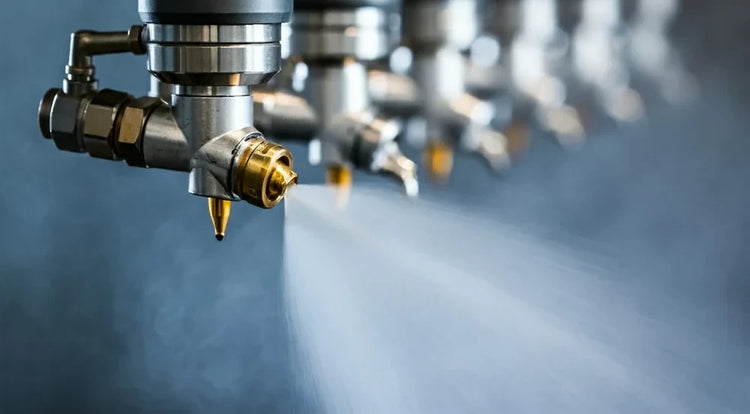
Every spray nozzle and washdown gun that contacts a dairy processing environment must satisfy three simultaneous constraints that have no equivalent in general industrial spray applications: 3-A Sanitary Standards acceptance, FDA 21 CFR compliance, and USDA Dairy Program equipment guidelines. This hub maps every spray application in a dairy plant — CIP silos, cheese vats, bottling lines, and facility washdown — to the correct NozzlePro and SuperKlean hardware specification.
3-A Sanitary Standards are the U.S. industry framework governing the design and fabrication of dairy processing equipment — including spray nozzles and washdown devices — to prevent microbiological contamination of milk and milk products. A spray nozzle that does not comply with 3-A Standard No. 78-03 for CIP systems cannot legally be used in a Grade A dairy facility as defined under the FDA Pasteurized Milk Ordinance (PMO). For plant engineers specifying replacement or upgrade spray hardware, 3-A acceptance is not optional — it is the minimum equipment qualification for any surface that contacts the product, contacts cleaning solutions that subsequently contact the product, or is located in a zone where airborne contamination is possible.
FDA 21 CFR Part 110 (Current Good Manufacturing Practice) and the PMO require that all food-contact surfaces be fabricated from nontoxic, non-absorbent, corrosion-resistant materials capable of withstanding repeated exposure to the cleaning and sanitizing chemicals used in dairy CIP circuits — typically 1.5–3% NaOH caustic wash at 70–80°C, 1–2% HNO₃ acid rinse, and 100–200 ppm peroxyacetic acid sanitizer. The material that satisfies all these requirements in spray nozzle construction is electropolished 316L stainless steel: 316L rather than 304 because its higher molybdenum content resists chloride pitting from hypochlorite sanitizers, and electropolished because it achieves the Ra ≤32 µin surface finish below which Listeria biofilm cannot maintain stable attachment under CIP flow velocities.
Dairy Spray & Washdown Coverage Matrix
Select the application that matches your process zone. Each sub-page contains position-specific nozzle specifications, flow rate data, chemical compatibility, and engineering reference blocks.
| Application Zone | Primary Equipment | Key Standard | Critical Spec | Sub-Page |
|---|---|---|---|---|
| Milk silos & storage tanks — CIP | Rotary impingement nozzles | 3-A 78-03 / PMO | Full 3D coverage; eliminates agitator shaft shadow zones; 60% water saving vs. static | CIP Silo & Tank Nozzles → |
| Cheese vats & cultured dairy vessels | High-impact rotating jet cleaners | 3-A 78-03 / FDA | 3.5–5 bar; 40–80 kPa impact; disrupts casein biofilm; 90°C compatible | Cheese Vat Nozzles → |
| GMP facility floor & equipment washdown | SuperKlean washdown stations, guns & hoses | FDA 21 CFR 110 | 200°F rated; ergonomic water-saver trigger; drop-resistant rubber casing | GMP Washdown → |
| Bottling, capping & conveyor lubrication | Air-atomizing & flat-fan nozzles | FDA 21 CFR 110 | PAA sanitizing mist 50–150 µm; conveyor lube at 0.5–2 mL/min; 400–1,200 BPM | Bottling & Conveyor → |
| SuperKlean flagship washdown gun | SuperKlean Water-Saver Nozzle | FDA 21 CFR 110 | 200°F; rebuildable cartridge; variable pattern; drop-tested rubber body | SuperKlean Gun → |
Four Engineering Pillars for Dairy Spray Compliance
Dairy processing is the most demanding sanitary spray environment in the food industry — hot caustic cycles, cryogenic chill water, high-speed packaging lines, and USDA-inspected product zones coexist in the same facility. Here is what makes NozzlePro hardware specification-ready for every zone.
316L Electropolished Stainless Steel Throughout
Material compliance — 3-A / FDA / PMOEvery NozzlePro dairy-grade nozzle body, orifice insert, and connection fitting is manufactured from ASTM A276 316L stainless steel and electropolished to Ra ≤32 µin (0.8 µm) internal surface finish — the threshold below which dairy biofilm formation rate drops to near zero, per EHEDG and 3-A engineering studies.
No Crevices, No Dead Legs, No Threads in Product Zones
Hygienic design — EHEDG / 3-A geometry3-A Standard No. 78-03 prohibits threaded connections, gaps, and crevices in any nozzle component exposed to product or CIP cleaning solution. NozzlePro dairy nozzles use smooth-bore tri-clamp or sanitary butt-weld connections with internal radii ≥3/16 inch and no internal cavities that cannot be reached by CIP solution flow.
Chemical Compatibility for the Full Dairy CIP Sequence
NaOH caustic · HNO₃ acid · PAA sanitizerThe standard dairy CIP chemical sequence cycles the spray nozzle through acidic, alkaline, and oxidizing environments within a single hour. NozzlePro dairy nozzle materials are validated against the complete sequence — not just one chemical at a time.
ISO 9001 Manufacturing & Traceability
Consistent orifice dimensions · material certs · batch traceabilityNozzlePro is certified to ISO 9001 for manufacturing. Batch traceability allows any installed nozzle to be traced to its production run within the NozzlePro quality management system.
Dairy Spray Nozzle Engineering: Questions & Answers
Dairy plants require electropolished 316L stainless steel spray nozzles because three regulatory frameworks — the FDA Pasteurized Milk Ordinance, 3-A Sanitary Standard No. 78-03, and USDA Dairy Program equipment guidelines — mandate that all food-contact and CIP-contact surfaces be fabricated from nontoxic, corrosion-resistant material with a smooth, cleanable finish. 316L SS provides the necessary corrosion resistance to the complete dairy CIP chemical sequence (1.5–3% NaOH at 80°C, 1% HNO₃ at 70°C, 100–200 ppm PAA) through its higher molybdenum content vs. 304 SS. Electropolishing reduces the surface finish from the Ra 64–125 µin left by standard machining to Ra ≤32 µin (0.8 µm) — the EHEDG-validated threshold below which Listeria monocytogenes and other dairy pathogens cannot maintain stable biofilm attachment under normal CIP flow velocities.
Switching from static spray balls to rotary impingement CIP nozzles in milk silo and storage tank cleaning typically reduces CIP water consumption by 50–70% per cleaning cycle for equivalent tank coverage quality. A static spray ball cleaning a 100,000-liter silo requires 2,000–3,000 liters of water per CIP cycle; a rotary impingement nozzle achieves the same or superior mechanical cleaning action using 600–900 liters per cycle by concentrating the flow into high-velocity jets rather than distributing it as low-pressure cascading flow. For a dairy plant running four silo CIP cycles per day, this represents a water saving of 4,400–8,400 liters per day per silo — plus proportional savings in heating energy, chemical consumption, and wastewater treatment volume.
The correct CIP nozzle for cleaning behind an agitator shaft is a rotary impingement nozzle rather than a static spray ball. Agitator shafts, bearing housings, and impeller hubs create geometric shadow zones in the tank interior that static spray balls cannot reach with adequate impact velocity. Listeria monocytogenes, which forms persistent biofilms in dairy environments at temperatures as low as 4°C, exploits these shadow zones as refugia between CIP cycles. A rotary impingement nozzle produces 2–4 high-velocity jets at 3.5–6 bar that rotate in a programmed 3D pattern, systematically covering all tank surfaces including the geometry behind agitator shafts. The mechanical impact from the concentrated jet physically disrupts the biofilm structure in a way that low-velocity cascade flow from a static spray ball cannot replicate.
NozzlePro does not hold 3-A Symbol Program type approval on its dairy spray nozzles. NozzlePro is certified to ISO 9001 for manufacturing and supplies dairy-grade nozzles fabricated to 316L SS with electropolished Ra ≤32 µin surface finish, tri-clamp sanitary connections, and FDA-compliant EPDM/PTFE seals — the material and design requirements defined in 3-A Sanitary Standard No. 78-03. Customers are responsible for their facility's 3-A compliance determination and equipment qualification using industry-standard testing protocols.
Dairy CIP Chemical Sequence & Nozzle Compatibility
Key Parameters for Dairy Spray Nozzle Specification
Every Dairy Spray Zone. One Engineering Partner.
CIP silos, cheese vats, bottling lines, facility washdown — NozzlePro and SuperKlean cover every spray application in your plant. Contact our dairy application engineers with your process zone, tank dimensions, and CIP parameters.
Dairy Sub-Pages & Related Collections