
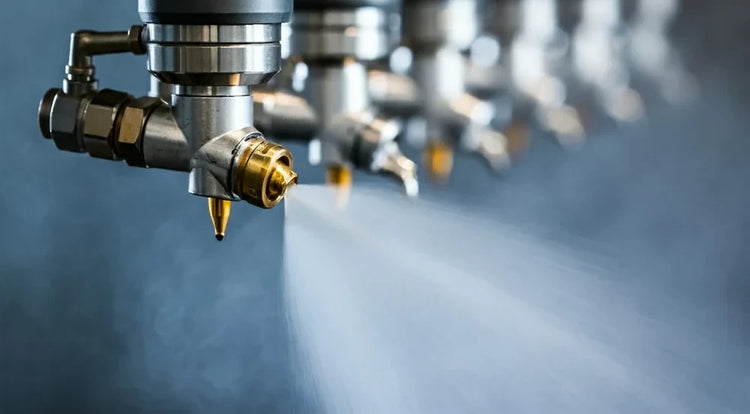
Spray Nozzle
Material Selection Guide
The right nozzle material for your application depends on the liquid being sprayed, the operating temperature, and the mechanical demands of the service. This guide covers every NozzlePro body material and seal option — what each one handles well, what it doesn't, and how to choose between similar options.
Every spray nozzle has two material decisions: the body material (brass, stainless, PVDF, etc.) and the seal material (PTFE, EPDM, Viton, etc.). Both must be chemically compatible with the liquid being sprayed and the operating temperature. A 316 stainless body with EPDM seals that is incompatible with your liquid is as much a failure as the wrong body material — and seal failures are often faster and harder to detect.
Work through the body materials first to identify the correct structural material for your application, then confirm the seal material against your specific liquid. If you have any uncertainty about compatibility, contact NozzlePro's application team with the liquid name or composition, concentration, and operating temperature before ordering.
Brass is the standard material for the broadest range of NozzlePro spray nozzles. Its combination of machinability, dimensional stability, and moderate corrosion resistance makes it the right choice for water, mild cleaning solutions, and most standard industrial applications where the liquid is not highly corrosive and metal ion contamination is not a concern.
Brass is a copper-zinc alloy — this matters for compatibility. Applications involving ammonia or amines can cause stress corrosion cracking in brass under some conditions. Applications requiring metal-free contact with product (food, pharmaceutical, electronics) should use stainless or plastic alternatives. But for the majority of industrial washdown, cooling, and process spray applications using water-based liquids at ambient to moderate temperatures, brass delivers the best combination of performance and value.
316 stainless steel is the standard upgrade from brass for any application involving corrosive liquids, elevated temperatures, or product cleanliness requirements. The addition of molybdenum (2–3%) to the 316 alloy significantly improves resistance to chloride pitting compared to 304 stainless — making 316 the correct choice for washdown and CIP applications in food processing, pharmaceutical, and chemical facilities where cleaning agents and process chemicals are involved.
316 SS handles the full range of neutral to moderately acidic and alkaline solutions that brass cannot — dilute sulfuric acid, sodium hydroxide solutions to moderate concentrations, most common cleaning agents, hot water and steam, and many solvents. Its temperature rating to approximately 400°F makes it suitable for hot washdown, steam, and elevated-temperature process spray applications where plastic materials would be inadequate.
304 vs. 316 Stainless — Always Specify 316
NozzlePro specifies 316 stainless as the standard for all stainless nozzles. When buying from any supplier, confirm the alloy is 316 (UNS S31600) and not 304 (UNS S30400). The difference matters — 304 has no molybdenum addition and is significantly more susceptible to chloride pitting in the wet industrial environments where spray nozzles operate. Do not substitute 304 for 316 in spray nozzle applications involving any chloride-containing liquid or environment.
Polyvinylidene fluoride (PVDF, sold commercially as Kynar) is the fluoropolymer of choice for spray nozzle applications involving aggressive chemicals that exceed the capabilities of 316 stainless steel. Its resistance to strong acids, strong bases, oxidizing agents, halogens, and many organic solvents is excellent — superior to 316 SS in most aggressive chemical environments.
PVDF is particularly common in pharmaceutical and chemical manufacturing applications using peracetic acid (PAA) sanitizers, hydrogen peroxide, strong hypochlorite solutions, and mineral acids. It is also appropriate where metal-free product contact is required and polypropylene's chemical or temperature resistance is insufficient. PVDF has good mechanical strength and impact resistance compared to other fluoropolymers — it machines well and holds precise orifice dimensions reliably.
Polypropylene is the most cost-effective plastic nozzle material and provides good chemical resistance to a wide range of mild acids, alkalis, and aqueous solutions at temperatures below approximately 175°F. It is the correct material when metal is not required, cost must be minimized, and operating temperature and chemical aggressiveness are within polypropylene's capabilities.
Polypropylene's limitations are temperature and solvent resistance. Above 175°F it softens and loses dimensional stability, causing orifice distortion and unreliable spray performance. Against aromatic hydrocarbons (toluene, xylene), chlorinated solvents, strong oxidizing acids, and concentrated sulfuric acid, polypropylene does not hold up. For those services, PVDF or stainless steel is the correct choice.
Hastelloy C-276 is a nickel-molybdenum-chromium alloy with exceptional resistance to corrosion in highly aggressive chemical environments — environments that attack 316 stainless steel rapidly. Its combination of high nickel, high molybdenum, and tungsten content gives it resistance to both oxidizing and reducing acid environments, halide-containing solutions, and mixed acid systems that would be unusable with any lower-tier metallic material.
Hastelloy spray nozzles are specified for chemical process applications involving hydrochloric acid at elevated concentrations or temperatures, wet chlorine gas scrubbing, mixed acid systems, and highly corrosive process streams in specialty chemical and pharmaceutical manufacturing. The cost premium over 316 stainless is substantial — Hastelloy C-276 should be specified only when an application review confirms that 316 SS or PVDF will not provide adequate service life. Contact NozzlePro's application team to confirm whether Hastelloy is genuinely required before ordering.
When the Liquid Carries Solids
Standard nozzle materials wear rapidly in liquids carrying suspended solids. As the orifice enlarges from abrasion, flow rate increases above specification and spray pattern quality degrades — often without any visible sign that the nozzle has worn.
Abrasion in spray nozzles occurs primarily at the orifice — the point of highest liquid velocity. As particles in the liquid stream pass through the orifice at high velocity, they erode the orifice edge and enlarge the opening. The rate of erosion depends on particle hardness, particle concentration, particle size, and liquid velocity (which is set by operating pressure). Higher pressure means higher orifice velocity and faster wear.
When abrasion is a concern, the most effective solution is a harder orifice material — either a hardened insert in a standard body, or a full hard-material nozzle. The service life improvement from upgrading to a hard material is typically 5–20× compared to standard brass or stainless for abrasive liquids.
A worn nozzle orifice is not visible to the naked eye until the damage is severe. The practical detection method is periodic flow measurement: collect the output of each nozzle in a graduated container for one minute and compare to the rated flow at your operating pressure. A flow increase of more than 10–15% above the new-nozzle specification indicates the orifice has enlarged beyond acceptable limits and the nozzle should be replaced. Set a routine flow check schedule based on your expected service life — do not wait for visible damage or obvious spray pattern degradation.
The Second Material Decision — Just as Important as the Body
Seal compatibility is checked separately from body material. A body that is chemically compatible with your liquid may be paired with a standard seal that is not — and the seal will fail first, causing leakage before the body shows any corrosion.
Nozzle seals are the O-rings, gaskets, and seat materials at the threaded connection, between body sections, or at the orifice seat. They are exposed to the full liquid chemistry and temperature. Seal failures manifest as leakage at the body joint — which can be immediate if the liquid aggressively attacks the seal elastomer, or gradual as the seal swells, hardens, or deteriorates over weeks of operation.
Material Selection by Application Type
Use this table as a starting point. Always verify against the specific liquid composition, concentration, and temperature before final selection.
| Application / Liquid Type | Brass | 316 SS | PVDF | PP | Recommended Seal |
|---|---|---|---|---|---|
| Water & general washdown | ✓ | ✓ | ✓ | ✓ | EPDM or PTFE |
| Hot water & steam (>180°F) | ◑ to ~250°F | ✓ | ◑ to 250°F | ✗ | EPDM or PTFE |
| Food processing CIP | ✗ | ✓ | ✓ | ◑ | EPDM or PTFE |
| Pharmaceutical / sanitary | ✗ | ✓ | ✓ | ◑ | PTFE or EPDM |
| Dilute acids (pH 3–6) | ◑ | ✓ | ✓ | ✓ | PTFE or EPDM |
| Strong acids (HCl, H₂SO₄ >10%) | ✗ | ✗ | ✓ | ◑ | PTFE |
| Caustic / alkali (NaOH) | ◑ dilute only | ✓ | ✓ | ✓ | EPDM or PTFE |
| Peracetic acid / H₂O₂ | ✗ | ◑ | ✓ | ◑ | PTFE |
| Petroleum oils & fuels | ✓ | ✓ | ◑ | ✗ | Viton or Buna-N |
| Organic solvents (aromatics) | ✓ | ✓ | ◑ | ✗ | Viton or PTFE |
| Abrasive slurries | ✗ | ◑ hardened insert | ✗ | ✗ | Depends on liquid |
✓ = generally compatible | ◑ = compatible with conditions or limitations | ✗ = not recommended. Verify against specific liquid, concentration, and temperature before specifying.
How to Work Through Material Selection
Material Selected.
Ready to Choose Connection Size?
With body and seal material confirmed, the next step is selecting the correct NPT connection size for your pipe or manifold.