
Spray Nozzles for
Robotic Spray Coating
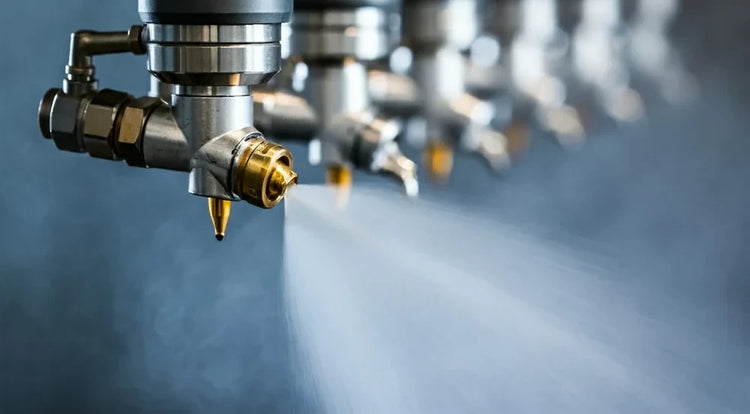
Robotic spray coating systems apply thin, controlled films of liquid to parts or surfaces — mold release agents to tooling before each production cycle, rust inhibitors and anti-corrosion coatings to machined or fabricated metal parts, lubricants to components before assembly, and surface treatments before painting or bonding. The nozzle mounted on the robot arm or fixed in the coating manifold determines film thickness uniformity, material consumption, and whether drips or runs occur at the part edges and in cavities. NozzlePro supplies flat fan nozzles with precise orifice sizing and optional anti-drip features for robotic coating applications across manufacturing and industrial processing.
In manual spray coating, an experienced operator compensates for nozzle variation by adjusting gun speed, distance, and overlap in real time. In a robotic system, the program is fixed — the robot moves at the same speed, at the same standoff distance, with the same overlap on every cycle. Any variation in the nozzle's spray pattern or flow rate directly produces variation in the coating film. A nozzle with an uneven fan pattern deposits more material at the center and less at the edges of each pass, creating stripes in the coating when examined under proper lighting. A nozzle with a slightly enlarged orifice — worn from abrasive coating material or aggressive chemistry — delivers more fluid per pass than the program was calibrated for, causing runs or excess material consumption.
For robotic coating, the nozzle must deliver a consistent, uniform flat fan pattern at the exact flow rate the system was programmed around — cycle after cycle. NozzlePro's ISO 9001 certified manufacturing ensures orifice dimension consistency that makes this repeatability achievable, both within a production batch and across replacement nozzles over the system's service life.
Four Robotic Coating Applications and Their Nozzle Requirements
Each coating application has different material viscosity, required film thickness, surface area, and chemistry — which together determine the nozzle specification.
Flat Fan Angle, Flow Rate, and Anti-Drip Features for Robotic Coating
Spray Angle Selection for Robotic Path Coating
In robotic coating applications, the flat fan spray angle determines the coverage width per robot pass at a given standoff distance. A wider angle covers more surface area per pass but reduces impact energy per unit area and can produce thinner edges with poor overlap characteristics. A narrower angle concentrates the coating material into a tighter band with better edge definition but requires more overlapping passes for complete coverage. For most robotic coating applications at standoff distances of 6–18 inches, a 65°–80° flat fan angle provides the best balance — wide enough for efficient coverage with reasonable pass spacing (40–60% overlap between adjacent passes), narrow enough for good film thickness uniformity across the full fan width.
Narrower fan angles (25°–50°) are used when the robot is working at close standoff distances, in narrow slots or channels, or when high coating material viscosity limits achievable fan width at the available operating pressure. Wider angles (90°–110°) suit large flat surface coating at higher standoff distances where film thickness uniformity requirements are less stringent.
Anti-Drip and Positive Shutoff Nozzles
Standard hydraulic nozzles continue to drip for a fraction of a second after the solenoid valve closes — the residual pressure in the line bleeds off through the nozzle orifice. In a robotic coating application where the robot is moving at 200–600 mm/sec, even a 0.1-second drip after valve close deposits a trail of coating material on the part surface or the nozzle retracts over. Anti-drip nozzles incorporate a spring-loaded ball or needle that positively closes the orifice when line pressure drops below a set threshold — typically 5–15 PSI. When the control valve closes and pressure drops, the anti-drip mechanism closes the orifice within milliseconds, eliminating the tail drip.
When to specify anti-drip vs. standard nozzles
Anti-drip nozzles are the correct specification for any robotic coating application where: (1) the nozzle position moves over completed coated surfaces during retract, (2) the coating material is applied to vertical or overhead surfaces where a drip would be visible in the finished coating, or (3) the cycle rate is high enough that residual drip accumulates and causes coating defects on subsequent parts. Anti-drip nozzles cost more than standard nozzles and have a slightly more complex maintenance requirement — the spring and seat must be inspected during nozzle service intervals. For applications where the nozzle retracts over non-critical areas and drip frequency is low, standard nozzles may be acceptable.
Viscous coating materials require pressure and orifice size confirmation
Standard hydraulic flat fan nozzles are sized for water-like fluids. Coating materials with viscosity above 50 cP — thick rust inhibitors, some mold releases, assembly greases applied as a spray — require larger orifice sizes at the same flow rate to compensate for viscosity-related pressure drop across the orifice. Contact NozzlePro with your coating material's viscosity at operating temperature and the required flow rate; we will confirm the correct orifice size for viscous fluid spray application.
What to Provide When Specifying Robotic Coating Nozzles
Coating applications require more detailed fluid information than wash or quench applications — viscosity, surface tension, and required film thickness all affect orifice selection.
- Coating material, viscosity, and carrier type — Water-based, solvent-based, or oil-based; viscosity in cP at the operating temperature. This determines body and seal material, and whether the standard catalog orifice sizing applies or a larger orifice is needed for viscous fluid.
- Required film thickness or application rate — Target wet film thickness (microns or mils) or target application rate (grams per square meter or fluid ounces per square foot). This, combined with robot speed and standoff distance, determines the required flow rate per nozzle.
- Operating pressure at the nozzle — Supply pressure after all upstream losses (regulator, solenoid valve, line length). Confirm this is the pressure at the nozzle, not at the pump outlet.
- Standoff distance and coverage width required per pass — Distance from nozzle tip to part surface at the programmed robot position, and the desired spray band width at that distance. These two parameters determine the correct fan angle.
- Vertical, overhead, or horizontal spray orientation — Determines whether anti-drip nozzle specification is required. Vertical and overhead coating positions always require anti-drip.
- Cycle rate and nozzle on-time per cycle — High-cycle applications with short on-times stress the anti-drip mechanism more than low-cycle applications. Provide cycles per hour and nozzle activation duration per cycle for anti-drip nozzle life assessment.
Robotic Coating Nozzle Selection by Application
| Application | Pattern | Angle | Pressure | Material | Anti-Drip | Note |
|---|---|---|---|---|---|---|
| Mold release — injection / die cast | Flat fan | 65°–80° | 10–40 PSI | SS or PVDF | Required | Low flow; cavity faces often vertical or overhead |
| Rust inhibitor — machined steel parts | Flat fan | 65°–80° | 30–80 PSI | 316 SS / EPDM | Situational | Water-based inhibitor standard; film thickness calibration required |
| Assembly lubricant — precision | Flat fan | 50°–70° | 10–30 PSI | 316 SS / Buna-N | Required | Very low flow; confirm seal for lubricant base type |
| Stamping / press lubricant | Flat fan | 65°–80° | 30–80 PSI | 316 SS / Buna-N | Situational | PLC-timed to press stroke; higher flow than assembly lube |
| Adhesion promoter / activator | Flat fan | 65°–80° | 20–60 PSI | PVDF / PTFE | Required | Confirm chemistry compatibility; minimize dead volume in lines |
| Conversion coating (chromate, zirconate) | Flat fan | 65°–80° | 20–60 PSI | PVDF / PTFE | Situational | PVDF required — aggressive chemistry; confirm with chemistry supplier |
| Viscous coating (>50 cP) | Flat fan | Per application | Confirm with NozzlePro | Per chemistry | Required | Larger orifice needed; contact NozzlePro for sizing |
Specifying Nozzles for a Robotic Coating System?
Share your coating material, viscosity, required film thickness, operating pressure, standoff distance, and whether anti-drip is needed. NozzlePro will specify the correct flat fan nozzle, orifice size, material, and anti-drip option for your automated coating application.