

641 Products
Choose a series
Compare the series below, then select a nozzle to see its specifications.


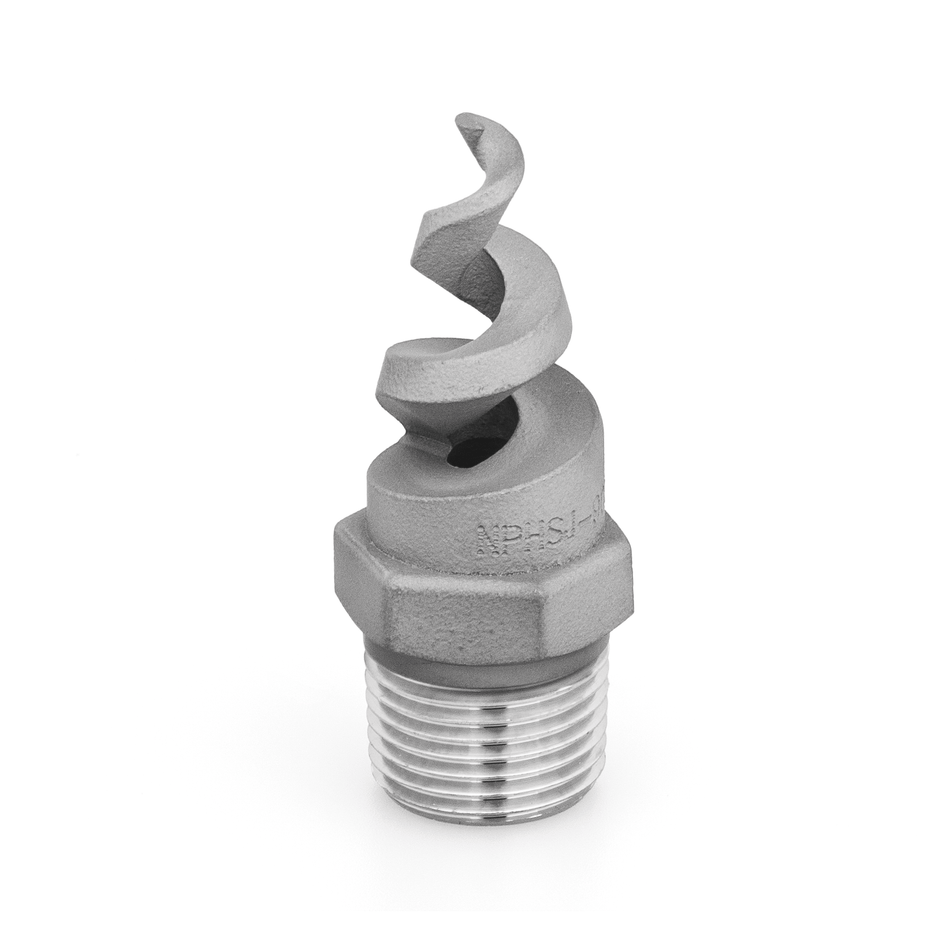


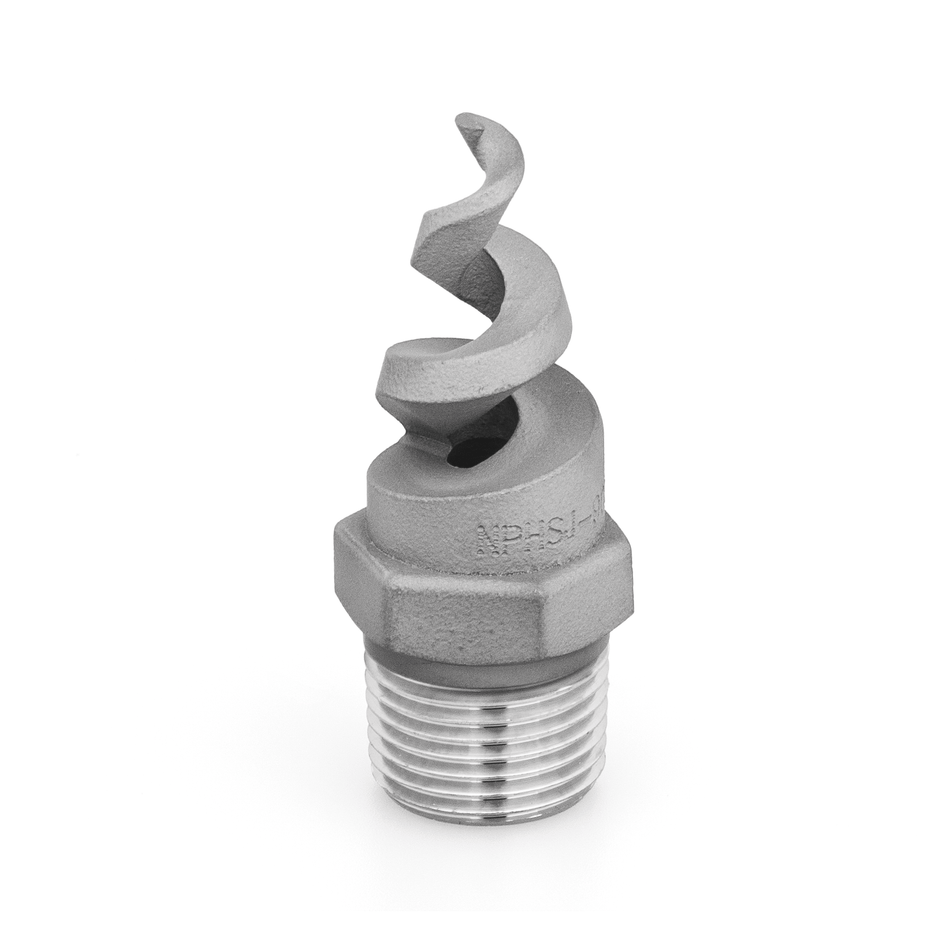


Spiral Spray Nozzles for Clog-Free Performance with Slurries and Viscous Fluids
Spiral nozzles use a free-passage design to deliver full or hollow cone patterns with superior resistance to clogging.
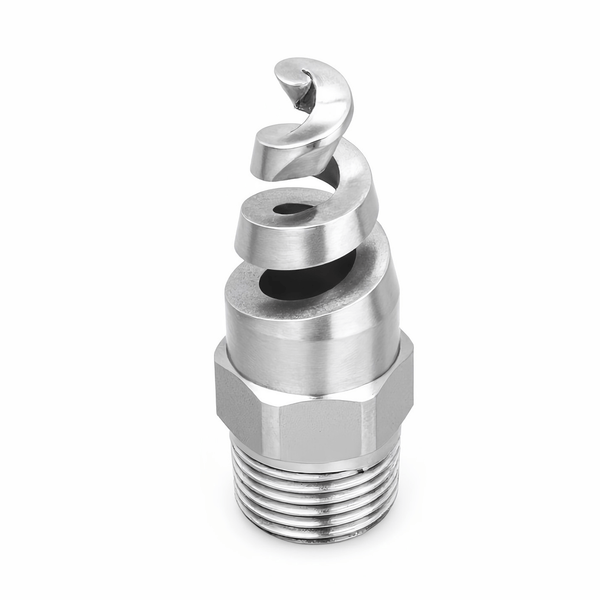
Spray Pattern
Spiral
Available SKUs
641 Products
Quality
Industrial Grade
Shipping
Ships Fast
How Spiral Spray Nozzles Work
Operating principles and performance characteristics
Operating Principle
Liquid enters the nozzle body and flows over the outer surface of a spiral-shaped deflector, a continuously curved helical surface with no internal ports, orifices, or vanes. The helical geometry imparts rotational energy to the fluid as it travels along the spiral. As the liquid separates from the tip of the deflector, centrifugal force spreads it outward into a cone-shaped spray. Full cone spiral nozzles use a deflector geometry that distributes the liquid evenly across the spray circle; hollow cone variants concentrate the spray at the perimeter by controlling the degree of centrifugal spread at the exit point. The free-passage clearance, the maximum diameter of a sphere that can pass through the nozzle without obstruction, is governed by the spacing between the deflector spirals, not by a narrow orifice bore. This is why spiral nozzles continue to perform in conditions that would clog any conventionally bored nozzle of equivalent flow rate.
What to Compare
Compare spiral spray pattern, capacity, material options such as 316L stainless steel, polypropylene, PTFE, and PVC, and connection details such as 3/8 in., 1/4 in., and 1/2 in. with NPT connections where available.
Installation & Maintenance
Start with the process result you need, then confirm mounting distance, pressure at the nozzle, fluid compatibility, and how easily the part can be serviced.
Spiral Nozzle Applications
Spiral Nozzles are the preferred choice for slurries, viscous fluids, liquids with suspended solids, and gas scrubbing.
Cleaning & Washing
Support rinsing, washdown, parts cleaning, and surface cleanup with coverage and impact matched to the soil load and line speed.
Cooling & Quenching
Control part temperature and process heat with spray coverage sized for the required cooling rate and heat removal.
Dust & Pollution Control
Capture airborne dust, cool gas streams, and suppress fugitive emissions with the right droplet size and coverage.
Fire Protection & Safety
Support cooling, deluge, and protective spray coverage where system reliability and distribution matter.
Spiral Nozzle Selection Guide
Select flow rate, cone angle, and material based on fluid viscosity, particle size, and operating pressure requirements.
Flow Rate & Pressure
Start with the flow rate you need at the operating pressure available at the nozzle or assembly.
Spray Pattern & Coverage
Choose the spiral spray pattern that best matches the coverage width, impact, atomization, or washdown result your process requires.
Materials & Connections
Select wetted materials compatible with the fluid, temperature, and wear conditions; common options may include 316L stainless steel, polypropylene, PTFE, and PVC; common sizes include 3/8 in., 1/4 in., and 1/2 in. with NPT connections where available.
Maintenance & Reliability
Consider clogging risk, wear life, ease of change-out, and the maintenance routine your process can realistically support.
Industries Using Spiral Spray Nozzles
Mining, wastewater treatment, chemical processing, and power generation use spiral nozzles for reliable performance in demanding fluids.
Spiral Nozzle FAQ
Answers to common questions about spiral nozzle free-passage clearance, cone angle options, and material selection.
What is a spiral nozzle?
A spiral nozzle produces a full cone or hollow cone spray pattern using a free-passage helical deflector rather than an internal orifice. Because there are no narrow passages for liquid to flow through, spiral nozzles resist clogging in applications where standard nozzles fail. They are also referred to as pigtail nozzles, helix nozzles, and corkscrew nozzles, all describing the same design principle.
What is the difference between spiral full cone and spiral hollow cone nozzles?
Spiral full cone nozzles distribute liquid uniformly across the entire spray circle, including the center. Spiral hollow cone nozzles concentrate spray at the perimeter of the cone, leaving the center relatively open. Full cone patterns are used when broad, even coverage is required — for example, in scrubber towers or cooling systems where the entire target area needs to be wetted. Hollow cone is preferred when maximizing droplet-to-gas contact at the spray perimeter matters, such as in venturi scrubbers and high-efficiency quench nozzle banks.
Are spiral nozzles suitable for slurries?
Yes, clog resistance in slurries and viscous fluids is the primary reason spiral nozzles are specified. The free-passage clearance accommodates particles, fibers, and entrained solids that would block the internal orifice of a standard hydraulic nozzle of the same flow rate. Always confirm the free-passage specification against the maximum particle size in your fluid before selection.
What materials are NozzlePro spiral nozzles available in?
NozzlePro spiral nozzles are available in 303/304 stainless steel, 316L stainless steel, and Teflon (PTFE). 316L is specified for corrosive media and chloride-containing fluids. Teflon is appropriate for highly aggressive chemical environments where stainless steel would corrode. Contact NozzlePro engineering if your application involves unusual chemical compatibility requirements.
What inlet sizes and connections are common for Spiral Spray Nozzles?
Common options vary by series, but many selections compare sizes such as 3/8 in., 1/4 in., and 1/2 in. with NPT connections where available.
What is free-passage clearance and why does it matter?
Free-passage clearance is the maximum diameter of a sphere that can pass through the nozzle without blockage. For spiral nozzles, this is determined by the gap between the helical deflector spirals rather than by a drilled orifice. Larger spiral nozzles typically offer clearances of 5–15 mm or more. Matching the free-passage spec to your actual maximum particle size prevents blockage and avoids costly maintenance downtime.
Which applications are common for Spiral Spray Nozzles?
Common applications include Cleaning & Washing, Cooling & Quenching, Dust & Pollution Control, and Fire Protection & Safety.
Which industries commonly use Spiral Spray Nozzles?
Spiral Spray Nozzles are frequently selected in Building Materials, Chemical Processing, Energy & Power Generation, and Mining.
How can I reduce clogging, wear, or maintenance issues with Spiral Spray Nozzles?
Choose the correct material and orifice design for the fluid, verify filtration where needed, and set a maintenance routine based on actual service conditions.
When should I contact NozzlePro about Spiral Spray Nozzles?
Reach out when you need help balancing process performance, pressure, chemistry, maintenance access, or multiple candidate series.
Related Clog-Resistant Nozzle Products
Full cone and hollow cone nozzles in corrosion-resistant materials complement spiral nozzles in challenging process environments.


Need Help Selecting the Right Nozzle?
Our engineering team is ready to help you find the perfect spray solution for your application.