
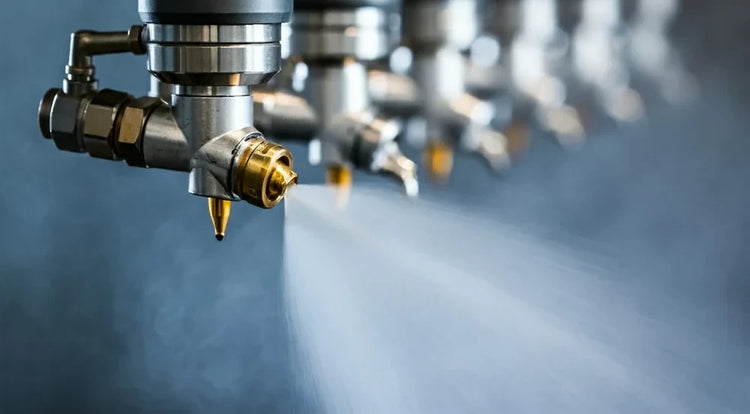
Precision Spray Solutions for Automotive Manufacturing
High-performance spray nozzles for paint preparation, pretreatment, cooling, lubrication, surface coating, parts washing, and dust suppression across vehicle assembly and component manufacturing plants

Automotive manufacturing plants operate spray systems where nozzle performance is a production quality parameter — not a utility concern. Phosphate pretreatment headers that deliver uneven coverage leave surface areas without adequate conversion coating, creating corrosion initiation sites that show up as paint failures within the vehicle warranty period. Lubrication nozzles that produce inconsistent emulsion film across the stamping die surface create thickness variation in the stamped part. Cooling nozzles in weld cells that provide inadequate heat extraction reduce weld quality and accelerate electrode wear.
NozzlePro supplies spray nozzles for every application in the automotive manufacturing plant — flat-fan pretreatment headers, hydraulic atomizing for MQL and emulsion lubrication, full-cone and hollow-cone for cooling and quenching, high-pressure for parts washing, and fog/mist for dust suppression at grinding and sanding stations. Application engineering support for header sizing, chemical compatibility, and material selection.
Automotive manufacturing uses spray nozzles across six major application areas: paint preparation and pretreatment uses flat-fan nozzles in multi-stage spray pretreatment headers for degreasing, phosphating, and rinse stages on body-in-white panels; cooling at weld, machining, and assembly stations uses full-cone or hollow-cone nozzles for heat extraction from tooling, weld fixtures, and components; lubrication (MQL and emulsions) uses hydraulic atomizing nozzles for uniform thin-film application to stamping dies and machining tools; coating and surface treatment uses hydraulic atomizing for primers and corrosion inhibitors and flat-fan for film uniformity; parts and assembly cleaning uses flat-fan sheeting nozzles for rinse stages and high-pressure jets for stubborn soils in parts washers; and dust suppression uses fog/mist nozzles at grinding, sanding, and polishing stations to capture airborne particulate. All automotive manufacturing nozzles require 316L stainless bodies with chemical compatibility verified against the specific pretreatment, lubricant, or cleaning chemistry used at each stage.
Automotive Manufacturing Nozzle Collections
Shop by application or nozzle type — all linked directly to collections
Automotive Manufacturing Spray Applications
Application-specific nozzle recommendations for each production stage — from body-in-white through final assembly
Paint Preparation & Pretreatment
- Degreaser & Cleaner Stages: Flat-Fan headers for uniform panel wet-out at line speed
- Phosphate Conversion Coating: Flat-Fan for uniform surface coverage — flow-matched to ±2% across header
- Rinse Stages: Full-Cone or flat-fan for complete chemical removal before the next stage
- Activator / Conditioner: Fog & Mist for controlled fine-droplet application
- 316L SS with EPDM or Viton seals — verify compatibility with specific pretreatment chemistry
Cooling — Weld, Machining & Assembly
- Weld Cell Electrode Cooling: Full-Cone for uniform heat extraction from resistance weld tips
- Machining Tool Cooling: Flat-Fan coolant bands for tool and workpiece temperature control
- Component Heat Quench: Full-Cone / Hollow-Cone for controlled heat extraction
- Weld Fixture Cooling: High-Pressure targeted impact for spatter removal and tool cooling
Lubrication — MQL & Emulsions
- Stamping & Press Shop: Hydraulic Atomizing for fine, uniform die lubricant film without compressed air
- Edge-to-Edge Strip Coverage: Flat-Fan across full blank and coil width
- Machining Coolant: Hydraulic Atomizing for MQL cutting oil at machining centres
- Blow-Off Between Stages: Air Nozzles for targeted drying — no liquid atomisation
Coating & Surface Treatment
- Corrosion Inhibitor Application: Hydraulic Atomizing for wax and oil-based rust preventives
- Primer & Functional Coatings: Hydraulic Atomizing for controlled droplet size and minimal overspray
- Film Uniformity: Flat-Fan for edge control on panels and formed parts
- Automated on/off valve control for precise dosing matched to conveyor speed
Parts Washing & Assembly Cleaning
- Rinse Stages: Flat-Fan sheeting for thorough chemical removal from parts and assemblies
- Stubborn Soils: High-Pressure jets for machining chips, oil, and scale
- Baskets, Totes & Housings: Rotary Jet Devices for complete internal cleaning
- Final Rinse: Flat-fan with DI water — tight orifice tolerances to conserve DI water consumption
Dust Suppression
- Grinding & Sanding Stations: Fog & Mist arrays at source for airborne metal and abrasive dust agglomeration
- Welding & Cutting Areas: Fine Mist curtains to capture weld fume and fine particulate
- Painting Booths: Humidification for RH control that reduces electrostatic particle attraction
- Droplet size 10–100 µm for effective airborne particle agglomeration without wetting surfaces
Nozzle Pattern Selection for Automotive Manufacturing
Match spray pattern to the specific mechanism required at each production stage
Flat-Fan — Pretreatment & Film Coating
Defined spray angle and edge taper allow precise header design for uniform coverage across panel width at line speed. Standard for pretreatment headers, coating application, and rinse stages. Flow-matched sets within ±2% across all header positions are critical for uniform conversion coating thickness.
Shop Flat-Fan →Hydraulic Atomizing — MQL & Primer
Fine atomisation without compressed air — tight droplet spectrum, low drift, and easy system integration. Standard for stamping die lubrication, MQL machining, and functional coating application where precise film thickness and minimal overspray are required.
Shop Hydraulic Atomizing →Full-Cone & Hollow-Cone — Cooling
Volumetric coverage for heat extraction from tooling, weld electrodes, and components. Full-cone for dense, uniform coverage; hollow-cone for higher water impact velocity where faster heat removal is needed at weld cell electrode tips and high-heat-load machining positions.
Shop Full-Cone →Fog & Mist — Dust & Humidity
10–100 µm droplets remain suspended to agglomerate with airborne grinding dust and weld fume. For paint booth humidification, RH control prevents electrostatic particle adhesion to freshly coated panels. Compatible with purified water systems in paint booths.
Shop Fog & Mist →Automotive Plant Nozzle Selection Principles
Engineering factors that determine correct nozzle specification in automotive manufacturing environments
- Pretreatment Header Coverage Uniformity Is a Corrosion Warranty Parameter — Phosphate conversion coating in the spray pretreatment tunnel must achieve uniform coverage across every body panel surface at line speed — dry zones or low-coverage areas from misaligned, worn, or flow-mismatched nozzles create inadequate conversion coating that becomes a corrosion initiation site after e-coat and topcoat are applied. Paint failures within the vehicle corrosion warranty period trace directly to pretreatment stage coverage gaps. Replace pretreatment header nozzle sets simultaneously — mixing worn and new nozzles creates flow imbalance across the header width worse than uniform wear.
- MQL Lubrication Film Uniformity Determines Stamped Part Thickness Variation — Die lubricant film uniformity in the press shop directly affects friction distribution across the stamping die surface during forming. Non-uniform lubricant film creates differential friction zones that produce material flow variation — translated into part thickness deviation and surface defects. Hydraulic atomizing nozzles provide the most consistent fine-film application because their droplet size is governed by orifice geometry and fluid pressure, not air pressure variation. Flat-fan header spacing must be calculated for 20–30% overlap at the blank surface to eliminate dry lanes between adjacent spray patterns.
- Chemical Compatibility Must Be Verified for Both Body and Seal — Automotive pretreatment chemistry is varied and aggressive — heated alkaline degreaser (pH 10–13), acid activation (pH 2–4), zinc or iron phosphate (pH 2–3), zirconium conversion coating (pH 3–5), and multiple rinse stages at different temperatures. Each stage requires independent material verification. EPDM seals perform well in alkaline degreaser and neutral rinse; Viton is required for acid activation and phosphate stages. 316L SS body is adequate for most stages; duplex or Hastelloy for high-chloride stages. Verify the complete seal material against every chemistry the nozzle is exposed to during the full pretreatment sequence — including CIP cleaning chemistries.
- Weld Cell Cooling Nozzle Condition Directly Affects Weld Quality and Electrode Life — Resistance weld electrode tip temperature is controlled by the internal water cooling channel — not external spray cooling. However, external spray cooling at weld cell positions affects inter-weld dwell time, spatter management, and fixture temperature. A spray cooling nozzle that fails or misaligns in a weld cell causes the fixture temperature to rise above the controlled range, producing geometric deviations in the fixture and inconsistent weld positioning. Inspect weld cell cooling nozzles at every planned maintenance interval and include them in the weld quality monitoring scope — not just the weld parameter logs.
- Air Nozzles for Blow-Off Are Not Interchangeable with Atomising Nozzles — In automotive manufacturing, air nozzles serve a specific function — removing existing liquid from a surface between processing stages without adding more liquid. They do not atomise; they direct a high-velocity air stream. Using an air-atomising nozzle in a blow-off application defeats the purpose by adding liquid to the surface being dried. Using an air nozzle as an atomising nozzle for lubrication or coating is equally incorrect — air nozzles do not produce a controlled liquid spray pattern. Select the correct nozzle type for the intended function; do not substitute between these categories even when the connection thread is compatible.
Why Choose NozzlePro for Automotive Manufacturing?
Application engineering, flow-matched sets, and complete plant coverage
Production Quality Engineering — Not Just Nozzle Supply
Automotive manufacturing spray applications are production quality parameters — pretreatment coverage, lubrication film uniformity, and cooling consistency all affect the vehicle that leaves the assembly plant. NozzlePro application engineers work with your process engineering and maintenance teams to specify nozzles for each position with the parameters that matter: flow rate at operating pressure, spray angle, header spacing, and chemical material compatibility — not just catalogue selection.
Flow-Matched Sets for Pretreatment Headers: Flat-fan nozzle sets for pretreatment tunnel headers supplied with flow verification data confirming ±2% uniformity across all positions. Replace full header sets simultaneously — NozzlePro supplies complete pretreatment tunnel replacement sets staged for planned maintenance windows.
Chemical Compatibility Documentation: Material compatibility verification for nozzle body and seal materials against your specific pretreatment chemistry sequence — not generic stainless/EPDM defaults that may fail in acid activation or high-temperature phosphate stages.
Application Sizing: Pretreatment header nozzle spacing calculations from conveyor width, spray angle, standoff, and line speed. MQL lubrication header design from blank width and die geometry. Dust suppression fog array design from grinding station layout and exhaust flow data.
Frequently Asked Questions
Common questions about spray nozzles in automotive manufacturing plants
What spray nozzles are used in automotive paint pretreatment tunnels?
Flat-fan nozzles are standard for automotive spray pretreatment tunnel headers — degreaser, activation, phosphate, and rinse stages. Flat-fan nozzles provide a defined spray angle and edge taper that allows precise header design: nozzle spacing is calculated from spray angle and standoff distance to achieve 20–30% pattern overlap at the panel surface, producing uniform coverage across the full body panel width at line speed. All nozzles in each header must be flow-matched to within ±2% of the design flow rate at operating pressure — flow variation across the header width creates coverage non-uniformity that becomes visible as differential conversion coating thickness. Full-cone nozzles are used in some rinse stages for volumetric coverage; fog/mist for fine activator application. 316L SS bodies with EPDM seals for alkaline degreaser and neutral rinse; Viton seals for acid activation and phosphate stages.
What nozzle is best for stamping die lubrication in the press shop?
Hydraulic atomizing nozzles are standard for stamping die lubrication — they produce a fine, uniform die lubricant film using line pressure alone, without requiring compressed air. The droplet size and film uniformity are governed by the orifice geometry and fluid pressure, providing consistent application across the die surface at every stroke. Flat-fan nozzles are used for coil and blank edge-to-edge pre-lubrication on incoming strip material, with nozzle spacing calculated for 20–30% overlap at the blank surface to eliminate dry lanes. Key material requirement: die lubricants are often oil-based or contain additives that degrade EPDM seals — specify Viton or PTFE seals for lubricant contact applications and verify compatibility with your specific die lubricant formulation before specifying seal material.
How often should automotive pretreatment nozzles be inspected and replaced?
Inspect automotive pretreatment tunnel nozzles at minimum every 4 weeks in continuous production — pull a 10% sample from each stage header and flow-verify at operating pressure. Replace the full header set when the sample average flow deviation exceeds ±10% from the design value. In highly corrosive acid activation and phosphate stages, inspection intervals may need to shorten to every 2 weeks depending on the chemistry concentration and temperature. Replace full header sets simultaneously rather than individual nozzles — adding new nozzles to a partially worn header creates worse flow imbalance than a uniformly worn set. Stage the replacement set inventory in advance so a complete header change can be completed during a scheduled maintenance window without extended line downtime.
What nozzle materials resist automotive pretreatment chemicals?
Automotive pretreatment sequences span a wide chemistry range — from highly alkaline (pH 12–13, heated) to acidic (pH 2–4) — and nozzle material must be verified at every stage independently. For alkaline degreaser and neutral rinse: 316L SS body with EPDM seals is standard. For acid activation, zinc or iron phosphate (pH 2–4): 316L SS body but Viton seals required — EPDM degrades rapidly in dilute acid. For zirconium conversion coating (pH 3–5 with fluoride): verify 316L compatibility against fluoride concentration — some fluoride-containing systems require duplex SS or PTFE body. For high-temperature phosphate (60–80°C): EPDM at elevated temperature — verify temperature rating of the specific EPDM compound. The seal material compatibility is often the most overlooked selection variable and the most common cause of premature seal failure in pretreatment systems.
What is the best nozzle for dust suppression at automotive grinding and sanding stations?
Fog/mist nozzles producing 10–100 µm droplets are standard for airborne dust agglomeration at grinding, sanding, and polishing stations in automotive manufacturing. The nozzle manifold should create a suspended droplet curtain in the airflow path downstream of the dust generation point — not aimed directly at the grinding wheel or workpiece where turbulence disperses the fog before it can agglomerate with the dust particles. Droplet size is the critical variable: droplets above 200 µm fall out of the airstream before contacting airborne particles; droplets below 10 µm may be too fine to effectively agglomerate with metal grinding particles. In paint booths, humidification nozzle systems maintain 50–70% RH to reduce electrostatic particle attraction to freshly coated panel surfaces — this is a fog distribution application, not a dust agglomeration application, and requires separate design from grinding station suppression arrays.
Optimise Your Automotive Manufacturing Spray Systems
Share your application, production stage, chemistry, conveyor width, and line speed — we'll specify the right nozzle, flow rate, and header configuration for every position in your plant.