
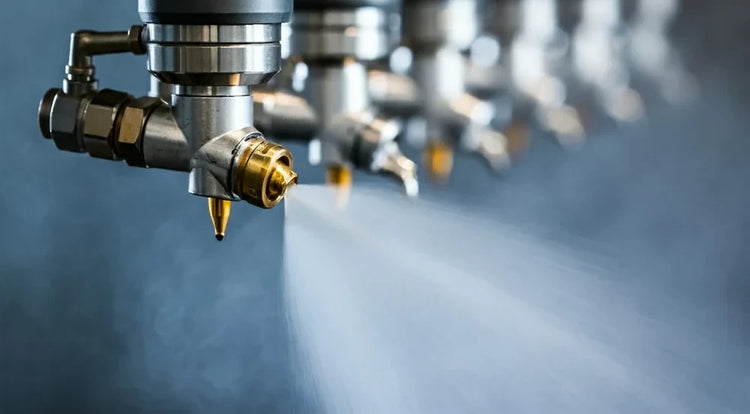

Boquillas de alta presión:
La guía completa de selección y aplicación
Cómo la presión cambia el diseño de las boquillas, por qué la dureza del material es la variable decisiva, cómo combinar la boquilla adecuada con su aplicación, y las prácticas de seguridad y gestión del desgaste que protegen tanto su proceso como a su equipo.
Puntos clave
- La presión aumenta la velocidad del líquido a través del orificio, lo que acelera el desgaste exponencialmente. Un aumento del 10% en el orificio aumenta el caudal aproximadamente en un 21%, desperdiciando material en cada ciclo de pulverización.
- La dureza del material es la variable de mayor impacto en la vida útil de las boquillas de alta presión; los insertos de orificio de carburo duran mucho más que el acero inoxidable estándar.
- El tipo de patrón de pulverización (abanico plano, cono hueco o chorro sólido) debe coincidir con la geometría de aplicación específica y los requisitos de suministro, no solo con la clasificación de presión.
- La medición regular del caudal a una presión fija es la forma más objetiva de detectar el desgaste del orificio antes de que cause problemas de calidad o coste.
- La pulverización a alta presión conlleva un grave riesgo de lesiones por inyección: la capacitación integral del operador y el estricto cumplimiento de los equipos de protección individual (EPI) son innegociables, no opcionales.
- El diseño del cuerpo de la boquilla, la protección del orificio empotrado y las características de alineación son detalles de ingeniería que diferencian las boquillas de alta presión construidas específicamente de las alternativas de uso general.
La presión cambia todo el comportamiento de una boquilla. A 50 PSI, prácticamente cualquier material de boquilla dura años. A 1.500 PSI, un orificio de latón puede desgastarse de forma medible en horas de uso continuo. A 3.000 PSI, la diferencia entre una boquilla estándar y una diseñada específicamente para el trabajo puede significar la diferencia entre una aplicación consistente y controlada y un sistema que drena su presupuesto de material a través de un orificio que crece en cada turno.
La selección de boquillas de alta presión no es simplemente una cuestión de encontrar una boquilla clasificada para su presión de funcionamiento. Requiere comprender qué hace la presión al orificio físico, cómo responden los diferentes materiales al desgaste erosivo, qué geometrías de patrón de pulverización proporcionan la cobertura adecuada para su aplicación y cómo detectar y gestionar el desgaste antes de que comprometa su proceso o su estructura de costes.
Esta guía le ofrece una visión completa, desde la física de la erosión de los orificios hasta las decisiones prácticas de selección, las estrategias de gestión del desgaste y los protocolos de seguridad que rigen la pulverización a alta presión en aplicaciones industriales, de revestimiento, de fabricación y de tratamiento de superficies.
Cómo afecta la presión al rendimiento de la boquilla
Para entender por qué las boquillas de alta presión requieren una ingeniería especializada, ayuda entender lo que realmente sucede dentro de un orificio de boquilla bajo presión. El orificio es una restricción dimensional precisa: cuando el líquido se fuerza a través de él bajo presión, esa energía de presión se convierte en energía cinética (velocidad). La relación se rige por el principio de Bernoulli: cuanto mayor sea la presión aguas arriba, más rápido saldrá el líquido del orificio y más energía cinética transportará.
Esa energía cinética es útil: es lo que impulsa un patrón de abanico plano a través de la superficie de un panel, lo que hace que un cono hueco atomice un recubrimiento dentro de una tubería o lo que proporciona la fuerza de impacto de un chorro sólido sobre una superficie para limpiar. Pero también significa que el líquido y cualquier sólido en suspensión dentro de él impactan las paredes del orificio a alta velocidad en cada pasada. Con el tiempo, este impacto elimina material del borde del orificio, agrandando la abertura en lo que se conoce como desgaste erosivo.
La clave es que el flujo a través de un orificio escala con el cuadrado de su diámetro. Esto significa que el desgaste no solo añade un poco de consumo de material extra, sino que lo agrava. Una boquilla que tiene un 15% de exceso de tamaño utiliza drásticamente más pintura, adhesivo o recubrimiento por pasada de lo que especifica, sin ninguna mejora correspondiente en la calidad de la aplicación. En entornos de producción de alto volumen, el desgaste no detectado del orificio puede representar miles de dólares en consumo excesivo de material por mes.
"Un orificio desgastado es un impuesto oculto en su línea de producción: lo paga en exceso de material, energía de bombeo y calidad degradada, pero rara vez aparece en un informe de mantenimiento hasta que alguien lo mide."
El problema del desgaste: lo que le cuesta
El desgaste del orificio es predecible: todas las boquillas se desgastarán con el tiempo, y la tasa de desgaste es principalmente una función de la presión de funcionamiento, la velocidad del líquido, la abrasividad del fluido y las partículas arrastradas, y la dureza del material del orificio. Lo que separa una operación de pulverización bien gestionada de una mal gestionada es la proactividad con la que se rastrea el desgaste y la rapidez con la que se reemplazan las boquillas desgastadas.
Cómo se manifiesta el desgaste en su proceso
- Mayor consumo de material: El impacto de coste más directo: se aplica más recubrimiento, pintura o adhesivo por ciclo de lo especificado, sin beneficio de calidad.
- Sobrecarga de la bomba: Un flujo mayor de orificios sobredimensionados exige más capacidad de la bomba, lo que aumenta el consumo de electricidad y acelera el desgaste de la bomba.
- Degradación del patrón de pulverización: A medida que el orificio se agranda, la geometría del abanico plano o del cono se vuelve menos definida. La uniformidad de la cobertura disminuye, la definición de los bordes se suaviza y los pases superpuestos producen un espesor de película desigual.
- Defectos de calidad de la superficie: En aplicaciones de recubrimiento y pintura de precisión, las boquillas desgastadas producen variabilidad en la formación de la película que se traduce en una tasa de rechazo: un retrabajo mucho más costoso que el reemplazo de la boquilla que lo habría evitado.
- Problemas en el proceso posterior: En aplicaciones de adhesivos o selladores, una boquilla desgastada que aplica un exceso de química puede causar fallos de unión, problemas de curado o el ensuciamiento posterior del equipo de montaje.
Regla práctica: La mayoría de las aplicaciones de boquillas de alta presión utilizan un aumento del caudal del 10 al 15% por encima del nominal como el umbral de reemplazo. Una vez que el caudal medido a su presión de funcionamiento estándar excede ese umbral, la boquilla debe ser reemplazada, no limpiada, ajustada o mantenida en servicio.
Por qué la dureza del material es la variable decisiva
Si acepta que el desgaste del orificio es inevitable y que su tasa está impulsada principalmente por las condiciones de funcionamiento, entonces la palanca más efectiva que tiene para prolongar la vida útil es la dureza del material del orificio. Los materiales más duros resisten el desgaste erosivo de manera más efectiva, y las diferencias entre los materiales son enormes, no marginales.
La resistencia a la abrasión de los materiales de las boquillas abarca varios órdenes de magnitud. El aluminio y el latón, comunes en boquillas agrícolas y de uso general de baja presión, se encuentran en el extremo inferior de la escala. El acero inoxidable estándar ofrece una resistencia al desgaste significativamente mejor, pero sigue siendo limitado en aplicaciones exigentes de alta presión. Los materiales de carburo, incluido el carburo de tungsteno, se encuentran en el extremo superior del rango práctico para boquillas industriales, ofreciendo una resistencia a la abrasión muchas veces mayor que el acero inoxidable.
Resistencia a la abrasión relativa por material
En términos prácticos, un inserto de orificio de carburo de tungsteno puede durar 30 o más veces más que una boquilla de acero inoxidable estándar que opere en condiciones equivalentes. Para la mayoría de las aplicaciones de producción de alta presión, esta diferencia justifica con creces el coste superior de la boquilla, especialmente cuando se tiene en cuenta el coste del material excesivo consumido por una boquilla de acero inoxidable desgastada en la comparación.
Cuándo especificar carburo de tungsteno
- Presiones de funcionamiento superiores a 500 PSI en entornos de producción continuos o de alto ciclo
- Fluidos abrasivos: pinturas con escamas metálicas, lechadas cerámicas, recubrimientos con muchas partículas, adhesivos con rellenos
- Aplicaciones donde el costo del material por unidad es significativo y la sobreaplicación afecta directamente los márgenes
- Sistemas robóticos o automatizados donde se requiere consistencia en el rendimiento de la boquilla durante todo un turno de producción
- Cualquier aplicación donde el costo y el tiempo de inactividad por el reemplazo frecuente de boquillas exceda la prima por un material más duro
Explore la colección de boquillas de carburo de tungsteno de NozzlePro, diseñadas para aplicaciones de pulverización de alta presión exigentes en las industrias de pintura, revestimiento, adhesivos y tratamiento de superficies.
Tipos de boquillas de alta presión y patrones de pulverización
Seleccionar el patrón de pulverización adecuado es tan importante como seleccionar el material correcto. La presión de funcionamiento determina cuánta energía está disponible en el orificio, pero la geometría del orificio determina cómo esa energía se moldea en un patrón de pulverización y se distribuye sobre la superficie objetivo.
| Tipo de patrón | Cómo funciona | Mejores aplicaciones | Ventaja clave |
|---|---|---|---|
| Abanico plano | El orificio elíptico crea una lámina de líquido que se extiende en un plano | Pulverización de pintura, revestimiento, marcado vial, aplicación de adhesivos, acabado de paneles | Cobertura uniforme superpuesta; formación de película predecible en superficies planas o curvas |
| Abanico plano uniforme | La geometría modificada del orificio produce una distribución uniforme de borde a borde, eliminando el sesgo de centro pesado o borde pesado | Recubrimiento robótico de precisión; líquidos viscosos o rellenos propensos a una distribución desigual | Espesor de película consistente en todo el ancho de pulverización, crítico en aplicaciones de tolerancia estrecha |
| Cono hueco | La cámara de giro o la entrada tangencial hacen girar el líquido en un anillo en forma de cono | Revestimiento interior de tuberías; enfriamiento evaporativo; generación de partículas finas | Atomización fina alcanzable a alta presión sin aire comprimido |
| Chorro sólido | El orificio circular proporciona una columna de líquido ininterrumpida con la máxima fuerza de impacto | Descalcificación de superficies, limpieza dirigida, preparación para corte de hormigón | Máxima energía cinética por unidad de área; mayor impacto mecánico para la eliminación de superficies |
| Abanico descentrado | Orificio en ángulo con respecto a la línea central de la boquilla; se utiliza cuando el objetivo gira o la boquilla está estacionaria | Revestimiento interior de latas; revestimiento de contenedores; aplicaciones de piezas de trabajo giratorias | Cobertura uniforme de superficies interiores cilíndricas cuando la pieza de trabajo gira al pasar por el chorro |
Selección del ángulo de pulverización
Dentro de cualquier tipo de patrón, el ángulo de pulverización determina el ancho de cobertura a una distancia determinada. Los ángulos más amplios (80°–110°) proporcionan una cobertura amplia en forma de abanico, ideal para grandes superficies planas a alturas moderadas. Los ángulos más estrechos (15°–40°) concentran el chorro en una banda más ajustada, lo que es más adecuado para áreas objetivo estrechas, distancias de separación más cercanas o aplicaciones donde la precisión de la colocación importa más que la amplitud de la cobertura. Los sistemas robóticos y automatizados a menudo utilizan boquillas de ángulo cerrado para controlar el exceso de pulverización y garantizar una precisión de colocación repetible.
Explore la biblioteca de patrones de pulverización de NozzlePro. Navegue por las boquillas organizadas por tipo de patrón de pulverización para encontrar la geometría que se adapte a su aplicación.
Guía de selección: combinación de boquilla y aplicación
La selección de boquillas de alta presión requiere definir cuatro parámetros antes de consultar cualquier catálogo: la presión de funcionamiento que su sistema suministra en la entrada de la boquilla, el caudal necesario para lograr la tasa de aplicación deseada, el ángulo de pulverización que cubre su área objetivo a su distancia de trabajo y las propiedades del fluido que determinan los requisitos de material y geometría. Con estos cuatro números definidos, la selección se reduce a una lista corta.
Proceso de selección paso a paso
- Defina la presión de funcionamiento en la entrada de la boquilla. Mida la presión real en la punta de pulverización, no en la salida de la bomba. La caída de presión a través de las líneas de suministro y los accesorios es real y puede ser significativa en tramos largos o a altos caudales.
- Calcule el caudal requerido. Comience por su tasa de aplicación objetivo: cuánto material por unidad de área, a qué velocidad de línea o tiempo de ciclo. Calcule hacia atrás a través del número de boquillas en el sistema para llegar a los requisitos de flujo por boquilla en galones por minuto.
- Seleccione el ángulo de pulverización. Según su distancia de separación y el ancho de cobertura necesario por boquilla, seleccione el ángulo que proporcione ese ancho de cobertura. La mayoría de los fabricantes publican el ancho de cobertura a distancias estándar; utilícelos como su filtro principal.
- Identifique el tamaño de capacidad coincidente. Con la presión y el flujo requerido establecidos, busque el tamaño de capacidad en los datos de rendimiento para el patrón y ángulo elegidos que proporcione el flujo deseado a su presión de operación.
- Especifique el material del orificio. Evalúe el nivel de presión, la abrasividad del fluido, el volumen de producción y la sensibilidad al costo del material. Acero inoxidable estándar para aplicaciones de menor exigencia o intermitentes; carburo de tungsteno para servicio continuo de alta presión o fluidos abrasivos.
- Confirme las características de diseño del cuerpo. Para sistemas robóticos o automatizados, verifique que el cuerpo de la boquilla tenga superficies de posicionamiento u otras características de alineación para asegurar una orientación repetible del patrón de pulverización. Confirme que el inserto del orificio esté empotrado en el cuerpo para protegerlo de daños físicos.
| Perfil de la aplicación | Rango de presión | Patrón | Material recomendado |
|---|---|---|---|
| Pulverización manual de pintura, recubrimientos generales | 500–3,000 PSI | Abanico plano | Carburo de tungsteno para producción; acero inoxidable endurecido para uso ligero |
| Sellado/recubrimiento robótico de uniones automotrices | 1,500–4,000 PSI | Abanico plano uniforme o chorro sólido | Carburo de tungsteno: crítico para la alineación; debe mantener la tolerancia del patrón |
| Marcado de carreteras/señalización de pavimentos | 2,000–4,000 PSI | Abanico plano (borde grueso) | Carburo de tungsteno: servicio continuo al aire libre, pintura abrasiva |
| Pulverización de adhesivos y materiales viscosos | 1,000–4,000 PSI | Abanico plano uniforme | Carburo de tungsteno con geometría de orificio resistente a obstrucciones |
| Recubrimiento interior de tuberías y recipientes | 400–2,000 PSI | Cono hueco | Acero inoxidable o carburo de tungsteno según la abrasividad |
| Limpieza de superficies a alta presión | 1,000–5,000 PSI | Abanico plano o chorro sólido | Carburo de tungsteno: la presión más alta, el más crítico en cuanto a desgaste |
Encuentre su boquilla de alta presión
La colección de alta presión de NozzlePro incluye diseños de abanico plano, cono hueco, chorro sólido y diseños especiales en carburo de tungsteno y acero inoxidable, en una amplia gama de ángulos de pulverización, capacidades y rangos de presión.
Comprar boquillas de alta presión Colección de carburo de tungstenoAplicaciones industriales
Las boquillas de alta presión sirven a una amplia gama de industrias donde la entrega controlada de líquidos a alta presión es un requisito fundamental del proceso. El punto en común es que estas aplicaciones exigen un rendimiento constante durante un alto número de ciclos, a menudo con fluidos abrasivos, viscosos o químicamente agresivos.
Pintura y materiales viscosos
Pulverización de pintura sin aire, recubrimientos de alto espesor, aplicación de epoxi y sistemas de adhesivos espesos donde el desgaste de las boquillas estándar comprometería rápidamente la formación de la película.
Fabricación de automóviles
Sellado robótico de uniones, recubrimiento de bajos, inyección de cera en cavidades y recubrimiento protector de carrocerías en blanco: aplicaciones que requieren tolerancias de patrón ajustadas durante millones de ciclos.
Recubrimiento y tratamiento de superficies
Recubrimientos protectores industriales, aplicación de agentes desmoldeantes, recubrimiento de moldes y pulverización de pretratamiento donde un espesor de película uniforme es un requisito de calidad del producto.
Lavado a presión
Limpieza comercial e industrial, limpieza de flotas, lavado de exteriores de edificios y desengrase de equipos donde la entrega a alta presión es el mecanismo de limpieza.
Procesamiento de acero y metales
Eliminación de incrustaciones, desincrustación antes del laminado o conformado, pulverización de enfriamiento y preparación de superficies antes de operaciones de recubrimiento o galvanizado.
Materiales de construcción
Aplicación de lechada para baldosas cerámicas, adhesivos y recubrimientos para techos, pulverización de aislamiento y sistemas de sellado estructurales que requieren suministro a alta presión de materiales viscosos o con relleno.
Monitoreo del desgaste y momento de reemplazo
Una de las prácticas de mantenimiento de mayor valor en cualquier operación de pulverización de alta presión es el monitoreo sistemático del desgaste de la boquilla. Sin un programa de medición, las boquillas desgastadas permanecen en servicio más tiempo del debido, lo que continúa consumiendo material en exceso y degradando la calidad del proceso, mientras que el costo se acumula de manera invisible en cada ciclo de producción.
Cómo medir el desgaste de la boquilla
El método más confiable es una prueba de flujo directa: recolecte la salida de cada boquilla durante un período de tiempo medido a una presión fija y repetible, y compare el flujo medido con la especificación nominal. No se requiere equipo especial más allá de un manómetro calibrado, un recipiente de recolección y un cronómetro. Realizar esta prueba a intervalos programados, semanalmente en operaciones de gran volumen, mensualmente en entornos de menor exigencia, crea un historial de flujo para cada posición de la boquilla que hace visibles las tendencias de desgaste antes de que se vuelvan costosas.
Indicadores visuales de desgaste
- Ampliación del patrón: Un orificio desgastado produce un patrón de pulverización más ancho y con bordes más suaves a la misma presión que una punta nueva. Si el ancho de su pulverización a la distancia estándar ha aumentado notablemente, es casi seguro que la boquilla está sobredimensionada.
- Concentración de borde grueso: El desgaste selectivo en un lado de un orificio de abanico plano crea un patrón donde un borde transporta sustancialmente más flujo que el otro, visible como una racha en el recubrimiento aplicado o un cordón irregular en aplicaciones de adhesivo.
- Cola: Las colas de patrón alargadas y no uniformes en los bordes de la pulverización son un indicador confiable de deformación del orificio y deben provocar un reemplazo inmediato en aplicaciones de precisión.
- Cambios en la calidad de la superficie: En aplicaciones de pintura y recubrimiento, los aumentos inexplicables en la piel de naranja, goteos o descuelgues en sustratos por lo demás inalterados a menudo se remontan a un caudal que ha superado la tasa de entrega diseñada del sistema.
Mejores prácticas de mantenimiento
Establezca un programa de verificación de flujo
Establezca un intervalo fijo para realizar pruebas de flujo en cada posición de boquilla de su sistema a una presión estándar. Documente los resultados y marque cualquier posición que se haya desviado más allá de la tolerancia del 10 al 15% para su reemplazo.
Mantenga un registro de boquillas
Registre la fecha de instalación, las horas de servicio, el fluido manejado y las mediciones de flujo para cada boquilla. Un registro revela las tendencias de la tasa de desgaste, ayuda a predecir los intervalos de reemplazo y respalda la documentación de calidad.
Nunca desatasque bajo presión
Una boquilla de alta presión obstruida debe despresurizarse antes de intentar desatascarla. Usar un dedo, un alambre o una herramienta para desatascar un orificio mientras el sistema está en funcionamiento es un riesgo grave de lesión por inyección.
Utilice únicamente herramientas de limpieza suaves
Al limpiar los orificios entre ciclos de producción, use un cepillo suave, un palillo de madera o un remojo en solvente; nunca use alambre, objetos metálicos punzantes ni aire comprimido dirigido a la cara del orificio, lo que puede dañar los bordes de carburo.
Inspeccione el cuerpo y las juntas
Las juntas del cuerpo de la punta desgastadas o dañadas causan pérdida de presión entre el cuerpo de la boquilla y la punta, lo que resulta en una presión de suministro inconsistente en el orificio. Reemplace las juntas según un cronograma, no de forma reactiva.
Proteja contra daños por impacto
El inserto del orificio en una punta de carburo de tungsteno es duro pero quebradizo; una caída sobre una superficie dura o un impacto directo pueden astillar el borde del orificio y comprometer inmediatamente la calidad del patrón de pulverización. Guarde las puntas de repuesto en recipientes acolchados.
Requisitos de seguridad para la pulverización a alta presión
Riesgo de lesión por inyección: Los chorros de líquido a alta presión, particularmente a presiones superiores a 1,000 PSI, pueden penetrar la piel y el tejido subcutáneo sin una herida visible de inmediato. Las lesiones por inyección son emergencias médicas que requieren intervención quirúrgica inmediata. Una boquilla de alta presión apuntada a cualquier parte del cuerpo humano debe tratarse como un arma seria, no como una herramienta de limpieza o desatasque.
Prácticas de seguridad obligatorias
- Nunca apunte una boquilla presurizada hacia usted mismo o hacia otras personas, incluso durante las pruebas, el ajuste o la resolución de problemas. No hay excepciones a esta regla.
- Despresurice completamente antes de manipular las boquillas. Apague la bomba, libere la presión de la línea de suministro y verifique la presión cero en un manómetro antes de conectar, desconectar, limpiar o ajustar cualquier boquilla del sistema.
- Use el EPP adecuado. Como mínimo: un protector facial o gafas de seguridad con protectores laterales, guantes resistentes a productos químicos clasificados para el fluido que se pulveriza y ropa protectora adecuada para la presión de funcionamiento. Consulte la FDS del fluido para conocer los requisitos adicionales de EPP.
- Inspeccione los accesorios y las conexiones antes de cada uso. Un accesorio defectuoso a alta presión puede expulsar líquido a una velocidad peligrosa. Verifique que todas las conexiones estén correctamente realizadas y apretadas antes de la puesta en marcha del sistema.
- Bloqueo/Etiquetado antes del mantenimiento. Cualquier tarea de mantenimiento en un sistema de boquillas de alta presión, incluido el reemplazo de boquillas, la limpieza de filtros o la desconexión de la línea, requiere un aislamiento total de la energía según las normas de bloqueo/etiquetado (LOTO) de OSHA.
- Capacite a todos los operadores antes del primer uso. El personal que opera, mantiene o trabaja cerca de equipos de pulverización de alta presión debe recibir capacitación documentada que cubra el riesgo de lesiones por inyección, los procedimientos operativos correctos, la respuesta a emergencias y los requisitos de EPP.
Compre la colección de alta presión de NozzlePro
Puntas de carburo de tungsteno, boquillas de abanico plano, cono hueco y chorro sólido, además de diseños de lavado a presión y tratamiento de superficies, diseñadas para trabajos industriales exigentes y listas para enviar.
Boquillas de alta presión Puntas de carburo de tungstenoPreguntas frecuentes
No existe un umbral de presión universal único, pero las boquillas diseñadas para presiones de funcionamiento superiores a aproximadamente 500 PSI generalmente se consideran de alta presión. Las aplicaciones de recubrimiento y pintura industriales suelen funcionar entre 1,000 y 3,000 PSI, mientras que la preparación de superficies y ciertas aplicaciones de limpieza alcanzan el rango de 5,000 PSI. La característica definitoria es que a estas presiones, los materiales de boquilla estándar se desgastan rápidamente y la geometría del orificio debe diseñarse específicamente para el trabajo, lo que hace que la selección de materiales y el diseño del orificio sean sustancialmente más críticos que en las aplicaciones de baja presión.
La tasa de desgaste se escala con la energía cinética del líquido que pasa a través del orificio, y la energía cinética aumenta con el cuadrado de la velocidad. La alta presión significa alta velocidad, lo que significa que cada paso de líquido a través del orificio elimina más material del borde del orificio que a menor presión. Incluso un pequeño ensanchamiento del orificio tiene un efecto compuesto en el caudal: un aumento del 10% en el diámetro del orificio aumenta el caudal en aproximadamente un 21%, lo que significa que la boquilla desgastada está entregando significativamente más material por ciclo mientras la calidad del patrón de pulverización se deteriora.
El carburo de tungsteno ofrece una resistencia a la abrasión dramáticamente mayor que los metales de ingeniería estándar. En una escala normalizada donde el latón y el aluminio se sitúan en 1x, los materiales de carburo alcanzan de 180x a 250x. Esto significa que un inserto de orificio de carburo puede durar 30 o más veces más que un equivalente de acero inoxidable en condiciones de funcionamiento equivalentes. En aplicaciones de producción de alto volumen, esto se traduce directamente en menos ciclos de reemplazo, un rendimiento de pulverización más consistente con el tiempo y un costo combinado de boquilla más material en exceso significativamente menor en comparación con el uso de puntas de menor costo que se desgastan rápidamente.
Tres indicadores fiables: (1) el caudal medido ha aumentado más de un 10-15% por encima de la especificación nominal a su presión de funcionamiento estándar; (2) el ancho del patrón de pulverización ha aumentado visiblemente, los bordes se han suavizado o ha aparecido una concentración de borde pesado; y (3) el acabado superficial o la calidad del recubrimiento se ha deteriorado a pesar de mantener los parámetros del proceso. Un programa de verificación de caudal (midiendo el rendimiento de cada boquilla a una presión fija de forma regular) es el enfoque más objetivo y rentable para la gestión del reemplazo y elimina las conjeturas de la decisión.
Los patrones de alta presión más comunes son el abanico plano (el estándar para la mayoría de las aplicaciones de pintura y recubrimiento), el abanico plano uniforme (distribución uniforme de borde a borde para aplicaciones de precisión), el cono hueco (atomización fina para enfriamiento y recubrimiento de tuberías) y el chorro sólido (máxima fuerza de impacto para desincrustación y preparación de superficies). Dentro de cada tipo de patrón, una amplia gama de ángulos de pulverización (típicamente de 5° a 110°) y tamaños de orificios permiten ajustarse a prácticamente cualquier combinación de distancia de separación, ancho de cobertura y requisito de caudal.
La regla de mayor prioridad es nunca apuntar una boquilla presurizada a ninguna parte del cuerpo humano; las lesiones por inyección de chorros de líquido a alta presión son emergencias médicas. Siempre despresurice completamente antes de conectar, desconectar o limpiar una boquilla. Use EPP adecuado para la presión y el fluido, incluida protección facial y guantes resistentes a productos químicos. Aplique los procedimientos de bloqueo/etiquetado antes de cualquier tarea de mantenimiento. Capacite a todos los operadores antes del primer uso y documente esa capacitación. El equipo de pulverización de alta presión es capaz de causar lesiones graves; debe operarse con la misma disciplina aplicada a cualquier otro sistema de presión industrial.
Obtenga la boquilla de alta presión adecuada para su proceso
NozzlePro tiene en stock boquillas de alta presión de carburo de tungsteno y acero inoxidable con patrones de abanico plano, cono hueco, chorro sólido y especiales, con el ángulo de pulverización, capacidad y clasificación de presión que su aplicación requiere.
Explorar boquillas de alta presión Contacte a nuestro equipo


