
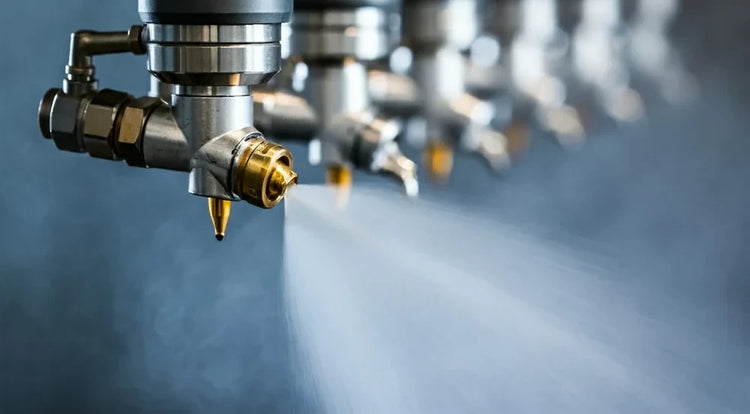
Boquillas pulverizadoras para
la producción de hidrógeno y la captura de carbono
La producción de hidrógeno y la captura y almacenamiento de carbono (CCS) son las áreas de aplicación industrial de pulverización de más rápido crecimiento, impulsadas por la inversión federal en el clima, los créditos fiscales de la IRA, los programas de préstamos del DOE y los compromisos de cero emisiones netas de las empresas de servicios públicos y los emisores industriales. Estos procesos operan con disolventes de amina corrosivos, agua de humidificación ultrapura y fluidos criogénicos a temperaturas que se aproximan a los -320 °F. El hilo conductor es que los materiales estándar de las boquillas industriales (acero al carbono, latón y elastómeros estándar) son inadecuados para las tres aplicaciones. Las aleaciones especiales, la atomización de precisión y los diseños con clasificación criogénica no son mejoras en estos servicios. Son la especificación de referencia.
En la mayoría de las aplicaciones de pulverización industrial, la selección de materiales es una consideración secundaria: primero se determinan el tipo de boquilla y los parámetros operativos, luego se verifica que los materiales sean aceptables. En la producción de hidrógeno y CCS, la selección de materiales es la pregunta de ingeniería principal, porque los fluidos y las temperaturas involucradas eliminan la mayoría de los materiales estándar incluso antes de considerar el tipo de boquilla.
El disolvente de amina pobre caliente a 240 °F en un absorbedor de CO₂ (el fluido que elimina el CO₂ de los gases de combustión) es uno de los entornos más corrosivos en el procesamiento químico. La combinación de la concentración de amina, la carga de CO₂, la acumulación de sales estables al calor y la temperatura elevada ataca rápidamente el acero al carbono, provoca el agrietamiento por corrosión bajo tensión en muchos grados de acero inoxidable y degrada las juntas y los cuerpos de polímero en semanas. La humidificación del electrolizador PEM utiliza agua ultrapura con una conductividad inferior a 1 µS/cm; cualquier contaminación por iones metálicos de un cuerpo de boquilla corroído cambia la química del agua lo suficiente como para dañar la membrana de ionómero. El hidrógeno líquido a -320 °F provoca una falla por transición dúctil a frágil en el acero al carbono, el latón y muchos grados de acero inoxidable austenítico, a menos que la aleación se haya probado específicamente a temperatura criogénica. La especificación del material de la boquilla para cada una de estas aplicaciones no es una práctica de ingeniería conservadora, es el mínimo requerido para evitar fallas rápidas en el servicio.
Captura de CO₂, producción de hidrógeno y almacenamiento criogénico
Absorción y depuración de CO₂
Sistemas de disolventes de amina y amoníaco para CCS de gases de combustiónLa captura de carbono postcombustión elimina el CO₂ de los gases de combustión de las centrales eléctricas y las instalaciones industriales al poner el gas en contacto con un disolvente absorbente, con mayor frecuencia monoetanolamina (MEA), MDEA promocionada con piperazina o amoníaco acuoso. El disolvente absorbente se pulveriza o distribuye en la parte superior de una columna de absorción y fluye hacia abajo, absorbiendo el CO₂ del gas de combustión que fluye hacia arriba. Luego, el disolvente rico en CO₂ se bombea a un recipiente regenerador donde el calor libera el CO₂ para su compresión y almacenamiento, y el disolvente pobre se devuelve al absorbedor.
Las boquillas o distribuidores de pulverización que introducen el disolvente de amina pobre en la parte superior de la columna del absorbedor funcionan a 100-160 °F en contacto directo con el disolvente de amina. Las boquillas en el sumidero del regenerador y la zona del rehervidor funcionan a 220-260 °F en contacto con amina pobre caliente, una condición significativamente más corrosiva. El disolvente de amina también acumula sales estables al calor (formiato, acetato, oxalato, glicolato) de la degradación de la amina y los contaminantes de los gases de combustión que hacen que el disolvente sea progresivamente más corrosivo durante la campaña entre los ciclos de recuperación de amina.
Humidificación de electrolizadores
Control de humedad de precisión para la producción de hidrógeno PEM y alcalinoLa producción de hidrógeno verde por electrólisis del agua requiere una gestión cuidadosa del agua y el entorno de humedad dentro de la pila del electrolizador. En los electrolizadores de membrana de intercambio protónico (PEM), la membrana de ionómero debe permanecer hidratada para mantener la conductividad protónica; una membrana seca pierde conductividad, aumenta la resistencia interna y puede desarrollar microagujeros que permiten el cruce de hidrógeno y oxígeno, creando un peligro para la seguridad. En los electrolizadores alcalinos, las corrientes de gas deben humidificarse para controlar la concentración de electrolito de hidróxido de potasio (KOH) que puede transportarse en la fase gaseosa.
Las boquillas de humidificación que controlan la humedad de la membrana en los sistemas PEM utilizan agua ultrapura, agua que ha sido desionizada a una resistividad superior a 1 MΩ·cm y una conductividad inferior a 1 µS/cm. Este es un requisito específico impulsado por la química de la membrana de ionómero: cualquier contaminación por iones metálicos del suministro de agua ultrapura introducida por un cuerpo de boquilla corroído migra a la membrana y envenena los sitios catalíticos. El envenenamiento del catalizador de platino por iones de hierro incluso en concentraciones de partes por mil millones causa una degradación medible en el rendimiento de la membrana durante la vida útil de la pila del electrolizador.
Refrigeración y almacenamiento criogénicos
GNL y hidrógeno líquido: temperaturas de hasta -320 °FEl gas natural licuado (GNL) se almacena a -260 °F; el hidrógeno líquido (LH₂) a -320 °F. Los sistemas de pulverización en las instalaciones de GNL y LH₂ cumplen dos funciones: sistemas de enfriamiento de emergencia y protección contra derrames que rocían líquido criogénico para controlar la temperatura y la formación de nubes de vapor durante los eventos de liberación, y sistemas de pulverización de proceso que controlan las tasas de generación de vapor durante el llenado, la carga y las operaciones de control de presión de los tanques.
A temperaturas criogénicas, las limitaciones de la ciencia de los materiales en la selección de boquillas son absolutas. El acero al carbono sufre una transición dúctil a frágil por debajo de -40 °F y se fractura sin previo aviso bajo carga de impacto o presión a temperaturas de GNL. Las boquillas de latón y aleaciones de cobre están excluidas del servicio de hidrógeno líquido porque el fragilización por hidrógeno de las aleaciones de cobre ocurre rápidamente a temperaturas de LH₂. La mayoría de los cuerpos de boquillas de polímero, incluido el PTFE, que tiene una excelente resistencia química, se vuelven quebradizos por debajo de -100 °F. El panorama de materiales se reduce drásticamente: los aceros inoxidables austeníticos (304L, 316L) clasificados para servicio criogénico, el Inconel 625 y las aleaciones de aluminio son las opciones principales para GNL; el hidrógeno líquido agrega la restricción adicional de la fragilización por hidrógeno, eliminando muchas aleaciones que funcionan adecuadamente a temperatura de GNL.
Qué aleación para qué aplicación, y por qué
Las aplicaciones de hidrógeno y CCS abarcan una gama más amplia de requisitos de materiales que casi cualquier otro dominio de ingeniería de pulverización, desde el calor corrosivo de un rehervidor regenerador hasta el frío que fragiliza el almacenamiento de hidrógeno líquido. La aleación seleccionada para cada posición debe coincidir con la química específica del fluido, la temperatura y la carga mecánica en esa posición. Este es un resumen de las aleaciones primarias utilizadas en estas aplicaciones y las condiciones que determinan cuándo cada una es apropiada.
Superaleación de níquel-molibdeno-cromo con una excelente resistencia a la corrosión oxidante y reductora simultáneamente. Resiste la corrosión por picaduras y grietas en el agresivo entorno mixto de disolventes de amina calientes, soluciones cargadas de CO₂, sales estables al calor y contaminantes de los gases de combustión. El material estándar de la industria para las posiciones de boquillas del regenerador y el rehervidor en CCS postcombustión, donde el acero inoxidable 316L experimenta una corrosión acelerada.
Acero inoxidable austenítico con molibdeno para resistencia a las picaduras. El material base para posiciones de absorbedores de amina más frías (por debajo de 160 °F), servicio de electrolizadores alcalinos y aplicaciones criogénicas de GNL. Se requiere un grado bajo en carbono (designación L) para evitar la precipitación de carburos en las zonas afectadas por el calor de las soldaduras que provoca sensibilización y corrosión intergranular. No sustituir el 316 estándar (no L) en ninguna aplicación de CCS soldada o criogénica.
Aleación de níquel-cromo-molibdeno con alta resistencia, excelente tenacidad criogénica hasta -320 °F y resistencia a la fragilización por hidrógeno que la elimina de la consideración en muchas aleaciones de níquel de menor grado. La aleación preferida para cuerpos de boquillas de hidrógeno líquido y para aplicaciones de pulverización de gas hidrógeno a alta presión donde la fragilización por hidrógeno del acero al carbono y los aceros de baja aleación es un modo de falla. También se utiliza en boquillas de inyección de CO₂ a alta presión para el servicio de tuberías de almacenamiento.
Excelente resistencia a la corrosión en entornos oxidantes y ligeramente reductores, incluido el amoníaco acuoso y las soluciones concentradas de amina, donde se prefieren las aleaciones de níquel, pero se aplican restricciones de costos. También es adecuado para la humidificación de electrolizadores con agua ultrapura: el titanio tiene una de las tasas de lixiviación de iones metálicos más bajas de cualquier metal estructural en agua de alta pureza. Quebradizo por debajo de -100 °F y no apto para servicio criogénico por debajo de ese umbral.
Cero lixiviación de iones metálicos: el material definitivo para la humidificación con agua ultrapura de electrolizadores PEM, donde incluso la contaminación por trazas de metales causa el envenenamiento del catalizador de la membrana. Resistencia química en toda la gama química de aminas y electrolizadores alcalinos. Límite de temperatura de aproximadamente 250 °F continuo; quebradizo por debajo de -100 °F en grados de PTFE estándar; PCTFE para aplicaciones de sellado criogénico. Se utiliza para cuerpos de boquillas completas y como material de sellado en todas las aplicaciones de CCS y electrolizadores.
Perfluoroelastómero con la resistencia química del PTFE combinada con el rendimiento de sellado elastomérico — el material de sellado correcto para las posiciones de boquillas de regenerador y hervidor por encima de 250 °F, donde el PTFE pierde su compresibilidad de sellado bajo carga térmica sostenida. Clasificado para 600 °F continuos; compatible con todos los solventes de amina, glicol magro caliente y cáustico a temperatura elevada. La especificación de sellado premium para las posiciones más calientes y corrosivas en los sistemas de regeneración de CCS.
Lavado con aminas: distribución de la columna, productos de degradación y entorno de corrosión del regenerador
Las plantas de captura de carbono postcombustión están diseñadas para eliminar el 85-95% del CO₂ de una corriente de gas de combustión, un objetivo de rendimiento que está directamente relacionado con la calidad del contacto gas-líquido en la columna absorbedora. Las boquillas de distribución de amina magra en la parte superior de la columna absorbedora son el punto de partida de este contacto gas-líquido. Su rendimiento (uniformidad de cobertura, tamaño de gota y ausencia de canalización) determina la eficacia con la que la amina entra en contacto con la corriente de gas que asciende a través del empaque inferior.
Diseño del distribuidor y eficiencia de captura de CO₂
La columna absorbedora de amina suele contener un empaque estructurado o aleatorio con una altura de 20 a 60 pies. El empaque crea una gran superficie húmeda para la transferencia de masa gas-líquido, pero solo si el distribuidor de líquido en la parte superior del empaque humedece toda el área de la sección transversal de manera uniforme. Un distribuidor que entrega el 70% del flujo de amina a un lado de la columna deja el otro lado del empaque seco. El gas que pasa a través del empaque seco no recoge CO₂ en la amina y sale del absorbedor, lo que reduce la eficiencia de captura por debajo del objetivo de diseño.
A escala comercial (500–5000 toneladas de CO₂ capturadas por día), cada punto porcentual de eficiencia de captura por debajo del objetivo representa de 5 a 50 toneladas de CO₂ por día que no se capturan, lo que significa una reducción directa de los créditos de carbono generados y un déficit de cumplimiento de la obligación de captura de la instalación según su permiso o estructura de incentivos. Para los proyectos con garantía de préstamo del DOE y los proyectos con crédito fiscal IRA 45Q, el incumplimiento de la tasa de captura contratada conlleva disposiciones de penalización financiera. La especificación del distribuidor de boquillas no es un detalle secundario, sino que está directamente relacionada con el rendimiento de ingresos y cumplimiento del proyecto CCS.
Los disolventes de aminas acumulan sales termoestables (HSS, por sus siglas en inglés) (formiato, acetato, oxalato, tiosulfato y otros aniones de ácidos orgánicos formados por la degradación de las aminas y la contaminación de los gases de combustión) a lo largo de la campaña operativa entre eventos de recuperación de aminas. La concentración de HSS suele aumentar de casi cero al inicio de la campaña a 2-5% en peso al final de la campaña, durante 3-12 meses de operación. La tasa de corrosión en las posiciones de las boquillas del regenerador y del rehervidor aumenta significativamente a medida que aumenta la concentración de HSS; los materiales de las boquillas que son adecuados al inicio de la campaña pueden corroerse inaceptablemente al final de la campaña. El Hastelloy C-276 mantiene tasas de corrosión aceptables en todo el rango de concentración de HSS típico de las campañas de MEA y MDEA promovidas; el 316L SS no lo hace.
- Distribuidores anulares para columnas absorbedoras de gran diámetro (más de 6 pies de diámetro) — múltiples boquillas pulverizadoras o orificios distribuidos alrededor del anillo proporcionan una cobertura uniforme de toda la sección transversal del empaque; una única boquilla central no puede cubrir una columna de gran diámetro sin una pulverización dirigida que entre en contacto con la pared de la columna en lugar del empaque
- Especificar la densidad de puntos del distribuidor en función del tipo de empaque: el empaque estructurado requiere una mayor densidad de puntos del distribuidor (más de 4 puntos de goteo por pie cuadrado) que el empaque aleatorio para lograr una distribución inicial de líquido uniforme antes de que el empaque lo redistribuya; el diseño del distribuidor debe coincidir con los requisitos de caudal de líquido del proveedor del empaque.
- Inspeccionar las boquillas del distribuidor en cada parada programada para detectar obstrucciones por depósitos de productos de degradación de aminas — las sales de formiato y acetato pueden cristalizar en los orificios de las boquillas durante las paradas de producción; una boquilla distribuidora bloqueada reduce la cobertura de la columna y la eficiencia de captura hasta la siguiente parada
- Hastelloy C-276 para todos los distribuidores de líquido del regenerador, boquillas del sumidero y posiciones de pulverización del rehervidor — la prima de costo sobre el 316L SS para estas posiciones de boquilla se recupera dentro de la primera campaña al evitar el mantenimiento no planificado debido a la corrosión acelerada en el ambiente de amina caliente
Humidificación de electrolizadores: agua ultrapura y riesgo de contaminación de la membrana
Las pilas de electrolizadores PEM funcionan a 50-80 °C y requieren que la membrana mantenga una alta actividad del agua, normalmente por encima del 0.85 de humedad relativa, en todo el rango de funcionamiento para mantener la conductividad de los protones. Demasiado seca y la conductividad disminuye; demasiado húmeda y el agua líquida inunda las capas de difusión de gas, bloqueando el transporte de gas hidrógeno. El requisito de control de la humedad es estricto en ambas direcciones, y la boquilla de humidificación es el instrumento de precisión que mantiene el punto de funcionamiento dentro de las especificaciones.
Riesgo de contaminación por lixiviación de iones metálicos
Las membranas de los electrolizadores PEM utilizan un ionómero de ácido perfluorosulfónico (PFSA), más comúnmente Nafion, que conduce protones a través de una red de grupos sulfonato unidos a la cadena principal del polímero. Los cationes metálicos de la membrana se unen fuertemente a los grupos sulfonato mediante intercambio iónico, desplazando protones y reduciendo la conductividad de la membrana. El efecto es acumulativo e irreversible a temperaturas de funcionamiento: una vez que los iones metálicos se han intercambiado en la membrana, requieren un lavado ácido agresivo para eliminarlos, e incluso la eliminación parcial deja algunos sitios de la membrana permanentemente ocupados.
La contaminación por iones de hierro a 50 partes por billón en el suministro de agua ultrapura es suficiente para producir una degradación medible de la membrana en 1000 horas de funcionamiento del electrolizador. Este es el umbral de calidad del agua que determina la selección del material de la boquilla para la humidificación PEM: la boquilla no debe aportar iones metálicos al suministro de agua ultrapura a una velocidad que supere este umbral durante la vida útil de diseño del electrolizador. El acero inoxidable 316L estándar a temperatura ambiente lixivia iones de hierro, cromo y níquel a velocidades que son aceptables para la mayoría de las aplicaciones de tratamiento de agua y procesos, pero que pueden acercarse al umbral de contaminación de la membrana en servicio ultrapuro, particularmente a la temperatura elevada de la zona de humidificación del electrolizador (60-80 °C).
PTFE y titanio: las dos opciones seguras para agua ultrapura PEM
Para las boquillas de humidificación de electrolizadores PEM, NozzlePro recomienda cuerpos de boquilla de PTFE completos (cero lixiviación de iones metálicos, excelente compatibilidad química con agua ultrapura, límite de temperatura de 250 °F, por encima del rango de funcionamiento del electrolizador) o cuerpos de titanio Grado 2 (tasa de lixiviación de iones metálicos extremadamente baja en agua de alta pureza, mayor resistencia mecánica que el PTFE para aplicaciones de humidificación a alta presión). Ambas opciones eliminan el riesgo de contaminación de la membrana por parte de la boquilla de humidificación. El Hastelloy C-276, aunque excelente para el servicio de aminas, contiene un alto contenido de níquel que se lixivia a velocidades que pueden acercarse al umbral de contaminación de PEM en agua ultrapura a 70 °C, por lo que no se recomienda para el servicio de humidificación de PEM a pesar de su amplia resistencia química.
- Boquillas de atomización de aire de precisión de 10 a 50 µm Dv50 para la humidificación de membranas: niebla fina que se evapora rápidamente y se distribuye uniformemente por la sección transversal de la corriente de gas, evitando la inundación de agua líquida de la capa de difusión de gas mientras se mantiene la actividad de agua objetivo.
- Trayectoria húmeda completamente de PTFE o titanio desde el suministro de agua ultrapura hasta la salida de la boquilla: cualquier accesorio, válvula o conector de acero inoxidable en la trayectoria húmeda entre el desionizador y la boquilla es una fuente potencial de iones; revise todo el sistema de humidificación, no solo el cuerpo de la boquilla.
- Control de humedad en lazo cerrado con un sensor de punto de rocío aguas abajo del humidificador: la retroalimentación en tiempo real permite que el caudal de la boquilla siga los cambios en la temperatura y el caudal del gas de entrada que, de lo contrario, desviarían la actividad del agua de la membrana fuera del rango objetivo.
- Monitorear periódicamente la impedancia de la pila del electrolizador como indicador de la salud de la membrana: el aumento de la resistencia de alta frecuencia en las mediciones de espectroscopia de impedancia electroquímica (EIS) indica deshidratación o contaminación de la membrana; correlacionar las tendencias de impedancia con los datos de rendimiento del sistema de humidificación identifica eventos de contaminación antes de que produzcan daños permanentes en la membrana.
Sistemas de pulverización criogénicos: GNL a -260 °F y hidrógeno líquido a -320 °F
Las restricciones de materiales a temperaturas criogénicas eliminan más del 90% del catálogo de boquillas estándar. El cambio fundamental en el comportamiento del material por debajo de -40 °F, la transición dúctil a frágil en los metales cúbicos centrados en el cuerpo, hace que un material que supera todas las pruebas mecánicas a temperatura ambiente falle catastróficamente bajo carga de impacto a temperatura criogénica. La selección de boquillas para servicio de GNL e hidrógeno líquido comienza con una lista reducida de materiales criogénicamente calificados y avanza para identificar qué diseños de boquillas pueden fabricarse con esos materiales a la presión nominal requerida.
La transición de dúctil a frágil y por qué elimina la mayoría de las aleaciones
Los metales cúbicos centrados en el cuerpo (BCC) —acero al carbono, acero inoxidable ferrítico, la mayoría de los aceros de baja aleación— experimentan una marcada transición de un comportamiento de fractura dúctil a uno frágil a medida que la temperatura desciende a través de un rango de transición. Por encima de este rango, una grieta en el material requiere una energía significativa para propagarse; por debajo de él, la misma grieta se propaga catastróficamente con esencialmente ninguna entrada de energía. Para el acero al carbono, esta transición ocurre entre -20 °F y -60 °F. A la temperatura del GNL (-260 °F), el acero al carbono es completamente frágil —un impacto ligero o un pulso de presión que causaría deformación plástica a temperatura ambiente provoca una fractura repentina a la temperatura del GNL.
Los aceros inoxidables austeníticos (estructura cristalina cúbica centrada en las caras, o FCC) no experimentan la transición dúctil-frágil; permanecen dúctiles a temperaturas criogénicas siempre que la composición de la aleación no cause la formación de martensita a baja temperatura. Esta es la razón por la que el acero inoxidable 304L, 316L y las aleaciones de níquel austeníticas son los materiales estándar para el servicio criogénico. El hidrógeno líquido añade un segundo criterio de exclusión más allá de la transición dúctil-frágil: la fragilización por hidrógeno. A la presión y temperatura del LH₂, el hidrógeno molecular se disocia y difunde en muchas redes metálicas, reduciendo la ductilidad y la tenacidad a la fractura. El Inconel 625 y el acero inoxidable 316L tienen una resistencia documentada a la fragilización por hidrógeno en condiciones de LH₂; muchas otras aleaciones no la tienen.
Las boquillas instaladas en servicio de GNL o LH₂ deben enfriarse gradualmente desde la temperatura ambiente hasta la temperatura de funcionamiento; el enfriamiento rápido por contacto directo con líquido criogénico produce gradientes térmicos severos en la pared de la boquilla que crean una tensión térmica que excede la resistencia a la fluencia del material. Incluso los grados de acero inoxidable austenítico pueden agrietarse o distorsionarse durante un enfriamiento agresivo si la velocidad de cambio de temperatura no se controla. Siga el procedimiento de enfriamiento de la instalación, que especifica la velocidad máxima permitida de cambio de temperatura durante el llenado inicial. Una boquilla criogénica que sobrevive miles de horas de servicio en estado estacionario puede fallar en la primera hora de funcionamiento si no se sigue el procedimiento de enfriamiento.
- Construcción totalmente metálica para boquillas de hidrógeno líquido: los sellos de PTFE y la mayoría de los componentes poliméricos se vuelven quebradizos a temperaturas de LH₂; especifique asientos de metal a metal con asientos y cuerpo de Inconel 625 o 316L SS; sin insertos de asiento de polímero.
- Sellos de PCTFE para servicio de GNL cuando se requiere un material de sellado: el policlorotrifluoroetileno mantiene una flexibilidad y fuerza de sellado adecuadas hasta -300 °F; el PTFE estándar pierde la compresibilidad de sellado por debajo de -150 °F y no es confiable para servicio de GNL.
- Solicite al proveedor de la boquilla la certificación de la prueba de impacto Charpy a la temperatura de servicio: una energía de impacto Charpy superior a 27 J (20 ft-lb) a la temperatura de funcionamiento es la verificación estándar de que la aleación se encuentra en el régimen dúctil a la temperatura de servicio; estos datos deben acompañar a cualquier boquilla suministrada para servicio de GNL o LH₂.
- Prueba de fugas de helio después de la instalación a temperatura ambiente antes del enfriamiento: los sellos criogénicos deben ser herméticos a temperatura ambiente; si hay una fuga a temperatura ambiente, empeorará a temperatura criogénica a medida que el cuerpo de la boquilla se contrae; no proceda al enfriamiento con ninguna fuga detectable a temperatura ambiente.
Selección de boquillas por aplicación de hidrógeno y CCS
Contacte a NozzlePro con su química de solventes, temperatura de operación, presión y requisitos de pureza. Para aplicaciones criogénicas, se encuentran disponibles a pedido la certificación de impacto Charpy y los datos de prueba de fragilización por hidrógeno.
| Aplicación | Tipo de boquilla | Temperatura / Presión | Requisito clave | Cuerpo y sellos |
|---|---|---|---|---|
| Distribuidor de amina magra absorbedor de CO₂ | Distribuidor de anillo o cono completo multipunto | 100–160 °F / 10–30 PSI | Cobertura completa de la sección transversal de la columna; sin canalización; inspeccionar depósitos de HSS en cada parada. | Cuerpo de acero inoxidable 316L Sellos de PTFE |
| Boquillas de regenerador y rehervidor de amina | Cono completo o sumidero de boquilla pulverizadora | 220–260 °F / 15–50 PSI | Amina magra caliente con acumulación de HSS; resistencia sostenida de Hastelloy C-276 durante la acumulación de HSS. | Cuerpo de Hastelloy C-276 Sellos de Kalrez |
| Absorbedor CCS de amoníaco refrigerado | Distribuidor de anillo o cono completo | 32–50 °F / 10–30 PSI | Amoníaco acuoso altamente corrosivo para el acero inoxidable; Hastelloy C-276 o titanio grado 2 | Hastelloy C-276 o Ti Gr.2 Sellos de PTFE |
| Humidificación de electrolizadores PEM | Atomización por aire, precisión | 140–175 °F / 20–80 PSI | Agua ultrapura — cero contaminación por iones metálicos; precisión de ±1% HR; solo vía húmeda de PTFE o Ti Gr.2 | Cuerpo de PTFE o Ti Gr.2 Sellos de PTFE |
| Humidificación de gases de electrolizadores alcalinos | Atomización por aire o niebla de cono completo | 140–175 °F / 20–80 PSI | 25–30% en peso de KOH compatible; verificar el riesgo de SCC del acero inoxidable 316L a la concentración y temperatura de KOH | Cuerpo de acero inoxidable 316L Sellos de PTFE |
| Sistemas de pulverización para instalaciones de GNL (-260 °F) | Cono completo o abanico plano, clasificado para criogenia | −260 °F / 20–150 PSI | Prueba de impacto Charpy a −260 °F; sellos de PCTFE; procedimiento de enfriamiento gradual; sin metales BCC | Cuerpo de acero inoxidable 316L (grado L) Sellos de PCTFE |
| Sistemas de pulverización de hidrógeno líquido (-320 °F) | Construcción totalmente metálica, clasificada para criogenia | −320 °F / 20–200 PSI | Resistencia a la fragilización por hidrógeno a temperatura de LH₂; certificación de impacto Charpy a -320 °F; asiento de metal a metal; sin polímeros | Cuerpo de Inconel 625 Asiento de metal a metal |
| Inyección de CO₂ supercrítico (almacenamiento CCS) | Atomización hidráulica o pulverización con válvula de retención | 90–150 °F / 1000–3000 PSI | El CO₂ supercrítico es un disolvente potente — verificar todos los elastómeros contra la extracción de scCO₂; Inconel 625 para servicio de CO₂ a alta presión | Cuerpo Inconel 625 Sellos Kalrez o PTFE |
Aleaciones especiales para todo el rango de temperaturas
Desde hidrógeno líquido a −320 °F hasta servicio de regenerador de aminas calientes a 260 °F, NozzlePro especifica la combinación de aleaciones —cuerpo, componentes internos y sello— que se adapta a la química y la temperatura exactas del fluido en cada posición de pulverización. No hay valores predeterminados de catálogo estándar en estas aplicaciones.
La especificación de la aleación es la ingeniería. Hágalo bien.
El lavado con aminas, la humidificación PEM y el almacenamiento criogénico requieren una aleación y un material de sellado diferentes seleccionados para la química y la temperatura reales del fluido, no un valor predeterminado de catálogo de acero inoxidable. Póngase en contacto con NozzlePro con sus requisitos de disolvente, temperatura, pureza y presión y especificaremos cada posición correctamente con la documentación de aleación adecuada.