
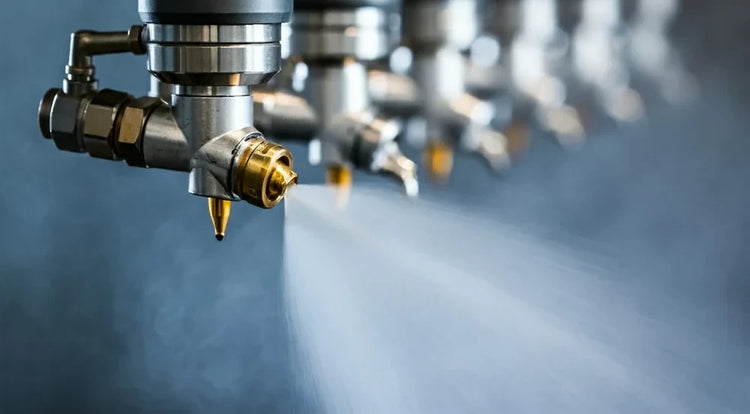
Boquillas de Pulverización para
Sistemas de Limpieza de Gases de Escape y Scrubber Marinos
Las boquillas de inyección de agua de lavado EGCS operan en condiciones que hacen que la mayoría del hardware industrial de pulverización sea la elección incorrecta desde el principio. Los gases de escape calientes a 200–250 °C, acidificados a un pH de 2–3 por el dióxido de azufre disuelto de la combustión de HSFO, crean un entorno donde el acero inoxidable 316L se corroe completamente a través de su espesor de pared en un solo ciclo de dique seco. La selección correcta del material de la boquilla —Dúplex 1.4462, Súper Dúplex 2507 o Carburo de Silicio— no es una mejora de rendimiento. Es la diferencia entre un depurador que cumple con el Anexo VI de MARPOL en cada viaje y uno que falla antes de la próxima inspección del Control del Estado del Puerto.
Los depuradores de sistemas de limpieza de gases de escape (EGCS) marinos utilizan boquillas de pulverización para inyectar agua de lavado —ya sea agua de mar en sistemas de circuito abierto o solución alcalina recirculada en sistemas de circuito cerrado— en el flujo de gases de escape. El agua de lavado entra en contacto con el dióxido de azufre de los gases de escape, lo absorbe y transporta el ácido sulfuroso y sulfúrico resultante desde la fase gaseosa hacia el flujo de descarga de agua de lavado. Las boquillas que realizan esta función operan continuamente en un entorno corrosivo y de alta temperatura, que se encuentra entre los más exigentes de cualquier aplicación de pulverización industrial.
La especificación correcta de la boquilla para el servicio EGCS depende de la posición dentro del depurador (torre de pulverización de entrada primaria vs. garganta venturi vs. etapas de pulido secundarias), la temperatura del gas de escape en esa posición, el pH del agua de lavado en esa posición y si el sistema es de circuito abierto (agua de mar), circuito cerrado (solución alcalina) o híbrido. No existe un solo tipo de boquilla o grado de material correcto para todas las posiciones en una instalación EGCS; esta página cubre la base de ingeniería para la especificación posición por posición.
Scrubbers de Circuito Abierto vs. Circuito Cerrado: Química Diferente, Demandas de Boquillas Diferentes
La diferencia fundamental entre los sistemas EGCS de circuito abierto y cerrado radica en lo que contiene el agua de lavado, y esa diferencia determina directamente el grado del material de la boquilla, la geometría del orificio y el intervalo de mantenimiento.
Sistemas de Circuito Abierto
Agua de lavado de mar — operación oceánica sin restriccionesSistemas de Circuito Cerrado
Agua de lavado alcalina recirculada — operación en ECA y puertosTres Posiciones de Pulverización, Tres Problemas de Ingeniería Diferentes
Un depurador marino no es una aplicación de pulverización de una sola posición. La temperatura, el pH, la velocidad del gas y la calidad del agua en la torre de pulverización de entrada principal, la garganta del venturi y las etapas de pulido secundarias son todas diferentes, y la especificación de la boquilla en cada posición debe derivarse de las condiciones en esa posición, no de una selección única para todo el sistema.
Torre de Pulverización de Entrada Primaria
Temperatura más alta — exposición ácida más altaLa torre de pulverización de entrada primaria es donde el gas de escape entra al depurador a su temperatura más alta, típicamente 200–280°C para un gran motor diésel marino de dos tiempos que usa combustible pesado. Las primeras filas de boquillas de inyección de agua de lavado en esta zona experimentan la temperatura total del gas de escape entrante en la cara de abajo mientras inyectan agua de lavado a temperatura cercana al ambiente. Esto crea un gradiente térmico a través del cuerpo de la boquilla que, combinado con la atmósfera de escape altamente ácida y que contiene cloruro, crea el entorno material más exigente en toda la instalación EGCS.
El agua de lavado en esta posición también es más efectiva para la absorción de SO₂ porque la fuerza impulsora para la absorción de gas en el líquido es más alta cuando el agua de lavado está fresca (menor contenido de SO₂ disuelto) y el gas está más caliente. Lograr el tamaño de gota correcto en esta posición —lo suficientemente fino para maximizar el área de contacto gas-líquido, pero lo suficientemente grueso para caer contra la corriente ascendente del gas de escape entrante— tiene el mayor impacto en la eficiencia general del depurador de cualquier posición en el sistema.
Garganta del Depurador Venturi
Mayor velocidad del gas — máxima abrasiónLos diseños de depuradores venturi aceleran el gas de escape a través de una sección de garganta constreñida, alcanzando típicamente velocidades de gas de 40 a 80 m/s en la garganta. A estas velocidades, el gas de escape transporta partículas finas de combustión incompleta con suficiente energía cinética para causar erosión directa de los cuerpos de las boquillas y los bordes de los orificios, el mismo mecanismo de abrasión de doble superficie descrito para los depuradores de gases de alto horno, pero ahora combinado con cloruro de agua de mar y la química de gases de escape ácidos que acelera el componente de corrosión de la sinergia corrosión-erosión.
Pulido Secundario y Lavado del Eliminador de Niebla
Temperatura más baja — prevención de arrastre de gotas finasDespués de la etapa de depuración primaria, el gas de escape parcialmente limpiado pasa por etapas de pulverización secundarias y una sección de eliminador de niebla. Las etapas de pulverización secundarias continúan la absorción de SO₂ a temperaturas de gas más bajas (típicamente 40–80 °C en este punto) y concentraciones de ácido más bajas. Las boquillas de lavado del eliminador de niebla limpian periódicamente los paneles del eliminador de niebla para evitar que se acumulen depósitos de sal y ácido en la superficie y restrinjan el flujo de gas. Estas posiciones operan en un entorno mucho menos agresivo que la entrada primaria, pero aún requieren materiales resistentes a la corrosión porque el gas de escape sigue siendo ácido y contiene cloruros.
Cárter del depurador y lavado interno
Eliminación de depósitos de hollín y sulfato entre viajesDurante el funcionamiento, el hollín carbonáceo y los depósitos amorfos de sulfato se acumulan en las superficies internas de la torre depuradora, en los colectores del anillo de pulverización y en los paneles eliminadores de niebla. Estos depósitos reducen la eficiencia del contacto gas-líquido, restringen el flujo de gas a través del depurador y, si se permite que se acumulen en capas gruesas, pueden desprenderse como grandes bloques que bloquean los orificios individuales de las boquillas. El lavado interno de la torre depuradora entre viajes o en los intervalos de mantenimiento programados es necesario para mantener la eficiencia de depuración del diseño durante la vida útil operativa del buque.
Optimización del tamaño de las gotas para la absorción de SO₂: equilibrio entre el área de contacto y la caída de presión de tiro
La distribución del tamaño de las gotas producidas por las boquillas de inyección de agua de lavado del EGCS es el principal determinante de la eficiencia de depuración a cualquier caudal de agua de lavado dado. Si se equivoca en cualquier dirección, ya sea demasiado fina o demasiado gruesa, esto cuesta dinero en el consumo de combustible, capital en equipos sobredimensionados o riesgo de incumplimiento debido a un rendimiento deficiente.
Por qué más fino no siempre es mejor para las gotas de los depuradores marinos
La absorción de SO₂ de la fase gaseosa a la fase líquida se rige por la teoría de la transferencia de masa: la tasa de absorción es proporcional al área interfacial total gas-líquido, que es proporcional al área superficial total de las gotas por unidad de volumen del depurador. Para un caudal de agua de lavado dado, las gotas más pequeñas producen más área superficial total que las gotas más grandes (el área superficial se escala como 1/d para un volumen dado). Esto crea un fuerte incentivo de ingeniería para producir las gotas más finas posibles para maximizar la eficiencia de depuración.
Sin embargo, los depuradores EGCS operan con una corriente de gases de escape que fluye hacia arriba y que arrastra las gotas si son lo suficientemente finas como para ser arrastradas. La velocidad de sedimentación terminal de una gota de agua en el aire se escala con el cuadrado del diámetro de la gota: una gota de 100 µm tiene una velocidad terminal de aproximadamente 0,25 m/s, mientras que una gota de 500 µm se asienta a aproximadamente 2,5 m/s. En una torre depuradora donde la velocidad ascendente del gas es de 2 a 4 m/s, las gotas por debajo de aproximadamente 300 a 400 µm serán arrastradas hacia arriba por la corriente de gas en lugar de caer hacia el cárter; o se reintroducen en el gas limpio y escapan a través de la chimenea de escape, o cargan la sección del eliminador de niebla, aumentando la caída de presión y reduciendo el caudal de gas disponible.
La penalización por caída de presión de la atomización excesivamente fina
En una instalación de EGCS marina, el depurador crea una caída de presión en la trayectoria de los gases de escape que el motor debe superar; esta contrapresión adicional es el costo energético directo de la operación de depuración. Una atomización fina que crea una carga excesiva en el eliminador de niebla eleva la caída de presión a través del depurador más allá del valor de diseño. En un gran motor diésel marino de dos tiempos, cada 10 mbar adicionales de contrapresión del escape corresponden a un aumento de aproximadamente 0,3-0,5% en el consumo específico de combustible. Para un motor principal de 12.000 kW que funciona en el mar durante 5.000 horas al año con un coste de HSFO de 600 $/tonelada, un consumo de combustible adicional del 0,4% debido a un exceso de contrapresión cuesta aproximadamente entre 15.000 y 25.000 $ al año, más que el coste de volver a especificar el conjunto de boquillas. Póngase en contacto con NozzlePro con el diámetro de su torre depuradora, el caudal de gases de escape y la velocidad de gas de diseño para recibir una recomendación de tamaño de gota específica para su sistema.
El mecanismo de fallo por picaduras del 316L: por qué el acero inoxidable estándar no es adecuado para EGCS
El acero inoxidable austenítico 316L logra su resistencia a la corrosión a través de una película pasiva de óxido de cromo en su superficie. En agua de mar limpia a temperatura ambiente, esta película pasiva es estable y proporciona una protección adecuada contra la corrosión general. En el ambiente de agua de lavado del EGCS (agua que contiene cloruros a temperatura elevada, en contacto con gases de escape acidificados con un pH de 2 a 3), la película pasiva es atacada por dos mecanismos simultáneos que actúan de forma sinérgica.
Los iones de cloruro desestabilizan la película pasiva en los defectos superficiales, iniciando la corrosión por picaduras en los lugares de los defectos. El ambiente ácido (pH 2-3) impide que la película pasiva se vuelva a formar sobre los puntos de picaduras activos; una vez que se inicia una picadura, la química local de la picadura se vuelve cada vez más ácida (hidrólisis de FeCl₃), lo que impide aún más la repassivación y acelera la tasa de crecimiento de la picadura. Este mecanismo autocatalítico es lo que hace que las boquillas EGCS de acero inoxidable 316L fallen por picaduras en meses de servicio en lugar de años; las picaduras crecen progresivamente hasta que penetran a través de la pared de la boquilla o causan una falla mecánica del borde del orificio.
La mayor resistencia a las picaduras del Dúplex 1.4462, cuantificada por la fórmula PREN (PREN = %Cr + 3,3×%Mo + 16×%N), refleja una película pasiva más resistente a la despasivación inducida por cloruros. Con un PREN de 35 a 38, el Dúplex 1.4462 mantiene la estabilidad de la película pasiva a concentraciones y temperaturas de cloruros en las que el acero inoxidable 316L (PREN de 24 a 26) ya ha iniciado picaduras activas. Para la posición de pulverización de entrada primaria, donde la temperatura y la carga ácida son más altas, el Super Dúplex 2507 (PREN superior a 40) proporciona el margen adicional necesario para un servicio fiable a largo plazo entre los intervalos de dique seco.
Una vez que se inician las picaduras en una boquilla EGCS de acero inoxidable 316L, el mecanismo de crecimiento autocatalítico de las picaduras significa que la tasa de fallo se acelera en lugar de permanecer constante. Una boquilla que no muestra corrosión visible después de seis meses puede mostrar picaduras pasantes en los tres meses siguientes porque la química local de la picadura se ha vuelto autosuficiente. Las inspecciones del control del estado del puerto que detectan fallos en las boquillas del EGCS pueden dar lugar a restricciones operativas que son mucho más caras que el coste de la especificación correcta del dúplex en la instalación inicial. El coste incremental entre las boquillas EGCS de acero inoxidable 316L y las de dúplex 1.4462 se recupera con un solo incidente de reparación evitado.
Material de las boquillas EGCS por posición del depurador
Póngase en contacto con NozzlePro indicando su fabricante de depuradores, la geometría de la torre, el perfil de temperatura de los gases de escape y la química del agua de lavado. La selección de materiales específicos para cada posición es esencial: un único grado de material en todo el depurador está sobredimensionado en algunas posiciones o subdimensionado en otras.
| Posición del depurador | Rango de temperatura | pH en la posición | Material recomendado | Restricción clave | Reemplazar en |
|---|---|---|---|---|---|
| Anillos de pulverización de entrada primaria — más cercanos a la entrada de gases de escape | 200–280 °C | pH 2–3 | Cuerpo de Super Dúplex 2507 o cerámica de SiC | La temperatura más alta + la carga ácida más alta — Dúplex 1.4462 en su límite de servicio; SiC preferido para una resistencia ilimitada a la corrosión | Inspeccionar en cada dique seco; reemplazar a cualquier signo de picaduras o distorsión del orificio |
| Anillos de pulverización primaria — filas superiores (gas parcialmente enfriado) | 120–200 °C | pH 2.5–4 | Dúplex 1.4462 o Super Dúplex | Todavía dentro del rango de aceleración de la corrosión para el acero inoxidable 316L; el Dúplex 1.4462 proporciona un servicio adecuado; actualizar a Super Dúplex si la temperatura del gas se mantiene por encima de 150 °C en esta posición | Inspeccionar cada 12 meses; reemplazar con una desviación del caudal del 10% |
| Inyección de garganta Venturi | 150–250 °C | pH 2–3 | Cuerpo de dúplex o superdúplex + insertos de SiC | La velocidad del gas de 40-80 m/s provoca una rápida abrasión de los orificios metálicos; los insertos de SiC son obligatorios en la garganta del venturi, independientemente del grado de corrosión | Inspeccionar en cada dique seco; medir el diámetro del orificio; reemplazar si el aumento supera el 10% |
| Etapas de pulverización de pulido secundario | 40–80 °C | pH 4–6 | Dúplex 1.4462 | Resistencia a la corrosión adecuada a menor temperatura y pH; se requiere monitoreo de incrustaciones; no especificar acero inoxidable 316L incluso en esta posición | Inspeccionar cada 12 meses; limpiar con ácido si se detectan incrustaciones |
| Boquillas de lavado del eliminador de niebla | 40–80 °C | pH 5–7 | Dúplex 1.4462 | Enjuague periódico a baja presión — ambiente químico moderado; patrón de cono completo para cobertura del panel; presión de suministro de 1–3 bar | Inspeccionar cada 12 meses |
| Lavado interno de hollín del depurador | Temperatura ambiente–60 °C | pH variable | Dúplex 1.4462 | pH variable durante el lavado a medida que se disuelven los depósitos ácidos; abanico plano de alto impacto o chorro sólido; el dúplex maneja todo el rango | Inspeccionar anualmente |
Especificación de boquillas depuradoras EGCS de un vistazo
Parámetros clave para las boquillas de inyección de agua de lavado EGCS
Materiales de grado EGCS suministrados por NozzlePro
Todas las boquillas fabricadas bajo ISO 9001. Documentación del grado de material disponible bajo petición. Los clientes son responsables de la presentación a la sociedad de clasificación utilizando el hardware suministrado por NozzlePro.
Las fallas de las boquillas EGCS son interrupciones operativas, no eventos de mantenimiento.
Un depurador que no puede alcanzar los objetivos de pH del agua de lavado porque sus boquillas de entrada primarias se han picado no demuestra el cumplimiento del Anexo VI del MARPOL en la próxima inspección del Control del Estado del Puerto. Especifique Dúplex o SiC desde la instalación, no después de la primera falla. Póngase en contacto con NozzlePro con su fabricante de depuradores, el perfil de temperatura de los gases de escape y la química del agua de lavado.