
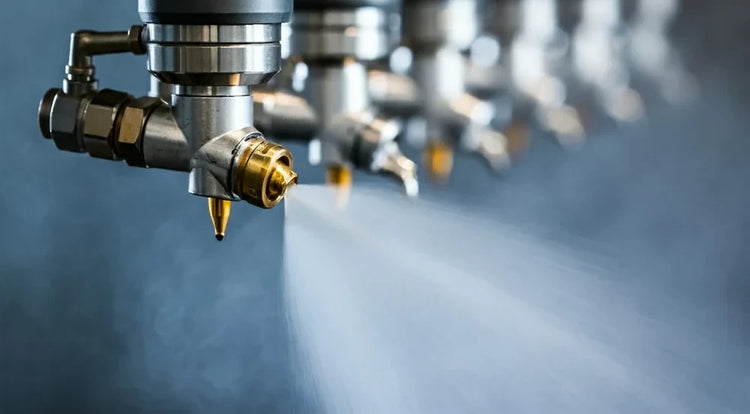
Industrial Spray Nozzle Troubleshooting Guide
Problem / Symptom / Solution for the twelve most common spray nozzle failures — clogging, uneven pattern, dripping, low flow, corrosion, vibration, misting when droplets expected, and more
Find your observed symptom in the Quick-Symptom Lookup below or jump to the matching problem section. Each problem entry gives: what you observe (Symptom), why it happens (Problem / Root Cause), and what to do about it (Solution) — in that order. The most important first step for any nozzle problem: measure actual supply pressure at the nozzle manifold inlet under full-flow conditions before diagnosing the nozzle itself. Many apparent nozzle failures are actually supply pressure problems — wrong pressure produces all the same symptoms as a failed nozzle.
The two most common misdiagnoses: (1) A nozzle delivering less flow than expected is diagnosed as clogged when the actual cause is supply pressure below design — clean the nozzle, reinstall it, and the problem recurs. (2) A nozzle producing a narrower-than-rated spray angle is diagnosed as worn or clogged when the actual cause is the same: operating below rated pressure. Measure pressure first.
Most nozzle troubleshooting calls follow a predictable pattern: the nozzle is suspected first, but the actual cause is upstream. Low flow from a correctly functioning nozzle at below-design supply pressure looks identical to low flow from a clogged nozzle at correct supply pressure. Uneven spray pattern from a nozzle operating below its minimum rated pressure looks identical to a nozzle with a partially blocked orifice. Before disassembling any nozzle, attach a calibrated pressure gauge at the manifold inlet and verify pressure under full-flow conditions — not at the pump gauge, not at rest, and not from memory of what the system was last set to. That one measurement resolves approximately 40% of reported nozzle problems without touching the nozzle.
The second most valuable diagnostic step before disassembly: timed flow collection. Divert the nozzle output into a calibrated container for 30 seconds at measured supply pressure. Compare collected volume against rated flow × 0.5 minutes. If flow is below rated: suspect clogging. If above rated: suspect wear. If at rated: the nozzle is functioning correctly — the problem is elsewhere in the system (coverage geometry, liquid properties, or process conditions that have changed).
Quick-Symptom Lookup — Jump to Your Problem
Find your observed symptom and go directly to the detailed solution
No spray / no flow from position
Orifice fully blocked; supply valve closed; supply line blocked; fitting not fully engaged
→ See Problem 1: CloggingReduced flow — less than expected
Partial clogging; supply pressure below design; worn check valve; strainer blocked
→ See Problem 3: Low FlowMore flow than expected
Orifice wear; supply pressure above design; wrong nozzle model installed
→ See Problem 4: High Flow / WearSpray pattern streaky or asymmetric
Partial blockage on one side; uneven orifice wear; foreign particle lodged in orifice
→ See Problem 2: Uneven PatternSpray angle narrower than rated
Operating below rated pressure; liquid viscosity higher than rated; partial clogging
→ See Problem 6: Narrow AngleDripping or drooling when off
Worn anti-drip tip; failed check valve; residual pressure not fully relieved; worn orifice
→ See Problem 5: Dripping / LeakingFine mist instead of coarse droplets
Operating above rated pressure; wrong nozzle type installed; air entrainment in liquid supply
→ See Problem 7: Unintended MistingNozzle body corroding rapidly
Wrong body material for chemical; higher concentration or temperature than specified; seal failure letting chemical reach body threads
→ See Problem 8: Corrosion FailureVibration, chattering, or spray noise
Cavitation; pressure oscillation from pump; resonance in manifold piping; partially blocked strainer creating turbulent flow
→ See Problem 9: Vibration / NoiseWhite mineral deposits at orifice
Hard water mineral scale (calcium carbonate, calcium sulfate, silica) precipitating as spray evaporates
→ See Problem 10: Scale BuildupPulsing, surging, or intermittent flow
Pump pulse not dampened; pressure regulator hunting; air/vapor in supply line; partially blocked strainer
→ See Problem 11: Pulsing / SurgingProcess result poor despite normal flow and pattern
Wrong nozzle type for application; incorrect standoff distance; liquid property change; coverage overlap insufficient
→ See Problem 12: Poor CoverageMaster Diagnostic Reference Table
Observed symptom → most likely cause → first diagnostic step → corrective action
| Observed Symptom | Most Likely Root Cause | First Diagnostic Step | Corrective Action |
|---|---|---|---|
| No flow from position | Complete orifice blockage; supply valve closed; fitting not sealed | Check supply valve; measure pressure at manifold; remove nozzle and inspect orifice | Clear clog or replace nozzle; verify supply valve fully open; re-seat fitting |
| Flow <90% of rated | Partial clogging; supply pressure below design; strainer blocked | Measure pressure at manifold under flow; timed flow collection test | Restore design pressure; clean strainer; clean or replace nozzle |
| Flow >110% of rated | Orifice wear enlargement; supply pressure above design; wrong nozzle | Timed flow collection; verify supply pressure; confirm nozzle model number | Replace worn nozzle; reduce pressure to design; confirm correct model |
| Asymmetric spray pattern | Partial blockage on one side of orifice; uneven wear; particle lodged in slot | Pattern card test; 10× loupe inspection of orifice | Remove foreign particle; clean; replace if wear-caused asymmetry confirmed |
| Streaks in flat-fan pattern | Foreign particle or scale deposit in fan slot; orifice slot wear; liquid viscosity too high | Remove nozzle; inspect slot under loupe; measure liquid viscosity | Clean slot; replace if slot is worn; reduce liquid viscosity or switch nozzle type |
| Hollow center in full-cone | Operating below minimum rated pressure; orifice partially blocked at center | Verify supply pressure at manifold; increase to rated; retest pattern | Restore rated pressure; if hollow persists at correct pressure, clean or replace |
| Dripping when flow is off | Worn or damaged anti-drip tip; failed check valve insert; residual line pressure | Close supply completely; observe — dripping with fully closed supply confirms valve/tip failure | Replace anti-drip tip or check valve; add pressure-relief valve to eliminate residual line pressure |
| Spray angle narrower than rated | Operating below rated pressure; liquid more viscous than rated; partial clogging | Measure supply pressure; check liquid viscosity; flow test | Restore rated pressure; switch to nozzle rated for actual viscosity; clean clog |
| Spray angle wider than rated | Orifice edge wear; operating above rated pressure | Timed flow test (worn nozzle also shows excess flow); verify pressure | Replace worn nozzle; reduce pressure to rated maximum |
| Fine mist instead of droplets | Pressure far above rated; air entrainment in supply; wrong nozzle type | Measure pressure; bleed air from supply line; confirm nozzle model | Reduce pressure; purge air; install correct nozzle type for required droplet size |
| Nozzle body rapid corrosion | Wrong body material for chemical environment; concentration or temperature above specification | Identify exact chemical, concentration, and temperature; check material specification | Upgrade to compatible body material per compatibility guide; also check seal material |
| Pulsing / intermittent flow | Pump pulsation not dampened; air in supply line; pressure regulator instability | Install pressure gauge at manifold and observe reading under flow — stable or oscillating? | Add pulse dampener; bleed air from supply; tune or replace pressure regulator |
| White scale at orifice | Hard water mineral precipitation (CaCO₃, CaSO₄, SiO₂) as spray evaporates at orifice | Collect scale sample; dissolve in vinegar (acid-soluble = CaCO₃) or not (silica) | Citric acid soak; scale inhibitor in supply; DI or softened water; TC inserts for high-TDS |
| Good flow and pattern but poor process result | Wrong nozzle type for application; incorrect standoff; liquid property change; insufficient overlap | Review nozzle type vs. application requirement; measure actual standoff; check liquid spec sheet | Re-specify nozzle type; adjust mounting height; confirm liquid properties match design spec |
Spray Nozzle Clogging — Partial or Complete Orifice Blockage
Clogging occurs when material accumulates in or at the nozzle orifice to a point where it reduces or stops flow. Four distinct clogging mechanisms require different solutions:
- Particulate blockage — solid particles in the supply liquid larger than the orifice free passage
- Mineral scale — dissolved minerals precipitating at the orifice as liquid evaporates
- Biological growth — algae, biofilm, or bacterial slime colonizing the orifice interior during standby periods
- Chemical precipitation — two incompatible chemicals reacting within the nozzle to form an insoluble precipitate
- Zero flow from one or more positions while adjacent positions are flowing normally
- Timed flow collection below 90% of rated flow at correct supply pressure
- Visible debris, scale, or biological growth at the orifice face under 10× loupe inspection
- System supply pressure rising while total flow decreases — pump working harder against partial blockage across multiple positions
- Clogging occurring in a pattern (same positions, same side of manifold) suggesting contamination source in the supply
Particulate: Add or clean 100-mesh (150 µm) inline strainer upstream of manifold. For fine fog nozzles: 200-mesh. Switch to spiral nozzles (large free passage) for liquids with unavoidable suspended solids.
Mineral scale: Soak in 5% citric acid solution for 2–4 hours (dissolves CaCO₃ and CaSO₄). Add scale inhibitor (10–20 ppm phosphonate) to supply. Install softener or RO for fine fog systems.
Biological: Weekly 15-minute hypochlorite flush (2–5 mg/L free chlorine) through nozzle internals. Program fresh-water purge cycle at system shutdown.
Chemical precipitation: Identify reaction — separate injection points or reformulate the supply chemistry.
Particulate Blockage
Particles larger than the nozzle's minimum free passage (orifice diameter or slot width) wedge in the orifice. Common sources: rust scale from unlined steel supply pipe; debris from recent pipe work; undissolved solids in the spray liquid; strainer mesh torn or bypassed.
Fix: Install or clean upstream strainer. Flush supply line before reconnecting nozzle system after any maintenance. Add magnetic separator for ferrous debris.Mineral Scale (CaCO₃, CaSO₄, SiO₂)
Hard water spray partially evaporates at the orifice exit, concentrating dissolved minerals above solubility limit and precipitating scale crystals that progressively narrow and eventually block the orifice. Worsens during standby when residual liquid in the nozzle evaporates completely.
Fix: Citric acid soak (5%, 2–4 hrs); scale inhibitor addition; softened or DI water supply; fresh-water purge cycle at shutdown to displace hard water from orifice before standby.Biological Fouling (Algae, Biofilm)
Common in lagoon aeration, wastewater spray, outdoor evaporation systems, and any system where warm, nutrient-containing liquid sits stagnant in nozzle internals during long standby periods. Biofilm hardens inside the orifice and is not removed by water flushing alone.
Fix: Weekly chlorine flush through manifold during operation. Programmatic shutdown purge cycle. Switch to spiral nozzles (biological material passes through large free passage without blocking).Chemical Precipitation (In-Orifice Reaction)
Two reactive chemicals introduced at different points in the supply system arrive at the nozzle orifice in sufficient concentration to react and form an insoluble precipitate — for example, calcium-containing water mixing with phosphate-based scale inhibitor forming calcium phosphate; or lime slurry mixing with CO₂-containing air forming CaCO₃ scale at the orifice exit.
Fix: Separate injection points so reactive chemicals mix only in the process zone, not in the supply piping. Identify precipitate chemistry by pH and solubility testing.Uneven or Distorted Spray Pattern — Asymmetric, Streaky, or Hollow
- Foreign particle lodged asymmetrically in the orifice slot or orifice exit — deflects part of the liquid sheet
- Uneven orifice wear — one side of the orifice abraded more than the other, producing an asymmetric opening
- Scale or biological deposit on one side of the orifice
- Supply pressure below rated minimum — produces hollow center in full-cone, collapsed pattern in flat-fan
- Liquid viscosity higher than nozzle's rated viscosity — liquid sheet does not break up uniformly at the orifice exit
- Orifice physically damaged (dent, impact damage) from over-torquing during installation or from debris impact
- Pattern card test shows unequal coverage left-to-right (flat-fan) or missing zone (full-cone, hollow-cone)
- Process result shows stripes of over-application alternating with under-application — in coating, cleaning, or chemical dosing
- Full-cone nozzle producing hollow center or donut pattern instead of filled circle
- Flat-fan producing a curve or arc rather than a straight rectangular pattern — indicating one side is deflected relative to the nozzle axis
- Visible streak of concentrated spray within an otherwise fan-shaped pattern — classic sign of a particle lodged in the orifice slot
Particle in orifice: Remove nozzle; inspect and clear orifice under 10× loupe with a soft non-metallic pick (wooden toothpick, soft polymer rod — never a metal probe which will enlarge or scratch the orifice). Reinstall and retest pattern.
Below-rated pressure: Verify and restore design supply pressure at nozzle manifold under flow. Retest — pattern often corrects immediately at correct pressure.
Uneven wear: Replace nozzle. Uneven wear is permanent — cleaning will not restore symmetry. Upgrade to TC insert if abrasive wear is the cause.
High viscosity: Reduce liquid temperature (lowers viscosity); switch to nozzle with wider slot or larger orifice rated for the actual liquid viscosity.
Physical damage: Replace nozzle. Dents or deformations from impact cannot be repaired without precision machining.
Flow Rate Below Rated — Less Liquid Than Expected at Operating Pressure
- Supply pressure below design — the most common cause; often masked by checking pump gauge rather than nozzle inlet pressure under flow
- Partially clogged orifice reducing effective orifice area
- Clogged or undersized supply strainer creating pressure drop between pump and nozzle
- Partially closed isolation valve in the supply line
- Undersized supply piping causing excessive friction pressure drop at design flow rate
- Liquid temperature higher than design, reducing viscosity — counterintuitively, this usually increases flow slightly, not decreases it; if viscosity has increased, flow decreases
- Wrong nozzle model installed (lower K-factor than specified)
- Timed flow collection at operating conditions delivers less than 90% of expected volume
- Spray visually weaker or shorter throw than normal
- Cleaning or cooling performance below specification despite nozzle appearing to spray
- Process monitoring shows under-dosing trend — less reagent applied than supply flow meter indicates (if system has a supply flow meter, compare against nozzle-level timed collection)
- Pump outlet pressure normal but manifold inlet pressure measurably lower — confirms pressure drop between pump and manifold
Step 1: Measure actual supply pressure at the nozzle manifold inlet with a calibrated gauge under full-flow conditions. Compare to design pressure. If below design: find and correct the supply pressure cause (valve, strainer, pipe sizing) before touching the nozzle.
Step 2: If pressure is at design but flow is still low: remove and inspect nozzle for clogging. Clean if clogged. Retest flow after cleaning.
Step 3: If pressure and nozzle are correct but flow remains low: verify the nozzle model number matches specification (check K-factor on datasheet against required K-factor for target flow).
Step 4: If all the above are correct: check liquid properties — density and viscosity at actual operating temperature — and compare to design values. Higher viscosity than design reduces flow and narrows spray angle.
Flow Rate Above Rated — More Liquid Than Specified, or Orifice Wear Confirmed
- Orifice wear — abrasive particles in the spray liquid have enlarged the orifice over time. A 10% diameter increase produces a 21% flow increase (area = diameter²)
- Supply pressure above design — nozzle is functioning correctly but at higher-than-specified pressure
- Wrong nozzle model installed — higher K-factor than specified
- Orifice insert missing or dislodged — TC or ceramic insert that was providing calibrated flow is absent or displaced, leaving a larger uncontrolled opening
- Timed flow collection at design pressure delivers more than 110% of expected volume
- Spray pattern wider than rated (wear-caused orifice enlargement also widens the pattern angle)
- Process showing over-application — coating weight above spec, chemical overdosing, excessive water use
- Supply pressure gauge reading above design setting — may not have been checked since initial commissioning
- Loupe inspection of orifice face shows rounded edges, enlarged or irregular opening compared to new nozzle of same model
Orifice wear: Replace nozzle immediately — cleaning does not restore a worn orifice. Replace the full nozzle set for the spray level, not individual positions only. Upgrade to tungsten carbide orifice inserts to prevent recurrence. See How to Detect Nozzle Wear for cost impact calculation.
Above-design pressure: Reduce supply pressure to design value at the pressure regulator. Retest flow — if still above 110% of rated after pressure correction, orifice wear is also present.
Wrong nozzle model: Compare the installed nozzle model number against the specification. Replace with correct model.
Missing TC insert: Disassemble nozzle body to verify TC insert is seated correctly. Replace if missing or displaced.
Dripping or Leaking When Flow Is Off — Nozzle Does Not Shut Off Cleanly
- Worn or damaged anti-drip tip — the spring-loaded shutoff mechanism inside anti-drip nozzle designs fails to hold the orifice closed against residual line pressure
- Failed or worn check valve insert — common in nozzles with built-in check valves for back-siphonage prevention
- Residual line pressure after supply valve closes — pressure in the supply manifold between the control valve and the nozzle is not fully relieved; liquid slowly weeps through the orifice under this residual pressure
- Worn orifice combined with surface tension failure — a significantly enlarged orifice in a fine-mist or low-flow nozzle may allow liquid to drip through by gravity/surface tension even with zero supply pressure
- External leakage from the nozzle body connection — thread seal failure, not dripping from the orifice
- Visible liquid dripping from the nozzle orifice after the supply control valve has been closed
- Slow accumulation of liquid below nozzle positions between spray cycles — wet floor, staining, or chemical deposit in non-spray periods
- Distinguishing orifice drip from body leak: orifice drip produces drops from the spray orifice itself; body leak produces drops from the thread connection or body seam
- Dripping only from some positions, not all — random anti-drip tip failures vs. system-wide residual pressure problem (which would affect all positions equally)
Anti-drip tip failure: On serviceable nozzle designs, the anti-drip tip assembly is a replaceable cartridge — remove the tip, inspect the spring and seating surfaces, replace the cartridge. For non-serviceable designs: replace the full nozzle.
Residual line pressure: Install a pressure-relief or drain-back valve on the supply manifold that relieves residual pressure to drain when the supply valve closes. Alternatively, install the supply control valve at the lowest point in the manifold to allow gravity drain-back between cycles.
Thread/body leak: Re-seal with PTFE thread tape (2–3 wraps on NPT threads); Viton O-ring if face-seal connection; Loctite 567 or equivalent pipe sealant for persistent thread leaks. Do not overtorque — most nozzle bodies crack at 2–3× the correct torque.
Worn orifice drip: Replace nozzle — the enlarged orifice is below the surface tension threshold that would normally hold liquid back at zero pressure.
Spray Angle Narrower Than Rated — Coverage Area Smaller Than Design
- Operating below rated pressure — the most common cause; spray angle decreases progressively as supply pressure drops below the rated minimum. A flat-fan nozzle rated 80° at 40 PSI may spray only 60–65° at 20 PSI
- Liquid viscosity higher than rated — viscous liquids resist the sheet breakup that creates the full angle; the spray emerges as a narrower, thicker sheet or stream
- Liquid surface tension higher than rated (cold liquid, different formulation) — affects sheet breakup efficiency
- Partial clogging on the periphery of the orifice, restricting the outermost flow paths that create the wide angle
- Nozzle installed at below-minimum standoff distance — pattern has not fully developed its rated angle at too short a distance
- Pattern card test at design standoff shows coverage width smaller than the expected W = 2 × standoff × tan(θ/2) calculated for the rated angle
- Gaps in coverage between adjacent nozzle positions — nozzles that provided overlapping coverage at commissioning now have visible gaps
- Process showing uneven result in a regular repeating pattern corresponding to the nozzle spacing — under-treated zones between positions, over-treated zones under each nozzle position
Low pressure (most likely): Measure pressure at manifold under full-flow conditions. If below rated minimum for the installed nozzle: restore design pressure. Re-test pattern — angle typically returns to rated immediately at correct pressure.
High viscosity liquid: Warm the liquid to reduce viscosity. If warming is not possible: switch to a nozzle specifically rated for the liquid's actual viscosity — ask manufacturer for viscosity-corrected angle data or switch to a wider angle model to compensate.
Partial clogging on orifice periphery: Clean nozzle; retest. If cleaning restores the angle, add upstream filtration to prevent recurrence.
Short standoff: Increase the nozzle-to-target distance to at least the minimum value where the spray pattern has fully developed its rated angle — typically 50–150 mm minimum depending on nozzle size and angle.
Unintended Fine Mist — Producing Fog When Coarse Droplets Are Required
- Supply pressure significantly above rated maximum — excessive pressure atomizes the liquid far more finely than the nozzle was designed to produce
- Air entrainment in the liquid supply — air bubbles in the supply cause chaotic two-phase flow at the orifice, producing a fine mist rather than the designed droplet distribution
- Wrong nozzle type installed — a hydraulic atomizing or fog nozzle installed where a full-cone or flat-fan nozzle was specified
- Two-fluid (air-atomizing) nozzle receiving air at a higher air-to-liquid ratio than designed — excess atomizing air produces finer droplets than required
- Cavitation within the nozzle body — low-pressure voids forming and collapsing in the liquid flow path, contributing to fine atomization beyond the normal pressure-drop mechanism
- Visible fine mist or fog extending well beyond the intended spray zone — drifting to adjacent areas or equipment
- Surface wetting pattern shows fine droplet impact marks (small, many) where large droplet impacts (few, large) are expected
- Process performance poor in ways consistent with fine droplets — inadequate impact force for cleaning, poor penetration of a particulate bed, excessive evaporation before the target
- In dust suppression: fine mist is actually desired, so confirm the observation is actually a problem rather than correct behavior
Excess pressure: Reduce supply pressure to the rated operating range for the installed nozzle. Larger droplets at lower pressure require less pump energy and deliver better process performance for most impact-dependent applications.
Air entrainment: Bleed the supply line and manifold to remove entrained air. Check the supply pump for air ingestion (cavitating pump, vortex at suction inlet, above-minimum submergence depth of suction inlet). Install a deaeration section or air separator on the supply line.
Wrong nozzle type: Confirm the installed nozzle model number. Replace with the specified nozzle type for the required Dv50 at design supply pressure.
Air-atomizing ratio too high: Reduce atomizing air pressure or flow rate to the recommended air-to-liquid ratio for the target Dv50. Obtain the manufacturer's Dv50 vs. air/liquid ratio curves for the specific nozzle model.
Rapid Nozzle Corrosion — Body Pitting, Thread Failure, or Orifice Surface Degradation
- Nozzle body material incompatible with the spray chemical — the most common cause; see Materials Compatibility Guide
- Chemical concentration or temperature higher than the material's rated service conditions
- Seal material failure allowing chemical to contact body threads — Buna-N seals in oxidizer or acid service swell and fail, exposing threads to chemical attack
- Galvanic corrosion — two dissimilar metals in contact in the spray system (brass nozzle in a stainless manifold, or vice versa) with the spray chemical acting as the electrolyte
- Crevice corrosion at thread connections — even corrosion-resistant alloys can fail by crevice corrosion in chloride environments at thread roots where oxygen access is limited
- Concentrated chemical at the orifice during standby — high-TDS or high-concentration chemical that was not flushed from the nozzle evaporates between spray cycles, concentrating at the orifice face and causing accelerated attack
- Visible pitting, discoloration, or surface roughening on the nozzle body exterior and orifice face — appearing within weeks rather than years of installation
- Thread connection corroding faster than the body surface — indicates crevice corrosion mechanism or failed thread sealant allowing chemical into the thread root
- Uniform surface dissolution rather than pitting — may indicate a different corrosion mechanism (uniform attack in strong acid vs. pitting in chloride)
- Corrosion pattern starting at the orifice face and working inward — typical of concentrated chemical evaporating at the orifice exit during standby
- Seal material visibly swollen, cracked, or dissolved — indicating the seal is the first point of failure, subsequently exposing the body to chemical attack
Wrong body material: Identify the exact chemical, concentration, and temperature using the Materials Compatibility Guide. Replace with the correct body material. Do not re-install the incorrect material while sourcing the upgrade.
Seal failure: Replace seals with the correct material for the chemical environment (Viton FKM for acids and oxidizers; PTFE for aggressive chemicals). Inspect threads for corrosion damage before re-sealing.
Galvanic corrosion: Eliminate the dissimilar metal contact — use same material throughout the manifold and nozzle assembly; or install dielectric isolation bushings between dissimilar metals.
Standby concentration attack: Program a fresh-water flush cycle at system shutdown to displace concentrated chemical from nozzle internals before standby. Dilute chemical injection upstream of nozzle rather than concentrated chemical at nozzle.
Vibration, Chattering, or Noise — Nozzle or Manifold Shaking During Operation
- Pump pulsation — reciprocating (piston, diaphragm) pumps produce periodic pressure pulses that can excite resonance in the nozzle manifold piping; the nozzle vibrates at the pump pulse frequency
- Cavitation within the nozzle — when supply pressure drops below the liquid's vapor pressure in a high-velocity orifice zone, vapor cavities form and collapse violently, producing noise and micro-erosion damage
- Hydraulic resonance — standing pressure waves in a long supply manifold can create pressure oscillations that cause vibration at specific nozzle positions
- Partially blocked strainer — turbulent, non-uniform flow past a partially clogged strainer creates velocity fluctuations that propagate to the nozzle manifold
- Nozzle body resonance — the nozzle body and the liquid sheet it produces can resonate at specific flow conditions, particularly in flat-fan nozzles at certain pressures
- Audible chattering or buzzing from one or more nozzle positions — typically at a fixed frequency related to the pump speed or a harmonic of it
- Spray pattern oscillating visibly — the spray fan shaking or swinging at the vibration frequency
- Pressure gauge needle oscillating — indicates pressure pulsation in the supply
- Premature nozzle body wear at thread connections — vibration loosens threaded connections over time, causing leaks and potential nozzle ejection
- Accelerated orifice erosion — cavitation-induced erosion produces a distinctive cratered orifice face appearance under 10× loupe inspection
Pump pulsation: Install a pulse dampener (accumulator or pulsation dampener) on the pump discharge line between the pump and the nozzle supply manifold. Increase supply pipe diameter to reduce flow velocity and dampen pulsation propagation.
Cavitation: Increase supply pressure at the nozzle inlet — cavitation requires that local pressure drops below vapor pressure, which is prevented by maintaining adequate supply pressure. Check for: excessive flow velocity through a too-small supply pipe; sharp bends immediately upstream of the nozzle; partially closed valve immediately upstream of the nozzle. Cavitation produces a distinct crackling or grinding noise, distinct from pump pulsation vibration.
Strainer blockage: Inspect and clean the inline strainer. Turbulent flow from a partially blocked strainer disappears immediately when the strainer is cleaned.
Manifold resonance: Add vibration dampening supports to the manifold piping; reduce supply pressure slightly; change the manifold pipe diameter or length to shift the resonant frequency away from the operating condition.
Mineral Scale Buildup at Orifice — White Deposits Restricting or Deflecting Spray
- Hard water supply (calcium and magnesium ions above 150 ppm as CaCO₃) — dissolved minerals precipitate as calcium carbonate scale when the spray evaporates at the orifice exit or during standby
- High-TDS process water — any spray system using recirculated or concentrated process water accumulates mineral deposits as the dissolved solids exceed solubility at the orifice
- Hot supply water above 60°C — calcium carbonate solubility decreases at elevated temperature, accelerating scale formation at operating temperature compared to ambient
- Scale inhibitor absent or depleted — threshold scale inhibitors prevent nucleation; their absence allows rapid crystal growth on orifice surfaces
- Inadequate or absent shutdown flush cycle — residual liquid in the nozzle during standby fully evaporates, leaving concentrated mineral deposits at the orifice
- Visible white, gray, or yellowish deposits on the orifice face and surrounding nozzle exterior surface
- Progressive flow reduction over weeks — scale gradually narrows the orifice
- Spray pattern asymmetry or streak caused by a scale deposit on one side of the orifice deflecting the liquid sheet
- Scale pattern on nozzle exterior concentrated at the orifice exit — where spray evaporation is most intense — rather than uniformly distributed on the body
- Dissolves in vinegar or dilute acid (citric acid): scale is CaCO₃. Does not dissolve: silica scale — requires different cleaning chemistry
Immediate cleaning: Soak nozzle in 5% citric acid solution for 2–4 hours for CaCO₃/CaSO₄ scale. For silica scale: dilute HF (1–2%) or proprietary silica descaler — confirm material compatibility before use. Never use metal tools to scrape orifice scale — deform or enlarge the orifice.
Prevention — scale inhibitor: Dose 10–20 ppm phosphonate or polyacrylate scale inhibitor into the spray supply. Select inhibitor chemistry to match the dominant scale mineral (carbonate inhibitor for CaCO₃; sulfate inhibitor for CaSO₄/gypsum; dispersant for silica).
Prevention — water treatment: Softened or DI water supply for fine fog nozzle systems (below 30 µm Dv50) where scale is the primary maintenance problem. Softened water below 50 ppm hardness effectively eliminates carbonate scale formation.
Prevention — shutdown flush: Program a 5–10 minute clean water flush at system shutdown to displace hard water from nozzle internals before standby. Prevents the evaporation-concentration mechanism that causes scale during overnight or weekend standby.
Upgrade: TC orifice inserts resist scale-erosion damage to the orifice face better than SS when scale deposits are mechanically removed between cycles — the scale-erosion cycle that progressively enlarges SS orifice faces leaves TC orifice geometry essentially unchanged.
Pulsing or Surging Flow — Intermittent Spray Rather Than Continuous Steady Output
- Pump pulsation not dampened — diaphragm and piston pumps produce sinusoidal pressure pulses; at low flow rates or with small manifolds, these pulses are not dampened and reach the nozzle as visible flow surges
- Air or vapor trapped in the supply line — air pockets compress and expand as pressure varies, producing pressure spikes and drops that cause pulsing flow
- Pressure regulator instability ("hunting") — a pressure regulator attempting to maintain setpoint can oscillate around the setpoint if the control damping is insufficient, producing periodic surges above and below design pressure
- Partially blocked strainer — unsteady flow through a near-blocked strainer produces chaotic pressure fluctuations downstream
- Intermittent automatic valve opening and closing on a timed or sensor-based control cycle — the "pulse" is intentional but its effect on process quality may be unintended
- Spray fan visibly pulsing — expanding and contracting at a regular frequency corresponding to pump speed
- Pressure gauge needle oscillating — quantifies the pressure swing amplitude; more than ±10% of design pressure indicates a dampening problem
- Sputtering or spitting spray — characteristic of air entrainment rather than pump pulsation; the two are distinguishable by sound (pulsation has a regular rhythm; air entrainment produces irregular sputtering)
- Process showing periodic banding or non-uniformity — in coating or cleaning applications, pulsing flow produces alternating heavy and light application zones at a frequency corresponding to the pulse rate × line speed
Pump pulsation: Install a pulsation dampener (gas-charged accumulator) on the pump discharge. Size the accumulator for the pump's displacement volume per stroke. Alternatively: switch to a centrifugal pump (inherently pulse-free) for the supply, if the required flow rate and pressure are within centrifugal pump range.
Air entrainment: Bleed all high points in the supply piping through bleed valves. Ensure the supply tank suction inlet is submerged below the minimum liquid level at all times — vortex formation at the suction draws air. Add an air separator or deaeration column if the liquid naturally contains dissolved gas that outgasses at the nozzle pressure.
Regulator hunting: Adjust the regulator's internal damping setting if adjustable. Replace with a higher-quality back-pressure regulator with better stability characteristics. Add a damping orifice (small-diameter restriction) immediately downstream of the regulator to slow the response of the downstream pressure to regulator movement.
Strainer blockage: Clean strainer. Pressure drop across a clean strainer should be below 2–3 PSI; above 5 PSI indicates significant blockage.
Poor Process Result Despite Normal Flow and Pattern — Coverage Gap or Application Problem
- Wrong nozzle type for the application — flat-fan where full-cone is needed, or vice versa; hydraulic nozzle where the target droplet size requires air-atomizing
- Incorrect standoff distance — nozzle mounted too close (pattern not yet fully developed) or too far (pattern has expanded beyond the target area and coverage density is too low)
- Insufficient nozzle spacing overlap — adjacent nozzle coverage areas do not overlap enough; gaps exist between positions at the target surface
- Liquid properties have changed from design — different formulation, temperature, viscosity, density, or surface tension affecting droplet size and pattern behavior
- Target surface or geometry has changed — a design change to the process line or equipment being sprayed means the original nozzle layout no longer covers the intended area
- Operating pressure changed from design — even if all individual nozzle parameters look correct, a pressure change shifts droplet size, pattern angle, and coverage simultaneously
- Process quality problem that cannot be traced to a specific nozzle failure — all nozzles appear to be functioning individually but the collective result is below specification
- Regular, repeating pattern in the process output corresponding to the nozzle spacing — alternating heavy and light zones separated by the nozzle-to-nozzle pitch
- Process quality better in the center of the spray zone than at the edges — edge nozzle coverage is inadequate
- Problem appeared after a scheduled maintenance event (nozzle replacement with different-angle or different-K nozzles) or a process change (different product width, different line speed, different liquid formulation)
Wrong nozzle type: Map the application requirement against the nozzle type selection guide. Key questions: (a) Is impact force important? → flat-fan. (b) Is 360° coverage of a 3D object needed? → full-cone. (c) Is fine droplet size at low flow rate needed? → hydraulic atomizing or air-atomizing. (d) Is the target a narrow linear zone? → flat-fan. Re-specify the correct nozzle type and test at a single position before converting the full manifold.
Wrong standoff: Calculate the correct standoff for the installed nozzle angle and required coverage width: standoff = W ÷ (2 × tan(θ/2)). Adjust nozzle mounting to achieve this standoff. Retest coverage.
Insufficient overlap: Reduce nozzle-to-nozzle spacing so adjacent coverage areas overlap by at least 10–20% at the target surface (25–30% for critical uniformity applications). Use the coverage width formula: spacing = W × (1 − overlap fraction).
Changed liquid properties: Obtain the current liquid viscosity, density, and surface tension. Compare to the original design specification. If significantly different: re-specify the nozzle for the actual liquid properties, or adjust supply pressure to compensate.
The Five-Minute Pre-Diagnosis Protocol — Before Touching Any Nozzle
Step 1 — Measure pressure at the nozzle manifold, not at the pump. Use a calibrated pressure gauge at the manifold inlet under full-flow conditions. Record the value. Compare to design pressure. This single measurement resolves 40% of reported nozzle problems without disassembly.
Step 2 — Timed flow collection on the affected position. Collect output into a calibrated container for 30 seconds at the measured supply pressure. Calculate the deviation from rated flow at that pressure (using Q = K × √P if the K-factor is known). If below −10%: suspect clogging or pressure issue. If above +10%: suspect wear or pressure above design.
Step 3 — Pattern card test. Hold white card at design standoff for 2 seconds. Assess for symmetry, coverage width, and absence of voids. Compare against new-nozzle baseline if available. Asymmetric or streaky pattern confirms orifice issue. Correct width and symmetry but wrong total coverage confirms a spacing or standoff problem, not a nozzle problem.
Step 4 — Loupe inspection. Remove nozzle. Inspect orifice face at 10× magnification. Note: visible scale, debris, rounded edges (wear), pitting (corrosion), or physical damage. This step takes 30 seconds and confirms or rules out the most common orifice failure modes before any cleaning or replacement is attempted.
Step 5 — Document and compare. Log the findings at this position alongside: installation date, service hours, last inspection result, and adjacent position results. A single failing position in an otherwise healthy system points to a local cause (specific particle contamination, localized abrasion hotspot). Multiple positions failing in the same pattern points to a system cause (supply water quality, system-wide pressure issue, common service condition change).
Frequently Asked Questions — Spray Nozzle Troubleshooting
Direct answers to the most common nozzle troubleshooting questions
Why is my spray nozzle clogging so frequently?
Frequent clogging means the root cause has not been addressed — only the symptom. There are four distinct clogging mechanisms, each requiring a different prevention approach. (1) Particulate blockage: the supply liquid contains particles larger than the nozzle's minimum free passage (orifice diameter or slot width). Fix: install a 100-mesh inline strainer immediately upstream of the nozzle manifold, sized for the design flow rate without excessive pressure drop. For fine fog nozzles (below 30 µm Dv50): 200-mesh. If the liquid inherently contains large particles (biological solids, fiber, slurry solids): switch to spiral nozzles with 5–15 mm free passage that passes the particles without clogging. (2) Mineral scale: hard water minerals (calcium carbonate, calcium sulfate, silica) precipitating at the orifice. Fix: scale inhibitor addition at 10–20 ppm; softened or DI water supply; shutdown flush cycle to displace hard water from the orifice before standby. (3) Biological growth: algae, biofilm, or bacterial slime colonizing the orifice interior during standby periods in systems handling warm, nutrient-containing liquid. Fix: weekly chlorine flush (2–5 mg/L free chlorine for 15 minutes through the manifold); programmatic shutdown purge with clean water. (4) Chemical precipitation: two reactive chemicals meeting in the nozzle to form an insoluble precipitate. Fix: separate injection points so the reactive chemicals mix in the process zone, not in the supply pipe. Identify which mechanism applies to your system by examining the removed clog material: hard white mineral = scale; soft fibrous or biological = biofilm; hard white/gray crystalline = scale or precipitation; visible solid particles = particulate blockage. Each mechanism has a distinct appearance.
How do I fix an uneven spray pattern on a flat-fan nozzle?
Uneven flat-fan pattern has four likely causes, diagnosed in this order: (1) Operating below rated pressure — the most common cause and the easiest to fix. Flat-fan nozzles produce narrower, thicker, and less uniform fans at below-rated pressure. Measure actual supply pressure at the manifold inlet under full-flow conditions. If below rated minimum for the installed nozzle: restore design pressure and retest the pattern before any further diagnosis. Many flat-fan pattern problems disappear entirely at correct supply pressure. (2) Particle or scale deposit in the fan slot — a foreign particle lodged asymmetrically in the flat-fan slot deflects part of the liquid sheet, producing a streak or tail in one direction. Remove the nozzle, inspect the slot under 10× loupe illuminated from behind, and clear any debris with a soft non-metallic pick (toothpick or soft plastic — never a metal probe or drill). Reinstall and retest. (3) Uneven orifice slot wear — abrasive liquid has worn one side of the flat-fan slot more than the other, producing a permanently asymmetric opening. This cannot be corrected by cleaning — replace the nozzle and upgrade to TC orifice insert if abrasive wear is the service condition. (4) Liquid viscosity above rated — viscous liquid resists the uniform sheet breakup that creates the flat fan, producing a narrower, rounder pattern or a central thick stream with thin wings. Warm the liquid to reduce viscosity, or switch to a nozzle with a wider slot specifically rated for the actual liquid viscosity. Pattern card test results: symmetric fill across the full rated fan width = correct; narrow fan centered on axis = low pressure or high viscosity; asymmetric fill or streak to one side = particle or wear; missing center, heavy on edges = operating at boundary of rated pressure range.
My spray nozzle is dripping when the system is off — how do I stop it?
Dripping when the spray system is off has three distinct causes requiring different solutions. First, determine whether the drip is from the orifice (drops falling from the spray tip) or from the thread connection (drops running down the body from where the nozzle screws into the manifold) — these are different problems. For orifice drip: (a) Residual line pressure — the most common cause. Even with the main supply valve closed, there is often residual pressure in the supply manifold between the valve and the nozzle that slowly forces liquid through the orifice. Solution: install a pressure-relief valve or drain-back valve on the manifold that vents residual pressure to drain when the main supply valve closes, or reposition the main supply valve to the lowest point in the manifold to allow gravity drain-back. (b) Worn or failed anti-drip tip — nozzles designed for drip-free shutoff have a spring-loaded tip that seals the orifice at zero pressure. When this tip wears or its spring fatigues, it no longer seals the orifice against the weight of the liquid column above it. On serviceable nozzle designs the tip assembly is a replaceable cartridge; on non-serviceable designs replace the full nozzle. (c) Worn orifice enlarged beyond surface tension hold-back threshold — a severely worn orifice in a fine-mist nozzle may be too large for surface tension to hold liquid back at zero supply pressure. Only replacement corrects this. For thread connection leaks: clean and re-seal threads with fresh PTFE tape (2–3 wraps on NPT, applied in the thread helix direction); for persistent leaks use anaerobic pipe sealant (Loctite 567 or equivalent). Never overtorque — most nozzle bodies (especially PVDF and brass) crack at 2–3 times the correct installation torque, which is typically only 10–20 ft-lb for most nozzle sizes.
What causes cavitation in a spray nozzle and how is it prevented?
Cavitation in spray nozzle systems occurs when the local liquid pressure drops below the liquid's vapor pressure at its operating temperature — causing vapor bubbles (cavities) to form in the high-velocity flow zone within or immediately upstream of the orifice. These vapor cavities collapse violently when they move into a higher-pressure zone, producing intense local pressure spikes (up to 50,000 PSI in the microsecond-duration collapse event) that erode the orifice metal surface and produce the characteristic crackling or grinding noise. Cavitation erosion on an orifice face has a distinctive cratered, rough texture visible under 10× magnification — distinct from the smooth, rounded enlargement of abrasive wear. Four conditions cause nozzle cavitation: (1) Supply pressure above the maximum rated for the specific nozzle — excessive pressure at the orifice creates excessively high local velocity at the vena contracta (narrowest flow point), dropping local pressure below vapor pressure. Solution: reduce supply pressure to within rated range. (2) Sharp-edged orifice with a poorly rounded inlet — the geometry produces a severe flow separation at the orifice inlet edge, creating a low-pressure recirculation zone where cavitation initiates. This is a nozzle design issue — switch to a nozzle with a better-rounded orifice inlet profile or anti-cavitation geometry. (3) Very hot liquid — vapor pressure increases with temperature; at liquid temperatures above 80–90°C, cavitation can initiate at normal operating pressures. Reduce liquid temperature or reduce operating pressure for hot liquid service. (4) Insufficient inlet pressure (suction cavitation) — if the supply pump is cavitating (insufficient NPSH at the pump inlet), the flow reaching the nozzle contains vapor that causes nozzle cavitation. Fix the pump cavitation first. The diagnostic test: reduce supply pressure by 20–30% while observing the nozzle. If the crackling noise stops: cavitation was the cause, and the operating pressure was too high or the nozzle has an inlet geometry problem. If noise persists at reduced pressure: other cause.
Why does my spray nozzle pattern look good individually but the process coverage is still uneven?
Good individual nozzle performance with poor collective coverage is a system geometry problem, not a nozzle failure problem. Three system geometry issues produce this symptom: (1) Insufficient spacing overlap — each nozzle covers its individual area correctly at design standoff, but the nozzle-to-nozzle spacing is too wide, leaving gaps between the coverage areas of adjacent nozzles at the target surface. The correct nozzle spacing for uniform coverage: spacing = W × (1 − overlap fraction), where W is the coverage width at standoff and the overlap fraction is 0.10–0.20 for most applications (0.25–0.30 for precision coating). If the installed spacing is wider than this, add intermediate nozzles or reduce standoff distance to widen coverage per nozzle. (2) Wrong standoff distance — if nozzles are mounted closer to the target than the distance at which their patterns have fully developed, coverage is narrower than expected, creating gaps. If mounted further than design, patterns have expanded beyond design width and are at lower flux density — potentially with overlap but at lower application rate per unit area than designed. Calculate the correct standoff from the rated coverage width at design pressure: standoff = W ÷ (2 × tan(θ/2)), and verify the installed mounting height against this value. (3) Wrong nozzle type for the application — the most common version of this problem involves using flat-fan nozzles on a target with significant surface texture or three-dimensional geometry (parts washing, vessel coating). Flat-fan nozzles deliver high impact and good coverage on flat surfaces but miss recesses, blind holes, and surfaces not parallel to the flat-fan plane. Full-cone nozzles or angled flat-fan nozzles at multiple orientations are required for complex 3D target geometry. Test before committing to a system change: add a temporary nozzle at the midpoint between two existing positions and observe whether the uniformity problem improves — if it does, spacing overlap was the issue.
How do I know whether my nozzle needs cleaning or replacement?
The definitive test is timed flow collection at operating pressure, compared against the rated flow from the manufacturer's datasheet. Cleaning restores a clogged nozzle; replacement is required for a worn nozzle. The two failure modes produce opposite flow rate deviations: Clogging reduces flow below rated — the orifice area is partially blocked. If timed collection at design pressure delivers less than 90% of the expected volume: the nozzle is likely clogged or supply pressure is below design. Confirm which: measure pressure at manifold under flow first. If pressure is correct and flow is still low: the nozzle needs cleaning. Clean using the appropriate method for the clog type (acid soak for mineral scale; solvent soak for organic residue; backflush or ultrasonic cleaning for particulate). After cleaning: retest flow. If flow is restored to within ±10% of rated: cleaning was successful; return to service. If flow is still below 90% after cleaning: either cleaning was incomplete (repeat or use stronger method) or the orifice has been permanently narrowed by heavy scale growth or corrosion — replace the nozzle. Wear increases flow above rated — the orifice area has been permanently enlarged. If timed collection delivers more than 110% of expected volume: the nozzle is worn. Cleaning does not restore a worn nozzle. The excess flow results from a permanently larger orifice, and no cleaning procedure reduces orifice size. Replace immediately. Replace as a complete set for the spray level — not the single worn position — to maintain coverage uniformity. Visually: a clogged nozzle shows debris, scale, or biological material on the orifice face. A worn nozzle shows smooth, rounded orifice edges with no deposits — it looks clean but is oversized. This is why visual inspection alone is insufficient and timed flow measurement is the definitive test.
Still Stuck? Describe Your Problem and We'll Diagnose It
Tell us: observed symptom, nozzle type and model, supply pressure at the manifold under flow, liquid type and temperature, and when the problem started — our application engineers will identify the root cause and recommend the corrective action.