

Cómo calcular el espaciado de tuberías colectoras para una superposición del 100% de la pulverización de chorro plano
El diseño de una barra de pulverización sobre una cinta transportadora, una línea de lavado o un recipiente de procesamiento requiere un espaciado preciso de las boquillas para lograr una cobertura uniforme sin huecos ni superposiciones excesivas. Esta guía desglosa la física y las matemáticas en una lista de verificación de ingeniería paso a paso.
El objetivo de una barra de pulverización es una cobertura uniforme y constante en un área objetivo. Demasiado espacio entre las boquillas dejará puntos secos; muy poco espacio desperdiciará producto mientras crea una deposición desigual. La clave es comprender cómo el patrón de pulverización de una boquilla de chorro plano se expande a medida que viaja desde el orificio hasta la superficie objetivo, y luego usar esa geometría para establecer el espaciado exacto de centro a centro en su colector.
Esta guía describe el cálculo, proporciona ejemplos resueltos y le ofrece una lista de verificación lista para usar en el campo para especificar su próxima instalación de cabezal de pulverización.
Calcule el ancho teórico de la pulverización en su superficie objetivo usando C = 2 × H × tan(θ/2), donde H es la distancia vertical de la boquilla al objetivo y θ es el ángulo de pulverización del chorro plano. Para una superposición del 100% (donde el borde de pulverización de cada boquilla alcanza el centro del patrón de la boquilla adyacente), establezca el espaciado de boquillas de centro a centro igual a C / 2. Esto asegura que cada punto del objetivo reciba pulverización de al menos dos boquillas adyacentes, eliminando los puntos secos y proporcionando una cobertura uniforme.
La geometría de un patrón de pulverización de chorro plano
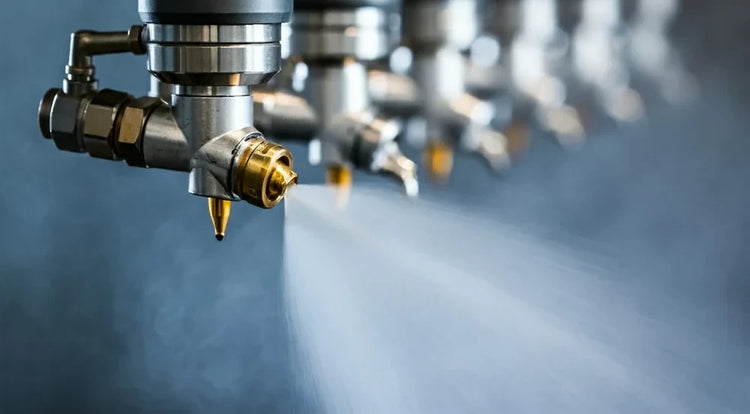
Una boquilla de chorro plano pulveriza líquido en una forma de abanico delgada y ancha. El ángulo de ese abanico, medido desde la punta de la boquilla hasta los bordes exteriores del patrón, es el ángulo de pulverización. Este ángulo es una propiedad fija del diseño de la boquilla y siempre se imprime en la hoja de datos.
A medida que la pulverización desciende desde el orificio de la boquilla, el patrón se ensancha. Cuando llega a su objetivo (una cinta transportadora, una superficie de lavado o una línea de procesamiento), el ancho de la pulverización se ha expandido significativamente. Cuanto más alto coloque la boquilla sobre el objetivo, mayor será la cobertura, pero también menor será la intensidad de la pulverización.
La relación es puramente geométrica: el ancho de la cobertura crece linealmente con la altura. Doble la distancia, doble el ancho de la cobertura. Esta relación lineal es lo que nos permite predecir y controlar la superposición de la pulverización con matemáticas simples.
El método de cálculo de tres pasos
Encuentre el ancho teórico de cobertura de la pulverización
Comience con el ángulo de pulverización de su boquilla (de la hoja de datos) y la distancia vertical desde el orificio de la boquilla hasta la superficie objetivo. Estas dos medidas determinan qué tan ancho será el patrón de pulverización cuando llegue al objetivo.
Donde:
C = ancho de cobertura (pulgadas o milímetros)
H = distancia vertical de la boquilla al objetivo
θ = ángulo de pulverización en grados
tan(θ/2) = tangente de la mitad del ángulo de pulverización (use una calculadora científica o una herramienta en línea)
Comprender el requisito de superposición del 100%
Las boquillas de chorro plano están diseñadas para funcionar con una superposición del 100%. Esto significa que el borde exterior del patrón de pulverización de una boquilla debe alcanzar la línea central del patrón de la boquilla adyacente. En este nivel de superposición, cada punto del objetivo recibe líquido de al menos dos boquillas, lo que garantiza una distribución uniforme y elimina las rayas secas.
Una superposición del 100% es el estándar de la industria para el lavado, las barras de pulverización CIP y las aplicaciones de recubrimiento de transportadores. Menos superposición deja huecos; más superposición desperdicia energía y productos químicos sin mejorar la uniformidad.
Calcular el espaciado de boquillas de centro a centro (paso)
Para lograr una superposición del 100%, establezca la distancia física de centro a centro entre las boquillas adyacentes en su cabezal igual a la mitad del ancho de cobertura. Esta sencilla relación asegura que cada patrón de pulverización se superponga perfectamente con sus vecinos.
Este espaciado asegura: Borde del patrón de la boquilla A = Centro del patrón de la boquilla B = 100% de superposición.
Ejemplo resuelto: barra de pulverización de lavado sobre una cinta transportadora
• Ángulo de pulverización de la boquilla (θ) = 80° (chorro plano típico)
• Distancia vertical al transportador (H) = 24 pulgadas
Paso 1: Calcular el ancho de cobertura (C)
θ/2 = 80° / 2 = 40°
tan(40°) ≈ 0.839
C = 2 × 24 × 0.839 = 40.3 pulgadasPaso 2: Comprender la superposición del 100%
Con una superposición del 100%, el patrón de cada boquilla se extiende desde su centro hacia afuera aproximadamente 20 pulgadas (la mitad del ancho de cobertura), encontrándose con el centro del patrón de la siguiente boquilla.
Paso 3: Calcular el espaciado de las boquillas
Paso = 40.3 / 2 = 20.15 pulgadasResultado: Espacie sus boquillas a 20.15 pulgadas de centro a centro (redondee a 20 pulgadas para la perforación práctica del colector) en su cabezal. Con este espaciado y altura, logrará una cobertura total sin huecos y una superposición uniforme en toda la cinta transportadora.
Notas prácticas para el campo
Tenga en cuenta las variaciones del ángulo de pulverización
Los diferentes modelos de boquillas de chorro plano tienen diferentes ángulos de pulverización: 65°, 80°, 95° y 110° son comunes. Siempre verifique el ángulo exacto en la hoja de datos de su boquilla antes de calcular. Un chorro estrecho de 65° y un chorro ancho de 110° requerirán un espaciado completamente diferente a la misma altura del cabezal.
Mida la altura desde el orificio, no desde el cuerpo de la boquilla
El ángulo de pulverización se define desde el orificio (la abertura por donde sale el líquido), no desde la parte posterior del cuerpo de la boquilla. Si su colector está empotrado o si la boquilla está enroscada profundamente en un saliente, asegúrese de medir la distancia vertical desde el punto de pulverización real, no desde la entrada de la rosca. Un error de solo una o dos pulgadas puede alterar su cobertura.
Pruebe previamente en una sección de cabezal corta
Antes de comprometerse con una barra de pulverización de longitud completa, construya una sección de prueba de 3 a 5 boquillas con el espaciado calculado, colóquela a la altura de diseño y haga pasar agua o producto a través de ella. Observe visualmente la superposición en la superficie objetivo. Los puntos secos o las áreas demasiado húmedas son una retroalimentación inmediata de que necesita ajustar la altura o el espaciado.
Tenga en cuenta las caídas de presión en cabezales largos
En un colector de más de 20 pies de largo, la presión puede disminuir de un extremo a otro, lo que hace que las boquillas anteriores pulvericen más finamente y las boquillas posteriores pulvericen más grueso. Si este es un problema, use un colector de orificio equilibrado o instale una segunda línea de suministro que alimente desde el extremo más alejado. Esto mantiene la presión constante en todas las boquillas.
Cuándo ajustar el espaciado: escenarios comunes
Los cambios de altura obligan a nuevos cálculos
Si su aplicación mueve las boquillas más cerca o más lejos del objetivo, incluso por 3-4 pulgadas, recalcule el paso. La relación es lineal: mueva las boquillas 4 pulgadas más alto y su espaciado requerido aumenta aproximadamente un 10%. Por el contrario, baje las boquillas y reduzca el espaciado proporcionalmente.
Espacios reducidos y cintas estrechas
Si su transportador es estrecho y su paso calculado es más ancho que el ancho de su cinta, tiene opciones limitadas: (1) aumentar la altura de la boquilla para expandir el ancho de la pulverización (permite un espaciado más amplio), (2) cambiar a una boquilla con un ángulo de pulverización más estrecho o (3) usar boquillas más cercanas con superposición parcial (menos del 100%, lo cual es aceptable si verifica la cobertura uniforme en las pruebas). La opción 1 suele ser la solución más limpia.
Sobre-cobertura y desperdicio de producto
Si su espaciado es mucho más estrecho que el valor de superposición del 100% (por ejemplo, espaciado en C/3 en lugar de C/2), está ejecutando una superposición del 200%, cada punto es rociado por tres boquillas. Esto funciona, pero desperdicia producto, aumenta el desgaste de la bomba y genera calor y neblina innecesarios. También hace que cualquier obstrucción individual de la boquilla sea menos obvia hasta que la cobertura se vuelva visiblemente desigual. Evite el espaciado excesivo deliberado a menos que tenga una razón específica (por ejemplo, uniformidad extremadamente crítica en una línea farmacéutica).
Preguntas frecuentes
Una superposición del 100% es el estándar de la industria y el valor predeterminado más seguro. Menos del 100% (espaciado más amplio) deja huecos y riesgos de puntos secos, especialmente si las boquillas se obstruyen. Más del 100% (espaciado más estrecho) es aceptable y a veces necesario, pero desperdicia producto y energía. Si se desvía, verifique la cobertura experimentalmente antes de la producción total.
Muy sensible. El ancho de cobertura escala linealmente con la altura, por lo que un error del 10% en la altura produce un error del 10% en el espaciado calculado. En una altura de 24 pulgadas, un error de 2.4 pulgadas desplazaría el espaciado aproximadamente 2 pulgadas, lo cual es suficiente para crear puntos secos visibles. Mida la altura cuidadosamente con una regla o cinta métrica, no a ojo.
Las boquillas anguladas o inclinadas complican significativamente las matemáticas porque el ángulo de pulverización y la caída vertical ya no están alineados. Para aplicaciones de precisión, mantenga las boquillas verticales. Si debe angularlas (por ejemplo, para un transportador inclinado), consulte la guía del fabricante de la boquilla o realice pruebas en el sitio para verificar la uniformidad de la cobertura.
No directamente. Las boquillas de atomización de aire se comportan de manera diferente porque el flujo de aire interactúa con el líquido de formas complejas que dependen de la presión del aire, el caudal y la expansión del aire atomizador. Para los cabezales de atomización de aire, consulte las guías de aplicación del fabricante de la boquilla y siempre realice pruebas in situ. Las boquillas de cono hueco (cono completo) utilizan la misma fórmula geométrica que las de chorro plano, pero el comportamiento de uniformidad y superposición puede diferir debido a su forma de cono.
No. El ángulo de pulverización de una boquilla de chorro plano es una propiedad geométrica fija del diseño del orificio. No cambia con la presión. Lo que sí cambia es la intensidad de la pulverización (espesor del chorro) y el tamaño de gota más fino: una mayor presión atomiza el líquido más finamente, pero la forma general del chorro permanece igual. Opere dentro del rango de presión especificado en la hoja de datos de la boquilla.
Use cualquier aplicación de calculadora de smartphone (configurada en modo científico), o escriba "tan(ángulo)" en Google. Una referencia rápida: tan(32.5°) ≈ 0.636 (para un ángulo de pulverización de 65°), tan(40°) ≈ 0.839 (para 80°), tan(47.5°) ≈ 1.088 (para 95°). Tenga una pequeña hoja de referencia en su teléfono para sus boquillas de uso común.
Especifique su cabezal de pulverización con confianza
Las boquillas de chorro plano de NozzlePro vienen con especificaciones exactas de ángulo de pulverización. Utilice el método de cálculo anterior con el ángulo de su boquilla para dimensionar su cabezal perfectamente.
Ver guías de selección de boquillas¿Tiene una geometría de pulverización compleja o necesita ayuda para validar su diseño? Contacte a nuestro equipo técnico; podemos ayudarle a optimizar el tipo de boquilla, el espaciado y la presión para su aplicación exacta.
Los cálculos de cobertura de pulverización asumen patrones de pulverización limpios y sin distorsiones en condiciones controladas. Factores del mundo real — corrientes de aire, cambios de viscosidad, deriva de la temperatura del colector y desgaste de las boquillas con el tiempo — pueden afectar la uniformidad. Siempre valide las pruebas en el sitio y planifique la inspección y el reemplazo regulares de las boquillas como parte de su programa de mantenimiento.


