
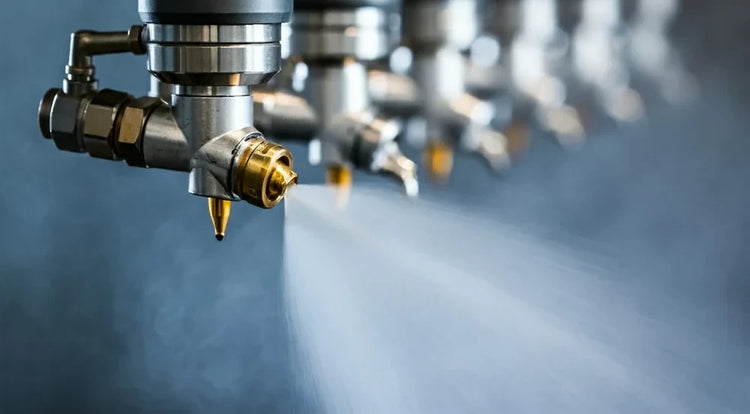

Wet Scrubber Nozzles:
The Complete Specification Guide for Recirculating Systems
How to select the right hollow cone nozzle type, spray angle, and material for your recirculating wet scrubber — so your system achieves design-rated gas capture efficiency and stays online between planned maintenance windows.
Key Takeaways
- Hollow cone nozzles — specifically spiral-body designs — are the industry standard for recirculating wet scrubbers because they maximize droplet surface area in the gas stream and pass recirculated liquid without clogging.
- Nozzle material must be chemically compatible with your scrubbing liquid, not just the gas stream. PVC covers most acid service; PP handles broader pH ranges; PVDF and PTFE address the most aggressive chemistries.
- Spray angle selection is driven by vessel diameter and nozzle mounting height — the goal is uniform liquid distribution across the entire cross-section, not just coverage of the center.
- Recirculating systems concentrate dissolved solids over time. Only high-MFP spiral-body nozzles resist the scaling and particulate clogging that shuts down standard nozzles within weeks.
- A worn or clogged scrubber nozzle doesn't just cause maintenance downtime — it reduces scrubbing efficiency, potentially causing a compliance event before the problem is detected.
A wet scrubber's job is to bring a contaminated gas stream into maximum contact with a scrubbing liquid, transfer pollutants from the gas phase to the liquid phase, and do it continuously, reliably, and within the constraints of your permitted emission limits. Everything about that process depends on what happens at the spray nozzle.
The nozzle is where scrubbing liquid is converted from pressurized supply flow into the finely distributed droplet cloud that actually contacts the gas. Get the nozzle type, spray angle, orifice size, and material right, and your scrubber operates at its design efficiency with a maintenance interval measured in years. Get any of them wrong, and you're dealing with uneven liquid distribution, premature clogging, corrosion-driven nozzle failure, or a system that passes inspection on paper while underperforming in operation.
This guide covers every specification decision that determines how well a wet scrubber nozzle performs — from the physics of hollow cone gas-liquid contact to the practical material selection decisions that keep nozzles operating in corrosive, recirculating scrubber environments.
How Recirculating Wet Scrubbers Work
A recirculating wet scrubber passes a contaminated gas stream — containing acid gases, particulates, solvent vapors, odorous compounds, or a combination — through a vessel where it contacts a continuously recirculated scrubbing liquid. The liquid absorbs or reacts with the contaminant, and the cleaned gas exits through a mist eliminator at the top of the vessel. The spent liquid is collected in the sump, treated or pH-adjusted as needed, and recirculated back to the spray header for another pass.
The scrubbing liquid in a recirculating system is not clean water. From the first cycle onward, it is picking up the pollutants it was designed to capture — acid, base, particulates, dissolved solids — and concentrating them with each pass. The nozzle operates in this increasingly loaded liquid for the entire service life of the system between maintenance shutdowns. This is what makes recirculating scrubber nozzle selection fundamentally different from a clean-water spray application: the nozzle must handle a corrosive, particle-laden, chemically active fluid continuously without degrading or clogging.
"A scrubber nozzle is in service 24 hours a day, spraying liquid that gets more concentrated and more demanding with every recirculation cycle. Material selection and free passage rating are not secondary concerns — they are the difference between a 2-week failure and a 2-year service interval."
Why the Nozzle Is the Critical Performance Variable
Wet scrubber efficiency — expressed as removal efficiency for a target pollutant — is governed by the contact between liquid droplets and the gas stream. The variables are contact time, droplet surface area per unit volume of liquid, and relative velocity between the droplet and the gas. The nozzle directly controls all three by determining how the liquid is broken up, distributed, and projected into the gas stream.
An undersized nozzle produces coarser droplets with less total surface area and shorter residence time in the gas stream — efficiency drops. An oversized or worn nozzle floods the vessel, increases pressure drop across the packing, and can push liquid into the outlet ductwork. An incorrectly angled nozzle creates coverage dead zones where gas bypasses without contacting liquid — the scrubber's rated efficiency assumes uniform liquid distribution across the full vessel cross-section, and any deviation from that produces localized breakthrough.
In a permitted facility, a scrubber that underperforms due to nozzle issues is not just an operational problem — it is a compliance risk. Emissions monitoring tied to scrubber operation can detect efficiency degradation before a formal inspection, but the root cause is often nozzles that have been clogged, worn, or simply misspecified from day one.
Hollow Cone Nozzles: The Scrubber Standard
Hollow cone spray nozzles are the dominant design in wet scrubbers. They project liquid in a cone-shaped ring of droplets with an empty center — creating a curtain of droplets suspended in the gas path rather than a solid mass. This maximizes the number of droplet-gas collisions per unit of liquid volume, which directly drives scrubbing efficiency. Spiral-body hollow cone nozzles are particularly favored in recirculating systems because they achieve the hollow cone pattern without an internal vane, giving them the highest possible free passage for contaminated scrubber liquids.
The hollow cone pattern produces a ring of droplets that fans outward from the nozzle outlet at a defined spray angle. In a spray tower scrubber, multiple hollow cone nozzles at staggered heights create overlapping curtains of droplets that fill the vessel cross-section with suspended liquid. As the gas rises through this liquid curtain, pollutant molecules and particles collide with droplets, are captured in the liquid film, and fall with the liquid to the sump below.
The empty center of the hollow cone pattern — which might seem like a coverage gap — is actually intentional. In a gas scrubbing application, the goal is to maximize the number of distinct droplet surfaces in the gas path, not to create a solid wall of water. A hollow cone achieves a higher total droplet surface area per unit of liquid volume than a full cone at the same flow rate, making it more efficient at gas-liquid mass transfer for the same water consumption.
Browse NozzlePro's hollow cone nozzle collection — including spiral-body, vane-type, and whirl designs in PVC, PP, PVDF, PTFE, and stainless steel for wet scrubber and chemical process applications.
Spiral-Body Designs: Maximum Free Passage for Recirculating Systems
Standard hollow cone nozzles use an internal vane or insert to impart swirl to the liquid, which creates the cone pattern. These internal elements create narrow clearances where particulates and scale deposits from recirculated scrubber liquid accumulate and block flow. Spiral-body hollow cone nozzles eliminate the internal vane entirely — the spiral groove machined into the nozzle body itself imparts the swirl as liquid passes through, leaving the flow path completely open. The result is a hollow cone pattern with the highest possible free passage, allowing particle-laden recirculated scrubber liquid to flow through continuously without obstruction.
The spiral-body (also called whirl-body or spiral jet) design is the engineering response to the clogging problem that plagues recirculating scrubber systems. By machining a helical groove directly into the interior bore of the nozzle, the design creates swirl in the liquid flow without introducing any internal restriction. The nozzle body itself is the swirl-generating mechanism — solid, cleanable, and offering an unobstructed through-bore that particles can traverse freely.
For facilities running recirculating systems where the scrubbing liquid accumulates dissolved solids, scale, or suspended particulates over time, spiral-body hollow cone nozzles are almost always the correct specification. The free passage advantage is not a minor improvement — it is the difference between a nozzle that runs reliably through a planned maintenance interval and one that requires individual inspection and cleaning within weeks of startup.
Hollow Cone Design Comparison
| Design Type | How Swirl Is Generated | Free Passage | Best For |
|---|---|---|---|
| Spiral / Whirl Body | Helical groove machined into the nozzle bore — no internal insert | Highest — equal to full bore diameter | Recirculating scrubbers; contaminated or particle-laden liquids; systems where clog-free operation is critical |
| Tangential Inlet | Liquid enters the swirl chamber at a tangent via angled side ports | High — ports sized for clean to moderately contaminated flow | Clean-to-moderate scrubber liquids; applications requiring finer atomization than spiral designs provide |
| Internal Vane | Fixed swirl vane insert in the liquid passage | Low — vane clearances trap particles | Clean water applications only; not recommended for recirculating scrubber systems |
| Deflector Type | Liquid impacts a shaped deflector surface that fans it into a cone | Very high — no internal constrictions | Very coarse atomization requirements; high-solids applications; where fine droplets are not needed |
Spray Angle and Coverage Sizing
Selecting the correct spray angle for a scrubber nozzle comes down to one objective: achieving uniform liquid distribution across the full cross-sectional area of the vessel at the nozzle's installed height. Coverage gaps leave bypass channels where gas can pass through without contacting liquid. Over-spray past the vessel wall creates channeling effects at the boundary that also reduce efficiency.
Sizing for Spray Tower Applications
In a spray tower with a single central nozzle per level, the spray angle must be wide enough that the outer edge of the hollow cone pattern reaches the vessel wall at the installed standoff height above the sump or packing. The geometry is straightforward: if the vessel has a 24-inch diameter and the nozzle is mounted 18 inches above the target level, the half-angle of the cone must be at least arctan(12/18) ≈ 33°, meaning a full spray angle of at least 67°. Most specifiers use a wider angle to ensure wall coverage with overlap — a 90° or 120° hollow cone nozzle at that height would provide wall coverage with some margin.
Sizing for Packed Bed Distributors
In a packed bed scrubber, multiple nozzles in a header manifold distribute liquid over the packing surface. Here, the goal is to tile the cross-section evenly without concentration at any point. Narrower angles (60°–80°) at closer spacing distribute more uniformly than wide-angle nozzles at greater spacing, which can create high-density zones under each nozzle and relative dry zones between them. Your packing supplier's recommended irrigation rate (gallons per minute per square foot of cross-section) determines total flow requirement; nozzle angle and spacing determine how that flow is distributed.
Operating pressure affects spray angle. Hollow cone spray angles are specified at a reference pressure (typically 10–15 PSI). Operating at significantly higher or lower pressure shifts the effective angle — lower pressure widens it slightly, higher pressure narrows it. Always confirm your operating pressure against the nozzle's published spray angle data, and allow margin in your coverage calculation.
Material Selection for Corrosive Scrubber Environments
Scrubber nozzle material must be selected for compatibility with the scrubbing liquid chemistry — not the gas stream. PVC is the most common choice for acidic service (HCl, dilute sulfuric, dilute nitric, chlorine scrubbing) due to its cost-effectiveness and broad acid resistance. Polypropylene (PP) handles a wider pH range and performs better than PVC under elevated temperatures. PVDF provides excellent resistance to halogens and aggressive organic acids. PTFE covers virtually every chemistry but at higher cost. 316L stainless steel is used where temperature or abrasion rules out thermoplastics, but is not suitable for hydrochloric acid or chlorinated environments.
| Material | Chemical Resistance | Temperature Limit | Typical Scrubber Applications |
|---|---|---|---|
| PVC (Type I) | Excellent resistance to dilute acids, alkalis, and chlorinated compounds; attacked by ketones and some aromatics | 140°F (60°C) | HCl scrubbers, chlorine scrubbers, acid mist control, metal finishing exhaust |
| Polypropylene (PP) | Broader acid/alkali range than PVC; better resistance to organic solvents and oxidizing acids | 212°F (100°C) | H2SO4, HNO3, caustic scrubbers, pharmaceutical exhaust, food processing odor control |
| PVDF (Kynar®) | Outstanding halogen and oxidizing acid resistance; handles Cl2, ClO2, HF at low concentrations | 275°F (135°C) | Semiconductor exhaust, chlorine and fluorine gas scrubbing, aggressive oxidizer service |
| PTFE (Teflon®) | Near-universal chemical resistance; handles virtually all acids, alkalis, solvents, and oxidizers | 450°F (232°C) | Highest-aggression chemistries; mixed acid service; applications where no other material is compatible |
| 316L Stainless Steel | Good general chemical resistance; attacked by chlorides and HCl — avoid in acid-chloride service | High | H2S scrubbers, ammonia scrubbers, high-temperature applications where thermoplastics are unsuitable |
| Hastelloy C-276 | Exceptional resistance to oxidizing and reducing acids including HCl; handles chloride-containing streams | High | Severely corrosive environments; mixed acid-chloride service; where stainless steel has failed |
Chemical processing nozzles in PVC, PP, PVDF, PTFE, and specialty alloys. Engineered for corrosive process environments across a wide range of scrubber chemistries and temperatures.
Nozzle Requirements by Scrubber Type
Different wet scrubber configurations impose different demands on nozzle performance. Understanding where your scrubber type sits on the spectrum helps narrow the specification to the right combination of pattern, angle, and material before getting into detailed sizing.
Spray Tower Scrubber
Multiple nozzle levels inside a vertical tower spraying countercurrent to rising gas. Hollow cone nozzles at wide angles (90°–120°) provide full vessel coverage. Low operating pressure typical (5–20 PSI). High free passage essential for recirculated liquid.
Packed Bed Scrubber
Header manifold above packing distributes liquid for irrigation. Uniform coverage across packing cross-section is the priority. Multiple nozzles at moderate angles (60°–80°) in a grid or ring pattern. Even distribution more important than droplet fineness.
Crossflow Scrubber
Gas flows horizontally through vertical liquid curtains. Flat fan or wide hollow cone nozzles create vertical spray sheets perpendicular to gas flow. Coverage of the full gas path cross-section in the horizontal plane is the primary sizing criterion.
Venturi Scrubber
Liquid injected at the venturi throat where high-velocity gas atomizes it. Nozzle role is liquid introduction, not atomization — the gas stream does the atomization work. Simple spray or injector nozzles; the critical spec is injection point placement and liquid distribution across the throat.
Recirculating Systems: Special Considerations
A once-through scrubber system — where scrubbing liquid is used once and discharged — presents a relatively forgiving nozzle environment. A recirculating system compounds every design challenge: the liquid becomes more concentrated, more corrosive, and more particle-laden with every cycle. Nozzle specification for a recirculating system must account for end-of-cycle liquid conditions, not just fresh makeup water.
Scale and Fouling Management
Dissolved minerals in the scrubbing makeup water, combined with the dissolved pollutants the system is capturing, create ideal conditions for scale formation on nozzle orifices and internal surfaces. Calcium carbonate, calcium sulfate, iron compounds, and silica deposits are common in scrubbers handling acid gases with hard water makeup. Spiral-body hollow cone nozzles resist scale buildup on internal surfaces because their smooth bore provides no ledges or vane edges where deposits can anchor — scale forms on smooth surfaces far more slowly than on internal inserts or edges.
Blowdown and Makeup Water Management
Controlling recirculated liquid concentration through regular blowdown and makeup water addition is the single most effective maintenance practice for extending nozzle service life in a recirculating scrubber. When dissolved solids are allowed to concentrate indefinitely, precipitation and fouling become unavoidable regardless of nozzle design. A well-managed blowdown program that maintains conductivity within an acceptable range reduces the demand placed on nozzle free passage and material resistance significantly.
Need Replacement Nozzles for Your Scrubber?
NozzlePro supplies hollow cone, spiral-body, and specialty scrubber nozzles in PVC, PP, PVDF, PTFE, and stainless — with the exact part match or a direct upgrade recommendation for your application.
Request a Quote Shop Hollow Cone NozzlesIndustry Applications
Recirculating wet scrubbers are installed across virtually every manufacturing sector that generates chemical exhaust, acid mist, or gas-phase pollutants as a byproduct of its process. The nozzle specification in each case reflects both the chemistry of the gas being scrubbed and the chemistry of the scrubbing liquid used to capture it.
| Industry | Gas Being Scrubbed | Typical Scrubbing Liquid | Recommended Nozzle Material |
|---|---|---|---|
| Metal Finishing / Plating | Acid mist (HCl, H2SO4, chromic acid) | Water or dilute caustic (NaOH) | PVC or PP |
| Semiconductor / Electronics | HF, Cl2, ClO2, solvent vapors | Water or dilute caustic | PVDF or PTFE |
| Pharmaceutical Manufacturing | Solvent vapors, HCl from synthesis | Water or dilute acid/base depending on gas | PP or PVDF |
| Wastewater Treatment | H2S, NH3, mercaptans | NaOH (for H2S); H2SO4 (for NH3) | PP or 316L SS (avoid SS for H2S-chloride service) |
| Chemical Manufacturing | HCl, Cl2, SO2, HNO3 mist | Water, caustic soda, or sodium carbonate | PVC (HCl/Cl2); PP or PVDF (SO2/HNO3) |
| Food Processing / Rendering | Ammonia, H2S, organic odors | H2SO4 (ammonia); NaOH (H2S) | PP or 316L SS |
| Pulp & Paper | Cl2, ClO2, TRS (sulfur compounds) | Water or oxidizing solution | PVDF or PTFE |
What to Have Ready When You Contact NozzlePro
Whether you need a direct part-number match for replacement nozzles or a full redesign of an underperforming scrubber spray system, providing complete data upfront allows NozzlePro to respond with an accurate specification in the first exchange. Here is what we need:
Wet Scrubber Nozzle Quote Checklist
Have your part number or scrubber specs ready? Contact NozzlePro and we'll match, replace, or upgrade your scrubber nozzles — with same or next-day response on standard configurations.
Frequently Asked Questions
What type of nozzle is used in a wet scrubber?
Hollow cone spray nozzles are the dominant design in wet gas scrubbers. Their hollow cone pattern creates a curtain of droplets suspended in the gas path that maximizes droplet surface area per unit of liquid volume — directly driving scrubbing efficiency through more pollutant-droplet collisions. Spiral-body hollow cone designs are particularly favored in recirculating systems because they achieve the hollow cone pattern with no internal vane, giving them maximum free passage for contaminated scrubber liquids.
Why is nozzle material so important in a chemical scrubber?
The scrubbing liquid in a chemical scrubber is often acidic, alkaline, or contains dissolved chlorides, solvents, or aggressive compounds. A nozzle material that is not chemically compatible will corrode, swell, or degrade — resulting in orifice enlargement and eventually nozzle failure. PVC is the most common choice for acidic scrubber applications; PP handles a broader pH range and elevated temperatures; PVDF covers halogens and aggressive oxidizers; PTFE handles virtually any chemistry. See NozzlePro's chemical processing nozzle collection for the full range of material options.
Why do scrubber nozzles clog in recirculating systems — and how do I prevent it?
Recirculating scrubber liquid concentrates dissolved minerals, scale-forming compounds, and particulates with each cycle. Standard nozzles with internal vanes or small passages trap these solids quickly. The most effective prevention is to specify spiral-body hollow cone nozzles, which have a completely open internal bore that particles pass through freely. Supplemental coarse strainers upstream of the header provide additional protection against large debris. Proper blowdown management — maintaining scrubbing liquid conductivity within limits — reduces the scaling load on nozzles significantly.
How do I select the correct spray angle for my scrubber nozzle?
Spray angle selection is driven by two factors: vessel diameter and nozzle mounting height above the target level. The outer edge of the hollow cone pattern must reach the vessel wall to achieve full cross-section coverage. For a central single-nozzle configuration, calculate the required half-angle as arctan(vessel radius / mounting height) and select the next wider standard angle with margin. For packed bed distributor headers with multiple nozzles, narrower angles (60°–80°) at closer nozzle spacing produce more uniform packing irrigation than wide-angle designs at wider spacing.
Can I upgrade to a different nozzle material without changing the orifice size?
Yes — in most cases a material upgrade is a direct like-for-like replacement. NozzlePro stocks hollow cone scrubber nozzles in the same orifice sizes and spray angle configurations across PVC, PP, PVDF, and PTFE bodies. Provide your existing part number and the chemistry you need to handle, and we can confirm the compatible material upgrade with the same flow and pattern performance. Thread connection type and size must match the existing header fitting, which we verify as part of the replacement specification.
What information do I need to get a quote for scrubber replacement nozzles?
For a replacement quote, the existing part number alone is often sufficient — we can match or recommend an upgrade from that. For a full specification, NozzlePro needs: scrubber type, vessel diameter, number and position of nozzle mounts, connection type and size, operating pressure and flow rate per nozzle, scrubbing liquid chemistry and pH, operating temperature, and whether the system is once-through or recirculating. If you're experiencing clogging, poor coverage, or premature wear with current nozzles, describing those symptoms helps us recommend a performance upgrade rather than a direct replacement.
Get the Right Nozzles for Your Scrubber — Fast
Have a part number? We'll match it or recommend a direct upgrade. Have a new application? Give us your scrubber type, vessel size, and liquid chemistry and we'll spec the complete nozzle configuration.
Request a Custom Quote Shop Hollow Cone Nozzles


