
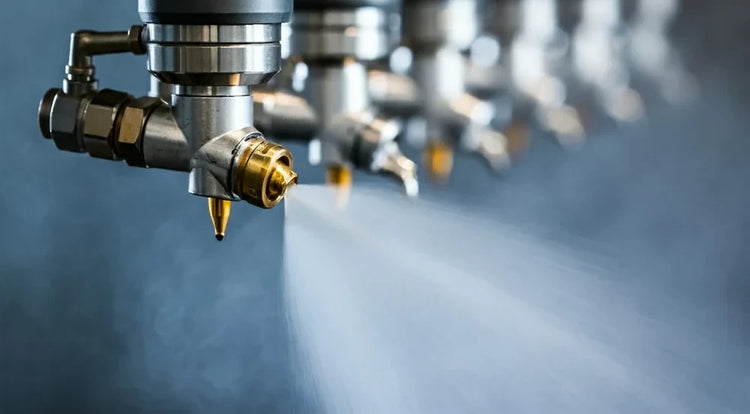

Spray Nozzles for Steel Coil Coating & Metal Painting Lines:
A Complete Engineering Guide
Every stage of a coil coating or metal painting line — from degreasing and chemical pre-treatment through paint application, cooling, and specialty coating — depends on correctly specified spray nozzles. This guide covers which nozzle type, pattern, and material the process demands at each stage.
Key Takeaways
- Pre-treatment is the most spray-intensive section of any coil coating or painting line — flat fan nozzles at precisely calculated spacing and pressure uniformly apply degreasing, conversion, and rinse chemistry across the full coil width.
- Non-uniform spray coverage in pre-treatment directly causes paint adhesion failures downstream — nozzle wear and miscalibration in this section is the leading spray-related cause of finished product defects.
- Air-atomizing nozzles are the standard for precision paint and specialty coating application where fine, consistent droplet size and controllable film build are required across variable paint formulations.
- Chemical conversion coating stages (phosphate, chromate-free) require nozzle materials matched to the specific chemistry — stainless steel handles alkaline stages; PVDF or polypropylene is required for acid conversion chemistries.
- Robotic painting systems require nozzles with consistent, documented performance over time — a worn nozzle produces non-uniform film that the robot's programmed path cannot compensate for.
- Tungsten carbide orifice inserts significantly extend service life in high-pressure rinse and surface preparation stages where erosive wear from contaminated rinse water degrades standard stainless nozzles rapidly.
Steel coil coating and metal painting lines are among the most technically demanding spray environments in manufacturing. The continuous, high-speed processing of steel coil — moving through cleaning, chemical treatment, painting, and curing in an unbroken sequence at speeds measured in meters per minute — leaves no tolerance for spray inconsistency. A nozzle that delivers 10% less flow than its neighbors in a pre-treatment stage leaves a strip of undertreated steel that will show as an adhesion failure in the finished paint film. A worn nozzle in a cooling header allows a hot zone that affects coating cure uniformity.
This guide covers what each section of a coil coating or metal painting line demands from its spray nozzles — from the chemistry of each stage through the nozzle type, spray angle, material, and maintenance practices that support consistent, high-quality production.
The Coil Coating Line: Where Spray Nozzles Are Active
A continuous coil coating line processes steel or aluminum coil in a single unbroken pass through a series of treatment, coating, and curing stages. Understanding the full process sequence — and identifying which stages are spray-dependent — is the starting point for any nozzle specification exercise.
Degreasing
Hot alkaline spray removes rolling oils and surface contamination
Spray StageRinse 1
Water rinse removes alkaline chemistry
Spray StageConversion Coat
Phosphate or chromate-free treatment creates paint adhesion layer
Spray StageRinse 2 & DI Rinse
Staged rinses ending with deionized water final rinse
Spray StagePrimer Coat
Roll or spray primer application; oven cure
Topcoat
Roll or spray color/finish coat; oven cure
Cooling
Water spray or air quench after cure ovens
Spray StageBackcoat / Specialty
Anti-fingerprint, lubricant, or design coating application
Spray StageOrange stages are spray-dependent — nozzle performance directly determines processing quality at those points. Stages 5 and 6 (primer and topcoat) are most commonly applied by roll coaters in continuous coil lines, though spray is used in some specialty coating configurations and in batch painting operations on formed parts.
Pre-Treatment: The Most Spray-Critical Section of the Line
Flat fan spray nozzles are the standard in metal pre-treatment spray stages. They produce a wide, overlapping sheet of liquid that covers the full coil width uniformly at consistent flow rate and pressure — the key requirement in degreasing, rinse, and conversion coating stages where coverage uniformity directly determines the quality of the paint-ready surface. Multiple nozzles are mounted on headers spanning the coil width, with spacing calculated to achieve overlap between adjacent spray patterns at the nozzle's specified operating pressure. Full cone nozzles are used in some enclosed spray booths where coverage from multiple angles is required. High-pressure flat fan nozzles serve high-impact rinse stages that use water impingement force to remove residual chemistry from the metal surface.
Pre-treatment is where the quality of a coil coating product is fundamentally determined. Paint adhesion, corrosion resistance, and long-term coating performance all trace back to the quality of the surface that was created in pre-treatment — and that surface quality is a direct function of how uniformly the cleaning, conversion, and rinse chemistries were applied by the spray nozzles in this section.
A pre-treatment spray header that has one or two partially worn or partially clogged nozzles produces stripes of under-treated steel running the full length of the processed coil. In degreasing, this means incompletely cleaned steel entering the conversion coating stage. In conversion coating, this means thin or absent conversion layer in the affected stripes. The paint applied over these defects will adhere differently — and the product will show corrosion or adhesion failure at those locations, often only after months of service in the field.
"In pre-treatment, the spray nozzle is the quality control device. Its uniformity is the uniformity of the conversion layer. Its wear is the degradation of surface preparation. Every coil processed through a worn nozzle is a product that has been underserved before the paint even touches it."
Pre-Treatment Header Design Principles
- Full-width coverage with overlap: Nozzle spacing along the header must be calculated to achieve overlap between adjacent spray patterns at the nozzle's rated operating pressure. Gaps between coverage zones leave strips of untreated metal.
- Consistent flow rate across all nozzles: All nozzles in a header should be the same capacity size and from the same production lot. Mixed capacity sizes produce uneven flow distribution across the coil width.
- Pressure consistency at each nozzle: Header pipe diameter must be sized to supply all nozzles at approximately equal pressure without significant pressure drop from the feed end to the far end of the header.
- Scheduled inspection and replacement: Pre-treatment nozzles should be flow-tested at defined intervals and replaced when wear causes flow rate to exceed 10–15% of nominal. Given the quality consequences of under-treating steel, this maintenance interval should be treated as non-negotiable.
NozzlePro's steel and metals collection includes flat fan, full cone, and high-pressure nozzles specified for the chemical and operating conditions of coil coating pre-treatment lines.
Chemical Conversion Coating: The Most Chemically Demanding Stage
Conversion coating is the stage where a thin, chemically bonded layer is created on the steel surface that serves as the adhesion promoter and corrosion inhibitor for the paint system above it. The chemistry applied varies by specification: zinc phosphate, iron phosphate, trivalent chromium (Cr3+), and a range of proprietary zirconium- or titanium-based chromate-free chemistries are all in use across the coil coating industry.
What all of these chemistries share is that they are applied as aqueous solutions at controlled concentrations and temperatures — and they are significantly more chemically aggressive than the alkaline degreasing solutions used in the cleaning stages upstream. This creates the primary engineering challenge for nozzle specification in this section: the nozzle material must be compatible with the specific chemistry, not just with generic process water.
| Conversion Chemistry | Typical pH | Recommended Nozzle Material | Note |
|---|---|---|---|
| Zinc Phosphate | 2.5–3.5 (acidic) | Polypropylene (PP) or PVDF | Phosphoric acid base attacks stainless steel over time; PP handles well at process temperatures |
| Iron Phosphate | 4.0–5.5 (mildly acidic) | PP or 316L SS (monitor for corrosion) | Less aggressive than zinc phosphate; some operations run 316L SS with frequent inspection |
| Trivalent Chromium (Cr3+) | 3.5–4.5 (acidic) | PVDF or PTFE-lined | Chromium compounds are aggressive; PVDF provides best durability at process concentrations |
| Zirconium / Titanium (Cr-free) | 3.0–5.0 (acidic) | PP or PVDF depending on formulation | Chemistry varies by supplier; confirm nozzle material compatibility with specific formulation |
| Alkaline Cleaner (degreasing) | 10–13 (strongly alkaline) | 316L SS or PP | 316L handles most alkaline cleaners at process temperatures; confirm at temperatures above 70°C |
Rinse Stage Nozzle Design
Rinse stages between chemical treatment zones serve a critical function: complete removal of the previous stage's chemistry before the metal enters the next treatment zone. Residual degreaser contaminating the conversion coating bath reduces conversion quality. Residual conversion chemistry in the primer zone affects adhesion. Rinse stage nozzle performance is often underspecified — treated as lower-criticality than the treatment stages themselves — but inadequate rinsing is a leading cause of corrosion failures in coated steel products.
Cascade Rinse vs. Counter-Current Rinse
Modern coil lines use counter-current rinse designs where clean water enters at the final rinse stage and overflows backward through earlier rinse stages — maintaining water quality at the critical final rinse while minimizing total water consumption. Nozzle selection and flow rate in each cascade stage must be balanced to maintain the required rinsing efficiency while operating within the counter-current water management constraints.
DI Final Rinse
The final rinse stage before drying uses deionized water to prevent mineral deposits from the conversion chemistry or tap water hardness from affecting paint adhesion. Flat fan nozzles in this stage must produce the finest mist consistent with the available pressure to minimize DI water consumption while achieving complete surface coverage. DI water at low mineral content has essentially no nozzle corrosion risk, so stainless steel is standard.
Paint and Coating Application Nozzles
Air-atomizing nozzles are the standard for spray paint application on steel where fine atomization and uniform film build are the requirements. They use compressed air to break paint into fine droplets (30–150 microns), producing a consistent spray pattern across a wide range of paint viscosities — including high-build primers, polyester and PVDF topcoats, and specialty coatings. In most continuous coil coating lines, the primary primer and topcoat are applied by roll coaters rather than spray nozzles; spray is used for backcoating (the reverse side), edge sealing, specialty topcoat applications, and batch painting of formed parts or components.
Air-Atomizing Nozzles
Fine, uniform droplets for consistent film build across a range of paint formulations. Independent control of air and liquid flow allows adjustment for different paint viscosities and target film thicknesses without changing hardware.
Hydraulic SprayFlat Fan Nozzles
Higher-flow, hydraulic-only atomization for coatings where fine droplet size is less critical than coverage rate. Used for anti-fingerprint coatings, oiling, and some primer applications where the coating formulation atomizes readily under pressure alone.
Viscous CoatingsViscous Material Nozzles
Engineered for high-viscosity coating formulations — thick primers, sealants, adhesives, and specialty coatings that cannot be atomized effectively by standard hydraulic nozzles without extremely high supply pressure.
Surface TreatmentCoating & Treatment Nozzles
Specialty coating application including anti-fingerprint treatments, corrosion inhibitors, temporary protective coatings, and surface treatments applied after the primary coating cycle.
Specialty and Design Coatings
An expanding segment of the coil coating market involves specialty finishes — wood grain effects, stone textures, metallic patterns, and custom design printing on coated steel for architectural, interior, and appliance applications. These applications push beyond the standard paint-line nozzle specification into more specialized territory.
Anti-Fingerprint and Protective Coatings
Anti-fingerprint coatings are thin, precisely dosed films applied to the coil surface after the primary topcoat — particularly on products intended for visible interior applications like appliance panels, architectural cladding, and automotive trim. The coating must be applied at very low and uniform film thickness (often 1–5 microns dry film). Air-atomizing nozzles provide the precise, low-flow delivery with fine atomization needed for these thin-film applications.
Lubricant and Stamping Oil Application
Steel coil intended for stamping, roll forming, or deep drawing applications often receives a thin lubricant oil coat before rewinding, which reduces die wear and prevents galling in subsequent forming operations. Flat fan nozzles at low pressure deliver a controlled oil film across the coil width. Precise film thickness control is important — too little lubricant causes forming defects; too much contaminates the forming dies and may interfere with downstream welding or adhesive bonding.
Design Printing on Metal
Design printing on coated steel — wood grain, brushed metal, stone, and custom graphic patterns — is primarily achieved through roll printing, screen printing, or digital inkjet technology rather than conventional spray nozzles. However, spray nozzles are involved in the pre-treatment and base coat stages that prepare the surface for print adhesion, and in applying clear protective topcoats over the printed design. The quality of the spray-applied stages directly affects print definition, adhesion, and long-term design durability.
Post-Cure Cooling Systems
After each cure oven on a coil coating line, the coated steel must be cooled rapidly before it can be handled, rewound, or passed through subsequent process stages. Coil temperatures leaving a cure oven can reach 200–250°C (392–482°F) — too hot for direct contact with coiling equipment or subsequent coating stages. Spray cooling systems using water or air-water mist bring the coil temperature down to a handleable range within the available line length.
Full cone nozzles are the standard for water cooling headers — their volumetrically filled cone pattern provides uniform surface contact across the full coil width and produces high heat transfer efficiency per unit of water consumed. Spray angle, nozzle-to-surface standoff distance, and flow rate must be calculated to achieve the required temperature drop within the available cooling section length without over-wetting the freshly cured coating surface.
Cooling uniformity matters for coating quality. A cooling system with uneven spray coverage — caused by worn, clogged, or misaligned nozzles — produces uneven temperature distribution across the coil width. This can cause differential thermal stress in the coating, particularly in polyester and PVDF topcoats, resulting in visible variations in gloss or surface texture that are detectable in finished product inspection.
Robotic Painting System Integration
In robotic painting systems for steel parts and assemblies, air-atomizing spray nozzles or spray guns are mounted on the robot's end-of-arm tooling. The robot's programmed path controls nozzle position, velocity, and orientation relative to the part surface — achieving consistent film build through the combination of path speed, standoff distance, spray pattern width, and flow rate. Nozzle performance consistency over time is essential: a worn or partially clogged nozzle produces non-uniform film that the robot cannot compensate for programmatically. Nozzle maintenance and replacement intervals must be integrated into the robotic cell's maintenance schedule with the same rigor as robot arm servicing.
Robotic painting systems for steel components — automotive body panels, architectural elements, appliance housings, industrial equipment — represent a growing application area where the precision of the spray nozzle directly determines coating quality on complex three-dimensional geometries. Unlike continuous coil line applications where the spray geometry is fixed and the coil moves past the nozzles, robotic painting requires the nozzle to reach and coat every surface of a complex part profile from multiple angles and distances as the robot arm moves through its programmed path.
Key Nozzle Requirements for Robotic Applications
- Consistent atomization across the full operating range: The robot path varies in speed and orientation — the nozzle must maintain consistent droplet size and spray pattern across the full range of flow rates and orientations it encounters during the programmed cycle.
- Low-weight, compact design: Robot payload capacity is a limiting factor. Nozzle assemblies for robotic end-of-arm tooling must minimize weight without sacrificing flow capacity or atomization quality.
- Rapid cleaning compatibility: Color change and cleaning cycles between different coating formulations require nozzles that flush cleanly without extended downtime. Internal geometry that traps coating residue increases color change time and waste.
- Documented wear performance: For robotic cells where coating quality is verified by automated inspection, nozzle wear must be characterizable — a known relationship between service hours and spray performance allows predictive replacement scheduling rather than reactive response to quality failures.
NozzlePro's air-atomizing and coating nozzle collection includes designs for robotic end-of-arm tooling, automated painting lines, and precision coating applications on steel and metal substrates.
Material Selection for Coil Line Chemistry
Material selection for coil coating line nozzles spans the full range from standard 316L stainless steel for alkaline and neutral stages through chemical-resistant thermoplastics for acid conversion stages to tungsten carbide inserts for high-pressure, high-wear applications. Getting the material right at each stage prevents premature corrosion failure, maintains dimensional stability of the orifice for consistent flow rates over the service life, and avoids contamination of the process chemistry with corrosion products from an incompatible nozzle.
| Line Stage | Typical Chemistry | Recommended Nozzle Material |
|---|---|---|
| Degreasing spray | Hot alkaline (pH 10–13) | 316L stainless steel — handles alkaline well; avoid at very high temperature |
| Conversion coating spray | Acidic phosphate or Cr-free (pH 3–5) | Polypropylene (PP) or PVDF — stainless steel corrodes in acidic conversion chemistries |
| Rinse stages (fresh water) | Water (neutral to mildly acidic) | 316L SS — standard; excellent service life in fresh water rinse duty |
| DI final rinse | Deionized water (low conductivity) | 316L SS — DI water has low corrosion aggression; standard stainless is appropriate |
| High-pressure rinse | Water at 40–80+ bar | Hardened SS or tungsten carbide orifice insert — high-pressure abrasive wear demands harder materials for consistent orifice geometry |
| Paint / coating spray | Solvent or water-borne paint | 316L SS; PTFE seals — solvent compatibility varies by formulation; confirm solvent resistance of all wetted materials |
| Cooling water | Process water | 316L SS — cooling water service is low-aggression for stainless; hardened SS if water is scale-forming |
End-Use Industries for Coil-Coated Steel
Understanding the end-use application helps specify the coating line and its nozzle requirements — a line producing automotive exposed panels has different coating quality and cycle time requirements than one producing agricultural equipment paneling or roofing sheet.
Specifying Nozzles for a Coil Coating or Metal Painting Line?
NozzlePro supplies flat fan, air-atomizing, full cone, high-pressure, and specialty coating nozzles in 316L stainless, PP, PVDF, and tungsten carbide — engineered for every stage of steel and aluminum coil processing and robotic metal painting applications.
Shop Steel & Metals Nozzles Request a QuoteWhat to Have Ready When You Contact NozzlePro
Specifying nozzles for a coil coating or metal painting line requires different data depending on which section of the line you are addressing. The checklist below covers the full scope — provide the sections relevant to your specific inquiry.
Coil Coating & Metal Painting Line Nozzle Quote Checklist
Ready to specify nozzles for your line? Contact NozzlePro with your stage, chemistry, and pressure data and we'll recommend the right nozzle type, material, and capacity size for each application point.
Frequently Asked Questions
What spray nozzles are used in a steel coil coating line?
Flat fan nozzles are the standard in pre-treatment spray stages — degreasing, rinse, and chemical conversion coating — because they produce an overlapping sheet of liquid across the full coil width at consistent pressure and flow rate. Air-atomizing nozzles are used for precision paint and specialty coating application. Full cone nozzles serve cooling water systems after cure ovens. High-pressure flat fan nozzles handle high-impact rinse stages. Nozzle material varies by stage chemistry — 316L stainless for alkaline and neutral stages, polypropylene or PVDF for acid conversion coating chemistry.
Why is pre-treatment spray coverage so critical to coil coating quality?
Every coated steel product's long-term performance — paint adhesion, corrosion resistance, and coating durability — traces back to the quality of the conversion layer created in pre-treatment. That layer's uniformity is a direct function of how evenly the pre-treatment chemistry was applied by the spray nozzles. A worn, clogged, or misaligned nozzle in a pre-treatment header creates a strip of undertreated steel running the full length of the processed coil. Paint applied over that strip will adhere differently and will show adhesion or corrosion failure in field service — often long after the coil has been processed into finished product and installed. Pre-treatment nozzle maintenance is one of the highest-value quality interventions available on a coil coating line.
What nozzle material is needed for chemical conversion coating spray stages?
It depends on the specific chemistry. Zinc phosphate and trivalent chromium conversion coatings are acidic (pH 2.5–4.5) and attack stainless steel over time. Polypropylene (PP) handles most phosphate chemistries well at process temperatures. PVDF provides better resistance for chromium-based and more aggressive formulations. For alkaline degreasing stages, 316L stainless steel is standard. For zirconium/titanium chromate-free chemistries, confirm compatibility with the specific supplier's formulation data before specifying — these vary significantly in pH and active chemistry between manufacturers. Specifying the wrong nozzle material in a conversion coating stage results in rapid corrosion, orifice enlargement, and potential contamination of the conversion bath with corrosion products.
How are spray nozzles integrated into robotic metal painting systems?
Air-atomizing nozzles or spray guns are mounted on the robot's end-of-arm tooling (EOAT). The robot's programmed path controls position, velocity, and standoff distance to the part surface — translating those parameters into consistent film build through the relationship between path speed, spray width, and flow rate. The nozzle itself must deliver consistent atomization and spray geometry across the full range of conditions it encounters during the programmed cycle. A worn nozzle changes that relationship and produces non-uniform film that the programmed path cannot compensate for — which is why nozzle replacement intervals must be built into the robotic cell's maintenance program with the same discipline as robot arm servicing.
What is the difference between roll coating and spray coating on a coil line?
Roll coating uses metering rolls to apply a controlled, uniform film of paint or primer to the coil surface — it is the dominant method for primary coat layers in continuous coil lines because of its precise, consistent film build and high throughput capability. Spray coating uses nozzles to apply atomized paint to the coil or part surface — it is used for backcoating (the reverse side of the coil), specialty topcoats, edge treatment, anti-fingerprint coatings, lubricant application, and batch painting of formed parts where roll geometry cannot reach all surfaces. Both methods are used on many coil lines, with spray serving the stages and applications that roll coating cannot address as effectively. NozzlePro's coating and surface treatment collection covers the spray nozzle requirements for all spray-applied stages in both continuous and batch metal painting operations.
Get the Right Nozzle for Every Stage of Your Coating Line
NozzlePro supplies spray nozzles in the materials, patterns, and pressure ratings required for steel coil pre-treatment, chemical conversion, paint application, cooling, and robotic painting — with stage-by-stage specification support.
Request a Line-by-Line Quote Shop Steel & Metals


