
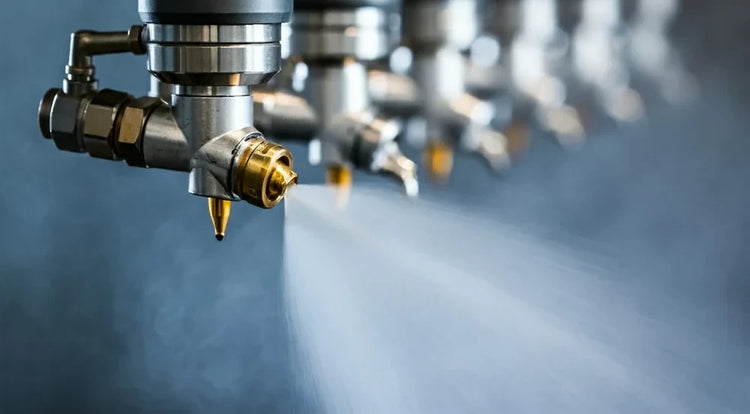

Spray Nozzles for Chemical Manufacturing Plants
Corrosive gas scrubbing, acid and alkali process injection, cooling systems, and emergency containment — a complete spray nozzle application and material selection guide for chlor-alkali, specialty chemical, and chemical processing facilities.
Key Takeaways
- Material selection is the foundational specification decision for every spray nozzle in chemical plant service. A nozzle that performs for years in food processing or HVAC will fail within weeks in wet chlorine, concentrated HCl, or sodium hypochlorite service if the wrong body material is selected.
- PVDF (polyvinylidene fluoride) is the standard body material for nozzles in chlorine scrubbing, hypochlorite service, and most acid gas scrubbing applications. Polypropylene is acceptable for dilute concentrations at ambient temperature. 316L stainless steel is not suitable for wet chlorine or hypochlorite service.
- PTFE seals are required for virtually all spray nozzle positions in chemical plant corrosive gas scrubbing service. Nitrile (NBR) and EPDM seals degrade rapidly in chlorine, HCl, and hypochlorite environments and must not be used.
- Full cone spray nozzles are the standard for packed tower scrubber liquid distribution — complete and even coverage of the packing cross-section is the critical performance parameter, because dry zones in the packing pass gas without contact with scrubbing liquid, reducing removal efficiency.
- Process chemical injection nozzles for reactive chemistry (sizing agents, neutralizing agents, chlorine into solution) must be matched to the reaction chemistry — the injection point position, flow rate, droplet size, and mixing energy from the spray all affect whether the reaction proceeds as designed.
Chemical manufacturing plants operate spray nozzles in service conditions that demand a fundamentally different approach to specification than virtually any other industrial application. In a food processing facility, choosing the wrong nozzle material typically means premature wear and replacement cost. In a chemical plant handling chlorine, hydrochloric acid, caustic soda, or sodium hypochlorite, choosing the wrong nozzle material can mean rapid corrosion failure, contamination of the process stream with corrosion products, and a maintenance hazard in a chemically hazardous environment.
The chemical plant's spray nozzle selection process starts not with flow rate or spray pattern — it starts with compatibility. What is the nozzle contacting? At what concentration? At what temperature? These three questions determine the body material, seal material, and orifice insert material before any other specification variable is addressed. This guide covers the most common spray nozzle applications in chemical manufacturing — the application, the nozzle type, and the material — with specific focus on the corrosive chemical environments that distinguish this industry from others.
Spray Nozzle Applications in Chemical Manufacturing Facilities
Chemical manufacturing plants use spray nozzles across six major application categories. Wet scrubber systems for corrosive gas control — including chlorine, hydrochloric acid, sulfur dioxide, and ammonia scrubbing — are the most critical spray application in facilities that produce or handle these gases. Process chemical injection spray nozzles introduce reactants, neutralizing agents, and treatment chemicals at specific points in batch or continuous processes. Cooling spray systems manage process temperatures using water or process liquid. Sodium hypochlorite (bleach) production facilities use spray in mixing and dilution steps. Emergency deluge and water curtain systems provide toxic gas containment in the event of a release. And general facility washdown spray serves the sanitation and maintenance cleaning requirements that apply to all production facilities. Each application has different nozzle type, pressure, flow rate, and material requirements — determined first by the chemical compatibility of the nozzle with the liquid at each spray point.
Chlorine Gas Scrubbing
Caustic scrubbing towers absorb fugitive and process vent chlorine before atmospheric release. Full cone PVDF nozzles distribute scrubbing solution uniformly across the packing bed. The most critical safety-compliance spray application at a chlor-alkali facility.
HCl Gas Scrubbing
Hydrochloric acid gas from synthesis, venting, or reaction off-gas is absorbed in packed scrubbing towers. Water or dilute caustic is the scrubbing liquid. PVDF nozzles distribute scrubbing liquid across the tower cross-section.
Process Injection
Chemical reactants, neutralizing agents, and treatment chemicals injected at defined points in batch or continuous processes. Nozzle selection must account for the reaction chemistry at the injection point.
Cooling Systems
Process cooling towers and direct spray cooling manage reactor temperatures and condenser loads. Cooling water nozzle specification must account for any process chemical contamination of the cooling circuit.
Hypochlorite Handling
Sodium hypochlorite (bleach) transfer, mixing, and dilution steps use spray nozzles compatible with the oxidizing environment. PVDF is required — bleach rapidly degrades stainless steel and most elastomers.
Emergency Containment
Water curtain and deluge spray systems provide toxic gas containment and chemical dilution in the event of an uncontrolled release. These systems must be designed for reliable activation without operator intervention.
Chlorine Gas Scrubbing Systems: The Compliance-Critical Spray Application
For chlor-alkali plants and other facilities that produce, handle, or use elemental chlorine, the wet scrubbing system that controls chlorine emissions from process vents, tanks, and equipment is not optional infrastructure — it is a safety and environmental compliance requirement. Chlorine is a toxic gas with an immediately dangerous to life and health (IDLH) concentration of 10 ppm; effective scrubbing of even small vent streams is essential.
The chemistry of chlorine scrubbing is well-established: chlorine is absorbed into dilute caustic soda (sodium hydroxide) solution, producing sodium hypochlorite and sodium chloride. The packed tower or spray tower scrubber maintains a contact zone between the incoming gas and the scrubbing liquid, and the nozzles distribute the scrubbing liquid uniformly across this zone to maximize gas-liquid contact.
Nozzle Requirements for Chlorine Scrubbing
- Full cone coverage pattern: The scrubbing liquid must be distributed uniformly across the entire cross-section of the packing bed. Any area of the packing that doesn't receive adequate scrubbing liquid becomes a dry zone where chlorine passes through without being absorbed — reducing the scrubber's removal efficiency. Full cone nozzles centered at the top of the packing provide the complete cross-sectional coverage that chlorine scrubbing requires.
- PVDF body material: The scrubbing liquid (dilute NaOH) and the absorbed product (sodium hypochlorite) are both present in the scrubber, and the nozzle body must be resistant to both. PVDF provides this resistance. Stainless steel corrodes rapidly in hypochlorite service; polypropylene degrades at elevated temperature or high chlorine concentration.
- PTFE seals throughout: No standard elastomer seal is compatible with the combination of chlorine, hypochlorite, and caustic present in a chlorine scrubbing system. PTFE provides broad chemical resistance across the chemistry range encountered at different points in the system.
- Clog-resistant orifice design: If the scrubbing solution contains suspended solids (as some recirculating scrubbing systems do after extended operation), orifice design must accommodate potential particle passage. Larger orifice diameters or spiral nozzle designs reduce clogging risk in recirculating scrubber systems with accumulated solids.
- Pressure matched to scrubber pump: The scrubbing liquid pump capacity and supply pressure determine which nozzle orifice size achieves the required flow rate distribution. Over-pressure produces fine atomization that may be carried out of the scrubber by the gas stream rather than contacting the packing; under-pressure produces inadequate flow rate and uneven distribution.
Never use 316L stainless steel nozzles in chlorine or sodium hypochlorite scrubber service. Wet chlorine attacks stainless steel through pitting and crevice corrosion — a nozzle that appears serviceable can fail suddenly from a corrosion pit that was not visible on the outer surface. Sodium hypochlorite (bleach) aggressively attacks stainless steel through a different mechanism (passive layer breakdown). Metallic corrosion products from a failing stainless nozzle contaminate the scrubbing loop, affect scrubbing chemistry, and create a scale deposit that can block distribution. PVDF nozzles are the correct specification for this service.
Hydrochloric Acid Gas Scrubbing: Absorption and Neutralization
Hydrochloric acid gas (HCl) is generated as a byproduct or product in numerous chemical manufacturing processes — chlorination reactions, synthesis of organic chlorine compounds, and recovery operations all produce HCl off-gas that must be scrubbed before atmospheric release. HCl scrubbing is typically performed with water (forming hydrochloric acid solution) or dilute caustic (for neutralization to sodium chloride and water).
The critical distinction between HCl scrubbing and chlorine scrubbing is the liquid phase chemistry. HCl absorbed in water forms hydrochloric acid — a strong acid whose concentration in the scrubber sump can reach significant levels in a recirculating system. The nozzle body and seals must be resistant to hydrochloric acid at the concentrations and temperatures present in the specific scrubber design.
"In a chemical plant, the wet scrubber is the last line of defense between the process and the atmosphere. The nozzle inside it is the component that determines whether that defense works at specification."
Material Selection for HCl Scrubbing Nozzles
PVDF is again the standard body material for HCl scrubbing nozzles, providing resistance to hydrochloric acid across the range of concentrations encountered in scrubbing service. For very high HCl concentrations or elevated temperatures, Hastelloy C-276 provides superior corrosion resistance, though at significantly higher cost. Polypropylene is acceptable for dilute HCl at ambient temperature but should not be used in hot or concentrated acid service. PTFE seals are required throughout.
NozzlePro's wet scrubber spray nozzle guide covers nozzle selection for packed tower, spray tower, and venturi scrubber configurations — including recirculating system nozzle specifications for systems with elevated solids loading.
Process Chemical Injection Spray
Many chemical manufacturing processes introduce reagents, neutralizing agents, or treatment chemicals through spray nozzles at defined points in the process. The spray nozzle is a process component in these applications — its flow rate, droplet size, spray pattern, and placement affect not just the quantity of chemical added but how effectively it mixes with the process stream and whether the intended reaction or treatment proceeds at the required rate.
| Injection Application | Nozzle Requirement | Key Parameter | Material Note |
|---|---|---|---|
| Chlorine into reaction vessel | Fine distribution into process liquid; maximum contact area | Droplet size and dispersion into the liquid phase | PVDF body, PTFE seals; all wetted parts resistant to elemental chlorine |
| Caustic neutralization | Controlled addition of NaOH to acidic stream; uniform mixing | Flow rate accuracy; must not over-add (heat of neutralization) | PVDF or PP body for concentrated caustic; PTFE seals |
| Chloropicrin synthesis reagents | Precise metered addition of reactive chlorinating agents | Flow rate precision; compatibility with organochlorine reaction chemistry | PVDF or Hastelloy depending on specific reagent chemistry |
| Hypochlorite dilution | Controlled water addition to concentrated NaOCl for product dilution | Flow rate; uniform mixing to achieve target concentration | PVDF body; PTFE seals; no stainless or carbon steel contact |
| Brine purification reagents | Chemical addition (Na₂CO₃, NaOH, BaCl₂) for brine pretreatment | Complete dispersion into flowing brine stream | PVDF or PP; PTFE seals; avoid any iron-containing materials |
Process Cooling Spray Systems
Chemical processes generate significant heat — from exothermic reactions, from compression and liquefaction, and from the electrical energy input in electrochemical processes such as chlor-alkali electrolysis. Cooling water systems manage this heat, and spray nozzles in cooling towers, direct spray coolers, and quench systems are part of this thermal management infrastructure.
In chemical plant cooling systems, nozzle material selection for the cooling water is often overlooked because cooling water appears less aggressive than the process chemicals. However, in chemical plants where the cooling circuit may receive trace contamination from process leaks, the cooling water chemistry can shift significantly over time. A cooling water circuit with even trace HCl contamination becomes acidic enough to affect nozzle materials. Any plant where process chemical contact with cooling water is possible should specify nozzle materials conservatively — PVDF rather than stainless steel even for "clean" cooling water positions.
Full cone nozzles and hollow cone nozzles are the standard for cooling tower spray distribution — both distribute cooling water in a pattern that maximizes surface area exposure to the air stream passing through the cooling tower, which drives evaporative cooling efficiency.
Sodium Hypochlorite (Bleach) Production and Handling Spray
Sodium hypochlorite — sold commercially as bleach — is produced at chlor-alkali facilities by reacting chlorine with caustic soda solution. Spray nozzles in the production and handling of sodium hypochlorite must be treated with the same material caution as nozzles in the chlorine scrubbing system, because sodium hypochlorite is a highly oxidizing liquid that attacks metals through a different mechanism than chlorine itself.
- Bleach is a powerful oxidizer: Sodium hypochlorite rapidly oxidizes metals that would otherwise be considered "corrosion resistant" — including 316L stainless steel. The passive oxide layer that protects stainless steel from corrosion is attacked by hypochlorite, leaving the base metal vulnerable to pitting.
- Available chlorine concentration matters: Commercial bleach ranges from ~3% to 15%+ available chlorine. Higher concentrations are more aggressively corrosive to most materials. PVDF maintains resistance across the commercial concentration range; polypropylene is acceptable for dilute concentrations at ambient temperature only.
- Temperature accelerates attack: Hypochlorite corrosivity increases significantly with temperature. Nozzles in hot bleach service require more conservative material selection than ambient temperature applications of the same product at the same concentration.
- Decomposition products: Sodium hypochlorite is unstable and decomposes over time, releasing oxygen and forming sodium chlorate and sodium chloride. This decomposition is accelerated by heat, UV light, and metal contamination. Metallic corrosion products from an incorrectly specified nozzle accelerate bleach decomposition in the system, reducing product quality and potentially creating oxygen release hazards.
Emergency Containment and Safety Spray Systems
Chemical plants handling toxic gases — chlorine, HCl, ammonia, hydrogen sulfide, and similar — must have emergency containment spray systems capable of protecting facility personnel and limiting off-site releases in the event of an uncontrolled release. Water curtain and deluge spray systems are the standard engineering control for this purpose.
Emergency spray systems for toxic gas containment must be designed for reliability under abnormal plant conditions — often the worst-case scenario for a toxic gas release involves the same accident, fire, or power failure that activates the emergency spray. Nozzle selection for emergency systems must account for:
- Activation without power: Emergency deluge systems activated by fusible links, pneumatic triggers, or gravity-fed water supplies do not require electrical power for operation. Nozzle flow characteristics under these passive activation conditions must be confirmed during system design.
- Nozzle condition after extended standby: Emergency spray systems may not activate for months or years between tests. Nozzle designs that can clog from mineral scaling or debris accumulation during standby require periodic inspection and maintenance to ensure they will function when needed.
- Water curtain effectiveness for chlorine: Water spray curtains for chlorine gas control work by absorbing chlorine into the water droplets, forming dilute hydrochloric acid and hypochlorous acid. The effectiveness depends on the interfacial area between the water droplets and the chlorine-air mixture — finer droplets provide more contact area per unit of water flow, but may be deflected by wind. The water curtain must be positioned and the nozzle coverage specified to intercept the expected chlorine plume path based on the facility's hazard analysis.
Material Selection: The Central Specification Decision for Chemical Plant Nozzles
In chemical manufacturing, material selection is not one specification variable among several — it is the variable that determines whether the nozzle works at all in the intended service. The following matrix covers the most common chemical plant environments and the nozzle body materials appropriate for each.
The standard nozzle body material for chemical plant corrosive service. Resistant to elemental chlorine (wet), hydrochloric acid (all concentrations to ambient temperature), sodium hypochlorite (commercial concentration range), sodium hydroxide (caustic soda, all concentrations), sulfuric acid, and most other mineral acids and alkalis. Suitable for continuous service up to approximately 140°F (60°C) in most chemical environments. The correct default choice for all chlor-alkali and bleach-service spray nozzles.
Acceptable for dilute concentrations of most mineral acids and alkalis at ambient temperature. Lower cost than PVDF. Not suitable for concentrated acids, oxidizing environments (chlorine, hypochlorite at elevated concentration), or service above approximately 120°F (49°C). Appropriate for dilute caustic washdown, dilute acid process water, and similar low-aggression applications only. Not the correct material for chlorine scrubber or bleach-handling service.
Not suitable for wet chlorine, sodium hypochlorite, or hydrochloric acid service. Rapidly corrodes through pitting and crevice attack in chlorine and hypochlorite environments. Appropriate for caustic soda (sodium hydroxide) service and general industrial applications, but must not be selected for any spray position in chlorine, HCl, or bleach contact. Commonly misspecified as "corrosion resistant" without qualification — in chlor-alkali service, stainless steel is the wrong answer.
For applications where even PVDF's chemical resistance is insufficient — typically high-concentration HCl above approximately 20%, hot concentrated chlorine, or mixed acid environments. Hastelloy C-276 provides metal-class corrosion resistance that exceeds stainless by orders of magnitude in these environments. Significantly more expensive than PVDF; use only where PVDF service life in the specific chemical environment is demonstrably inadequate.
For extreme chemical environments where no structural plastic or common alloy provides adequate resistance, PTFE-lined nozzles combine the structural strength of a metal or reinforced body with the near-universal chemical resistance of PTFE lining. Appropriate for applications with mixed chemistry, alternating chemical exposure, or where the process chemistry is uncertain or variable. Higher cost; used in critical positions where compatibility uncertainty justifies the investment.
Seal and O-Ring Selection for Corrosive Chemical Service
| Seal Material | Suitable For | Not Suitable For |
|---|---|---|
| PTFE | Universal — chlorine, HCl, caustic, hypochlorite, most acids, most alkalis, solvents. The correct default for chemical plant service where any doubt exists. | Applications requiring resilient elastic sealing — PTFE has limited elastic recovery. Can cold-flow under sustained compressive load. |
| Viton (FKM) | Many organic solvents, mineral acids at moderate concentration, caustic at low concentration. Good elastic recovery for dynamic sealing. | Concentrated ammonium hydroxide, ketones, some amines. Check against the specific chemical — Viton compatibility is complex. Not universally suitable for chlorine or bleach service. |
| EPDM | Dilute caustic (sodium hydroxide), potable water, many food-contact applications, steam service. | HCl, chlorine, concentrated acids, aromatic hydrocarbons, chlorinated solvents. Swells and degrades rapidly in chlorine and hypochlorite. |
| Nitrile (NBR) | Petroleum-based oils, some fuels, general industrial water service. | NOT SUITABLE for any chlor-alkali or bleach service. Nitrile degrades rapidly in HCl, chlorine, and hypochlorite. Commonly misspecified in chemical plant nozzles with predictable failure results. |
| Silicone | Food-contact applications, certain solvent environments, temperature extremes. | Concentrated acids, concentrated caustic, oxidizing environments. Not appropriate for chlorine or bleach chemical plant service. |
When in doubt about seal compatibility, specify PTFE. PTFE's near-universal chemical resistance makes it the safe default for chemical plant spray nozzle sealing when the precise chemistry at the nozzle position is uncertain, when the chemistry changes over time, or when a single nozzle specification must cover multiple service conditions. The trade-off is that PTFE's limited elasticity means it requires correct installation torque and periodic retightening to maintain sealing force — a worthwhile maintenance requirement in environments where a leaking nozzle creates a chemical exposure hazard.
Spray Nozzle Solutions for Chemical Manufacturing Facilities
NozzlePro supplies PVDF, polypropylene, and specialty alloy spray nozzles for corrosive chemical plant service — including chlorine scrubbing, HCl absorption, hypochlorite handling, and process injection — with PTFE and Viton seal options matched to your process chemistry.
Request a Chemical Plant Quote Shop Chemical Processing NozzlesFrequently Asked Questions
What spray nozzle material is suitable for chlorine scrubbing systems?
PVDF (polyvinylidene fluoride) is the standard spray nozzle body material for chlorine scrubbing systems. It resists elemental chlorine in aqueous solution, the sodium hypochlorite produced in the scrubber sump, and the sodium hydroxide (caustic soda) used as the scrubbing agent. All seals must be PTFE — Viton is acceptable in some concentration ranges, but PTFE provides the broadest compatibility across the chlorine scrubber environment. Polypropylene is acceptable only for dilute concentrations at ambient temperature; stainless steel is not suitable and will corrode through pitting in both chlorine and hypochlorite contact. Never use nitrile (NBR) or EPDM seals in chlorine scrubbing systems — both degrade rapidly in this service.
What nozzle type is used to distribute scrubbing liquid in a packed tower wet scrubber?
Full cone spray nozzles are the standard for packed tower scrubber liquid distribution. Positioned above the packing bed, full cone nozzles distribute scrubbing liquid uniformly across the full tower cross-section, ensuring that all of the packing receives contact with the scrubbing solution. Complete and even distribution is the critical performance parameter — any zone that receives inadequate scrubbing liquid becomes a bypass path where gas passes through without contacting the scrubbing liquid, reducing removal efficiency. In smaller towers (up to approximately 600mm diameter), a single centered full cone nozzle may provide adequate coverage. In larger towers, multiple full cone nozzles on a spray header ensure overlap coverage that eliminates dry zones. All nozzle materials must be compatible with the specific scrubbing liquid at the specific concentration and temperature in the system.
Why is sodium hypochlorite (bleach) so aggressive to stainless steel spray nozzles?
Sodium hypochlorite is a powerful oxidizing agent that attacks stainless steel through a mechanism called passive layer breakdown. Stainless steel's corrosion resistance depends on a thin chromium oxide passive layer on the surface — this layer protects the underlying steel from direct chemical attack. Hypochlorite destroys this passive layer by oxidizing the chromium oxide, exposing fresh steel to corrosive attack. The result is pitting corrosion — initially small, localized pits that progress rapidly through the material as the corrosion concentrates at the pit bottom. This type of corrosion is particularly dangerous because a nozzle can appear intact on the outside while a corrosion pit progresses through the wall. PVDF is immune to this mechanism because it contains no passivating layer to attack — the polymer itself is chemically resistant to hypochlorite across the commercial concentration range at ambient to moderate temperature.
How is a water curtain system designed for chlorine gas emergency containment?
A water curtain system for chlorine emergency containment intercepts and absorbs a chlorine plume before it reaches off-site receptor locations. The system consists of spray nozzles mounted on header pipes positioned between the release point and the protected boundary. When activated, the nozzles produce a dense spray curtain that contacts the chlorine-air plume — chlorine dissolves into the water droplets, forming dilute hydrochloric and hypochlorous acid. The design parameters include the expected release rate and concentration (from the facility's process hazard analysis), the prevailing wind conditions that determine the plume path, the required horizontal coverage to intercept the plume across its expected width, and the nozzle flow rate and droplet size needed to achieve the target chlorine absorption efficiency. Water curtain effectiveness is limited by wind speed and direction — systems designed for calm conditions may not provide adequate containment in high wind conditions, which is a consideration for the overall risk management strategy. Contact NozzlePro with your facility hazard analysis data and site layout for a water curtain nozzle specification and coverage calculation.
Chemical Plant Nozzle Solutions — PVDF, PTFE, and Specialty Alloy
NozzlePro supplies spray nozzles for chlor-alkali plants, specialty chemical facilities, and industrial chemical processing — specifying the correct body material, seal material, and nozzle design for each corrosive chemical service point in your facility.
Request a Quote Shop Chemical Processing Nozzles


