

Spray Nozzles for Industrial
Air Humidification Systems
How industrial high-pressure fog nozzles work, why droplet size below 10 microns is the critical specification, and how to select or replace nozzles in any spray humidification system — from film and textile manufacturing through electronics, printing, and pharmaceutical environments.
Key Takeaways
- High-pressure fog nozzles (500–1,500 PSI) are the industrial standard for spray humidification — operating pressure determines droplet size, and droplet size determines whether the system produces dry fog (correct) or wet mist (damaging to materials and surfaces).
- The 10-micron droplet threshold is the defining boundary: droplets below 10 microns remain suspended in air and evaporate completely; droplets above 10–20 microns fall and wet surfaces.
- Anti-drip nozzle design is non-negotiable in manufacturing environments — a humidification nozzle that drips during shutdown or between cycles deposits water on materials, equipment, and floors below.
- Humidification nozzle orifices (0.1–0.3mm) are among the smallest in industrial spray — they require softened or deionized water to prevent mineral scale blockage within days or weeks of operation.
- NozzlePro supplies replacement fog nozzles for existing humidification systems regardless of original equipment manufacturer — with part number cross-reference, orifice sizing, and thread matching.
Humidity is invisible infrastructure. In manufacturing facilities where it is correctly maintained, it is never thought about. When it falls outside the target range — because a nozzle has clogged, a nozzle has failed and is dripping, or a replacement was incorrectly specified — the consequences appear in the product, not in the humidification system itself. Static charge builds up on film surfaces. Textiles break. Printed inks dry unevenly. Paper dimensions shift. Adhesive bond strength changes.
At the center of every spray-based industrial humidification system is a nozzle that converts high-pressure water supply into a very fine mist — fine enough that every droplet evaporates before it can reach a surface. The specification of that nozzle — orifice diameter, operating pressure, anti-drip design, and connection geometry — determines whether the system achieves the dry fog performance the facility depends on, or produces wet mist that creates its own set of problems.
This guide covers how industrial humidification nozzles work, how to specify the right nozzle for a new system or replacement program, and what information NozzlePro needs to match an existing system's nozzle specification.
Why Manufacturing Facilities Need Precise Humidity Control
The consequences of low relative humidity in manufacturing environments are specific to the materials being processed, but they share a common mechanism: dry air draws moisture out of hygroscopic materials and promotes static charge accumulation on non-conductive surfaces. Both effects create quality problems and, in some cases, safety risks.
Film & Specialty Materials
Static charge on thin plastic and specialty films attracts dust contamination, causes films to cling together, and can create dangerous sparks in production environments. Humidity control at 45–55% RH suppresses static generation at the source.
Textile Manufacturing
Natural and synthetic fibers become brittle and break more frequently at low humidity. Static charge causes fibers to cling to machinery and each other. Maintaining 50–65% RH keeps fiber moisture content stable and eliminates static-related production interruptions.
Printing & Graphics
Paper and film substrates absorb and release moisture, changing their dimensions and flatness. Low humidity causes curling and misregistration in multi-pass printing. Ink drying time is affected by ambient humidity. Controlled RH (45–55%) maintains consistent substrate dimensions and print quality.
Electronics Assembly
Electrostatic discharge (ESD) from low-humidity static buildup destroys sensitive electronic components. IPC standards for electronics assembly environments specify minimum humidity levels. Spray humidification in clean rooms and assembly areas maintains ESD compliance without the condensation risk of conventional humidifiers.
"In film manufacturing, humidity control is not a comfort measure — it is a quality control measure. A 10% drop in relative humidity can produce more static-related defects in an hour than a day's worth of normal production."
The Right Nozzle for Industrial Air Humidification
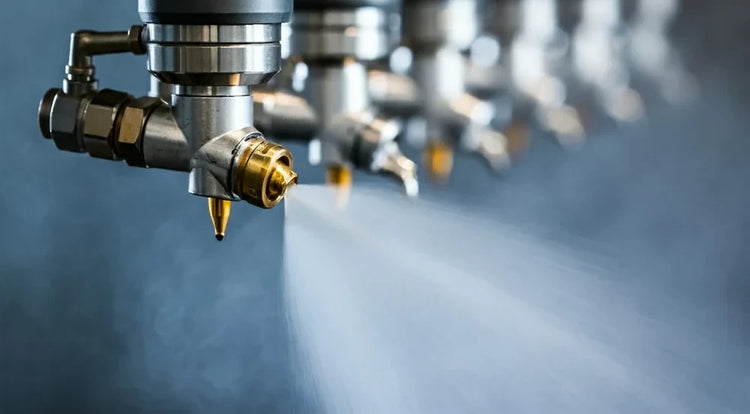
High-pressure fog nozzles are the standard for industrial air humidification. Operating at 500–1,500 PSI through precision orifices of 0.1–0.3mm diameter, they produce droplets below 10 microns — small enough to remain suspended in air and evaporate completely without contacting surfaces. This is called "dry fog." The nozzles are mounted on manifolds or lances in ductwork or room installations, fed by a dedicated high-pressure pump station. Anti-drip versions include a needle valve that closes when pressure is removed, preventing water from dripping onto materials or floors below the nozzle array during shutdown or between humidification cycles.
The high-pressure hydraulic fog nozzle works on a straightforward principle: forcing water at very high pressure through a precision-machined orifice so small that the hydraulic shear at the orifice exit breaks the water into droplets far smaller than any produced by standard spray systems. There are no moving parts in the nozzle itself — only the precision orifice and, in anti-drip versions, the spring-loaded needle valve that seats against the orifice when supply pressure is removed.
NozzlePro's fog and mist nozzle collection includes high-pressure fog nozzles for industrial humidification in 316L stainless steel — with anti-drip needle valve designs and orifice sizes for standard humidification operating pressures.
Dry Fog vs. Wet Mist: Why the Distinction Matters in Manufacturing
Dry Fog
Droplets below 10 microns. Remain suspended in air. Evaporate completely before reaching any surface. Raises relative humidity without wetting anything in the space — no condensation on materials, equipment, floors, or sensitive components.
- Safe for sensitive materials including film, textiles, paper, electronics
- No wet floors or condensation on equipment surfaces
- No corrosion risk to metal structures or machinery
- No mold or microbial growth from surface wetting
- Requires high-pressure pump system (500–1,500 PSI)
- Requires treated water to prevent orifice scaling
Wet Mist
Droplets above 10–20 microns. Fall under gravity. Contact surfaces below the nozzle. Raises humidity but also wets floors, materials, and equipment — causing damage in precision manufacturing environments.
- Wets sensitive materials — film, textiles, paper — causing defects
- Creates slippery floors and condensation on surfaces
- Promotes corrosion on metal equipment and structures
- Creates conditions for mold and microbial growth
- Can damage electrical equipment and control systems
- Lower pressure requirements — simpler pump infrastructure
Low-pressure systems advertised as "misting" are not equivalent to industrial dry fog humidification. Consumer and light commercial misting systems (30–100 PSI) produce droplets of 20–100+ microns that wet surfaces below the nozzles. They are appropriate for outdoor cooling — where surface wetting is acceptable — but not for indoor manufacturing environments where materials must remain dry. Industrial dry fog humidification requires minimum 500 PSI operating pressure with precision orifice nozzles.
Droplet Size and Why Pressure Drives It
The relationship between nozzle operating pressure and droplet size is the fundamental physics of high-pressure fog humidification. As pressure increases, the velocity of water exiting the orifice increases, and the hydraulic shear forces that fragment the water stream into droplets increase proportionally. Higher pressure produces smaller droplets — and smaller droplets evaporate faster and at greater air volumes, reaching the target relative humidity without surface wetting.
The orifice diameter interacts with pressure to determine droplet size: a larger orifice at the same pressure produces larger droplets than a smaller orifice. This is why humidification nozzle orifices are among the smallest in industrial spray — typically 0.1 to 0.3mm — to achieve the required sub-10 micron droplet distribution at practical operating pressures. Larger orifices would require impractically high pressures to achieve the same droplet size.
System Design: Duct-Mounted vs. Room-Mounted Installations
Industrial humidification systems install nozzles in one of two configurations — inside HVAC ductwork or directly in the manufacturing space — and the choice affects nozzle selection, spacing, and anti-drip requirements.
Duct-Mounted Humidification
Nozzles are installed on a lance or manifold inside the supply air duct, upstream of where conditioned air enters the space. The high-velocity airflow in the duct — typically 3–8 m/s — carries the fog droplets and provides the evaporation distance and air mixing needed for complete evaporation before the humidified air reaches the supply diffusers. Duct systems require precise nozzle spacing to achieve uniform distribution across the duct cross-section. Anti-drip is essential: any dripping during shutdown deposits water in the duct, eventually causing corrosion, biological growth in the duct liner, and potential water damage downstream.
Room or Zone-Mounted Humidification
Nozzles are mounted on overhead lances or manifolds directly in the manufacturing space — typically at 3–5 meters height — pointing downward or at an angle to project fog into the room air. The fog evaporates as it falls through the room before reaching the floor level. This approach provides localized humidity control in specific zones of a large facility. Anti-drip is even more critical here: a nozzle that drips directly into a production space deposits water directly onto materials, equipment, or floors below the manifold. Even a single drip event on film, textile, or paper products produces a visible defect.
| Parameter | Duct-Mounted | Room / Zone-Mounted |
|---|---|---|
| Nozzle position | Inside supply air duct on lance or manifold | Overhead in manufacturing space, 3–5m height |
| Evaporation mechanism | High-velocity duct airflow carries and evaporates droplets | Room air circulation; droplets evaporate during fall |
| Control precision | Whole-space control via HVAC system | Zone-specific — individual areas can be targeted |
| Anti-drip priority | High — prevents duct corrosion and biological growth | Critical — prevents direct wetting of materials below |
| Nozzle access | Requires duct access for inspection and replacement | More accessible — standard maintenance access to manifold |
| Typical spacing | Every 150–300mm across duct width, overlapping patterns | Every 0.5–1.5m along lance, multiple lances for zone coverage |
Anti-Drip: The Most Important Safety Feature in Manufacturing Humidification
The anti-drip needle valve is the most critical feature of a manufacturing humidification nozzle — more important than orifice size, operating pressure, or material specification. Its function is simple: when the humidification system shuts down (end of shift, cycle pause, system fault), the needle valve springs closed against the orifice, preventing any residual water in the supply line from dripping from the nozzle tip.
Without anti-drip control, every nozzle in the array becomes a slow drip source the moment system pressure is removed. In a facility manufacturing film, textiles, paper, or electronics, water drops falling from overhead nozzles onto product in process or stored below represent a significant quality and potentially safety risk. A single water drop on a reflective film surface, a specialty coating, or a precision-coated material leaves a permanent defect. Repeated drips on the same location cause equipment corrosion, floor damage, and biological growth in the facility ceiling space.
The needle valve in an anti-drip humidification nozzle is spring-loaded to the closed position. It opens only when supply pressure overcomes the spring force — meaning the nozzle flows only when the pump is running at full pressure, and closes immediately when pressure drops. The nozzle cannot partially drip; it is either open (flowing at operating pressure) or closed (sealed).
Not all fog nozzles include anti-drip valves as standard. When specifying replacement nozzles for an existing humidification system, confirm whether the original nozzles included anti-drip needle valves and ensure replacements match this specification. Installing standard (non-anti-drip) fog nozzles as replacements in a manufacturing humidification system will produce the dripping behavior the original design was built to prevent.
Water Quality and Nozzle Service Life
The 0.1–0.3mm orifice diameters standard in humidification fog nozzles are among the smallest in any industrial spray application. This precision creates an exceptional challenge: even water that appears clean contains dissolved minerals that deposit in and around these tiny orifices over time, progressively narrowing the orifice and increasing droplet size until the nozzle is effectively clogged and the system underperforms.
Hard water — the norm in most industrial water supplies — is the primary orifice life enemy. Calcium carbonate deposits from hard water can visibly block a 0.1mm orifice within days of operation without water treatment. Even moderately hard water (100–150 mg/L as CaCO₃) causes measurable orifice reduction within weeks.
Required Water Treatment
- Water softener: Exchanges calcium and magnesium ions for sodium, eliminating scale-forming minerals. Cost-effective for moderate hardness; requires periodic regeneration with salt. Does not remove all dissolved solids.
- Reverse osmosis (RO): Removes 90–99% of dissolved minerals including the scale-forming ions. Standard for high-performance humidification systems where nozzle life and consistent performance are priorities.
- Deionization (DI): Removes virtually all dissolved ions, producing near-pure water. Highest water quality for the most demanding systems and smallest orifice sizes.
Operating a humidification system with untreated hard water dramatically shortens nozzle service life, increases maintenance frequency, and — as orifices enlarge from scale damage and mechanical cleaning — degrades droplet quality over time. The water treatment investment pays back in extended nozzle service life, reduced maintenance labor, and consistent fog performance throughout the system's operating life.
Industries Where Industrial Humidification Nozzles Are Essential
Replacement Nozzle Supply for Existing Humidification Systems
Industrial humidification systems are long-lived infrastructure investments — many facilities operate the same system for 10–20+ years, maintaining it through nozzle replacement programs that keep the spray performance consistent without replacing the pump station, manifolds, or controls. Replacement nozzle procurement is the most common point of contact between a humidification system operator and a nozzle supplier.
NozzlePro supplies replacement fog nozzles for humidification systems originally equipped by any major system manufacturer. The replacement specification process works from whichever information is available:
- If you have the original nozzle part number: NozzlePro can cross-reference directly to the orifice size, anti-drip specification, and connection thread, and supply a direct replacement in 316L stainless steel.
- If the part number is unavailable: Provide the system's rated operating pressure, the number of nozzles in the array, and the system's total water consumption (L/hr or GPH). From this, NozzlePro can calculate per-nozzle flow rate and orifice size, and identify the correct replacement specification.
- If the connection thread is known: Provide thread type and size (NPT, BSP, or metric). Connection geometry is the most straightforward specification point and allows NozzlePro to narrow the replacement to the correct nozzle body family.
Have an existing nozzle part number or system details? Contact NozzlePro for a direct cross-reference quote — we typically respond within one business day on standard humidification nozzle configurations.
What to Have Ready When You Contact NozzlePro
Industrial Humidification Nozzle Quote Checklist
Replacing Humidification Nozzles or Specifying a New System?
NozzlePro supplies high-pressure fog nozzles with anti-drip needle valves for industrial air humidification in 316L stainless steel — with direct cross-reference capability for existing system replacement programs and technical support for new system specification.
Shop Fog & Mist Nozzles Request a QuoteFrequently Asked Questions
What type of spray nozzle is used in industrial air humidification systems?
High-pressure fog nozzles are the industrial standard — operating at 500–1,500 PSI through precision orifices of 0.1–0.3mm to produce droplets below 10 microns. These sub-10 micron droplets remain suspended in air and evaporate completely without contacting surfaces, raising relative humidity without condensation. Anti-drip needle valve versions are standard in manufacturing environments to prevent water dripping onto materials, equipment, and floors during system shutdown. Nozzle bodies are 316L stainless steel for durability and compatibility with treated water supplies.
Why does my humidification system require such high water pressure?
The high operating pressure (500–1,500 PSI) is required to produce droplets small enough to evaporate completely in air before reaching any surface. Droplet size decreases as pressure increases — at standard facility water pressure (40–80 PSI), even the finest nozzle orifice produces droplets of 50–150 microns that fall and wet surfaces below. At 800–1,000 PSI, the same orifice produces 5–10 micron droplets that remain suspended in air indefinitely at typical indoor air velocities. The high-pressure pump station is a fundamental component of any genuine industrial dry fog humidification system — it is not a design preference but a physical requirement for dry fog performance.
What water quality does a humidification system require?
Humidification fog nozzles require softened or purified water. Their precision orifices (0.1–0.3mm) are so small that hard water — even moderate hardness — deposits calcium carbonate scale that progressively blocks the orifice within days to weeks of operation. Most industrial humidification systems use a water softener at minimum; high-performance systems use reverse osmosis (RO) or deionization (DI) to provide near-pure water with no scale-forming ions. Operating with untreated hard water dramatically shortens nozzle service life, increases maintenance frequency, and eventually degrades fog quality as partially scaled orifices produce larger droplets. Water treatment is not optional — it is part of the system design.
How do I know if my humidification nozzles need replacing?
Three symptoms indicate humidification nozzles need service or replacement. First, the system is no longer achieving the target relative humidity despite the pump running correctly — clogged orifices reduce total water output, and the system underperforms. Second, the nozzle is visibly dripping rather than producing a fine fog — this indicates the anti-drip needle valve has failed or stuck open, or the nozzle orifice has been enlarged by scale damage and water is no longer atomizing at operating pressure. Third, visible water on surfaces below the nozzle array during or after humidification cycles — indicating droplets are too large to evaporate before falling. Inspect nozzles annually as a minimum; in hard water or high-use installations, semi-annual inspection and replacement on a defined schedule is better practice.
Can I use standard misting nozzles instead of industrial fog nozzles for humidification?
No — not in manufacturing environments where materials must stay dry. Standard misting nozzles designed for outdoor cooling or greenhouse applications operate at 30–100 PSI and produce droplets of 50–150 microns that fall and wet surfaces below the nozzle. In a manufacturing facility, this wets materials, floors, equipment, and control systems — causing defects, safety hazards, corrosion, and biological growth. Industrial dry fog humidification requires minimum 500 PSI with precision orifice fog nozzles to produce the sub-10 micron droplets that evaporate completely in air. The system pressure and nozzle specification are inseparable — changing one without the other does not achieve dry fog performance.
Need Replacement Humidification Nozzles or a New System Quote?
Share your existing nozzle part number, system pressure, or installation details and NozzlePro will confirm the correct replacement specification and pricing — typically within one business day.
Request a Quote Shop Fog & Mist Nozzles


