
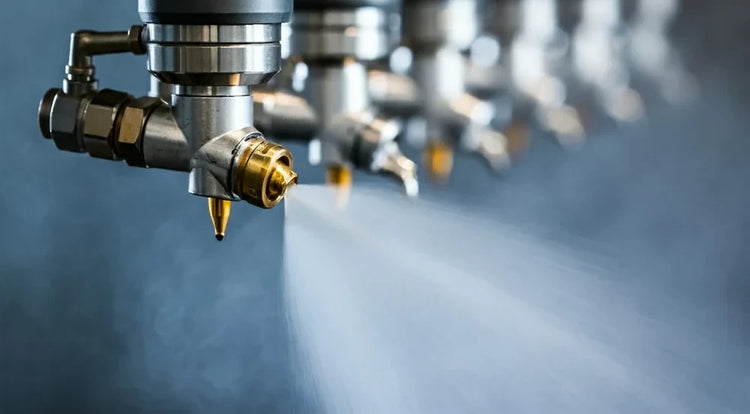

Spray Nozzles for Pulp and Paper Manufacturing
From forming fabric cleaning and press felt conditioning to high-pressure edge trim, chemical addition, and recovery system spray — a complete nozzle selection and specification guide for paper mill engineers and maintenance teams.
Key Takeaways
- Paper machines use spray nozzles throughout every major section — forming fabric cleaning, press felt conditioning, dryer tail cutting, chemical addition, coating operations, and recovery system atomization — each with distinct pressure, flow, pattern, and material requirements.
- Press felt conditioning showers are among the highest-impact spray applications in paper manufacturing: a blinded felt reduces dewatering efficiency, increases dryer steam consumption, limits machine speed, and can cause press roll sticking. Nozzle wear in the conditioner shower produces cross-machine felt variation that shows directly in paper quality.
- High-pressure fabric and felt cleaning nozzles (typically 10–40 bar) require tungsten carbide orifice inserts — the abrasive fiber and filler particles in white water erode stainless steel orifices rapidly at these pressures, causing the shower to lose effectiveness within weeks rather than months.
- Chemical addition spray nozzles must be specified for the specific chemistry at the injection point — sizing agents, retention aids, and biocide each have different corrosivity profiles that affect nozzle body and seal material selection.
- Spiral nozzles are preferred for applications where the spray liquid contains suspended fiber, filler, or broke particles — their open flow path resists the clogging that would stop a standard orifice nozzle within hours in fiber-laden white water service.
A paper machine is one of the most nozzle-intensive pieces of industrial equipment in existence. From the headbox to the reel, virtually every section of the machine depends on spray nozzles performing specific functions — cleaning fabrics, conditioning felts, cutting and threading, adding chemistry, removing condensate, and recovering broke. On a large machine running at speed, the shower systems are not auxiliary — they are integral to the machine's ability to produce paper at specification, at speed, without stopping.
The consequences of nozzle failure or wrong specification in a paper machine environment are immediate and measurable: a blinded press felt that wasn't conditioned adequately shows up as a wet sheet. A clogged forming fabric shower shows up as localized basis weight variation. A high-pressure tail cutter nozzle that's worn shows up as a failed tail threading sequence and a machine stop. Paper mill maintenance and process engineers who manage these systems benefit from understanding exactly which nozzle type belongs in which position — and why the specification matters.
Spray Nozzle Applications Across the Paper Machine
Paper machines use spray nozzles in every major section. In the forming section, high-pressure oscillating needle jet nozzles (10–40 bar) clean forming fabrics, while low-pressure flat fan flood showers remove surface debris. In the press section, conditioner showers restore press felt void structure using a combination of high-pressure jets and cleaning chemistry. High-pressure water jet nozzles cut paper edges and threading tails in the dryer section. Chemical addition nozzles introduce sizing agents, retention aids, and process chemicals at defined points in the wet end and stock system. Coating stations use spray or curtain systems for surface treatment. Broke pulpers use spray to facilitate re-pulping. Recovery boilers atomize black liquor through spray guns before combustion. Nozzle material, pressure, flow rate, and pattern must each be matched to the specific application and the liquid being sprayed.
Forming Section
High-pressure fabric cleaning nozzles and low-pressure flood showers maintain forming fabric drainage and remove fiber, filler, and pitch deposits.
Press Section
Conditioner showers are the most critical paper machine shower application — they determine press felt permeability, dewatering efficiency, and felt service life.
Dryer Section
High-pressure tail cutters thread the paper through the machine after breaks. Broke hole sprays prevent paper wrap-on in dryer pockets.
Coating & Size Press
Spray or curtain coating application, pre-metering sprays, and cleaning sprays for coating rods and doctor blades.
Stock Prep & Broke
Broke pulper spray accelerates re-pulping of broke paper. Chemical addition nozzles introduce chemistry at defined stock preparation points.
Recovery System
Black liquor spray guns atomize concentrated black liquor into the recovery boiler. Smelt dissolving tank sprays manage the hot smelt safely.
Forming Section: Fabric Cleaning Showers
The forming section is where the paper sheet is born — stock flowing from the headbox onto the forming fabric, water draining through the fabric, and the paper web beginning to develop structure and strength. The forming fabric must drain water efficiently at full machine speed while retaining fiber and filler. For this to work consistently, the fabric must be kept clean of fiber buildup, pitch and resin deposits, filler accumulation, and biological growth.
Types of Forming Section Showers
High-Pressure Oscillating Fabric Cleaning Showers
The primary cleaning shower for forming fabric maintenance. A narrow-angle needle jet or flat fan nozzle mounted on an oscillating beam traverses the full machine width, delivering a concentrated high-pressure stream (typically 15–40 bar / 220–580 PSI) that penetrates the fabric weave and dislodges accumulated contaminants from the fiber side. The oscillating action ensures complete cross-machine width coverage over a defined traverse cycle. Nozzle tip material for this application must be tungsten carbide — white water contains abrasive mineral filler particles (calcium carbonate, kaolin clay, titanium dioxide) that erode stainless steel needle jet orifices rapidly at these pressures, changing the spray angle, increasing flow rate, and reducing cleaning effectiveness within weeks of installation.
Low-Pressure Flood Showers (Wire Side)
Stationary flat fan or full cone nozzles positioned below the forming fabric on the wire return side apply a low-pressure water flood (1–5 bar / 15–70 PSI) that rinses the wire return before it re-enters the forming zone. These showers remove the bulk of retained fiber, filler, and dissolved organic material that the high-pressure oscillating shower dislodged but didn't fully flush through the fabric. Nozzle selection for flood showers prioritizes complete cross-machine coverage without gaps, clog resistance (white water contains fiber that can block standard orifice nozzles), and consistent low-pressure flow. Spiral nozzles are commonly specified for the wire return flood application — their open flow path resists clogging in fiber-laden white water service where a standard orifice would block repeatedly.
Trim Squirt Nozzles
High-pressure water jet nozzles positioned at the edges of the forming fabric cut the paper to the specified trim width as the sheet forms. These nozzles produce a concentrated, needle-fine jet that cuts cleanly through the wet sheet without disturbing the surrounding paper web. The trim squirt operates continuously at production speed and at pressures typically in the range of 40–80 bar (580–1,160 PSI). Tungsten carbide orifices are essential for trim squirt nozzles — the high operating pressure accelerates orifice wear, and a worn orifice that has enlarged produces a wider, lower-velocity jet that cuts poorly, producing ragged edges that cause downstream web handling problems.
Press Section: Felt Conditioning Showers
The press section is where the most water is removed from the paper web before drying — and the spray nozzle systems in this section have more influence on paper quality, dryer steam consumption, and machine speed than in any other section. Press felts carry the wet paper web through the press nips, accepting water from the sheet under the nip pressure and releasing it on the far side. For this to work, the felt must have open void structure — the spaces within the felt that accept and transport water must remain clear of the fiber, filler, coating, and biological deposits that accumulate during production.
"Press felt conditioning is the single most impactful shower application on a paper machine. A well-maintained felt dewatersthe sheet efficiently. A blinded felt costs the mill speed, steam, and sheet quality simultaneously."
Conditioner Shower Systems
High-Pressure Conditioning Jets
Oscillating high-pressure needle jet nozzles (typically 10–30 bar / 145–435 PSI) traverse the full felt width, delivering concentrated jets that penetrate the felt structure and dislodge accumulated material from within the felt body — not just the surface. The oscillating beam speed and dwell time at each position determine how much cleaning energy is applied per unit width of felt. A conditioner shower that is operated at too-low pressure, with worn nozzles, or with insufficient traverse speed delivers less cleaning energy than the felt needs, and the felt blinds progressively over the run.
Chemical Flooding Showers
Low-pressure flood showers apply conditioner chemistry — surfactants, detergents, or enzymatic cleaners — to the felt surface to assist chemical cleaning action. The chemistry loosens bound deposits that mechanical jet action alone cannot remove. Nozzle selection for chemical conditioning showers must account for the specific conditioner chemistry in use: some conditioner chemicals are aggressive enough to degrade standard elastomer seals. PTFE or chemically inert seal materials are the safe choice when the chemistry is not fully characterized.
Saver Shower (White Water Recovery)
The saver shower collects white water and fiber drained from the felt after the conditioning stage, directing it back to the white water system for reuse. The nozzles in the saver shower system manage this collection — full cone nozzles positioned to flush recovered white water into the collection trough. These nozzles operate in a continuous fiber and filler-laden liquid environment that requires clog-resistant designs such as spiral nozzles or large-orifice designs with minimal internal geometry.
NozzlePro's tungsten carbide nozzle collection includes needle jet and flat fan designs for high-pressure paper machine shower applications — with carbide hardness that extends orifice service life significantly in abrasive white water service.
Dryer Section: Tail Threading and Safety Sprays
High-Pressure Tail Cutter Nozzles
After a paper break, the sheet must be rethreaded through the dryer section. The threading tail is cut from the full-width paper sheet using a high-pressure water jet traversing rapidly across the machine to produce a narrow threading tail — typically 150–300mm wide — that operators thread through the dryer group before opening to full width. The tail cutter nozzle produces a fine, high-velocity water jet at pressures typically in the range of 60–100 bar (870–1,450 PSI). At this pressure, orifice condition is critical — a worn or enlarged orifice reduces jet velocity and produces a wider, less clean cut. Tungsten carbide inserts in tail cutter nozzle bodies provide the service life required for reliable tail threading in production environments.
Broke Hole Safety Sprays
In the event of a paper break inside the dryer section, a broke hole — a gap in the paper passing through a dryer pocket — allows paper to wrap around the dryer drum rather than passing through. Broke hole spray nozzles positioned in the dryer pockets detect broke and apply a water spray that prevents paper from wrapping the drum surface, which would cause a more severe break, potential equipment damage, and difficult manual removal. These nozzles must respond rapidly when broke is detected and deliver water at the correct angle to prevent wrap without drenching the drum surface excessively.
High-Pressure Cleaning Shower Systems: Why Orifice Material Determines Performance
The single most important nozzle specification decision in paper machine shower systems is orifice material selection for high-pressure applications. This is worth a dedicated section because it is consistently the specification error that most affects maintenance costs and shower performance over time.
| Pressure Range | Typical Application | Stainless Steel Orifice Life | Tungsten Carbide Orifice Life | Recommendation |
|---|---|---|---|---|
| 1–5 bar (15–70 PSI) | Flood showers, chemical addition, saver shower | Acceptable — wear is slow at low pressure | Extended, but not necessary | 316L SS acceptable; spiral nozzles for fiber-laden service |
| 5–15 bar (70–220 PSI) | Low-pressure conditioner showers, broke showers | Moderate — wear visible within months | Multi-year service life | Carbide recommended; SS acceptable for short intervals |
| 15–40 bar (220–580 PSI) | Forming fabric cleaning, press felt high-pressure jets | Poor — measurable wear within weeks in white water | Required for reliable performance | Tungsten carbide required |
| 40–100+ bar (580–1,450+ PSI) | Trim squirts, tail cutters, edge trim systems | Very poor — degradation within days | Best available; inspect periodically | Tungsten carbide required; inspect at defined intervals |
Worn high-pressure nozzle orifices have two failure modes, not one. The obvious failure mode is increased flow rate — the enlarged orifice delivers more water than specified, increasing water consumption and potentially over-wetting the fabric or felt. The less obvious failure mode is reduced jet velocity at the same supply pressure, because the same pressure now drives a larger-volume, lower-velocity stream rather than a smaller, higher-velocity jet. It is the jet velocity that does the cleaning work in high-pressure shower applications — not the water volume. A worn nozzle that is over-consuming water may simultaneously be cleaning less effectively, because both the volume and velocity have changed from specification.
Chemical Addition Spray Systems
Paper manufacturing uses a wide range of process chemicals that are introduced into the stock system, white water loop, or directly onto the paper web at specific points in the process. Spray nozzles introduce many of these chemicals — and the nozzle specification at each injection point must account for the specific chemistry, flow rate, and mixing requirement at that location.
| Chemical / Application | Injection Point | Nozzle Requirement | Material Note |
|---|---|---|---|
| Sizing agent (AKD, ASA, rosin) | Stock system before headbox; or size press application | Controlled flow rate; thorough mixing with stock or water | AKD and ASA are reactive — specify materials compatible with sizing chemistry; PTFE seals recommended |
| Retention aid | Stock inlet at fan pump or approach flow | Very low flow rate; very gentle application to avoid shear degradation of the polymer | 316L SS body suitable; large-orifice design to minimize shear at nozzle |
| Biocide / slimicide | White water system, chest, or shower systems | Controlled dose into the flowing stream; complete mixing | Biocides vary widely in corrosivity — confirm nozzle body and seal compatibility with specific product |
| Defoamer | Stock system, seal pit, saveall | Diluted application directly to foam-generating zones | 316L SS; confirm compatibility with oil-based defoamers |
| Pitch control chemistry | Forming fabric shower system or stock flow | Uniform distribution across machine width or into flowing stock | 316L SS acceptable for most pitch dispersants |
| Starch (converted) | Size press or surface application | Precision metering nozzle or curtain coater; uniform cross-machine profile | 316L SS; large orifice or spiral design to prevent starch particle clogging |
Coating and Size Press Spray Applications
For coated paper and board grades, spray nozzles play a role in both the application of coating and the maintenance of coating application equipment. Coating station spray applications include:
- Pre-wetting spray before blade or air knife coater: Applying a light water spray to the paper surface before coating entry can improve coating adhesion and reduce basis weight variation in the coated layer. The nozzle must apply a very light, uniform mist without disturbing the paper surface or causing local sheet saturation.
- Doctor blade and coating rod cleaning sprays: Localized water spray nozzles clean accumulated coating from doctor blades, metering rods, and blade holders during operation and changeover — preventing dried coating buildup that would cause streaks or blade damage.
- Coating pan and circulation system cleaning: CIP-type spray applications clean enclosed coating circulation tanks, mixing vessels, and distribution systems between grades or at end of production runs.
Stock Preparation and Broke System Sprays
Paper broke — paper that is rejected at any point in the machine or finishing operations — is recycled back to the process through the broke pulping system. Broke pulpers re-slush the dry or wet broke paper back into fiber suspension for reintroduction to the process. Spray nozzles in the broke pulper direct water streams at the broke pile entering the pulper to wet it rapidly and assist the pulping action, reducing the time required to slush broke to accept-able consistency.
In the stock preparation system, spiral nozzles are particularly well-suited for shower and addition applications because the stock system carries fiber, filler, knots, and other debris that would repeatedly clog standard orifice nozzles. The open spiral flow path passes particles that would block a conventional nozzle, reducing maintenance intervention and the risk of a blocked nozzle going unnoticed until it causes a process problem.
Recovery Boiler and Chemical Recovery Spray
In kraft pulp mills, the chemical recovery system converts spent cooking liquor (black liquor) back into usable cooking chemicals and generates steam and power through combustion. The spray nozzles in the recovery system are among the most demanding in any industrial environment — high temperature, corrosive liquids, and safety-critical operation.
Black Liquor Spray Guns
Black liquor spray guns atomize concentrated black liquor (typically 65–80% solids) into the recovery boiler furnace for combustion. The quality of atomization — droplet size distribution and spray pattern — directly affects combustion efficiency, char bed formation, and recovery boiler emissions. Spray guns for black liquor service must handle the highly viscous, abrasive, and corrosive properties of concentrated black liquor at elevated temperature while producing a consistent spray pattern over long operating intervals between planned maintenance shutdowns. Material selection for black liquor spray gun components requires specific attention to the corrosive chemistry of concentrated alkali liquor at high temperature.
Smelt Dissolving Tank Sprays
Hot smelt (the molten inorganic compounds produced by the recovery boiler) is dissolved in weak wash water in the dissolving tank to form green liquor. The spray nozzles introducing weak wash water into the dissolving tank must manage the violent reaction between molten smelt and water — directing the water at the correct angle and flow rate to dissolve the smelt safely. This is a safety-critical spray application where nozzle condition and coverage uniformity directly affect the safe and efficient operation of the dissolving tank.
Nozzle Material Selection for Paper Mill Applications
| Material | Best For | Not Recommended For |
|---|---|---|
| 316L Stainless Steel (body) | Low-pressure showers in white water service; chemical addition; most paper machine shower positions below 10 bar | High-pressure orifices above 10 bar in abrasive white water — orifice wear is too rapid for reliable performance |
| Tungsten Carbide (orifice insert) | All high-pressure shower applications above 10 bar; trim squirts; tail cutters; any oscillating high-pressure cleaning shower | Low-pressure flood showers where cost vs. benefit doesn't justify carbide; chemical environments that attack carbide binders |
| PVDF body | Chemical addition nozzles for corrosive or reactive chemicals (certain sizing agents, bleaching chemicals, biocides) | High-temperature steam service; high-pressure mechanical applications where structural strength is required |
| PTFE seals | Chemical addition nozzles; conditioner shower chemical service; any position where the liquid or cleaning chemistry is uncertain in corrosivity | Positions with temperature above PTFE's service limit; applications requiring elastomeric compression sealing |
| Spiral nozzle (open flow path) | White water flood showers; broke system sprays; starch and sizing addition; any service with suspended solids or fiber that would block standard orifice nozzles | High-pressure cleaning applications requiring a concentrated jet; applications requiring a defined, precise spray pattern |
Spray Nozzle Solutions for Pulp and Paper Mills
NozzlePro supplies nozzles for every section of the paper machine — from tungsten carbide high-pressure shower nozzles and spiral nozzles for white water service through chemical addition, coating, broke system, and recovery boiler applications. Contact us with your application details for a material recommendation and quote.
Request a Paper Mill Quote Shop Tungsten Carbide NozzlesFrequently Asked Questions
What spray nozzles are used on paper machines?
Paper machines use spray nozzles throughout every major section. In the forming section, high-pressure oscillating needle jet nozzles clean forming fabrics while low-pressure spiral or flat fan flood showers rinse the wire return. In the press section, conditioner showers apply high-pressure jets and chemistry to maintain press felt permeability and dewatering efficiency. High-pressure water jets cut paper edges and threading tails in the dryer section. Chemical addition nozzles introduce sizing, retention aids, biocide, and defoamer at specific process points. Coating operations use spray nozzles for pre-wetting and equipment cleaning. Broke pulpers use spray to accelerate re-slush of broke. Recovery boilers use spray guns for black liquor atomization. Each application has distinct nozzle requirements — contact NozzlePro with the specific machine position and liquid being sprayed for a matched recommendation.
Why are press felt conditioning showers so critical on a paper machine?
Press felt conditioning showers are among the highest-impact spray applications on a paper machine because the press felt directly controls how much water is removed from the paper web in the press section. A press felt in good condition — with open void structure and adequate permeability — accepts water from the wet paper web under press nip pressure and releases it efficiently. A felt that is blinded with accumulated fiber, filler, coating material, or biological growth cannot accept water from the web. The consequences are direct and measurable: the paper sheet exits the press section wetter than specification, requiring more dryer steam to reach target moisture content. Machine speed may need to be reduced because the press cannot maintain sheet dryness at full production speed. Sheet quality suffers because the wet sheet is weaker and more susceptible to cockle and stretch variation. And the felt reaches end of life faster because blinding accelerates physical degradation of the felt structure. Conditioner shower nozzle condition — pressure, flow uniformity, and cross-machine coverage — is the primary maintenance variable that determines felt performance.
Why do high-pressure paper machine shower nozzles require tungsten carbide instead of stainless steel?
Paper machine white water — the water recovered from the forming section and circulated through the shower system — contains suspended mineral filler particles (calcium carbonate, clay, titanium dioxide) and fiber fragments. At the pressures used in high-pressure shower applications (10–40 bar and above), these abrasive particles erode stainless steel orifice material at a rate that produces measurable dimensional change within weeks of installation. As the orifice enlarges, the nozzle delivers more water at a lower velocity than its specification — consuming more water while cleaning less effectively, because it is jet velocity rather than water volume that provides the mechanical cleaning energy at the fabric or felt surface. Tungsten carbide has hardness approximately 10 times that of stainless steel, which translates directly to service life that is measured in months or production seasons rather than weeks. The additional cost of carbide orifice inserts is recovered many times over in reduced nozzle replacement frequency and consistent shower performance between maintenance intervals.
Why are spiral nozzles used in paper mill white water shower applications?
Spiral nozzles are specified for white water flood shower and stock system applications because their open spiral flow path passes fiber, filler particles, and debris that would block a conventional orifice nozzle. White water in a paper mill carries suspended solids continuously — fiber fragments, filler particles, pitch deposits, and biological material are all present. A standard flat fan or full cone nozzle with a defined orifice geometry will clog repeatedly in this service, producing blocked nozzles that require frequent manual intervention to clear and that leave coverage gaps in the shower pattern during the time they are blocked. Spiral nozzles produce a full cone or hollow cone spray pattern without a conventional orifice — the spiral geometry creates the spray pattern through fluid dynamics rather than a restricting orifice, and can pass particle sizes that would instantly block a comparable-flow-rate conventional nozzle. For shower applications where coverage consistency matters more than precise pattern shape — wire return flood showers, saver showers, broke system sprays — spiral nozzles provide reliable, low-maintenance performance in white water service.
Supplying Paper Mills Across North America
NozzlePro supplies spray nozzles for every section of the paper machine — high-pressure tungsten carbide fabric and felt cleaning nozzles, spiral nozzles for white water service, chemical addition nozzles, and recovery system spray guns — matched to your machine's pressure, flow, and chemistry requirements.
Request a Quote Shop Tungsten Carbide Nozzles


