
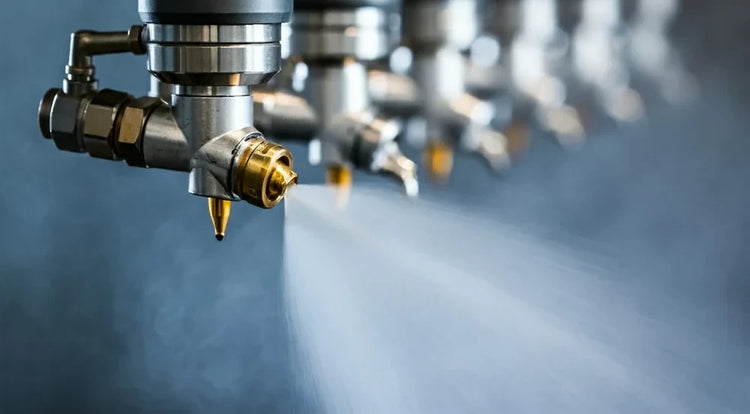

Spray Nozzles for Collaborative Robot
Sealant Applications
How to specify the right air-atomizing nozzle for spraying viscous sealants with a cobot — spray pattern selection, anti-drip requirements, end-of-arm tooling integration, viscosity considerations, and what you need to get a budgetary quote.
Key Takeaways
- External mix air-atomizing nozzles are the correct type for cobot sealant spray — they handle high viscosity, purge cleanly, and mount compactly on end-of-arm tooling without clogging risk in the liquid passages.
- Anti-drip needle valve control is not optional in a cobot application — during transit moves between seal paths, an uncontrolled nozzle deposits sealant wherever the arm happens to be traveling.
- Flat fan patterns suit seam sealing and linear bead coverage; round cone patterns suit spot application and gap filling. Pattern width at working distance is the critical dimension to specify upfront.
- Sealant viscosity determines atomizing air pressure, required fluid pressure, and minimum orifice size. If you don't have a viscosity measurement, the sealant type and approximate consistency is enough to get started.
- Cobot payload budget matters: specify the lightest nozzle assembly that meets the application requirements — stainless steel where durability demands it, aluminum where weight is tight.
Collaborative robots — cobots — are fundamentally changing how manufacturers approach sealant application. Where human operators once applied sealant by hand along window frames, electrical enclosure flanges, panel seams, and component joints, cobots now run that same path with greater consistency, no fatigue, and the flexibility to be reprogrammed for a different product geometry in an afternoon.
The cobot handles the motion. The spray nozzle handles the material. And the nozzle specification — type, pattern, viscosity compatibility, anti-drip control, and weight — determines whether the cobot's precise path actually translates to a consistent, quality sealant application or one that drips, clogs, or produces variable film thickness.
This guide covers everything needed to specify a spray nozzle for cobot sealant application — from selecting the right nozzle type for viscous materials through the anti-drip and EOAT integration details that make or break the application in production.
Why Collaborative Robots Are Transforming Sealant Application
Manual sealant application is one of the most ergonomically demanding tasks in manufacturing. Operators apply material along complex paths, maintain consistent standoff distance and travel speed, and repeat the same sequence for every part in the production run — all while managing a material that has a working life, can be temperature-sensitive, and must meet dimensional tolerances that visual inspection alone cannot reliably verify.
Cobots address the consistency problem directly. Once a sealing path is programmed, the cobot runs it identically on every part — same speed, same standoff, same orientation — for as many parts as the production schedule requires. Sealant application quality becomes a function of nozzle specification and material supply pressure, not of operator technique or attention.
"The cobot solves the motion consistency problem perfectly. The nozzle's job is to solve the material delivery problem — converting supply pressure into a defined spray pattern at the right flow rate, without dripping, without clogging, and within the cobot's payload budget."
The distinction between a cobot and a traditional industrial robot matters for nozzle selection: cobots operate in shared spaces with people, run at speeds that allow safe human proximity, and are typically smaller and lighter than industrial robots. This translates to tighter payload budgets for end-of-arm tooling and a preference for compact, lightweight nozzle assemblies over the larger, heavier spray guns common in dedicated robotic paint booths.
The Right Nozzle Type for Viscous Sealant Spray
External mix air-atomizing nozzles are the standard for sealant spray on collaborative robots. They use compressed air to atomize viscous sealant at the nozzle tip — outside the nozzle body — where the air and sealant never meet inside the liquid passages. This external mixing approach handles high-viscosity sealants (500–50,000+ cP) that would jam an internal mix or standard hydraulic nozzle, purges cleanly between runs, and mounts compactly on cobot end-of-arm tooling. For seam or bead applications, a flat fan air-atomizing pattern covers a defined width per pass. For spot application or gap filling, a round cone concentrates material on a precise target area.
The air-atomizing design solves the fundamental physics problem of spraying a viscous material: standard hydraulic nozzles atomize liquid by forcing it through a small orifice at high pressure, and that approach fails with sealants because the orifice required for fine atomization is too small to pass viscous material without impractically high fluid pressure. Air-atomizing nozzles remove that constraint by using the kinetic energy of the compressed air stream — not fluid pressure alone — to shear the liquid into droplets.
The result: consistent, fine-to-medium atomization of sealants that would be impossible to spray with a hydraulic nozzle alone, at fluid pressures achievable with a standard pressure pot or gear pump, and at a nozzle size and weight appropriate for cobot end-of-arm tooling.
NozzlePro's air-atomizing nozzle collection includes external mix designs for viscous sealant, adhesive, and coating applications — available in flat fan and round cone patterns with anti-drip and needle valve options.
External Mix vs. Internal Mix: Why It Matters for Sealants
External Mix Air-Atomizing
- Air and sealant meet at the tip — no viscous material inside air passages
- Handles high-viscosity sealants (500–50,000+ cP) reliably
- Purges cleanly — tip flush removes residual material without disassembly
- Ideal for materials with a working life or pot life
- Simpler maintenance — no internal mix chamber to clean
- Available with needle valve / anti-drip for cobot use
- Slightly coarser atomization than internal mix at the same air pressure
Internal Mix Air-Atomizing
- Finer droplets at lower atomizing air pressure
- Better for low-to-medium viscosity materials
- Air and liquid mix inside the body — viscous sealant can cure or gel internally
- Internal passages are small — high-viscosity sealant resists flow
- Difficult to clean between runs without disassembly
- Risk of cured sealant blocking internal air passages permanently
- Not suitable for sealants with short working life or pot life
Two-component sealants require additional consideration. If the sealant is a two-part system (e.g., 1:1 or 2:1 epoxy, silicone, or polyurethane), the components must be mixed immediately before spray and the nozzle must be purged before the mixed material reaches its gel time. External mix nozzles are required for two-component sealants — the mixing happens at the tip, and purging each component separately before the next run prevents cured material from building up in the nozzle body.
Spray Pattern Selection: Flat Fan vs. Round Cone
The spray pattern determines how the atomized sealant is distributed across the target surface as the cobot moves the nozzle along its programmed path. The two primary patterns for cobot sealant applications serve different geometries:
Flat Fan Pattern
Projects an elongated elliptical spray zone — wide in one axis, narrow in the other. As the cobot moves the nozzle along a seam, the flat fan pattern lays down a consistent-width band of sealant. Coverage width at working distance is the key parameter: a 4-inch fan width at 6-inch standoff, moving at 100mm/sec, deposits a defined film thickness per pass.
Best for: window frame sealing, panel joint sealing, flange sealing, any linear or curved seam where a consistent-width coverage band is the goal.
Flat Fan Nozzles →Round Cone Pattern
Projects a circular spray zone. For stationary or slow-moving cobot positions targeting a specific hole, gap, or connector, the round cone concentrates material in a defined circular area. Coverage diameter at working distance is the key parameter.
Best for: hole sealing, terminal potting, gap filling, corner joints, any application where coverage in a defined circular area is needed rather than a linear band.
Air-Atomizing Nozzles →Understanding Sealant Viscosity and What It Changes
Viscosity is the single variable that most affects nozzle specification for sealant spray. Different sealant formulations — silicone, polyurethane, MS polymer, acrylic, butyl — span a wide range of viscosity, and the correct nozzle configuration depends on where on that range the specific sealant falls.
Higher viscosity requires more atomizing air pressure and larger fluid orifices to achieve consistent atomization. The practical ranges for air-atomizing external mix nozzles on sealant applications are typically 500–30,000 cP with standard configurations, and up to 50,000 cP with heated fluid supply or higher-pressure systems. Above 50,000 cP, dispensing (bead extrusion) rather than spray atomization is usually the more appropriate approach.
What Viscosity Determines in Your Nozzle Spec
| Parameter | Low Viscosity Sealant (500–2,000 cP) |
Medium Viscosity (2,000–15,000 cP) |
High Viscosity (15,000–50,000 cP) |
|---|---|---|---|
| Atomizing air pressure | 10–25 PSI | 20–45 PSI | 40–80 PSI |
| Fluid supply pressure | 5–15 PSI (pressure pot) | 15–40 PSI | 40–100+ PSI (gear pump recommended) |
| Fluid orifice size | Smaller (0.030–0.046") | Medium (0.046–0.070") | Larger (0.070–0.125"+) |
| Heating benefit | Minimal | Moderate improvement | High — heating significantly reduces required pressures |
Don't know your sealant's exact viscosity? That's normal at the budgetary stage. Telling NozzlePro the sealant type (e.g., "RTV silicone, medium consistency — similar to honey") and whether it's single or two-component is enough to generate a budgetary specification and price range. Exact viscosity measurement can be confirmed during the specification refinement phase.
Anti-Drip Control: Non-Negotiable for Cobot Applications
A collaborative robot moves the nozzle continuously along a programmed path — and between sealing passes, it traverses to the next start point without spraying. During those transit moves, a nozzle without anti-drip control drips or dribbles sealant wherever the arm happens to be positioned. On a complex part with multiple sealing locations, this produces sealant deposits in locations that are difficult to detect and may compromise the part's function or appearance. An integrated needle valve or suck-back mechanism cuts off sealant flow precisely when the cobot's program commands a stop — preventing off-path deposition. For any spray nozzle mounted on a moving robotic arm, anti-drip is a fundamental requirement, not an optional upgrade.
Anti-drip mechanisms in air-atomizing nozzles work by blocking the fluid path at the nozzle tip when spraying is not commanded. The two common approaches are:
- Needle valve cutoff: A spring-loaded needle seats against the fluid orifice when fluid pressure is relieved, physically blocking liquid from exiting the tip. Activated by removing fluid supply pressure — the needle closes immediately when the supply solenoid shuts. Clean, reliable, and integrates directly with the cobot's I/O outputs that control the fluid supply valve.
- Suck-back (retract) valve: When fluid supply is cut, a slight negative pressure pulse retracts a small volume of sealant back from the tip, preventing the surface tension bead from forming and falling as a drip. More effective than simple cutoff for very viscous materials that tend to "string" after cutoff.
In a cobot integration, the anti-drip valve is typically controlled by a digital output from the cobot controller — the same I/O that commands the spray cycle. The cobot program issues an "output ON" command to open the fluid supply valve at the start of each seal path and "output OFF" at the end, with the anti-drip mechanism ensuring immediate cutoff at the nozzle tip.
End-of-Arm Tooling Integration
A cobot sealant spray nozzle is not just a component — it is part of a complete end-of-arm tooling (EOAT) assembly that must fit within the cobot's payload limit, reach the intended spray position, connect to compressed air and fluid supply, and interface with the cobot controller's I/O system.
Weight Budget
Cobot payload ratings typically range from 3 kg (small collaborative models) to 16–20 kg (larger models). This payload must cover the nozzle assembly, mounting bracket, fluid and air hose connections at the wrist, and any sensor or vision equipment mounted on the same EOAT. A complete sealant spray EOAT — nozzle, bracket, needle valve, and hose connections — typically adds 150–600 grams. For weight-sensitive applications, aluminum nozzle bodies significantly reduce weight versus stainless steel without sacrificing functional performance for most sealant chemistries.
Compressed Air and Fluid Supply
The cobot arm must route both compressed air (for atomization) and fluid supply (sealant) from the base of the arm to the EOAT. Most cobots accommodate this through integrated cable management channels in the arm — the hoses run internally or in a cable harness alongside the arm. Fluid supply comes from a pressure pot (simplest, best for low-to-medium viscosity sealants in batch production) or a gear pump with a flow controller (better for continuous production or high-viscosity materials requiring precise dosing).
I/O Integration
The cobot controller's digital outputs control the fluid supply solenoid valve (and therefore the needle valve anti-drip). Atomizing air can be supplied continuously or also switched through a solenoid for cleaner process control. Most cobot platforms — Universal Robots, Doosan, Fanuc CRX, ABB, Techman, and others — support standard 24V digital I/O that is fully compatible with industrial solenoid valves of the type used in sealant spray fluid control.
Key Specifications at a Glance
Nozzle Design
Air-atomizing external mix — air and sealant meet at the tip, not inside the nozzle body
Spray Pattern
Flat fan for seam/bead coverage; round cone for spot/gap filling — match to part geometry
Atomizing Air
Scales with viscosity — higher for thicker sealant; regulated independently from fluid pressure
Fluid Supply Pressure
Pressure pot for low-medium viscosity; gear pump for high viscosity or continuous production
Anti-Drip / Needle Valve
Integrated needle valve or suck-back prevents drips during cobot transit moves between seal paths
Working Distance
Standoff from nozzle tip to work surface — determines spray width and film thickness at given flow rate
Industries Using Cobot Sealant Spray
The cobot + sealant spray combination appears in any manufacturing process where a consistent sealant bead or film must be applied along a repeating path — and where the volume or mix of products doesn't justify a fully dedicated robotic cell.
Getting a Budgetary Quote from NozzlePro
A budgetary quote for a cobot sealant spray nozzle package is achievable with approximate data — exact measurements are not required at the budgetary stage. The goal is to establish nozzle type, pattern, and approximate configuration so that NozzlePro can provide a ±20% price range and a recommended starting specification for your application.
- Identify your sealant: Type (silicone, polyurethane, MS polymer, acrylic, epoxy, etc.), one- or two-component, and approximate consistency (thin / medium / thick — or compare to a familiar reference like "similar to maple syrup" or "like peanut butter"). If you have a product datasheet with viscosity, include it.
- Define the spray geometry: What shape is the sealing path? A linear seam along a flange (flat fan), a circular joint (flat fan traversing), a hole or gap to fill (round cone)? Approximate dimensions of the sealing zone and the target coverage width.
- Specify the cobot: Model and payload capacity. This determines maximum allowable EOAT weight and I/O interface options for the fluid control solenoid.
- Confirm available utilities: Shop air pressure (PSI), whether a pressure pot or pump system is available or if that is also part of the scope, and available I/O on the cobot controller for solenoid control.
- State production requirements: Parts per hour or per shift, approximate cycle time for the sealing operation, and whether the cobot runs attended or unattended.
Cobot Sealant Spray Nozzle — Budgetary Quote Checklist
Ready to Get a Budgetary Quote for Your Cobot Sealant System?
Send NozzlePro your sealant type, cobot model, and approximate spray geometry and we'll return a recommended nozzle specification and budgetary pricing — typically within one business day for standard configurations.
Request a Budgetary Quote Shop Air-Atomizing NozzlesFrequently Asked Questions
What type of spray nozzle is best for applying sealant with a collaborative robot?
External mix air-atomizing nozzles are the standard recommendation for cobot sealant spray. The external mix design — where compressed air and sealant meet at the nozzle tip rather than inside the body — handles viscous sealants that would jam internal mix nozzles, purges cleanly between runs, and is available in both flat fan (for seam sealing) and round cone (for spot application) patterns. The nozzle body is compact and lightweight, fitting within cobot payload budgets, and integrates with standard cobot I/O for anti-drip needle valve control.
Do I need an anti-drip valve on my cobot spray nozzle?
Yes — for virtually all cobot sealant spray applications. As the cobot moves between sealing passes, it traverses to the next start point without spraying. A nozzle without anti-drip control drips sealant along the transit path — depositing material where it doesn't belong and creating defects or contamination that can be difficult to detect and remove. An integrated needle valve cuts off flow precisely when commanded by the cobot's digital output, preventing off-path deposition. NozzlePro's air-atomizing nozzle range includes needle valve and suck-back options compatible with standard 24V cobot I/O systems.
What information do I need to get a budgetary quote for a cobot sealant spray nozzle?
For a budgetary quote, NozzlePro needs: sealant type and approximate viscosity (or consistency description), one- or two-component system, desired spray pattern (flat fan or round cone), approximate spray width or coverage area at working distance, cobot model and payload capacity, available compressed air pressure, and whether a fluid supply system (pressure pot or pump) is part of the scope. You do not need exact measurements — approximate values and descriptive information are sufficient for a ±20% budgetary price range and starting specification. Contact NozzlePro through the link above and we'll typically respond with a budgetary package within one business day.
What is the difference between external mix and internal mix nozzles for sealant?
In an external mix nozzle, compressed air and sealant meet outside the nozzle body — at the tip — where the air shears the sealant into droplets. In an internal mix design, they meet inside the body before exiting together. For viscous sealants, external mix is always preferred because there are no small internal passages where thick material can cure, gel, or jam. Cleaning requires only a tip purge. Internal mix designs produce finer atomization at lower air pressure but are impractical for most sealants — high-viscosity material resists flow through small internal passages, and any curing inside the nozzle body requires disassembly to clear.
Can I use a pressure pot to supply sealant to the cobot nozzle?
Yes — a pressure pot is the simplest fluid supply method for cobot sealant spray and works well for low-to-medium viscosity sealants (approximately 500–15,000 cP) at modest flow rates. The pot is pressurized with shop air (typically 15–50 PSI depending on viscosity), and the sealant flows to the nozzle through a hose routed alongside the cobot arm. For higher-viscosity sealants, longer production runs without reloading, or applications requiring precise flow metering, a gear pump with a flow controller is a better fit. NozzlePro can advise on fluid supply configuration based on your sealant viscosity and production requirements when you contact us for a quote.
Does cobot payload limit affect nozzle selection?
Yes — but rarely to a degree that eliminates nozzle options. Most external mix air-atomizing nozzles for sealant application weigh between 80 and 350 grams including the mounting body. A complete EOAT assembly — nozzle, bracket, needle valve, and hose connections at the wrist — typically adds 200–600 grams. For cobots with 3 kg payload this leaves 2.4–2.8 kg for other EOAT components; for 6 kg and above it is rarely a constraint. If weight is tight, specify aluminum nozzle bodies rather than stainless steel — the same nozzle geometry in aluminum can weigh 40–60% less. Provide your cobot model when requesting a quote and NozzlePro will confirm the recommended assembly weight.
Specifying a Cobot Sealant Spray System?
Tell NozzlePro your sealant type, cobot model, and spray geometry — we'll return a recommended external mix air-atomizing nozzle specification with budgetary pricing, typically within one business day.
Request a Budgetary Quote Shop Air-Atomizing Nozzles


