
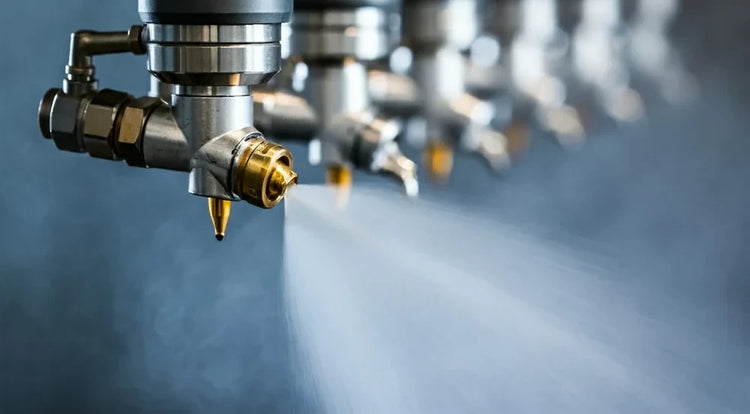

Spray Nozzles for Commercial Bagel Production
Steam injection, proof box humidity, topping adhesion, pan release, CIP cleaning, and washdown — the complete spray nozzle guide for high-volume bagel manufacturing facilities.
Key Takeaways
- Steam injection in the first phase of baking is the most critical spray application in commercial bagel production — it is what creates the glossy, chewy exterior crust that distinguishes a bagel from a bread roll with a hole. Inconsistent steam across the oven width produces inconsistent crust appearance and texture across the batch.
- Proof box humidity must stay in the 75–85% RH range to prevent dough surface skin formation during the rise. High-pressure fog nozzles producing sub-10-micron droplets achieve dry fog humidification — raising ambient humidity without wetting the dough surface directly.
- Topping adhesion — the ability of sesame, poppy, everything, and other toppings to stay on the bagel through baking — depends on the water spray applied to the bagel surface just before toppings are added. Insufficient moisture means toppings don't adhere; too much moisture causes toppings to clump and fall off non-uniformly.
- CIP spray balls for dough mixing equipment and trough cleaning must be sized to the vessel diameter and internal geometry. Dough equipment has high carbohydrate and protein soil loads that require mechanical impact cleaning action in addition to cleaning chemistry.
- Allergen washdown between product runs — particularly between plain and seeded varieties — is a food safety requirement. Sesame is a major allergen; inadequate washdown between plain and sesame-topped production runs creates cross-contact risk in a market where sesame allergen labeling is now required on US packaged foods.
The bagel is a more technically demanding product than it appears. The characteristic crust — glossy, slightly blistered, chewy without being tough — is the result of a deliberate thermal process that requires controlled moisture during baking. The distinctive interior — dense, chewy, and different in texture from any bread — comes from a leavening and proofing process that requires controlled humidity. And the toppings that cover nearly every variety on the market stay on the bagel through baking because of a water spray applied at exactly the right moment in the production line.
At commercial scale — thousands of dozen bagels per shift — every one of these liquid application steps is performed by a spray nozzle. This guide covers what each application requires, how to specify the right nozzle for it, and what happens when the specification is wrong.
Spray Nozzle Applications Across Commercial Bagel Production
Dough Mixing
Flour, water, yeast, salt, and malt combined in large commercial spiral or planetary mixers. No spray application at this stage — the water is batched directly into the mixer.
Shaping and Pan / Board Preparation
Bagels are formed by machine. Baking boards or sheet pans must be treated with release agent or cornmeal to prevent adhesion during baking. Air-atomizing oil spray or dusting systems apply this treatment.
Proofing — The "Sauna" Stage
Shaped bagels enter a high-humidity proof box for controlled rise. Humidity must be maintained at 75–85% RH to prevent the dough surface from drying. High-pressure fog nozzles provide dry fog humidification.
Retarding or Blast Freezing (for par-baked or frozen dough production)
Proofed bagels may be retarded or blast-frozen before baking for distribution to retail or foodservice locations. No spray application at this stage.
Topping Application
Before seeds or toppings are applied, a water spray wets the bagel surface. This is what makes sesame, poppy, everything seasoning, onion, and other toppings adhere through the baking process.
Oven Baking with Steam Injection
Steam in the first 2–4 minutes of baking creates the bagel's glossy, chewy crust by allowing full starch gelatinization before the surface sets. This is the most impactful spray application in the entire bagel production process.
CIP Cleaning and Facility Washdown
Mixing equipment, troughs, and all food-contact surfaces cleaned between runs and at shift end. CIP spray balls for enclosed vessels; food-grade washdown systems for the production floor and equipment surfaces.
Why Steam Creates the Bagel Crust — The Science Behind the Spray
Steam in the first 2–4 minutes of baking creates the bagel's glossy, chewy exterior by allowing full starch gelatinization before the crust sets. In a steam-rich oven environment, the bagel surface stays moist as temperature rises — the starch granules absorb water and swell into a gelatinized layer before the surface dehydrates and firms into a crust. This gelatinized starch produces the characteristic glossy, slightly blistered surface and the chewy resistance of a properly baked bagel. Without steam, the surface dries and sets before full gelatinization, and the result is a dull, bready exterior with none of the textural distinction that makes a bagel a bagel. In commercial tunnel ovens, steam nozzle uniformity across the full belt width directly determines whether every bagel in the batch gets the same crust.
This is worth dwelling on because it explains why steam injection is not a secondary feature of the oven — it is a primary production step with direct product quality consequences visible in every batch. A bakery that tolerates inconsistent steam delivery is tolerating inconsistent product, because the two are inseparable.
"The bagel's crust is not a product of the dough formula alone. It is a product of the spray of steam in the first minutes of baking. Change the steam, and you change the bagel."
The same principle applies to other boiled or steamed baked goods — soft pretzels, bialy, some types of rolls — where a moist surface during the early baking phase is essential for the characteristic crust texture. But bagels are the product where this relationship is most visible and most commercially consequential, because bagel buyers know what the crust should look and feel like, and they notice when it doesn't.
Steam Injection Nozzle Selection for Commercial Bagel Ovens
Commercial bagel ovens — typically continuous tunnel ovens at high production volumes — inject steam through nozzles positioned in the first zone of the oven. The steam distribution from these nozzles must be uniform across the full belt width, because any area of the belt that receives less steam produces bagels with a visibly different crust.
What to Specify
| Parameter | Requirement | Why It Matters |
|---|---|---|
| Nozzle type | Full cone or flat fan steam nozzles, spaced across a manifold spanning the full oven width | Coverage width from each nozzle, combined with nozzle spacing along the manifold, determines whether every point on the belt receives equal steam exposure |
| Materials | 316L stainless steel body; PTFE or high-temp silicone seals rated for continuous saturated steam service | Standard seals degrade rapidly in continuous steam service. Stainless construction survives the oven environment long-term. |
| Flow rate per nozzle | Match to oven manufacturer's specified steam injection rate and manifold pressure | Too little steam: under-baked crust appearance. Too much: excessive moisture retention, surface blistering beyond specification, downstream cooling and packaging problems. |
| Orifice design | Orifices sized to pass steam at the available manifold pressure without erosion or scaling | Steam nozzle orifices can scale from mineral deposits in the steam supply. Orifice design should allow scale deposits to be removed without damaging the nozzle. |
| Nozzle count and spacing | Calculated to produce uniform steam coverage across the full belt width with appropriate overlap between adjacent nozzle coverage areas | Insufficient nozzle count with wide spacing creates "steam lanes" — alternating zones of higher and lower steam exposure that produce visible banding in crust appearance |
Steam nozzle scaling is the most common maintenance issue in commercial bagel oven steam systems. Minerals dissolved in the steam supply — particularly calcium and magnesium carbonate — precipitate out of solution inside steam nozzle orifices, progressively narrowing them and reducing steam flow. A nozzle delivering less steam than its neighbors produces a visible cold or dull spot in the crust of the bagels passing through that zone. Establishing a routine inspection and descaling schedule prevents this from becoming a product quality problem. NozzlePro can recommend steam nozzle designs with orifice geometries that are less prone to scale deposit and easier to clean when scaling does occur.
NozzlePro's food and beverage nozzle collection includes 316L stainless steel full cone and flat fan nozzles rated for steam service, in a range of orifice sizes and flow rates for commercial bagel oven steam manifolds.
Proof Box Humidity: The Sauna Stage of Bagel Production
Commercial bagel producers commonly refer to the proofing chamber as the "sauna" — and the description is apt. The proof box must maintain high relative humidity at elevated temperature to allow the shaped bagel dough to rise fully without the surface drying. The critical constraint is that this humidity must be achieved through airborne moisture — dry fog — rather than by wetting the dough surface directly.
The target conditions for bagel proofing are typically:
Proofing target parameters: 75–85% relative humidity · 85–100°F (29–38°C) · Duration: typically 45–75 minutes depending on dough formula and yeast level · Dough surface must remain moist but not wet throughout
Why Proof Box Humidity Matters and What Goes Wrong Without It
- Skin formation: When the proof box humidity drops below target, the dough surface dries and forms a skin — a thin, slightly tough outer layer. This skin restricts dough expansion during proofing and creates a barrier that prevents full oven spring during baking. Bagels proofed in low-humidity conditions have a dull, slightly leathery surface after baking and may show surface cracking.
- Uneven proofing: In a large proof box, humidity can be uneven — higher near the humidification source, lower near doors, vents, or far-field positions. Bagels in lower-humidity zones develop skin and proof more slowly, producing a mixed batch where some bagels are fully proofed while others are under-proofed.
- Consistency across production shifts: Humidity variation between production shifts — from weather, door opening frequency, batch size, or maintenance state of the humidification system — produces product variation that is difficult to trace back to its cause. A properly maintained fog nozzle system with consistent supply pressure and clean orifices eliminates the humidification system as a variable.
Nozzle Specification for Proof Box Humidification
High-pressure fog nozzles producing droplets smaller than 10 microns are the correct tool for proof box humidification. At this droplet size, the fog evaporates completely in the ambient air before reaching any surface — the proof box air becomes more humid, but the dough surfaces, racks, boards, and walls do not get wet. Nozzles producing larger droplets — fog nozzles operated at too-low pressure, or misting nozzles producing 50–100+ micron droplets — deposit liquid water on the dough surface, wetting it unevenly and potentially causing surface adhesion or distortion of the shaped bagel.
Topping Adhesion Water Spray: Making Seeds Stay On
The majority of bagel varieties carry a surface topping — sesame seeds, poppy seeds, everything seasoning, dried onion, garlic, caraway, or some combination. In commercial production, these toppings are applied by conveyor through a topping drum or shower as the bagels move along the line. What makes them stick is a water spray applied to the bagel surface immediately before the topping application point.
The water spray for topping adhesion must hit every bagel surface at controlled volume. Too little moisture and seeds bounce off the dry dough surface during the tumbling or shower process — ending up on the conveyor and floor rather than on the product. Too much moisture and seeds clump, apply unevenly, and may cause the dough surface to become tacky and stick to conveyor or handling surfaces.
Nozzle Options for Topping Adhesion Spray
- Flat fan nozzles on a spray bar: For bagels on a flat conveyor belt, a spray bar of flat fan nozzles mounted above the belt and oriented perpendicular to the surface applies a uniform strip of moisture across the full belt width as bagels pass beneath. The nozzle-to-product distance, fan angle, and flow rate must be set to apply enough water to wet the dough surface without puddling.
- Air-atomizing nozzles: For a finer, more controlled water application — particularly on enriched doughs that should not be over-wetted — air-atomizing nozzles produce a fine mist that settles on the surface without the impact of a direct spray stream. This approach is more controlled but requires an additional compressed air supply at the spray station.
- Full cone nozzles: For bagels in multiple orientations or on racks with variable positioning, full cone nozzles distribute water in all directions from the nozzle centerline, providing more forgiving coverage regardless of exact bagel position.
Sesame allergen on the line requires a documented spray and rinse protocol during changeover. Sesame became a major food allergen requiring labeling under US federal law. In a bakery that produces both seeded (sesame) and unseeded products, the changeover between sesame and plain production runs requires a washdown that demonstrably removes sesame residue from all food-contact surfaces — including the water spray bar and nozzles used for topping adhesion. Nozzle designs that allow complete disassembly and cleaning should be specified for this spray station.
Baking Pan and Board Release Agent
Commercial bagels bake on linen-covered baking boards, sheet pans, or tunnel oven conveyor systems depending on the specific equipment. All of these surfaces require treatment to prevent bagels from adhering during the baking process and to ensure clean release during depanning. In high-volume production, this release treatment is applied automatically rather than manually.
For baking board production, air-atomizing nozzles applying a thin, uniform mist of food-grade oil or release agent are the standard approach — the same nozzle technology used in the bakery release agent case study documented elsewhere in NozzlePro's resources. The key specification requirements are:
- Thin, uniform film — enough to release without excess oil transfer to the bagel bottom surface
- External-mix air-atomizing design preferred to prevent release agent from contacting internal air passages during idle periods
- Nozzle coverage matching the board or pan width in a single pass
- Food-grade material construction: 316L stainless steel body, food-grade silicone or PTFE seals
See how improper air-atomizing nozzle sizing creates a cascade of bakery problems — including baked-on residue, floor hazards, and de-panning failures — in NozzlePro's bakery release agent case study.
CIP Cleaning for Dough Mixers, Troughs, and Production Vessels
Commercial bagel production involves large quantities of flour, water, yeast, and malt syrup — all of which create significant soil loads on dough mixing equipment, holding troughs, and production vessels. Dough residue that dries on equipment surfaces is far harder to remove than fresh residue, making prompt, effective cleaning after each production run important both for sanitation and for equipment maintenance.
For enclosed mixing bowls and holding vessels, CIP spray balls placed at the top of the vessel distribute hot cleaning solution across all interior surfaces during the cleaning cycle. The spray ball selection — static or rotary, orifice size, flow rate — must be matched to the vessel diameter and the dough soil load:
- Dough is a high-protein, high-carbohydrate soil that bonds strongly to stainless steel surfaces, especially if allowed to dry. Rotary spray heads providing mechanical impact in addition to chemical cleaning action are preferred over static spray balls for dough mixing equipment.
- Hot water is critical — cleaning solution temperature at 140–160°F significantly improves protein soil removal compared to ambient temperature cleaning.
- Spiral mixer bowls have complex internal geometry — the dough hook shaft, bowl scraper attachment points, and drain areas create shadow zones that need to be explicitly covered by spray ball placement.
Facility Washdown: End of Shift and Allergen Changeover
The bagel production environment accumulates flour dust, seed debris, oil from release agent spray, and dough residue across conveyors, floors, walls, and equipment surfaces throughout each production shift. End-of-shift washdown must remove this accumulation effectively before the next shift begins. Between production runs of different varieties — particularly between seeded and unseeded products — an allergen changeover washdown is a food safety requirement.
Food-grade bakery washdown nozzles and spray guns must deliver controlled water at sufficient pressure and flow rate to physically dislodge flour and seed debris from equipment surfaces without excessive splash and aerosol generation that spreads contamination around the facility. The washdown system should include hose stations at regular intervals throughout the production area with enough water pressure at each station to serve the cleaning tasks in that zone without significant pressure drop at the nozzle.
Food-Grade Nozzle Material Selection for Bagel Production
| Application | Liquid | Body Material | Seals |
|---|---|---|---|
| Steam injection — oven | Saturated steam (212°F / 100°C+) | 316L stainless steel | PTFE or high-temp silicone rated for continuous steam |
| Proof box humidification | Potable or softened water at high pressure | 316L stainless steel | Food-grade silicone or PTFE |
| Topping adhesion water spray | Potable water | 316L SS or food-grade polypropylene | Food-grade silicone |
| Pan/board release agent | Food-grade vegetable or mineral oil | 316L stainless steel | Food-grade silicone or PTFE |
| CIP spray balls — mixers | Hot caustic, acid, sanitizer | 316L stainless steel | PTFE — resistant to both caustic and acid at CIP temperatures |
| Facility washdown | Water, detergent, sanitizer | 316L SS gun body; food-grade rated | Food-grade silicone or EPDM |
Spray Nozzle Solutions for Your Bagel Production Line
NozzlePro supplies food-grade spray nozzles for every stage of commercial bagel production — from steam injection and proof box humidity to topping adhesion, pan release, CIP cleaning, and washdown — in 316L stainless steel with food-safe seals.
Shop Bakery Nozzles Request a QuoteFrequently Asked Questions
What spray nozzles are used in commercial bagel production?
Commercial bagel production uses spray nozzles at five key stages. Steam injection nozzles in the first oven zone are the most critical — steam in the initial baking phase creates the characteristic glossy, chewy bagel crust by keeping the surface moist long enough for the outer starch to fully gelatinize before setting. High-pressure fog nozzles maintain 75–85% RH in the proof box without wetting the dough surface. Flat fan nozzles on a spray bar apply water to bagel surfaces immediately before seeds and toppings are added. Air-atomizing nozzles apply release agent to baking boards or sheet pans. CIP spray balls clean enclosed mixing equipment, and food-grade washdown nozzles clean the production facility between runs and at end of shift.
Why does steam in the oven create a chewy, glossy bagel crust?
The bagel's distinctive crust texture is the product of starch gelatinization at the dough surface during the early phase of baking. When the bagel enters the oven, the outer starch layer must heat to the gelatinization temperature (around 140–160°F / 60–70°C for wheat starch) in the presence of sufficient moisture for the starch granules to absorb water, swell, and gelatinize. Steam in the oven provides that moisture — it keeps the surface moist through the gelatinization temperature range before the heat drives off water and the crust firms. The gelatinized outer starch layer produces the characteristic glossy surface (gelatinized starch is more reflective than ungelatinized) and the chewy resistance that distinguishes a bagel crust. Without steam, the surface dries before reaching full gelatinization temperature, and the result is an ungelatinized starch layer that bakes into a bready, matte, soft crust instead.
What humidity is required in a bagel proof box, and how is it maintained without wetting the dough?
Bagel proofing typically requires 75–85% relative humidity at 85–100°F (29–38°C). The challenge is maintaining this ambient humidity without depositing liquid water on the dough surface — which would disrupt the dough surface texture, cause uneven spots, or cause the dough to stick to the proofing boards. High-pressure fog nozzles generating droplets smaller than 10 microns produce dry fog — droplets that evaporate completely in the ambient air before reaching any surface. The air becomes more humid; no surface gets wet. Nozzles producing larger droplets operate differently: 50–100+ micron droplets from low-pressure misting nozzles evaporate slowly and deposit on surfaces before full evaporation. Specifying high-pressure fog nozzles at adequate system pressure (typically 800–1000 PSI) with correctly sized orifices for the proof box volume is the only reliable way to achieve and maintain target humidity without surface wetting.
How does water spray help seeds and toppings stick to bagels during baking?
Seeds and toppings adhere to bagels during baking through the same starch gelatinization mechanism that creates the crust. When the moist, seed-covered dough surface enters the oven and the outer starch gelatinizes, the gelatinized starch physically encapsulates the bottom portion of each seed, anchoring it to the surface as the crust firms. For this mechanism to work, the seed must be sitting on a moist surface at the time of oven entry. A water spray applied before the topping shower provides that surface moisture. Without adequate surface moisture, seeds sit on a dry dough surface, are not physically embedded by gelatinized starch during baking, and fall off when the finished bagel is handled. Too much moisture causes seeds to clump or slide off during the topping application process before baking. The correct application rate — just enough to wet the surface — requires a nozzle specified for the right flow rate and pattern coverage at the conveyor speed in use.
What washdown protocol is needed between seeded and plain bagel production runs?
Sesame is a declared major food allergen under US federal law, requiring label disclosure on any food product that may contain sesame. A bagel facility that produces sesame-topped varieties and also produces plain (unseeded) bagels must have a documented washdown procedure for the changeover between sesame and plain production that provides confidence that sesame residue on food-contact surfaces is removed below the threshold of allergenic concern. This washdown must cover all surfaces where sesame seeds may have landed during production — including the conveyor belt, conveyor frame channels, the topping adhesion spray bar and nozzles, the topping application system, and any shared handling equipment. Nozzle designs specified for the topping adhesion spray station should allow complete disassembly for inspection and cleaning to confirm no sesame residue remains in hard-to-see areas. Contact NozzlePro with your production line layout to discuss nozzle specifications that support effective allergen changeover.
Serving Commercial Bakeries Across the US
NozzlePro supplies food-grade spray nozzles for the full commercial bagel production process — from oven steam injection and proof box humidification to topping adhesion, pan release, CIP cleaning, and end-of-shift washdown. Contact us with your production line details for a nozzle recommendation and quote.
Request a Quote Shop Bakery Nozzles


