
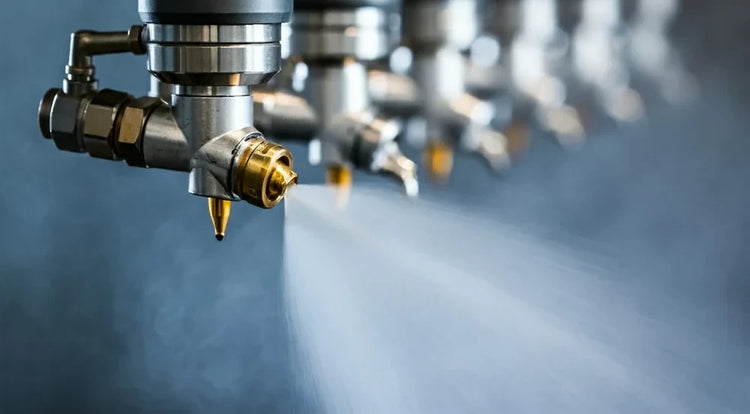

Ein Lager voller Industrie-Luftdüsen kann überwältigend wirken. Bei Hunderten von Formen, Größen und Materialien, die zur Verfügung stehen, woher wissen Sie, welche Ihr Problem tatsächlich löst, ohne Ihr Energiebudget zu sprengen?
Die Wahl der falschen Düse führt zu „schwacher“ Leistung oder, schlimmer noch, zu einem massiven Anstieg Ihrer Druckluftkosten. Bei NozzlePro haben wir den Auswahlprozess auf vier kritische Faktoren reduziert.
1. Das primäre Ziel identifizieren
Der erste Schritt bei der Auswahl einer Industriedüse ist die Definition der Aufgabe. Nicht alle Luftströme sind gleich.
-
Zum Trocknen großer Oberflächen: Sie benötigen eine Flachstrahldüse. Diese erzeugen einen breiten „Luftvorhang“, der Feuchtigkeit von ebenen Teilen oder Förderbändern fegt.
-
Für die Tiefenreinigung und Sacklöcher: Sie benötigen eine Runddüse mit hohem Schub. Diese bieten einen konzentrierten „Luftstoß“, um Späne oder Flüssigkeit aus engen Räumen zu entfernen.
-
Zum Kühlen von Teilen: Suchen Sie nach einer Luftverstärkerdüse. Diese bewegen ein großes Volumen Umgebungsluft mit geringeren Geschwindigkeiten, was perfekt ist, um Wärme von einem Teil abzuleiten, ohne Druckluft zu verschwenden.
2. Material und Umgebung abstimmen
Die Langlebigkeit Ihrer Düse hängt ganz von der Umgebung ab, in der sie eingesetzt wird.
| Material | Am besten geeignet für... | Hauptvorteil |
| Aluminium | Allgemeine Fertigung | Leicht und kostengünstig. |
| Edelstahl 316 | Lebensmittel, Pharma, hohe Hitze | Korrosionsbeständig und extrem langlebig. |
| Zinkmikron | Schwere Industrie | Hält rauen, abrasiven Umgebungen stand. |
| Kunststoff/PEEK | Empfindliche Oberflächen | Nicht abfärbend und chemisch beständig. |
3. Luftdüsen-Dimensionierung: Anschluss und CFM
Bei der Dimensionierung von Luftdüsen ist „größer“ nicht immer besser. Sie müssen die Düse an Ihre vorhandene Verrohrung und die Kapazität Ihres Kompressors anpassen.
-
Der Anschluss: Die meisten Industriedüsen verwenden 1/8", 1/4" oder 1/2" NPT (National Pipe Thread). Stellen Sie sicher, dass Ihr Schlauch oder Rohr zum Einlass der Düse passt.
-
Der CFM (Durchfluss): Überprüfen Sie den SCFM-Wert (Standard Cubic Feet per Minute) der Düse bei Ihrem Betriebsdruck (typischerweise 80 PSI). Wenn Ihr Kompressor nur 20 CFM erzeugen kann und Sie eine 40 CFM-Düse kaufen, bricht Ihr Systemdruck zusammen.
4. Abstand zum Ziel berücksichtigen
Verschiedene Luftdüsenanwendungen erfordern unterschiedliche Montageabstände.
-
Kurze Distanz (< 6"): Verwenden Sie eine Flachdüse für das hochwirksame „Abkratzen“ von Flüssigkeiten.
-
Lange Distanz (> 12"): Verwenden Sie einen Hochgeschwindigkeits-Luftstrahl. Diese sind so konzipiert, dass sie ihren „laminaren“ Fluss über eine längere Distanz beibehalten, ohne dass der Luftstrom sich zerstreut.
Finden Sie Ihre perfekte Lösung
Sie sind sich noch nicht sicher, welche Düse die richtige für Ihre Anwendung ist? Unser Expertenteam hilft Ihnen gerne dabei, die perfekte Lösung basierend auf Ihrem PSI, CFM und Zielabstand zu spezifizieren.


