
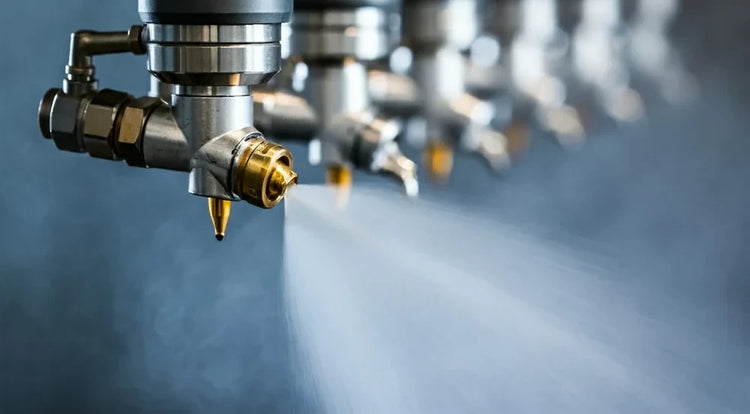
Sprühdüsen für die Tissueherstellung
Sprühdüsen für Kreppklebstoff für Yankee-Zylinder, Sprühsysteme für Yankee-Beschichtung, Düsen für die Anwendung von Erweichungschemikalien, Systeme zur Staubunterdrückung bei Tissue und Sprühanlagen für die Weiterverarbeitungslinie – hydraulische und luftzerstäubende Düsen für die präzise chemische Anwendung bei Toilettenpapier, Kosmetiktüchern, Papierhandtüchern und Serviettenmaschinen, die mit 1.200–2.000 m/min betrieben werden
Sprühdüsen für die Tissueherstellung sind Präzisionsinstrumente zur Flüssigkeitsanwendung, keine allgemeine industrielle Sprühausrüstung. Der auf eine Yankee-Zylinderoberfläche aufgetragene Kreppklebstoff muss zu einer bestimmten Tröpfchengröße zerstäubt, mit einem spezifischen Beschichtungsgewicht über die gesamte Maschinenbreite aufgetragen und am Applikationspunkt auf einer bestimmten Temperatur gehalten werden – denn die Viskosität des Klebstoffs, die Filmdicke und der Aushärtungszustand an der Kreppmesserleiste bestimmen zusammen das Kreppverhältnis, das Volumen, die Weichheit und die Blattintegrität des Tissues. Eine Düse, die den korrekten Gesamtdurchfluss liefert, aber eine ungleichmäßige Abdeckung über die Yankee-Breite erzeugt, führt zu einem Tissueblatt mit CD-Variationen in der Kreppstruktur – sichtbar als abwechselnd dichte und offene Kreppbänder, die Schwankungen im Flächengewicht und Probleme bei der Weiterverarbeitung am Rollenschneider verursachen.
Sprühsysteme für Weichmacher haben eine ebenso anspruchsvolle Anforderung an die Gleichmäßigkeit: Ein Entbindemittel oder quaternärer Ammoniumweichmacher, der mit einer Zugabemenge von 0,3–0,8 % zum Faserstoff gegeben wird, muss gleichmäßig über die gesamte Siebkastenbreite verteilt werden, da jede Abweichung von 0,1 % in der Weichmacherkonzentration über die CD eine entsprechende Variation in der Tissue-Weichheit und Zugfestigkeit erzeugt, die bei der Prüfung des Endprodukts nachweisbar und auf Handmustern sichtbar ist. NozzlePro liefert hydraulische und luftzerstäubende Düsen für die Anwendung von Yankee-Kreppklebstoffen, die Yankee-Beschichtung, die Verteilung von Weichmachern und die Staubunterdrückung an der Tissue-Verarbeitungslinie – in den Tröpfchengrößen, Durchflussraten und Gleichmäßigkeitspezifikationen, die die Chemie der Tissue-Maschine erfordert. ISO 9001 zertifizierte Herstellung.
Die Tissueherstellung verwendet Sprühdüsen in vier chemisch unterschiedlichen Anwendungen: Sprühdüsen für Kreppklebstoff tragen Polyvinylalkohol (PVA), Polyamid-Epichlorhydrin (PAE) oder kationische Stärkeklebstoffe auf die Yankee-Zylinderoberfläche vor dem Kreppmesser auf – hydraulische Zerstäubungsdüsen (1–5 bar, 80–150 µm Dv50) oder luftzerstäubende Düsen für Klebstoffe mit geringerer Viskosität erzeugen den erforderlichen feinen, gleichmäßigen Film; eine Gleichmäßigkeit des Beschichtungsgewichts innerhalb von ±3 % über die Yankee-Arbeitsbreite ist der Anwendungsstandard; Sprühdüsen für die Yankee-Zylinderbeschichtung tragen Trennmittel (typischerweise eine Mischung aus Kreppklebstoff und Trennmittelmodifikator) als kontinuierlichen dünnen Film auf die Yankee-Oberfläche auf – Hohlkegel- oder hydraulische Zerstäubungsdüsen bei 0,5–3 bar mit dem Verteiler über die gesamte Maschinenbreite, ausgelegt für Rücklaufzufuhr; Sprühsysteme für Weichmacher tragen Entbindemittel, quaternäre Ammoniumweichmacher und Polysiloxanweichmacher auf die Zellstoffaufschlämmung an der Ventilatorpumpe, am Stoffauflauf oder direkt auf das Blatt auf – luftzerstäubende Düsen für viskose Weichmacher erzielen die enge Tröpfchengrößenverteilung (50–120 µm), die für eine gleichmäßige Penetration in den Faserstoff erforderlich ist; und Düsen zur Staubunterdrückung bei Tissue verwenden Feinstnebel-Düsen (10–40 µm, 20–60 bar) an Rollenschneidern, Schneidemaschinen, Wicklern und Längssägen an der Weiterverarbeitungslinie, um luftgetragenen Tissuestaub zu agglomerieren, der Explosionsgefahren, Reinigungsprobleme und Atemwegsgefahren verursacht – die Tröpfchengröße muss an die Partikelgrößenverteilung des Tissuestaubs angepasst werden, um Agglomeration statt erneuter Befeuchtung des Blattes zu erreichen.
Kollektionen von Sprühdüsen für die Tissueherstellung
Nach Anwendung oder Düsenausführung einkaufen
Yankee-Zylinder-Chemie – Düsenrolle an jeder Position
Jede Sprühchemikalie im Yankee-System erfüllt eine spezifische Funktion – und jede erfordert eine andere Düsenausführung
Kreppklebstoff
Angewendet auf: Yankee-Oberfläche vor dem KreppmesserPVA, PAE oder kationische Stärke – verbindet das Blatt mit der Yankee-Oberfläche, um das Kreppverhältnis zu steuern. Auftragsgewicht ±3 % CD-Gleichmäßigkeit erforderlich. Hochviskose Sorten benötigen Luftzerstäubung; niedrigviskose Sorten eignen sich für hydraulische Zerstäubung.
Trennmittelmodifikator
Angewendet auf: Yankee-Oberfläche (gemischt mit Klebstoff)Regelt das Gleichgewicht zwischen Klebstoff und Trennmittel an der Kreppmesserleiste. Zu hoch: Blatt klebt, reißt. Zu niedrig: unzureichender Krepp, flaches Blatt. Das Verhältnis zum Klebstoff wird am Düsenverteiler durch separate Dosierleitungen gesteuert.
Entbindemittel
Angewendet auf: Ventilatorpumpe oder StoffauflaufKationische quaternäre Ammoniumverbindung – reduziert die inter-Faser-Bindungsstärke für verbesserte Weichheit. Wird dem Faserstoff mit einer Zugabemenge von 0,2–0,8 % zugesetzt; gleichmäßige Verteilung in der Aufschlämmung ist die Anforderung an das Düsendesign.
Polysiloxan-Weichmacher
Angewendet auf: Blattoberfläche oder FaserstoffSilikonbasierter Weichmacher für Premiumqualitäten – auf das trockene Blatt in der Weiterverarbeitungslinie oder auf den Faserstoff für Volumenweichheit aufgetragen. Die Anwendung in der Weiterverarbeitungslinie erfordert präzises Auftragsgewicht; die Anwendung im Faserstoff erfordert eine gleichmäßige Dispersionsdüse.
Yankee-Hauben-Zusätze
Angewendet auf: Yankee-Zylindertrockner-HaubenprallluftAnti-Nebelmittel und Hauben-Trennmittel, die in den heißen Prallluftstrom der Haube eingebracht werden – verhindern die Ansammlung von Klebstoffnebel in der Haube, der eine Brandgefahr und Ungleichmäßigkeiten der Beschichtung auf der Yankee-Oberfläche verursacht.
Lotion / Duftstoff
Angewendet auf: Blattoberfläche in der WeiterverarbeitungAloe Vera, Vitamin E oder Duftstoffe, die auf hochwertige Kosmetiktuchblätter in der Weiterverarbeitungslinie aufgetragen werden – hydraulische oder luftzerstäubende Düsen für einen feinen, gleichmäßigen Film über die Blattbreite ohne Überbefeuchtung.
Sprühapplikationen in der Tissueherstellung
Anwendungsspezifische Düsenempfehlungen mit den prozessualen Konsequenzen einer schlechten Spezifikation an jeder Position
Sprühdüsen für Kreppklebstoff
Hydraulische Zerstäubungsdüsen (1–5 bar, 80–150 µm Dv50) oder luftzerstäubende Düsen (20–40 psi Luft, 50–100 µm Dv50) tragen Kreppklebstofflösung auf die rotierende Yankee-Zylinderoberfläche vor dem Kreppmesser auf. Dies erzeugt einen kontrollierten Klebstofffilm, der das Tissueblatt während des Trocknens an die Yankee-Oberfläche bindet und die Kreppwirkung am Kreppmesser steuert. Das Auftragsgewicht des Kreppklebstoffs – typischerweise 5–25 mg/m² Trockenbasis, abhängig von Sorte und Messergeometrie – bestimmt die Haftfestigkeit zwischen Blatt und Yankee am Krepppunkt. Zu wenig Klebstoff: unzureichende Bindung, Blatt löst sich vor dem Kreppmesser und läuft zerknittert oder ungestützt; Maschine läuft mit unkontrolliertem Blattflattern, das zu Abrissen führt. Zu viel Klebstoff: übermäßige Bindung, Blatt kreppt nicht sauber am Messer; Kreppmesser verschleißt schneller; Kreppverhältnis ist niedriger als Zielwert, was zu weniger Volumen und geringerer Weichheit führt. Eine Gleichmäßigkeit in Querrichtung von ±3 % des Zielauftragsgewichts ist über die gesamte Yankee-Arbeitsbreite erforderlich – jede Abweichung von 3 % über diesem Schwellenwert erzeugt eine entsprechende Variation in der Kreppstruktur, die als CD-Variation im Tissue-Flächengewicht und Volumen erscheint, die sich durch die Weiterverarbeitung zieht und im Endprodukt nachweisbar ist. Die Düsenauswahl zwischen hydraulischer und luftzerstäubung hängt hauptsächlich von der Klebstoffviskosität ab: Klebstofflösungen mit niedriger Viskosität (unter 500 cP bei Anwendungstemperatur) zerstäuben ausreichend mit hydraulischen Düsen bei 1–5 bar; höher viskose Sorten (500–5.000 cP) erfordern luftzerstäubende Düsen, um die feine Tröpfchengröße zu erreichen, die für eine gleichmäßige Filmbildung bei Yankee-Oberflächengeschwindigkeiten von 1.200–2.000 m/min erforderlich ist.
Hydraulische ZerstäubungsdüsenSprühdüsen für die Yankee-Zylinderbeschichtung
Hohlkegel- oder hydraulische Zerstäubungsdüsen (0,5–3 bar) in einem Vollbreitenverteiler tragen die Yankee-Beschichtungsmischung – eine formulierte Mischung aus Kreppklebstoff und Trennmittelmodifikator – als kontinuierlichen dünnen Film auf die Gusseisenoberfläche des Yankee-Zylinders auf. Dies erhält die chemische Beschichtungsschicht, die sowohl das Ablöseverhalten des Blattes als auch die Verschleißrate des Kreppmesser bestimmt. Das Yankee-Beschichtungssystem ist ein kontinuierliches Gleichgewicht zwischen Adhäsion (der Kreppklebstoffanteil) und Trennung (der Trennmittelmodifikatoranteil) – die Kreppwirkung des Messers ist nur möglich, weil dieses Gleichgewicht das Blatt fest genug hält, um es zu kreppen, während es sauber genug abgelöst wird, um keinen übermäßigen Messerverschleiß oder Blattabrisse zu verursachen. Die Gleichmäßigkeit des Auftragsgewichts über die Yankee-Breite ist die kritische Düseneigenschaft – ein Hohlkegeldüsenverteiler mit ungleichmäßiger Durchflussverteilung erzeugt eine ungleichmäßige Beschichtungsschicht, die eine unterschiedliche Adhäsion über die Breite verursacht. In den Zonen mit hoher Adhäsion (unter hohem Durchfluss) ist das Blatt zu fest gebunden und das Kreppmesser unterliegt lokalem Verschleiß; in den Zonen mit geringer Adhäsion (unter geringem Durchfluss) löst sich das Blatt vorzeitig und die Kreppstruktur ist inkonsistent. Düsenmaterial: Die Kreppklebstofflösung ist nicht abrasiv, kann aber geringe Konzentrationen an anorganischen Additiven (Siliziumdioxid, Aluminiumoxid) für bestimmte Spezialbeschichtungsformulierungen enthalten – überprüfen Sie die Materialauswahl der Düsenöffnung anhand der spezifischen Beschichtungschemie. Standard 316L SS ist für die meisten wässrigen Kreppklebstoffsysteme ausreichend; PTFE- oder PVDF-Gehäusedüsen für Beschichtungen, die aggressive Lösungsmittel oder reaktive Komponenten enthalten.
HohlkegeldüsenSprühsysteme für Weichmacher
Luftzerstäubungsdüsen (50–120 µm Dv50) oder hydraulische Zerstäubungsdüsen für Entbindemittel, quaternäre Ammoniumweichmacher (QUAT), Polysiloxanweichmacher und Nassfestigkeitsmittel, die der Zellstoffaufschlämmung an der Ventilatorpumpe oder dem Stoffauflaufsystem oder der Blattoberfläche im Trockenabschnitt oder in der Veredelungslinie zugeführt werden. Entbindemittel und QUATs, die dem Faserstoff zugeführt werden, wirken, indem sie an Faseroberflächen adsorbieren und die Wasserstoffbindungsfähigkeit der Hydroxylgruppen reduzieren – dies reduziert sowohl die inter-Faser-Bindungsstärke (verbessert Weichheit und Fall) als auch die Zugfestigkeit des Blattes (die mit der Zugfestigkeitsspezifikation der Sorte abgeglichen werden muss). Die Anwendungsdüse für die chemische Zugabe zum Faserstoff muss eine gleichmäßige Dispersion des Weichmachers über den gesamten Faserstoffquerschnitt am Zugabepunkt erreichen – eine Düse, die den korrekten Gesamtdurchfluss liefert, aber in einer Zone des Ventilatorpumpenauslasses konzentriert ist, erzeugt einen Konzentrationsgradienten im Stoffauflauf, der als CD-Weichheitsvariation im fertigen Tissue erscheint. Für viskose Weichmacher (Polysiloxanemulsionen bei 5.000–50.000 cP) erzielen luftzerstäubende Düsen die feine Tröpfchengröße, die eine schnelle Dispersion im Faserstoff fördert, ohne schwebende Kügelchen von undispergiertem Weichmacher zu erzeugen. Die Oberflächenapplikation von Polysiloxanweichmacher auf das Blatt in der Veredelungslinie verwendet hydraulische Zerstäubungsdüsen bei sehr geringen Auftragsgewichten (0,1–0,5 g/m²) – die Präzision des Auftragsgewichts auf diesem Niveau erfordert Düsen mit enger Durchflusstoleranz und einem Verteilerdesign, das einen gleichmäßigen Durchfluss über die gesamte Breite der Veredelungslinie gewährleistet.
LuftzerstäubungsdüsenDüsen zur Staubunterdrückung bei Tissue
Feinstnebel-Düsen (10–40 µm Tröpfchen Dv50, 20–60 bar) an Rollenschneidern, Rundschneidern, Längssägen, Wicklern, Umrollern und Prägestationen in der Weiterverarbeitungslinie unterdrücken luftgetragenen Tissuestaub – die feinen Zellulosefasern und Füllstoffpartikel, die bei Schneide-, Präge- und Wickelvorgängen freigesetzt werden. Tissuestaub ist ein brennbares Material: Zellulosefaserstaub hat eine minimale Explosionskonzentration (MEC) von 60–100 g/m³ und eine minimale Zündenergie unter 100 mJ, was ihn in die Kategorie der brennbaren Staubgefahren einordnet, die NFPA 652/654-Konformitätsanforderungen auslöst. Bei Hochgeschwindigkeits-Veredelungsvorgängen (400–600 m/min) kann die Staubentwicklungsrate an einem Rundschneider oder einer Längssäge lokale Konzentrationen erzeugen, die innerhalb der Veredelungsmaschinenhaube nahe an die MEC herankommen – was die Staubunterdrückung zu einer Explosionsschutzfunktion sowie zu einer Reinigungsfunktion macht. Die Auswahl der Tröpfchengröße ist entscheidend: Tröpfchen über 60 µm sind zu schwer, um lange genug in der Luft zu bleiben, um feine Staubpartikel (typischerweise 5–50 µm Durchmesser) zu kontaktieren, bevor sie sich absetzen – sie benetzen die Geräteoberflächen, ohne eine Staubunterdrückung zu bewirken. Tröpfchen unter 10 µm verdunsten, bevor sie Staubpartikel im Luftstrom der Haube erreichen und agglomerieren. Der Bereich von 15–40 µm bietet die optimale Kombination aus Verweilzeit und Impuls für die Staubagglomeration ohne erneute Befeuchtung des Blattes. Düsenaktivierung: Eine bedarfsgesteuerte Aktivierung durch Staubkonzentrationsmonitore (fotoelektrische oder Laserpartikelzähler) anstelle des Dauerbetriebs verhindert die Aufnahme von Blattfeuchtigkeit durch kontinuierlichen Feinstnebel in der Umgebung der Veredelungslinie.
Nebel- und FeinstnebeldüsenDüsen für Lotion, Duftstoffe & Additive
Hydraulische Zerstäubungsdüsen (0,5–3 bar, 80–150 µm Dv50) für Lotionauftrag (Aloe Vera, Vitamin E, Mineralöl) und Duftstoffauftrag auf hochwertige Kosmetiktücher und Toilettenpapier in der Veredelungslinie – um den feinen, gleichmäßigen Film zu erreichen, der für eine gleichbleibende Produktqualität und die taktile Wahrnehmung des Verbrauchers erforderlich ist, ohne das Tissueblatt zu überbefeuchten oder ein Anhaften an den Veredelungswalzen zu verursachen. Das Auftragsgewicht der Lotion beträgt typischerweise 0,5–3,0 g/m² je nach Produkttyp – bei diesen Mengen ist eine Düsengleichmäßigkeit von ±5 % über die Breite der Veredelungslinie erforderlich, um eine gleichbleibende Produktqualität innerhalb der Sortenspezifikation zu gewährleisten. Eine gleichmäßige Lotionanwendung ist besonders kritisch für Kosmetiktücher: Verbraucherpanels können Schwankungen in der Lotionverteilung von nur ±10 % über die Tissuebreite als Unterschied in der Weichheit und im Tastgefühl wahrnehmen. Der Duftstoffauftrag, typischerweise bei geringeren Auftragsgewichten (0,05–0,3 g/m²), erfordert eine noch feinere Sprühkontrolle – luftzerstäubende Düsen für flüchtige Duftstoffe, die bei hydraulischer Zerstäubung unter höherem Druck teilweise verdunsten würden. Düsenmaterial für Lotion- und Duftstoffanwendungen: 316L SS ist für die meisten wässrigen Lotionsysteme ausreichend; PTFE-Gehäusedüsen für lösemittelbasierte Duftstoffkonzentrate. Der gesamte Fließweg von der chemischen Dosierpumpe über den Verteiler bis zur Düse muss auf chemische Verträglichkeit geprüft werden – Lotionsysteme, die silikonbasierte Additive verwenden, erfordern durchgängig PTFE- oder FKM-Dichtungen.
Hydraulische ZerstäubungsdüsenBefeuchtungs- und Wiederbenetzungsdüsen für die Weiterverarbeitungslinie
Feinstnebeldüsen (5–15 µm, Befeuchtungssysteme) oder kontrollierte Wiederbefeuchtungsdüsen (1–3 bar, 30–80 µm) für die Feuchtigkeitskonditionierung von Tissuebahnen in der Verarbeitungslinie – Aufrechterhaltung des Zielfeuchtigkeitsgehalts der Bahn (typischerweise 4–7 % für Tissue), der die Prägeleistung, die Haftfestigkeit der Lagenverklebung, die Laufruhe der Verarbeitungslinie und die Eigenschaften des Endprodukts beeinflusst. Die Tissuebahn, die von der Tissuemaschinenrolle zur Verarbeitungslinie gelangt, hat typischerweise einen Feuchtigkeitsgehalt von 3–5 %. Bei Feuchtigkeitsgehalten unter 4 % sind Tissuebahnen spröde, neigen an der Abwickelstation der Verarbeitungslinie zu Bahnbrüchen und erzeugen Prägemuster mit reduzierter Definition und erhöhter Staubentwicklung im Prägespalt. Bei Feuchtigkeitsgehalten über 7–8 % sind Tissuebahnen in der Verarbeitungslinie weich und rutschig, was die Prägedefinition reduziert und ein Abrutschen im Spalt bei der Protokollbildung und Wickelvorgängen verursacht. Befeuchtungssysteme, die ultrafeinen Nebel (5–15 µm) verwenden, konditionieren die Umgebung der Verarbeitungslinie – sie steuern die Umgebungsfeuchtigkeit auf einen Bereich von 50–65 % relativer Feuchte, in dem die Feuchtigkeit der Tissuebahn den Zielwert erreicht – anstatt Wasser direkt auf die Bahn aufzubringen, wodurch die lokale Überbefeuchtung vermieden wird, die direkter Sprühnebel erzeugen kann. Für die Oberflächenbefeuchtung der Bahn bei Premium-Verarbeitungsvorgängen (Mehrschichtlaminierung, Lotionauftrag) werden hydraulische Zerstäubungsdüsen mit sehr kontrollierten Beschichtungsgewichten verwendet.
BefeuchtungssystemeReferenztabelle für Sprühdüsen in der Tissueherstellung
Empfohlener Düsentyp, Betriebsparameter, verarbeitetes Fluid und kritische Konstruktionshinweise nach Anwendungsposition
| Anwendung / Position | Düsentyp | Druck / Dv50 | Verarbeitetes Fluid | Material | Kritischer Konstruktionshinweis |
|---|---|---|---|---|---|
| Yankee-Kreppklebstoff | Hydraulische Zerstäubung oder Luftzerstäubung | 1–5 bar; Dv50 80–150 µm | PVA-, PAE- oder kationische Stärkeklebstofflösung | Gehäuse aus 316L SS oder PTFE; 316L SS oder PVDF für PAE-Chemie | Auftragsgewicht ±3 % CD-Gleichmäßigkeit über die Yankee-Breite; Luftzerstäubung für viskose Klebstoffe >500 cP; Düsentemperatur muss Klebstoff über der Mindestfilmbildungstemperatur am Auftragspunkt halten; Loop-Return-Verteiler |
| Yankee-Beschichtung / Trennmittelgemisch | Hohlkegel oder Hydraulische Zerstäubung | 0.5–3 bar; Dv50 100–200 µm | Kreppklebstoff + Trennmittelgemisch | Gehäuse aus 316L SS; PTFE-Dichtungen; Überprüfung auf Modifier-Chemie | Gleichmäßiges Auftragsgewicht verhindert differenzielle Haftung – Zonen hoher Haftung verursachen Klingenverschleiß; Zonen geringer Haftung verursachen vorzeitiges Ablösen der Bahn; separate Dosierleitungen für Klebstoff und Trennmittel zur Anpassung des Verhältnisses ohne Änderung des Durchflusses |
| Debondingmittel / QUAT-Weichmacher (Stoff) | Luftzerstäubung oder Hydraulische Zerstäubung | 20–40 psi Luft; Dv50 50–120 µm | Kationische quartäre Ammoniumlösung (0.5–5 % aktiv) | Gehäuse aus 316L SS; PTFE-Dichtungen; Messing vermeiden (QUAT-Korrosion) | Anwendung am Fächerpumpenausgang oder am Stoffauflauf – gleichmäßige Dispersion im Stoffquerschnitt; ±0.1 % Zugaberatenabweichung = nachweisbare CD-Weichheitsabweichung; keine Messing- oder Kupferlegierungen im Strömungsweg – QUAT-Lösungen greifen Kupfer an |
| Polysiloxan-Weichmacher (Blattoberfläche) | Hydraulische Zerstäubung | 1–4 bar; Dv50 80–130 µm | Silikonemulsion (0.1–0.5 g/m² Auftragsgewicht) | Gehäuse aus 316L SS; PTFE- oder FKM-Dichtungen | Sehr geringes Auftragsgewicht – Präzision der Flusstoleranz entscheidend; ungleichmäßige Abdeckung auf Verbraucherhandpanels nachweisbar; Dichtungsmaterial auf Silikonemulsionschemie prüfen; keine EPDM-Dichtungen verwenden – Silikonemulsionen quellen EPDM auf |
| Staubunterdrückung in der Verarbeitungslinie | Feiner Nebel / Sprühnebel | 20–60 bar; Dv50 10–40 µm | Sauberes Frischwasser oder entmineralisiertes Wasser | Gehäuse aus 316L SS; TC-Einsatz bei >40 bar | Tröpfchengröße abgestimmt auf Staub-PSD (Tissue-Staub 5–50 µm) zur Agglomeration – über 60 µm setzt sich ab, bevor es den Staub berührt; unter 10 µm verdunstet; bedarfsgesteuerte Aktivierung durch Staubmonitore; NFPA 652/654 Kontext zur Einhaltung der Vorschriften für brennbaren Staub |
| Lotionauftrag (Verarbeitungslinie) | Hydraulische Zerstäubung | 0.5–3 bar; Dv50 80–150 µm | Wässrige Lotion (Aloe, Vitamin E, Mineralölemulsion) | Gehäuse aus 316L SS; PTFE-Dichtungen; PTFE-Gehäuse für Lösungsmittelsysteme | ±5 % Auftragsgewichtsgleichmäßigkeit über die Breite der Verarbeitungslinie für konsistente taktile Wahrnehmung durch den Verbraucher; beheizte Versorgungsleitungen für hochviskose Lotionsorten; Dichtung auf silikonbasierte Lotionsadditive prüfen; PTFE-Gehäuse für lösungsmittelbasierte Systeme |
| Duftstoffauftrag (Verarbeitungslinie) | Luftzerstäubung | 15–30 psi Luft; Dv50 50–100 µm | Duftstoffkonzentrat (wässrig oder lösungsmittelbasiert) | Gehäuse aus 316L SS oder PTFE; FKM-Dichtungen für Lösungsmittelduftstoffe | Luftzerstäubung verhindert Verflüchtigungsverluste während der Zerstäubung im Vergleich zu hydraulischen Düsen bei erhöhtem Druck; FKM (Viton)-Dichtungen für lösungsmittelbasierte Duftstoffsysteme – EPDM nicht akzeptabel; niedrige Auftragsgewichte (0.05–0.3 g/m²) erfordern Düsen mit verifiziertem Durchfluss |
| Befeuchtung der Verarbeitungslinie | Feinstnebel | 50–100 bar; Dv50 5–15 µm | Entmineralisiertes oder RO-Wasser | Gehäuse aus 316L SS; TC-Einsatz bei hohem Druck; PTFE-Dichtungen | Konditioniert die Umgebungs-RH auf 50–65 % für den Feuchtigkeitsausgleich der Bahn – nicht direkt auf die Bahn auftragen; entmineralisiertes oder RO-Wasser erforderlich, um Kalkablagerungen an feinen Düsen zu vermeiden; TC-Einsatz für jedes Speisewasser mit einer Härte über 50 ppm CaCO₃ |
Auswahlprinzipien für Sprühdüsen in der Tissueherstellung
Was die richtige Spezifikation für jede Tissuemaschine und Sprühposition in der Verarbeitungslinie bestimmt
- Die Temperatur der Kreppklebstoffdüse am Auftragspunkt bestimmt die Filmqualität – nicht die Versorgungstemperatur – Kreppklebstofflösungen – insbesondere PVA- und PAE-basierte Systeme – weisen starke Viskositäts-Temperatur-Beziehungen auf: ein PVA-Klebstoff bei 20 °C kann eine Viskosität von 2.000–5.000 cP aufweisen; bei 40 °C kann dieselbe Lösung 400–800 cP betragen. Bei Viskositäten über 1.500–2.000 cP können hydraulische Zerstäubungsdüsen nicht die für einen kontinuierlichen Kreppfilm erforderliche Tröpfchengröße und Gleichmäßigkeit erzeugen – der Flüssigkeitsstrahl zerstäubt nicht richtig und erzeugt einen streifigen, ungleichmäßigen Film auf der Yankee-Oberfläche. Die für die Zerstäubungsqualität maßgebliche Temperatur ist die Klebstofftemperatur an der Düsenmündung, nicht die Temperatur am Versorgungsverteiler oder im Mischtank. Beheizte Versorgungsleitungen vom Klebstoffmischpunkt zum Düsenverteiler sind bei gut konzipierten Kreppsystemen Standard, aber der Wärmeverlust entlang des letzten Zufuhrrohrs vom Verteiler zu jeder einzelnen Düse – oft 200–500 mm unbeheiztes Rohr – kann den Klebstoff unter die Mindestzerstäubungstemperatur an der Düsenmündung fallen lassen. Überprüfen Sie die Klebstofftemperatur direkt an der Düsenmündung (mit einem Thermoelementfühler im Düsenversorgungsanschluss, nicht am Verteiler), insbesondere bei breiten Maschinen, bei denen der Ausgleich der Verteilerversorgungstemperatur eine längere Verweilzeit im Verteiler erfordert. Die Mindestzerstäubungstemperatur für den spezifischen Klebstoff sollte vom Klebstofflieferanten bezogen werden – sie ist chemiespezifisch und kann nicht aus allgemeinen Richtlinien abgeleitet werden.
- Eine Variation der Zugabemenge von Weichmachern von ±0,1 % ist als CD-Weichheitsvariation im fertigen Tissue nachweisbar – die Düsengleichmäßigkeit muss diesem Standard entsprechen – Die quantitative Beziehung zwischen der Zugabemenge von Debonding-Mitteln und der Weichheit von Tissue (gemessen als MD-Zugfestigkeit als Proxy, da Debonding die Zugfestigkeit reduziert) ist im Arbeitsbereich annähernd linear: eine absolute Änderung der Zugabemenge von Debonding-Mitteln um 0,1 % im Stoff führt zu einer Änderung der MD-Zugfestigkeit um ca. 5–8 % und einer entsprechenden Änderung des Weichheitspanel-Scores. Wenn das Debonding-Mittel ungleichmäßig über die Breite des Stoffauflaufs aufgetragen wird – weil die Düse für die Stoffzugabe in einigen Zonen eine höhere Konzentration liefert als in anderen – weist die resultierende Tissuebahn eine CD-Variation in Zugfestigkeit und Weichheit auf, die konsistent, von Lauf zu Lauf und bei Produkttests nachweisbar ist. Ein Verbraucher-Weichheitspanel für ein hochwertiges Gesichts-Tissue kann Unterschiede von 10–15 % im Weichheitsscore feststellen, was bedeutet, dass eine CD-Variation der Zugabemenge von Debonding-Mitteln von ±0,15 % eine nachweisbare Weichheitsvariation erzeugt. Die Düsenspezifikation für die Zugabe von Debonding-Mitteln muss daher eine Durchflussgleichmäßigkeit von ±5 % über alle Positionen im Zugabeverteiler liefern – um die Zugabemengen-Gleichmäßigkeit von ±0,1 % zu erreichen, die eine nachweisbare CD-Weichheitsvariation verhindert. Dies ist keine konservative Spezifikation: es ist das Minimum, das erforderlich ist, um ein Qualitätsproblem zu vermeiden, das bereits innerhalb der Wahrnehmungsschwelle des Verbrauchers liegt.
- Tissue-Staub in Verarbeitungsbetrieben ist eine Gefahr durch brennbaren Staub – die Tröpfchengröße des Nebels muss auf die Staubpartikelgröße zur Agglomeration abgestimmt sein, nicht zur Oberflächenbenetzung – Der bei Rotationsschneidern, Stammsägen, Schneidemaschinen und Prägestationen entstehende Tissue-Staub besteht hauptsächlich aus feinen Zellulosefaserfragmenten und Füllstoffpartikeln im Bereich von 5–50 µm. Dieser Staub hat eine minimale Explosionskonzentration (MEC) von 60–100 g/m³ – eine Konzentration, die im Luftstrom innerhalb einer Verarbeitungshaube bei Produktionsgeschwindigkeiten über 400 m/min vorübergehend erreicht werden kann. NFPA 652 (Standard on the Fundamentals of Combustible Dust) und NFPA 654 (Prevention of Fire and Dust Explosions from the Manufacturing, Processing, and Handling of Combustible Particulate Solids) fordern Reinigungs- und Staubunterdrückungsmaßnahmen für Anlagen, in denen brennbare Staubkonzentrationen an jedem Maschinenstandort 25 % der MEC (15–25 g/m³) erreichen können. Feinstnebeldüsen unterdrücken diesen Staub durch Agglomeration – der Nebeltröpfchen kollidiert mit einem Staubpartikel, benetzt es und fügt genügend Masse hinzu, so dass das agglomerierte Partikel aus dem Luftstrom absinkt. Damit die Agglomeration funktioniert, muss die Nebeltröpfchengröße im gleichen Größenbereich wie das Staubpartikel liegen: Tröpfchen von 15–40 µm treffen und agglomerieren Staubpartikel von 5–50 µm effizient. Tröpfchen über 60 µm sind zu schwer, um lange genug im Luftstrom suspendiert zu bleiben, um Staubpartikel zu kontaktieren – sie fallen auf Maschinenoberflächen, benetzen Verarbeitungsanlagen und die Tissuebahn, ohne Staubunterdrückung zu gewährleisten. Tröpfchen unter 10 µm verhalten sich wie Dampf und verdunsten, bevor sie Staubpartikel kontaktieren. Die richtige Düsenspezifikation für die Tissue-Staubunterdrückung: Dv50 im Bereich von 15–35 µm bei Betriebsdruck, wobei die Tröpfchengröße durch Laserbeugung unter Betriebsbedingungen verifiziert und nicht aus den Katalogdaten des Düsenherstellers berechnet wird.
- Messing- und Kupferlegierungen dürfen in keinem Strömungsweg verwendet werden, der mit quartären Ammoniumweichmachern in Kontakt kommt – Korrosion ist schnell und Kontaminationen beeinträchtigen die Faserchemie – Quartäre Ammoniumverbindungen (QUATs), die in der Tissueherstellung verwendet werden – Dimethyldihydrogenated Tallow Ammonium Chloride (DHTDMAC) und seine Nachfolger, Imidazolinium-QUATs, Esterquats – sind stark korrosiv gegenüber Kupfer und Kupferlegierungen (Messing, Bronze) durch einen Mechanismus der Komplexbildung zwischen dem quartären Stickstoff und Kupferionen. In einem QUAT-Dosier- und Zuführsystem korrodiert jede Messingarmatur, jedes Ventilgehäuse, jede Pumpenkomponente oder Düse im Strömungsweg schnell – innerhalb von Tagen bis Wochen – und setzt Kupferionen in die QUAT-Lösung frei. Die Kontaminationsfolge: Kupferionen selbst in Spurenkonzentrationen (1–5 ppm) bilden über Ligandenaustausch Komplexe mit dem QUAT-Kation, wodurch das QUAT chemisch als Faser-Debonding-Mittel inaktiv wird und Kupfer in den Faserstoff gelangt. Kupfer im Tissue-Stoff schafft potenzielle regulatorische Probleme für Lebensmittelkontakt-Tissueprodukte, potenzielle Wechselwirkungen der Stoffchemie mit anderen Additiven und den Verlust des Weichmachereffekts, der durch das QUAT erzielt werden sollte. Überprüfen Sie das gesamte QUAT-Zuführsystem vom Lagertank über die Dosierpumpe und den Zuführverteiler bis zur Zuführdüse auf Messing- oder Kupferkomponenten – ersetzen Sie alle durch Komponenten aus 316L SS oder PTFE/PVDF. Dies ist ein routinemäßiger Überprüfungspunkt, wenn Mühlen von nicht-QUAT-Weichmachungsprogrammen auf QUAT-basierte Systeme umstellen, wird aber bei der Erstinstallation häufig übersehen.
- Der Kreppklebstoffverteiler muss eine Rücklaufschleife verwenden – eine einseitige Zufuhr erzeugt einen Schichtgewichtsgradienten über die Yankee-Breite, der proportional zur Maschinenbreite ist – Ein Kreppklebstoffauftragsverteiler, der von einer Seite gespeist wird, weist einen hydraulischen Druckgradienten vom Anschluss bis zum toten Ende auf: Düsenpositionen in der Nähe des Anschlusses erhalten Klebstoff mit höherem Druck und daher höherer Durchflussrate als Positionen am fernen Ende. Für eine 5 Meter breite Yankee-Maschine mit 20 Düsenpositionen im Abstand von 250 mm beträgt der Druckabfall vom Zulauf zum Totpunkt bei typischen Klebstoffdurchflussraten 0,15–0,5 bar, abhängig von der Klebstoffviskosität und dem Rohrdurchmesser des Verteilers – was eine Druckreduzierung von 10–25 % am fernen Ende darstellt. Bei Kreppklebstoffauftragsdrücken von 1–3 bar führt eine Druckreduzierung von 25 % am fernen Ende zu einer um etwa 13 % geringeren Durchflussrate an diesen Positionen (Durchfluss proportional zur Quadratwurzel des Drucks). Dieses 13%ige Schichtgewichtsdefizit an einer Yankee-Kante erzeugt einen systematischen CD-Kreppklebstoffgradienten – eine Kante der Tissuebahn hat 13 % weniger Klebstoff, kreppt anders und erzeugt Tissue mit unterschiedlichen Volumen-, Weichheits- und Zugeigenschaften als die gegenüberliegende Kante. Die Rücklaufschleifenverteilerzufuhr eliminiert diesen Gradienten, indem sie Klebstoff von beiden Enden gleichzeitig zuführt und Druck und Durchfluss über alle Düsenpositionen ausgleicht. Bei Kreppklebstoffsystemen ist die Konstruktion einer Rücklaufschleife nicht optional – sie ist die grundlegende Designanforderung, um eine Schichtgewichts gleichmäßigkeit von ±3 % über die Yankee-Breite zu erzielen.
Warum NozzlePro für die Tissueherstellung wählen?
Präzise Zerstäubung, chemiekompatible Materialien und Anwendungs-Engineering für jede Sprühposition an der Yankee-Maschine und Verarbeitungslinie
Verifizierte Tröpfchengröße, durchflussabgestimmte Sets und chemiekompatible Konstruktion – ISO 9001 zertifiziert
NozzlePro liefert Sprühdüsen für die Tissueherstellung mit der Düsenlochgeometrie, dem Durchfluss und den Zerstäubungseigenschaften, die die Tissuechemie erfordert – hydraulische Zerstäubungs- und luftzerstäubende Düsen für Kreppklebstoff- und Weichmacherauftrag, Hohlkegeldüsen für Yankee-Beschichtung und Feinstnebeldüsen zur Staubunterdrückung in der Verarbeitungslinie. ISO 9001 zertifizierte Fertigung mit individueller Durchflussverifizierung bei Betriebsdruck für alle Verteiler-Ersatzsets.
Chemiespezifische Materialauswahl: Quartäre Ammoniumweichmachersysteme erfordern die vollständige Eliminierung von Messing und Kupfer aus dem Strömungsweg – wir liefern Düsen mit 316L SS-Gehäuse und PTFE-Dichtungen für QUAT-Anwendungssysteme. PAE-Kreppklebstoffsysteme erfordern PVDF- oder PTFE-Gehäusedüsen und PTFE-Dichtungen, um der Epichlorhydrin-reaktiven Chemie zu widerstehen. Silikonemulsionssysteme erfordern FKM (Viton)- oder PTFE-Dichtungen – kein EPDM. Wir passen Düsenkörper- und Dichtungsmaterial an die spezifische Chemie an jeder Position an.
Verteilerführung für Kreppsysteme: Empfehlungen für die Konstruktion von Rücklaufverteilern für Ihre Yankee-Flächenbreite und Düsenanzahl, Auswahl des Kreppklebstoffdüsentyps basierend auf Ihrer Klebstoffviskosität bei Anwendungstemperatur und Berechnungen der Auftragsgewichtsgleichmäßigkeit für Ihre Maschinenbreite und Düsenabstände. Dies ist eine technische Anwendungsberatung, die die Empfehlungen Ihres Chemielieferanten für Tissuemaschinen und die Spezifikationen Ihres Prozessteams unterstützt.
Staubunterdrückung in der Verarbeitungslinie: Auswahl von Feinstnebeldüsen für Ihr spezifisches Staubentwicklungsprofil in der Verarbeitungslinie – Dv50 abgestimmt auf Ihre Tissue-Staubpartikelgrößenverteilung, bedarfsgesteuerte Aktivierungssystem-Konzeption und NFPA 652/654 Dokumentation im Kontext von brennbarem Staub für Ihre Sicherheitsüberprüfung.
Häufig gestellte Fragen
Häufige Fragen zu Kreppklebstoffdüsen, Yankee-Beschichtungssprühsystemen, chemischem Weichmacherauftrag und Staubunterdrückung in Tissue-Anlagen
Was verursacht Querrichtungs-Kreppvariation an Tissuemaschinen und wie trägt das Sprühdüsensystem dazu bei?
Querlaufende Kreppschwankungen – Tissue mit wechselnden dichten und offenen Kreppbändern über die Bahnbelagbreite – haben mehrere Ursachen, wobei das Sprühdüsensystem für den Kreppklebstoff eine davon ist, aber nicht immer die primäre. Der Beitrag der Sprühdüsen zur CD-Kreppschwankung: ungleichmäßiges Auftragsgewicht des Klebstoffs über die Yankee-Breite, verursacht durch einen Druckgradienten in einem einseitig gespeisten Verteiler, verschlissene oder teilweise blockierte Düsenpositionen oder eine ungleichmäßige Tröpfchengrößenverteilung, wenn einige Düsen teilweise verstopft sind. Jede dieser Ursachen erzeugt ein systematisches CD-Muster im Klebstofffilm – einige Zonen der Yankee-Oberfläche haben mehr Klebstoff als andere –, was zu entsprechenden Zonen stärkerer und schwächerer Blatt-zu-Yankee-Verbindung führt. Die Krepprakel kreppt diese Zonen unterschiedlich: Die stärker gebundenen Zonen kreppen mit einem höheren Kreppverhältnis (mehr Volumen, offenere Struktur, geringere Festigkeit); die schwächer gebundenen Zonen lösen sich früher und kreppen weniger (geringeres Volumen, dichtere Struktur, höhere Festigkeit). Das Ergebnis ist eine CD-Variation in der Kreppstruktur, die zu CD-Schwankungen im Flächengewicht, Volumen, Zugfestigkeit und Weichheit des Tissues führt. Nicht-Düsen-Ursachen für CD-Kreppschwankungen, die ausgeschlossen werden müssen, bevor das Problem dem Sprühsystem zugeschrieben wird: Verschleißprofil der Rakelklinge (ein abgenutzter Rakelabschnitt kreppt anders als angrenzende, ungenutzte Abschnitte), Temperaturvariation der Yankee-Trockneroberfläche (CD-Temperaturvariation beeinflusst den Aushärtungszustand des Klebstoffs und die Haftfestigkeit) und CD-Jet-Geschwindigkeitsschwankungen im Stoffauflauf (CD-Formierungsungleichmäßigkeit erzeugt CD-Schwankungen in den Bahneigenschaften vor dem Yankee). Diagnoseansatz: Messen Sie das Auftragsgewicht an mehreren Positionen über die Yankee-Breite mit einer Methode zur Analyse der Feststoffablagerungen (Papier auf die Yankee-Oberfläche auftragen, entfernen und gravimetrisch oder spektroskopisch analysieren), während das Sprühsystem läuft – wenn das Auftragsgewicht gleichmäßig ist, aber das Kreppen nicht, ist die Düse nicht die Ursache.
Welcher Düsentyp ist der richtige für die Kreppklebstoffanwendung – hydraulische Zerstäubung oder luftzerstäubende Düsen?
Die Wahl zwischen hydraulischen Zerstäubungsdüsen und luftzerstäubenden Düsen für die Kreppklebstoffanwendung hängt hauptsächlich von der Viskosität des Klebstoffs bei der Anwendungstemperatur und -konzentration ab. Hydraulische Zerstäubungsdüsen (nur Flüssigkeit, Druckzerstäubung bei 1–5 bar): funktionieren gut für niedrig- bis mittelviskose Klebstofflösungen unter 500 cP bei der Düsenfronttemperatur. Sie sind mechanisch einfacher (kein Luftversorgungssystem erforderlich), haben geringere Installationskosten und sind leichter zu reinigen. Die Einschränkung: Wenn die Viskosität über 500–800 cP ansteigt, benötigen hydraulische Düsen schrittweise höhere Versorgungsdrücke, um die gleiche Tröpfchengröße zu erreichen – über 1.500–2.000 cP erfordert das Erreichen eines Dv50 unter 150 µm mit hydraulischer Zerstäubung Drücke, die möglicherweise nicht mit der Klebstoffchemie oder dem Verteilerdesign kompatibel sind. Luftzerstäubungsdüsen (Flüssigkeit + Druckluft bei 15–40 psi): erreichen eine kleinere Tröpfchengröße (50–100 µm Dv50) bei viel geringerem Flüssigkeitsversorgungsdruck (0,5–2 bar), da die Zerstäubungsenergie von der Druckluft und nicht vom Flüssigkeitsdruck stammt. Dies macht sie zur richtigen Wahl für viskose Klebstoffsorten (500–5.000 cP), Klebstoffsysteme, die scherempfindlich sind (einige PVA-Sorten verlieren an Molekulargewicht, wenn sie unter hohem Druck durch kleine Öffnungen gepresst werden), und Anwendungen, bei denen der Klebstoff am Düsenkopf mit einer anderen Chemikalie gemischt werden muss. Luftzerstäubungsdüsen erfordern eine Druckluftversorgung (sauber, trocken, ölfrei, typischerweise 15–40 psi bei 1–5 SCFM pro Düse), und das Luft-Flüssigkeits-Verhältnis muss gesteuert werden, um die Zieltröpfchengröße aufrechtzuerhalten – eine Änderung der Klebstoffkonzentration ändert seine Viskosität, was die Tröpfchengröße bei einer festen Luftdruckeinstellung ändert. Praktische Empfehlung: Wenn die Viskosität Ihres Kreppklebstoffs bei Anwendungstemperatur unter 300 cP liegt, ist die hydraulische Zerstäubung einfacher und effektiver. Zwischen 300–800 cP sind beide praktikabel – wählen Sie basierend auf Ihrer bestehenden Infrastruktur (Verfügbarkeit von Druckluft, Präferenz). Über 800 cP ist die Luftzerstäubung die richtige Spezifikation.
Wie sollten weichmachende Chemikalien auf Tissue-Faserstoff aufgetragen werden, um eine gleichmäßige CD-Verteilung zu gewährleisten?
Eine gleichmäßige Querverteilung von weichmachenden Chemikalien im Tissue-Faserstoff erfordert sowohl die korrekte Auswahl der Zugabestelle als auch die korrekte Düsenkonfiguration an dieser Stelle. Auswahl der Zugabestelle: Die besten Zugabestellen sind jene, an denen sich der Faserstoff vor dem Stoffauflauf in einem turbulenten, gut durchmischten Fluss befindet – typischerweise die Rohrleitung des Ventilatorpumpenauslasses, der Einlassverteiler des Drucksiebannehmers oder der Einlass des Stoffauflauf-Anströmverteilers. Das Hinzufügen von Weichmacher zum Maschinenbrustkasten oder zur Siebwanne bietet eine unzureichende Mischzeit und eine unzureichende Turbulenz für eine gleichmäßige Verteilung über den Faserstoffstrom vor der Bildung am Stoffauflauf. Der Stoffauflauf selbst ist kein guter Mischort – das Hinzufügen von Chemikalien am Stoffauflaufeinlass kann Konzentrationsgradienten im Stoffauflaufstrahl erzeugen, die zu CD-Schwankungen in der gebildeten Bahn führen. Das Hinzufügen von Weichmacher am Ventilatorpumpenauslass in einer turbulenten Rohrzohne (Reynolds-Zahl über 10.000 – typischerweise jede Rohrgeschwindigkeit über 1–2 m/s bei typischen Rohrdurchmessern des Anströmungssystems) bietet 10–30 Sekunden turbulentes Mischen vor dem Stoffauflauf, was für die meisten Trennmittelsysteme ausreichend ist. Düsenkonfiguration an der Zugabestelle: Eine einzelne Einspritzdüse in einem Rohr erzeugt eine Konzentrationswolke, die sich durch turbulente Diffusion ausbreitet – effektiv für Rohre mit kleinem Durchmesser (unter 200 mm), wo die Wolke den gesamten Rohrdurchschnitt innerhalb der verfügbaren Mischlänge durchquert. Bei größeren Rohrdurchmessern (über 300 mm) oder wenn die Mischlänge kurz ist, erzielt ein Mehrpunkt-Einspritzverteiler, der den gesamten Rohrdurchschnitt überspannt (Ringverteiler mit 3–6 Einspritzdüsen), eine schnellere und gleichmäßigere Verteilung. Luftzerstäubungsdüsen für viskose Weichmacher erzeugen kleinere Tröpfchen, die sich schneller verteilen als einzelne Flüssigkeitsstrahlen – ein entscheidender Vorteil für Polysiloxan-Weichmacher mit 5.000–50.000 cP, die sich in turbulenter Strömung als große Flüssigkeitskugeln nur schwer auflösen.
Welche NFPA-Anforderungen gelten für die Staubunterdrückung bei Tissue und welches Sprühsystemdesign erfüllt diese?
Tissue-Verarbeitungslinien erzeugen bei Schneid-, Präge-, Wickel- und Schlitzvorgängen Zellulosefaser- und Füllstaub – dieser Staub erfüllt die NFPA-Definition eines brennbaren Staubes (Mindestexplosionskonzentration unter 500 g/m³, Mindestzündenergie unter 1.000 mJ). NFPA 652 (Ausgaben 2016 und später) verlangt von Einrichtungen, die brennbaren Staub handhaben, eine Staubgefahrenanalyse (DHA) aller Vorgänge durchzuführen, bei denen sich brennbarer Staub ansammeln oder in die Luft gelangen kann. NFPA 654 enthält die spezifischen Anforderungen für die Herstellung und Verarbeitung von partikulären Feststoffen. Die wichtigsten Schwellenwerte: Ein Bereich wird als Staubexplosionsgefahrenbereich klassifiziert, wenn die Konzentrationen brennbaren Staubes 25 % der Mindestexplosionskonzentration (MEC) erreichen können – für Tissue-Staub bei MEC ≈ 80 g/m³ liegt der Schwellenwert bei 20 g/m³. Hochgeschwindigkeits-Tissue-Verarbeitungsvorgänge (Rotationsschneider, Gattersägen mit 400+ m/min) können innerhalb von Maschinenhauben ohne Unterdrückung transient Konzentrationen über 20 g/m³ erzeugen. Ein Staubunterdrückungs-Sprühnebelsystem erfüllt die NFPA 654-Anforderungen zur Staubkontrolle, wenn es nachweislich die Staubkonzentrationen an den überwachten Stellen innerhalb der Maschinenhaube unter 25 % der MEC hält. Die Anforderungen an das Systemdesign: Feinnebel-Düsen (Dv50 15–40 µm), die innerhalb der Maschinenhaube an den Staubentstehungspunkten (Schneidklinge, Sägeblatt, Prägespalt) positioniert sind, mit bedarfsgesteuerter Aktivierung durch Staubkonzentrationsmonitore (Echtzeit-photoelektrische oder Laserpartikelzähler, die innerhalb der Haube überwachen). Ein kontinuierlicher Nebelbetrieb ist nicht erforderlich und kontraproduktiv – kontinuierlicher Nebel in einer Verarbeitungslinie führt Feuchtigkeit in das Blatt und die Ausrüstung ein. Das Unterdrückungssystem muss innerhalb von 2–5 Sekunden reagieren, nachdem der Staubmonitor den Auslösewert erreicht hat. Düsenpositionierung: innerhalb von 300–500 mm vom Staubentstehungspunkt, so ausgerichtet, dass der staubbeladene Luftstrom am Entstehungsort abgefangen wird, anstatt zu versuchen, Staub zu entfernen, der sich bereits im Haubenvolumen verteilt hat. Wasserversorgung: demineralisiertes oder Umkehrosmosewasser, um Kalkablagerungen an feinen Düsenöffnungen zu verhindern (Dv50 unter 30 µm erfordert Öffnungen unter 100 µm Durchmesser, die bei hartem Wasser schnell verkalken).
Wie wird das Auftragsgewicht des Yankee-Kreppklebstoffs gemessen und welche Indikatoren deuten auf eine ungleichmäßige Anwendung hin?
Die Messmethoden für das Auftragsgewicht des Yankee-Kreppklebstoffs reichen von einfachen Betriebsindikatoren bis hin zu analytischen Labortechniken, und der richtige Überwachungsansatz nutzt beides. Betriebsindikatoren für eine ungleichmäßige Klebstoffauftragung: Querprofil-Schwankungen in der Kreppstruktur, die im Blatt sichtbar sind (wechselnde enge und offene Kreppbänder), Querprofil-Schwankungen im Flächengewicht des Tissues, gemessen durch den Flächengewichtsscanner der Maschine, konsistente Querprofil-Muster in der Zugfestigkeit oder Dehnung an der Rolle und Rakelverschleißmuster, die einen beschleunigten Verschleiß in bestimmten Querprofil-Zonen zeigen (was auf lokalisierte übermäßige Haftung hindeutet). Dies sind nachlaufende Indikatoren – sie treten auf, nachdem die Ungleichmäßigkeit lange genug vorhanden war, um messbare Produkteffekte zu erzeugen. Direkte Messmethoden des Auftragsgewichts: Die am häufigsten verwendete Feldmethode ist der Yankee-Oberflächenablagerungstest – dabei wird ein vorgewogenes Labortuch oder eine Papierprobe mit kontrollierter Kontaktzeit und Druck auf die Yankee-Oberfläche gedrückt, entfernt, getrocknet und erneut gewogen, um das Ablagerungsgewicht pro Flächeneinheit zu berechnen. Die Durchführung an 5–7 Positionen über die Yankee-Breite zum gleichen Zeitpunkt im Klebstoffauftragszyklus liefert ein Querprofil des Auftragsgewichts. Eine Gleichmäßigkeit von ±3 % des Mittelwerts über die gesamte Yankee-Breite wird angestrebt – Positionen außerhalb dieses Bereichs deuten auf eine ungleichmäßige Düsenströmung, eine teilweise Düsenverstopfung oder einen Druckgradienten im Verteiler hin. Genauere Messung: Infrarotspektroskopie von Yankee-Oberflächenablagerungen (erfordert Laborprobenahme) oder Fluoreszenztracerzugabe zur Klebstofflösung (ermöglicht In-situ-Messung durch UV-Fluoreszenzscanner über die Yankee-Breite). Wenn die Auftragsgewichtsmessungen einen systematischen Gradienten von einer Kante zur anderen zeigen (keine zufällige Variation), ist die Ursache fast sicher ein Druckgradient im Verteiler durch einseitige Zuführung – implementieren Sie eine Ringverteilerzuführung. Wenn die Ungleichmäßigkeit periodisch ist mit Abständen, die dem Düsenabstand entsprechen, weisen eine oder mehrere Düsenpositionen eine teilweise Verstopfung oder Abnutzung auf – ersetzen Sie den gesamten Düsensatz des Verteilers.
Sprechen Sie mit einem NozzlePro Tissue-Fertigungsspezialisten
Teilen Sie uns Ihre Yankee-Breite, den Kreppklebstofftyp und die Viskosität, die Weichmacherchemie und die Konfiguration der Verarbeitungslinie mit – wir spezifizieren den korrekten Düsentyp, die Tröpfchengröße, das Verteilerdesign und die Materialauswahl für jede Tissuemaschine und jeden Sprühpunkt der Verarbeitungslinie.