
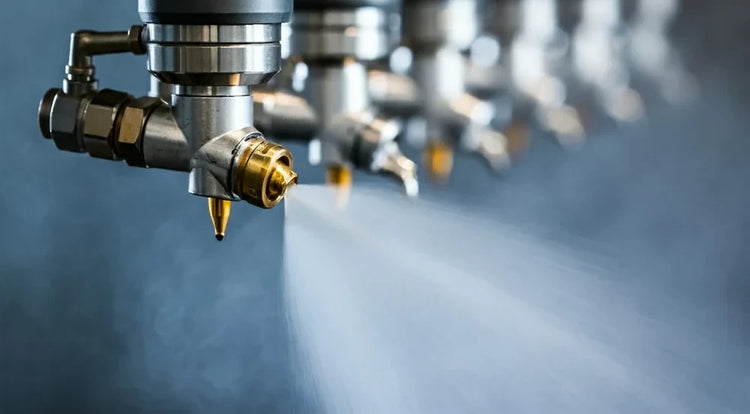
Sprühdüsen für
LNG-Bunkering, FGSS & kryogene Notkühlung
LNG als Schiffskraftstoff bringt zwei Herausforderungen im Bereich der Sprühtechnik mit sich, die im konventionellen Bunkerbetrieb keine Entsprechung finden. Während des Schiff-zu-Schiff- oder Terminalbunkerns wird unvermeidliches LNG-Boil-Off freigesetzt, das kalten, dichten Methandampf auf Deckhöhe abgibt – bei kryogenen Temperaturen schwerer als Luft, sammelt es sich in tiefer gelegenen Bereichen und Deckvertiefungen, wo es ein brennbares Gemisch mit der Luft bildet. Wasserschleier-Düsen um den Bunkermanifold beschleunigen die Erwärmung und Verteilung dieses Dampfes, bevor er eine Zündquelle erreicht. Gleichzeitig müssen die strukturellen Barrieren des LNG-Kraftstofftanks vor Strahlungswärme durch gleichmäßig abdeckende Deluge-Anlagen geschützt werden, die einen thermisch adäquaten Schutz gemäß NFPA 59A und IGC Code bieten.
LNG-Bunkerstationen auf Dual-Fuel-Schiffen und LNG-Bunkerschiffen verwenden zwei separate Sprühsysteme für zwei unterschiedliche Gefahrenkontrollfunktionen. Wasserschleierdüsen – Flachstrahldüsenanordnungen, die um den LNG-Bunkermanifold und die Schlauchanschlusspunkte positioniert sind – erzeugen eine kontinuierliche Wassersprühwand, die während des Transfers freigesetzten LNG-Boil-Off-Dampf abfängt, den kalten, dichten Dampf erwärmt, um ihn über seinen Dichte-Luft-Übergangspunkt anzuheben, und die Methankonzentration am Umfang der Bunkerstation unter die untere Explosionsgrenze (5 % v/v) verdünnt. Separat dazu bieten feste Deluge-Düsenanordnungen an der LNG-Kraftstofftankstruktur einen thermischen Notfallschutz für die Tankisolierung und die strukturellen Barrieren, wenn ein Brand neben dem LNG-Lagerbereich auftritt.
Die kritische Materialspezifikation für alle Sprühdüsen in der LNG-Bunkerumgebung ist die Kompatibilität mit kryogenen Dichtungen. Die Düsenkörper verarbeiten Wasser mit Umgebungstemperatur und bestehen typischerweise aus Edelstahl 316L – das Wasser selbst erreicht keine kryogene Temperatur. Jede Düse oder Armatur im Kreislauf, die jedoch bei einem Leck oder Auslaufen von LNG-Sprühnebel oder kryogenen Umgebungstemperaturen ausgesetzt sein könnte, muss PTFE- oder Edelstahl-Metalldichtungen aufweisen. Standard-EPDM- und NBR-Elastomer-Dichtungen verspröden und brechen unter etwa −40 °C, was weit über der −162 °C-Temperatur von LNG liegt.
LNG-Boil-Off während Bunkervorgängen ist hauptsächlich Methan – das gleiche Gas wie Erdgas – mit einer unteren Entflammbarkeitsgrenze von 5 % v/v und einer oberen Entflammbarkeitsgrenze von 15 % v/v in Luft. Die spezifische Gefahr von LNG-Boil-Off auf Deckhöhe im Vergleich zu einem komprimierten Erdgasleck ist die Dichte: Methan bei Umgebungstemperatur (Siedetemperatur von -162 °C) hat eine Dichte, die etwa das 1,5-fache der Luft beträgt, bevor es sich auf Umgebungstemperatur erwärmt. Kalter Methandampf steigt daher nicht auf und verteilt sich nicht natürlich, wie es bei Umgebungstemperatur der Fall wäre – er sinkt ab und sammelt sich in Bilgenöffnungen, Deckabläufen, geschlossenen Deckbereichen und an jeder tief gelegenen Stelle innerhalb des Bunkerbereichs. In diesen Sammelzonen kann die Methankonzentration den entflammbaren Bereich erreichen, bevor ein Gasdetektionssystem Alarm auslöst, und eine Zündung durch Abgase eines Dieselgenerators, Entlüftung der Bordküche oder Festmachausrüstung kann zu einem Flammenbrand oder einer Verpuffung führen.
Wasservorhänge bekämpfen diese Gefahr durch zwei gleichzeitige Mechanismen: Der Wasserstrahl überträgt Wärme auf die kalte Dampfwolke, erhöht deren Temperatur und verringert deren Dichte, so dass sie aufsteigt und sich verteilt, anstatt sich zu sammeln; und die große Wasseroberfläche der Vorhangtröpfchen verdünnt die lokale Methankonzentration, indem sie Umgebungsluft in die Dampfwolke einzieht und mischt. Beide Mechanismen hängen davon ab, dass der Wasservorhang zwischen der LNG-Freisetzungsstelle und den nächsten Zündquellen oder Personalzugangswegen positioniert ist.
Dampfschleier, Tanklöschung, FGSS-Kühlung und Schutz der Bunkereinrichtung
Jedes Sprühsystem in einer LNG-Brennstoffanlage erfüllt eine andere Sicherheitsfunktion mit unterschiedlichen Düsenspezifikationen, Aktivierungslogiken und Designreferenzstandards. Sie müssen alle zusammen spezifiziert werden – ein Dampfschleier ohne eine ausreichende Tanklöschung lässt den strukturellen Schutz unvollständig; eine Tanklöschung ohne Dampfschleier lässt den Personalbereich der Bunkereinrichtung ungeschützt.
LNG Boil-Off Dampfdispersionsschleier
Flachstrahl-Wasserschleier — Erwärmung und Verdünnung von kaltem, dichtem MethandampfDer Wasserschleier zur Dampfverteilung ist eine kontinuierliche Sprühwand aus Flachstrahldüsen, die um oder windabwärts des LNG-Bunkermanifolds und des Schlauchsattelbereichs positioniert ist. Ihre Funktion ist nicht die Brandunterdrückung – sie soll die Bildung einer brennbaren Dampfwolke verhindern, indem sie das freigesetzte LNG-Boil-Off-Gas erwärmt, bevor es sich auf Deckhöhe sammelt. Der Schleier aktiviert sich automatisch bei der Detektion einer Methankonzentration über einem definierten Sollwert (typischerweise 10–20 % der UEG, d.h. 0,5–1 % v/v Methan) oder manuell durch den Offizier, der für den Bunkervorgang verantwortlich ist.
LNG-Kraftstofftank-Notlöschung
Thermischer Schutz der Strukturbegrenzung — gleichmäßige Abdeckung bei 10–20 L/min/m²Der LNG-Kraftstofftank auf einem Dual-Fuel-Schiff – typischerweise ein Typ-C-Druckbehälter für kleine bis mittlere Anlagen oder ein Typ-B- oder Membrantank für große LNG-betriebene Schiffe – ist von einer vakuumisolierten Ummantelung oder Isolationsschicht umgeben, die das LNG bei –162 °C hält, indem sie den Wärmeeintrag auf die Boil-Off-Managementrate begrenzt. Im Falle eines Brandes neben dem LNG-Tankvolumen kann die Strahlungswärme des Brandes die äußere Oberfläche des Tanks erwärmen, den Wärmeeintrag in den Tank erhöhen, das Boil-Off beschleunigen und den Tankdruck erhöhen. Wenn der Druck die Einstellung des Tankentlastungsventils überschreitet, beginnt eine unkontrollierte Dampffreisetzung – die den angrenzenden Brand nähren oder neue Zündmöglichkeiten schaffen kann.
Das Notlöschsystem leitet Wasser gleichmäßig auf die äußere Oberfläche des Tanks, um die Strahlungswärmebelastung zu entfernen, bevor sie die äußere Oberflächentemperatur wesentlich erhöhen kann. Das Designziel ist, die äußere Oberfläche des Tanks unter einer definierten Temperaturobergrenze (typischerweise 50–80 °C) während des in NFPA 59A und dem IGF-Code festgelegten Designbrandszenarios zu halten.
FGSS-Anlagenkühlung & Ventilraum-Sprühanlagen
Kraftstoffgasversorgungssystem — Wärmetauscher- und VentilstrangschutzDas Brenngasversorgungssystem (FGSS) auf einem Dual-Fuel-Schiff umfasst den LNG-Verdampfer, Druckregelventile, Gas-Flüssigkeits-Abscheider und den Gasverteiler, der die Dual-Fuel-Motoren versorgt. Diese Komponenten befinden sich in einem speziellen FGSS-Raum oder Ventilstranggehäuse, das sowohl vor Brand als auch vor unbeabsichtigter kryogener Freisetzung geschützt werden muss. Der Verdampfer – der LNG von –162 °C auf die Betriebstemperatur des Motors erwärmt – verarbeitet sowohl kryogene Flüssigkeit auf der LNG-Seite als auch heißes Wasser, Dampf oder Glykol auf der Heizmediumseite, was seine unmittelbare Umgebung zu einem der extremsten thermischen Gradientenräume auf jedem Schiff macht.
Ship-to-Ship LNG-Bunkering — Schutz des Manifoldbereichs
Bunkerschiff zu Empfängerschiff — ESD, Vorhang- und DrainagekoordinationDas Schiff-zu-Schiff (STS) LNG-Bunkern – bei dem ein LNG-Bunkerschiff LNG an ein Dual-Fuel-Kreuzfahrtschiff, eine Fähre oder einen Containerschiff liefert – ist die am häufigsten verwendete Bunkermethode in Häfen ohne spezielle LNG-Terminalinfrastruktur. Die Bunkerverbindung erfolgt über einen kryogenen flexiblen Schlauch oder einen Marine-Lade-Arm zwischen den beiden Schiffen, die beide auf dem Wasser in Bewegung sind und relativen Bewegungen unterliegen, die die Schlauchverbindung belasten. Die Sprühschutzsysteme sowohl auf dem Bunkerschiff als auch auf dem Empfängerschiff müssen im vor Beginn des Betriebs vereinbarten Gemeinsamen Bunkerplan koordiniert werden.
Versagen von Kryo-Dichtungen: Warum Standard-Elastomere nicht in LNG-Sprühkreisläufen verwendet werden können
Die Düsenkörper in einem LNG-Bunkersprühsystem fördern Wasser mit Umgebungstemperatur – nicht LNG. Die Anforderung an die Kryo-Dichtung betrifft nicht das, was die Düse im Normalbetrieb fördert. Es geht darum, was mit dem Dichtungsmaterial während eines Worst-Case-Kryo-Leckageereignisses passiert, wenn der Sprühkreislauf dem Kontakt mit LNG oder den extrem niedrigen Umgebungstemperaturen ausgesetzt sein könnte, die durch eine große Kryo-Freisetzung an Deck entstehen.
Der Elastomerversprödungsmechanismus bei kryogenen Temperaturen
Elastomer-Dichtungen – EPDM, NBR (Nitril) und ähnliche Gummiverbindungen – erhalten ihre Dichtfunktion durch die viskoelastischen Eigenschaften der Polymerketten: Bei Betriebstemperatur sind die Ketten ausreichend beweglich, um sich unter der Kompressionslast des Fittings an die Gegenfläche anzupassen und eine gasdichte Schnittstelle zu schaffen. Dieses viskoelastische Verhalten hängt vollständig davon ab, dass das Polymer oberhalb seiner Glasübergangstemperatur (Tg) liegt – der Temperatur, unterhalb derer die Polymerketten ihre Beweglichkeit verlieren und das Material steif und spröde wie Glas wird.
Für EPDM liegt die Tg je nach spezifischer Formulierung bei ca. −40°C bis −55°C. Für NBR liegt die Tg bei ca. −30°C bis −40°C. Die LNG-Temperatur beträgt −162°C – 110°C bis 130°C unter der Glasübergangstemperatur dieser gängigen marinen Dichtungsmaterialien. Eine EPDM- oder NBR-Dichtung, die mit LNG in Kontakt kommt, verliert ihre Dichtfähigkeit nicht allmählich – sie wird augenblicklich zu einem spröden, keramikähnlichen Material, das unter den sehr geringen Kompressionslasten eines Standardrohrfittings bricht. Der Bruch erzeugt lose Fragmente und einen Leckagepfad, der das Entweichen von LNG ermöglicht und möglicherweise das Ereignis speist, das die ursprüngliche Leckage verursacht hat.
Im Normalbetrieb fördern die LNG-Bunkersprühdüsen Wasser mit Umgebungstemperatur und kommen nie mit LNG in Kontakt. Die EPDM-Dichtungen funktionieren einwandfrei. Das Szenario, das die falsche Spezifikation offenbart, ist ein LNG-Spill auf Deck während des Bunkerns – der Spill kommt mit den Sprühdüsenkörpern und deren Fittings in Kontakt, bevor das Sprühsystem aktiviert wird. EPDM-Dichtungen in diesen Fittings gefrieren und brechen innerhalb von Sekunden nach dem LNG-Kontakt, wodurch der Sprühkreislauf von einem intakten Notfallsystem zu einer Quelle zusätzlicher Leckage an jedem Dichtungsfehlerpunkt wird. Die korrekte Spezifikation – PTFE-Dichtungen, die bis −200°C ausgelegt sind, oder metallische Edelstahldichtungen ohne Elastomere – kostet bei der Installation geringfügig mehr und erhält die Integritäts des Sprühkreislaufs während des Ereignisses aufrecht, für das das Sprühsystem installiert wurde.
Positionierung der Dampfschleierdüse: Die Dichte-Crossover-Abstandsberechnung
Kalter Methandampf bei −162°C hat eine Dichte von ca. 1,8 kg/m³ – dichter als Luft mit 1,2 kg/m³ unter Standardbedingungen. Wenn sich der kalte Dampf erwärmt, nimmt seine Dichte ab; bei ca. −110°C sinkt die Dichte des Methandampfs unter die Dichte der Umgebungsluft und der Dampf beginnt zu steigen, anstatt sich zu sammeln. Der Wasserschleier muss dem Dampf genügend Wärme zuführen, um ihn über diese Dichte-Crossover-Temperatur innerhalb des Abstands vom LNG-Freisetzungspunkt bis zur ersten potenziellen Zündquelle oder dem belegten Raum zu erhöhen.
Die Wärmeübertragungsrate vom Wasserschleier zum kalten Dampf hängt von der Tröpfchenoberfläche pro Volumeneinheit des Schleiers ab (was der Hauptgrund ist, warum Flachstrahldüsen Vollkegeldüsen vorgezogen werden: Ihr flacher Strahl erzeugt ein dichteres, gleichmäßigeres Tröpfchenfeld pro Einheit der Düsenfläche als ein konischer Sprühstrahl aus der gleichen Position), der Temperaturdifferenz zwischen den Wassertröpfchen und dem kalten Dampf (die am Punkt des ersten Kontakts groß ist – ca. 163°C, wenn das Schleierwasser Umgebungstemperatur hat) und der Kontaktzeit zwischen der Dampfwolke und den Schleiertropfen. Die Schleierdurchflussrate und Düsenpositionierung müssen aus der konstruktiven LNG-Freisetzungsrate und dem Abstand zur nächsten Zündquelle berechnet werden – eine Berechnung, die für jede Bunkerstationsgeometrie spezifisch ist.
- Spezifizieren Sie PTFE-Dichtungen oder Edelstahl-Metalldichtungen an jeder Düse, jedem Fitting und jedem Ventil im LNG-Bunkersprühkreislauf – machen Sie keine Ausnahmen basierend auf "diese Komponente wird im Normalbetrieb nicht mit LNG in Kontakt kommen"; das Leckage-Szenario ist genau der Zeitpunkt, an dem normale Betriebsannahmen nicht gelten
- Berechnen Sie die Dampfschleierabdeckung aus der Design-LNG-Freisetzungsrate in Ihrem Bunkerverfahrenshandbuch – die Design-Freisetzungsrate zur Bemessung des Schleiers ist typischerweise die maximale Schlauchdurchflussrate, nicht die durchschnittliche Transferrate; der Schleier muss die schlimmstmögliche Freisetzung vor dem ESD-Schluss bewältigen
- Überprüfen Sie die Überflutungsrate des LNG-Tanks gemäß NFPA 59A Tabelle 11.3 oder dem IGF-Code-Äquivalent für Ihren spezifischen Tanktyp – Typ-C-Druckbehälter, Typ-B-Tanks und Membrantanks haben unterschiedliche thermische Eigenschaften und können unterschiedliche erforderliche Überflutungsraten haben; wenden Sie keine einzelne Durchflussratenannahme auf alle LNG-Tanktypen an
- Testen Sie das Sprühsystem vor jeder Bunkeroperation im vollen Durchfluss als Teil der Vor-Bunker-Checkliste – die Konsequenzen der Entdeckung einer blockierten Düse oder eines defekten Ventils während einer tatsächlichen LNG-Freisetzung sind weitaus größer als der Zeitaufwand eines Funktionsprüfung vor dem Betrieb
- Nehmen Sie die Aktivierung des Sprühsystems in das ESD-Testprogramm bei jedem geplanten Wartungsintervall auf – die ESD-zu-Sprüh-Aktivierungsverriegelung ist eine kritische Sicherheitsfunktion; testen Sie die gesamte Kette von der Gasdetektion oder manuellen ESD-Aktivierung über das Öffnen des Sprühventils bis zur Bestätigung des Düsenflusses bei jeder geplanten Schiffswartung
LNG-Sprühsystem Düsenwahl nach Funktion
Kontaktieren Sie NozzlePro mit Ihrer Bunkerstationsgeometrie, Ihrem LNG-Tanktyp und der Oberfläche, den Abmessungen des FGSS-Raums und dem Design-Referenzstandard. Die Durchflussrate des Dampfschleiers und die Tankflutabdeckung müssen anhand Ihres spezifischen Schiffslayouts berechnet werden – nicht anhand allgemeiner LNG-Industrie-Standardwerte.
| System / Funktion | Düsentyp | Druck / Durchfluss | Kritisches Erfordernis | Material |
|---|---|---|---|---|
| LNG-Boil-Off-Dampfdispersionsvorhang – Bunkerverteiler | Flachstrahl, 60°–80°, Vorhang-Array | 2–6 bar / 6–10 L/min/m² | Dichter Flachstrahlvorhang; leeseitig des Verteilers; 10–15% Überlappung zwischen den Fächern; durchgehende PTFE-Dichtungen; ESD- und Gasdetektionsverriegelung | 316L Edelstahl + PTFE-Dichtungen |
| LNG-Kraftstofftank-Notüberflutung – Außenfläche | Vollkegel, gleichmäßige Verteilung | 2–5 bar / 10–20 L/min/m² | Keine trockenen Stellen auf der Tankaußenfläche; NFPA 59A / IGF-Code-konforme Abdeckung; PTFE- oder Edelstahl-Metalldichtungen – kein EPDM; automatische Brandmeldeaktivierung | 316L Edelstahl + PTFE- oder Metalldichtungen |
| FGSS-Raum-Feuerlöschung und Anlagenkühlung | Hochdrucknebel oder Vollkegel-Überflutung | 2–60 bar / pro FGSS-Raumvolumen | Vollständige FGSS-Raumabdeckung; 316L Edelstahl; PTFE-Dichtungen; Gasdetektionsverriegelung; Koordination der Bodenentwässerung; keine Sprühpfützen auf kryogenen Geräten | 316L Edelstahl + PTFE-Dichtungen |
| STS-Bunkerung – Schlauchanschluss und Trockenkupplung | Flachstrahlvorhang + lokalisierter Vollkegel an der Kupplung | 2–5 bar | Abdeckung für Bunkerschiff und empfangendes Schiff; ESD-Verriegelung; Trockenkupplungs-Entwässerungssprühung; SGMF-Bunkerrichtlinien-Durchflussraten; durchgehende PTFE-Dichtungen | 316L Edelstahl + PTFE-Dichtungen |
| Terminal-Bunkerung – feste LNG-Anlage am Pier | Flachstrahlvorhang-Arrays, fest installiert | 2–6 bar / NFPA 59A-Raten | Feste Pier-Installation mit permanenter Versorgung; NFPA 59A Tabelle 11.3 Abdeckungsraten; PTFE-Dichtungen; Koordination mit dem Brandschutzsystem des Terminals | 316L Edelstahl + PTFE-Dichtungen |
| LNG-Bunkerschiffsdeck – allgemeiner Bereichsschutz | Vollkegel oder Flachstrahl, Deckswaschung | 2–5 bar | Allgemeine Deckkühlung und Dampfunterdrückung am Bunkerschiff selbst; Seewasserversorgung kompatibel; PTFE-Dichtungen für potenziellen Kryo-Kontakt; 316L Edelstahlkörper | 316L Edelstahl + PTFE-Dichtungen |
LNG-Bunkerung & Kryo-Kühlsprühspezifikation auf einen Blick
Schlüsselparameter für LNG-Bunker- und Kryo-Sicherheits-Sprühsysteme
Materialien für LNG-Bunker- und Kryo-Sprühdienst
Alle NozzlePro LNG-Sprühdüsen werden nach ISO 9001 hergestellt. Systemdesign, Klassifikationsgesellschafts-Einreichung und Einhaltung gesetzlicher Vorschriften liegen in der Verantwortung des Betreibers und Systemintegrators. NozzlePro liefert Hardware gemäß den angegebenen Leistungsparametern.
Das Dichtungsmaterial, das im Normalbetrieb versagt, wird es nie tun. Das, was bei einem Leckageereignis versagt, ist der Spezifikationsfehler.
PTFE- oder Edelstahl-Metalldichtungen an jeder Komponente im LNG-Bunkersprühkreislauf – nicht nur an den Düsen, die dem LNG am nächsten sind. Kontaktieren Sie NozzlePro mit Ihrem Bunkerstationslayout, der Tankoberfläche, den FGSS-Abmessungen und dem Design-Referenzstandard.