
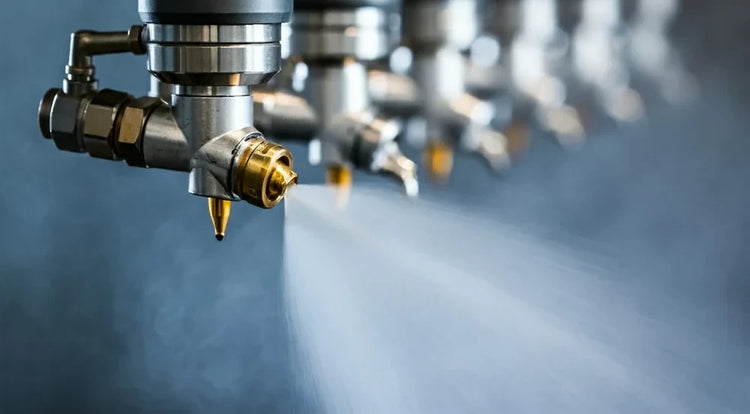
Sprühdüsen für Trocknerpartie und Luftsysteme
Feuchtigkeitsprofil-Rückbefeuchtungsdüsen zur Querprofil-Feuchtigkeitsregulierung der Bahn, Befeuchtungssysteme für Trocknerraum und Haube, Dampfkonditionierungs-Sprühdüsen für die Wiedereinführung von Ausschuss und Sortenwechsel, Düsen für Trennmittel auf der Trocknerzylinderoberfläche und Dampfkonditionierungssysteme mit Durchblasung — Nebel-, Sprüh- und ultrafeine Zerstäubungsdüsen für die Trocknerpartien von Papiermaschinen, Luftschwebetrockner und Luftsysteme im Converting-Bereich
Die Trocknerpartie ist der Bereich, in dem der Feuchtigkeitsgehalt der Bahn, das Querprofil der Feuchtigkeit und die Papiereigenschaften vor dem Aufwickeln festgelegt werden – und sie ist der energieintensivste Bereich der Papiermaschine, der 60–75 % des gesamten Prozessdampfs verbraucht. Sprühdüsen in der Trocknerpartie und den zugehörigen Luftsystemen erfüllen drei unterschiedliche Funktionen, die leicht verwechselt werden können, aber völlig unterschiedliche Düsenspezifikationen erfordern: Rückbefeuchtungsdüsen zur Feuchtigkeitsprofilierung fügen kontrollierte Mengen feinverteilten Wassers zu bestimmten Querzonen hinzu, um hohe Profilstellen zu korrigieren; Befeuchtungssysteme für die Trocknerhaube und den Maschinenraum regeln die relative Umgebungsfeuchtigkeit, um Spannungsbrüche und Bahnrisse zu verhindern, die auftreten, wenn die relative Feuchtigkeit plötzlich abfällt; und Dampfkonditionierungs-Sprühdüsen führen gesättigten oder überhitzten Dampf in Ausschuss-Wiederaufbereitungssysteme, zur Siebkasten-Spaltsenkung und zum Sortenwechselmanagement ein.
Jede dieser drei Funktionen falsch auszuführen, hat sofortige Produktionsfolgen. Überwässerte Rückbefeuchtungszonen durch übergroße Düsentröpfchen erzeugen sichtbare Wasserflecken auf der Bahnoberfläche oder verursachen Bahnpicking bei nachfolgenden Beschichtungs- oder Leimpressvorgängen. Unterbefeuchtete Trocknerräume führen dazu, dass sich die Bahn beim Kontakt mit kühlerer Umgebungsluft an der Rolle unterschiedlich zusammenzieht, was zu Spannungsschwankungen und Bahnbrüchen beim Maschinenanlauf und Sortenwechsel führt. Falsch konditionierter Dampf für die Ausschuss-Rückführung erzeugt Konsistenzspitzen, die sich bis zum Stoffauflauf fortpflanzen und als Flächengewichtsschwankungen auftreten. NozzlePro liefert die komplette Düsenhardware für alle drei Funktionen – jeweils in der korrekten Tröpfchengröße, dem richtigen Druck und der richtigen Durchflussspezifikation für ihre spezifische Rolle. ISO 9001 zertifizierte Fertigung.
Sprühdüsen für die Trocknerpartie und Luftsysteme erfüllen drei verschiedene Funktionen, die unterschiedliche Spezifikationen erfordern: Rückbefeuchtungsdüsen zur Feuchtigkeitsprofilierung verwenden Nebel- oder Feinsprühdüsen (20–80 bar, Dv50 30–80 µm) in individuell scannergesteuerten Querzonen über die gesamte Maschinenbreite – jede Zone wird durch den Bahnfeuchtescanner aktiviert, wenn diese CD-Position die Zielfeuchtigkeit um die Scanner-Totzone überschreitet; die Tröpfchengröße ist entscheidend: Tröpfchen über 100 µm erzeugen sichtbare Wasserflecken auf der Bahnoberfläche; Tröpfchen unter 20 µm verdunsten, bevor sie die Bahn in den Abständen der Trocknerhaube erreichen; Befeuchtungssysteme für Trocknerraum und Haube verwenden ultrafeine Nebeldüsen (50–150 bar, Dv50 5–15 µm), um die relative Luftfeuchtigkeit im Maschinenraum und in der Trocknerhaube bei 60–75 % relativer Luftfeuchtigkeit zu halten – wodurch die differenzielle Bahnschrumpfung und Spannungsbrüche verhindert werden, die auftreten, wenn die Umgebungsfeuchtigkeit bei kaltem Wetter oder Maschinenanläufen plötzlich sinkt; und Dampfkonditionierungs-Sprühdüsen führen Wasser in Dampfleitungen zur Befeuchtung, in Ausschuss-Auflösesysteme zur Konsistenzregelung und in die Siebkasten-Spaltanlaufleitungen zur thermischen Konditionierung ein – Vollkegel- oder Hohlkegeldüsen (2–10 bar), die eine vollständige Tröpfchenverdampfung vor dem Dampfzuführpunkt erzeugen. Alle Befeuchtungspositionen erfordern eine Versorgung mit demineralisiertem oder Umkehrosmosewasser, um die Ansammlung von Kalziumablagerungen in feinen Öffnungen unter 100 µm Durchmesser zu verhindern.
Düsengruppen für Trocknerpartie & Luftsysteme
Nach Anwendung oder Düsentyp einkaufen
Feuchtigkeitsprofil der Trocknerpartie – wo jede Sprühfunktion wirkt
Jedes Sprühsystem in der Trocknerpartie verfolgt ein anderes Feuchtigkeitsmanagementziel an einem anderen Maschinenstandort
Eintritt in die Vortrocknerpartie
Bahnfeuchtigkeit 45–60 % am Pressenaustritt. Keine Rückbefeuchtung hier – die Feuchtigkeit an diesem Punkt wird durch den Pressen-Nip-Druck und das Filzmanagement gesteuert.
Frühe Trocknergruppen (Gruppen 1–3)
Schnelle anfängliche Trocknungsphase. Der Dampfdruck steigt durch die Gruppen. Kantenbefeuchtungsdüsen korrigieren das im Formierbereich etablierte CD-Profil.
Mittlere Trocknerpartie
Bahnfeuchtigkeit 15–30 %. Primärer Rückbefeuchtungsbereich für die scannergesteuerten Düsen zur Feuchtigkeitsprofilierung. Die Bahn ist trocken genug, damit die Rückbefeuchtung messbar ist.
Späte Trocknergruppen (Letzte 20 %)
Bahnfeuchtigkeit 4–8 % Ziel. Sekundäre Rückbefeuchtungszone für die Feinprofilkorrektur. Überbefeuchtung hier ist vor der Aufrollung schwer zu beheben.
Vor-Rolle / Pope-Rolle
Bahnfeuchtigkeit am Rollenziel (typischerweise 4–6 %). Befeuchtungsspray konditioniert die Umgebungsluft an der Rolle, um eine differenzielle Kantenschrumpfung zu verhindern.
Inneres der Trocknerhaube
Heißer Bereich mit hoher Luftfeuchtigkeit. Befeuchtungssysteme halten den RH-Sollwert der Haube für eine konsistente Trocknungskurve und reduzierte Häufigkeit von Spannungsrissen.
Maschinenraum (Unter der Haube)
Klimatisierung der Umgebungsluft. Ultrafeine Nebelbefeuchtung hält 60–75 % relative Luftfeuchtigkeit aufrecht – entscheidend bei Kaltwetterbedingungen, wenn eindringende Außenluft die Innen-RH stark senkt.
Ausschuss-Rückführungssystem
Dampfkonditionierungs-Sprühdüsen an Ausschussbütte und Pulper regeln die Temperatur und Konsistenz des Ausschussstoffs vor der Rückführung zum Stoffauflauf.
Sprüh-Anwendungen für die Trocknerpartie
Anwendungsspezifische Düsenempfehlungen mit den Produktionsfolgen bei falscher Spezifikation
Feuchtigkeitsprofil-Rückbefeuchtungsdüsen
Nebel- und Feinsprühdüsen (20–80 bar, Dv50 30–80 µm) in individuell gesteuerten Querzonen-Verteilern bringen präzise Mengen feinverteilten Wassers auf bestimmte CD-Zonen der Bahn in der Trocknerpartie auf und korrigieren so die vom Bahnfeuchtescanner identifizierten Feuchtigkeitsprofil-Hochstellen. Jede CD-Zone – typischerweise 50–150 mm breit, abhängig von Maschinenbreite und erforderlicher Profilauflösung – wird durch ein einzelnes Ventil gesteuert, das sich öffnet, wenn der Feuchtescanner diese Position als unterhalb der Zielfeuchtigkeit liegend erkennt. Der Düsensprühstrahl muss die korrekte Wassermenge in Tröpfchen, die fein genug sind, um vom Papier ohne sichtbare Wasserflecken absorbiert zu werden, und grob genug, um den Abstand von der Düse zur Bahn (typischerweise 200–500 mm in Trocknerhaubeninstallationen) ohne Verdampfung vor dem Kontakt zurückzulegen, auf die Bahnoberfläche bringen. Der Dv50-Betriebsbereich von 30–80 µm ist spezifisch für diese Anwendung: Tröpfchen unter 25–30 µm werden vom Luftstrom der Trocknerhaube mitgerissen und verdunsten oder werden an der Zielzone vorbeigefegt; Tröpfchen über 80–100 µm treffen als einzelne flüssige Tropfen auf die Bahnoberfläche und erzeugen einen sichtbaren feuchten Fleck – ein Oberflächenfehler, der bei Druck- und Schreibpapieren inakzeptabel und bei Beschichtungsgewichten nachweisbar ist. Eine Verstopfung der Düsenöffnung muss verhindert werden – demineralisiertes oder RO-Wasser ist die obligatorische Versorgung für Rückbefeuchtungsdüsen, da die Öffnungen, die 30–80 µm Tröpfchen erzeugen, unter 150 µm Durchmesser liegen und bei einer Wasserhärte über 50 ppm CaCO₃ schnell verkalken.
Nebel- & SprühnebeldüsenBefeuchtungssysteme für Trocknerraum & Haube
Ultrafeine Nebeldüsen (50–150 bar, Dv50 5–15 µm) in Befeuchtungsanlagen der Trocknerhaube und des Maschinenraums halten die relative Umgebungsfeuchtigkeit bei 60–75 % RH, um die differenzielle Bahnschrumpfung, Spannungsschwankungen und Bahnrisse zu verhindern, die bei starkem RH-Abfall auftreten. Der Mechanismus: Papier und Karton sind hygroskopisch – sie nehmen Feuchtigkeit auf oder geben sie ab, um sich mit der Umgebungs-RH auszugleichen. Eine Bahn mit 5 % Feuchtigkeitsgehalt in 65 % RH Umgebung befindet sich im Gleichgewicht. Wenn die Umgebungs-RH auf 35 % fällt (häufig bei Kaltwetterbetrieb, wenn kalte, trockene Außenluft in den Maschinenraum eindringt), gibt die Bahn schnell Feuchtigkeit von ihren Kanten ab – die Kanten trocknen schneller als die Mitte, weil sie eine größere Oberflächenexposition haben. Diese differentielle Trocknung erzeugt eine differentielle Schrumpfung: Die Kanten wollen sich stärker zusammenziehen als die Mitte, was zu Spannung an den Bahnkanten führt, die sich als Kantenwelligkeit, erhöhte Häufigkeit von Bahnbrüchen am Rollenspulen und Varianz der Rollenfestigkeit äußert. Ultrafeiner Nebel bei Dv50 5–15 µm verhält sich wie ein Dampf – so kleine Tröpfchen haben eine vernachlässigbare Sedimentationsgeschwindigkeit und bleiben lange genug in der Luft suspendiert, um vollständig zu verdampfen, wodurch die RH der Umgebungsluft erhöht wird, ohne Wasser auf Bahnoberflächen oder Maschinenteilen abzulagern. Dies ist der kritische Unterschied zu Feuchtigkeitsprofil-Rückbefeuchtungsdüsen: Befeuchtungsdüsen konditionieren die Luft; Rückbefeuchtungsdüsen befeuchten die Bahn. Demineralisiertes Wasser ist unerlässlich – bei Dv50 5–15 µm bleiben gelöste Mineralien in hartem Wasser nach der Tröpfchenverdampfung als Aerosolpartikel zurück und lagern sich als Kalziumstaubverunreinigung auf Trocknerzylinderoberflächen, optischen Sensoren und Bahnoberflächen ab.
BefeuchtungssystemeDampfkonditionierungs-Sprühdüsen
Vollkegel- oder Hohlkegeldüsen (2–10 bar), die Wasser in Dampfleitungen oder Prozessluftströme zur Überhitzungsdämpfung und Sättigungsregelung in Papiermaschinen-Dampf- und Kondensatsystemen einbringen. Dampfkonditionierungssprühstrahl wird an drei Positionen im Papiermaschinen-Trocknerbetrieb eingesetzt: Entspannungsverteiler, wo der Dampfdruck reduziert und vor dem Eintritt in die Trocknerzylinder-Versorgungsleitungen auf Sättigung konditioniert werden muss (überhitzter Dampf in Trocknerzylindern reduziert die Wärmeübertragungseffizienz, indem er eine überhitzte Dampfsperre an der Zylinderwand erzeugt); Ausschuss-Pulper-Dampfinjektion, wo heißes Wasser oder Dampf dem Ausschussbehälter zugesetzt wird, um die Ausschussmasse über 60 °C zu halten, um eine effektive Faserdispersion zu gewährleisten und Konsistenzspitzen bei kaltem Material zu verhindern, wenn große Ausschussmengen in das System zurückgeführt werden; und Siebkasten-Lippen-Dampfkonditionierung, wo kleine Mengen Dampf oder heißes Wasser die Kondensation an den Siebkastenlippen während Sortenwechseln zu niedrigen Flächengewichten verhindern. Die Düse für Entspannungsanwendungen muss eine vollständige Verdampfung des eingespritzten Wassers erzeugen, bevor der Dampf den Trocknerzylindereinlass erreicht – nicht verdampfte Tröpfchen, die in die Zylinderversorgung gelangen, verursachen einen thermischen Schock an den Zylinderenden und eine Störung des Kondensatrings, die die Dampfeffizienz des Trockners reduziert. Vollkegeldüsen bei 2–8 bar stromaufwärts einer Mischstrecke bieten die Tröpfchenverteilung und Oberfläche, die für eine vollständige Verdampfung bei Dampfgeschwindigkeiten und -temperaturen im Bereich typischer Papiermaschinen-Dampfleitungen (150–180 °C, 5–12 bar) erforderlich sind.
VollkegeldüsenDüsen für Trennmittel auf Trocknerzylinderoberflächen
Hohlkegeldüsen (0,5–3 bar, Dv50 80–150 µm) tragen dünne Filme von Trennmittel oder Antihaftmittel auf die Oberflächen der Trocknerzylinder auf, um ein Anhaften der Bahn zu verhindern und eine saubere Bahnablösung beim Übergang zwischen den Trocknerzylindern zu erleichtern. Das Anhaften an der Trocknerzylinderoberfläche ist am häufigsten beim Maschinenanlauf, wenn die Zylinder kalt sind und Kondensat auf der Oberfläche eine temporäre Haftung zwischen der nassen Bahn und dem kalten Zylinder erzeugt, und bei Sortenwechseln zu geringeren Flächengewichten, wo die dünne Bahn nicht genügend Festigkeit hat, um sich sauber von der Zylinderoberfläche zu lösen. Trennmitteldüsen in der Trocknerpartie verwenden typischerweise Silikonemulsionen oder proprietäre Antihaftformulierungen mit sehr geringen Auftragsgewichten (0,05–0,2 g/m² Trockenbasis) – die Düse muss einen dünnen, gleichmäßigen Film statt lokalisierter feuchter Stellen erzeugen. Das Hohlkegelstrahlbild verteilt das Spray in einer ringförmigen Abdeckungszone, die für eine gegebene Düsenflussrate eine bessere Oberflächenabdeckungsgleichmäßigkeit bietet als ein fester Strahl oder Vollkegelstrahl. Material: 316L SS Gehäusedüsen mit PTFE- oder FKM-Dichtungen für Silikonemulsionsbetrieb – EPDM-Dichtungen quellen bei Silikonemulsionskontakt. Überprüfen Sie die Viskosität bei Anwendungstemperatur; Silikonemulsionen über 500 cP erfordern luftzerstäubende Düsen für eine ausreichende Filmbildung bei den erforderlichen geringen Auftragsgewichten.
HohlkegeldüsenCD-Profilregelung – Zonendesign & Scannerintegration
Das Feuchtigkeitsprofil-Rückbefeuchtungssystem ist nur so gut wie seine Zonenbreite, Zonenzahl und die Integration der Scannerantwort. Die Zonenbreite – die CD-Breite, die von einer einzelnen Düse oder Düsengruppe gesteuert wird – bestimmt die Auflösung der Profilkorrektur: Eine Maschine mit 50-mm-Zonen kann eine Feuchtigkeitsanomalie von 50 mm Breite korrigieren; eine Maschine mit 200-mm-Zonen kann keine Anomalie korrigieren, die schmaler als 200 mm ist. Die Zonenzahl über die Maschinenbreite ist das Produkt aus Maschinenbreite geteilt durch Zonenbreite – eine 9 Meter breite Maschine mit 100-mm-Zonen benötigt 90 unabhängig gesteuerte Düsenpositionen. Jede Zone benötigt ein Steuerventil (typischerweise ein schnell schaltendes Magnet- oder Pneumatikventil), einen Düsenverteilerabschnitt und eine Verbindung zum Feuchtescanner-Steuerungssystem. Die Einstellung der Scanner-Totzone – die Feuchtigkeitsabweichung, die die Zonenaktivierung auslösen muss – muss kalibriert werden, um die Profilkorrektur mit der Überkorrektur-Oszillation in Einklang zu bringen: Eine enge Totzone verursacht eine schnelle Zyklisierung, die ein wellenförmiges Feuchtigkeitsprofil mit abwechselnd nassen und trockenen Streifen erzeugt; eine breite Totzone lässt eine anhaltende Profilabweichung zu, die keine Korrektur auslöst. Die optimale Totzone beträgt typischerweise ±0,3–0,5 % Feuchtigkeit um den Ziel-Sollwert, validiert durch Überprüfung des Scanner-Feuchtigkeitsprofiltrends während des stationären Betriebs – das Profil sollte innerhalb der Totzone flach sein und nicht oszillieren.
Nebel- & SprühnebeldüsenLuftschwebetrockner & Prallhaubenspray
Feinsprüh- und luftzerstäubende Düsen zur Feuchtigkeitskonditionierung in Luftschwebetrocknern (verwendet für Beschichtungs- und Off-Machine-Beschichtungslinien) und Pralltrocknungshauben, wo hochgeschwindigkeitsheißluft direkt auf die Bahnoberfläche trifft. Luftschwebetrockner arbeiten bei Lufttemperaturen von 150–350 °C und Luftgeschwindigkeiten von 20–60 m/s – Sprühdüsen in diesen Umgebungen müssen Feuchtigkeit zur Profilkorrektur einbringen, ohne lokale Abkühlung zu erzeugen, die die Trocknungsgeschwindigkeit beeinflusst, und ohne flüssige Tröpfchen einzuführen, die groß genug sind, um durch den hochgeschwindigkeitsluftprallstrom von der Zielbahnoberfläche abgelenkt zu werden. Feinsprühdüsen bei 40–80 bar, die Dv50 20–50 µm erzeugen, sind für die Feuchtigkeitsprofilierung von Prallhauben geeignet – Tröpfchen in diesem Größenbereich haben genügend Impuls, um der Ablenkung durch den 20–60 m/s Luftstrom standzuhalten, während sie fein genug sind, um innerhalb der Trocknungszone zu verdunsten, anstatt als Flüssigkeit auf die Bahn aufzuprallen. Luftzerstäubungsdüsen bieten eine Alternative für Positionen, an denen der Wasserversorgungsdruck nicht ausreicht, um den erforderlichen Dv50 durch hydraulische Zerstäubung allein zu erreichen. Wartung von Haube und Luftsystem: Düsenöffnungen in Prallhaubeninstallationen monatlich überprüfen – der Hochtemperaturluftstrom beschleunigt die Kalkablagerung von gelösten Mineralien im Wasserversorgungssystem, und die Verstopfung von Öffnungen in Hochgeschwindigkeitsluftpositionen ist schneller als in Duschen bei Umgebungstemperatur.
LuftzerstäubungsdüsenReferenztabelle für Sprühdüsen für Trocknerpartie & Luftsysteme
Empfohlener Düsentyp, Druck, Tröpfchengröße, Material und wichtige Konstruktionshinweise für jede Sprühposition in der Trocknerpartie
| Position / Anwendung | Düsentyp | Druck | Tröpfchen Dv50 | Material | Kritische Entwurfsbemerkung |
|---|---|---|---|---|---|
| Feuchtigkeitsprofilierung Rückbefeuchtung — Mitteltrockner | Nebel / Feinsprühnebel — Zonenverteiler | 20–80 bar | 30–80 µm | 316L SS Gehäuse; PTFE-Dichtungen; TC-Einsatz bei >50 bar | Entmineralisiertes oder RO-Wasser zwingend erforderlich — Öffnungen unter 150 µm verkalken schnell bei hartem Wasser; Scanner-Totzone ±0,3–0,5 % Feuchtigkeit; Zonenbreite bestimmt Profilauflösung; Tröpfchen <25 µm verdampfen vor Blattkontakt bei 300–500 mm Abstand |
| Feuchtigkeitsprofilierung — Spättrockner / Voraufroller | Feinsprühnebel — Zonen, hohe Auflösung | 40–100 bar | 20–50 µm | 316L SS Gehäuse; PTFE-Dichtungen; TC-Einsatz Standard | Feinerer Nebel mit höherem Druck für die finale Profilkorrektur bei niedrigerem Feuchtigkeitsziel des Blattes; Überkorrektur an dieser Position kann vor dem Aufroller nicht mehr behoben werden; Totzone der Zonenaktivierung auf ±0,2–0,3 % Feuchtigkeit verschärft; nur DI-Wasser |
| Trocknerhaubenbefeuchtung | Ultrafeiner Nebel — verdampfend | 50–150 bar | 5–15 µm | 316L SS Gehäuse; PTFE-Dichtungen; TC-Einsatz Standard | Ultrafeine Tröpfchen verdampfen vollständig — erhöhen die RH ohne Oberflächen zu benetzen; hartes Wasser hinterlässt mineralische Aerosole auf Dosenoberflächen und optischen Sensoren — DI/RO-Wasser zwingend erforderlich; Ziel 60–75 % RH; modulierende Regelung über RH-Sensor der Haube |
| Raumbefeuchtung der Maschine | Ultrafeiner Nebel — Zonenarrays | 50–100 bar | 5–15 µm | 316L SS Gehäuse; PTFE-Dichtungen; TC-Einsatz | Kritisch bei Maschinenstarts bei kaltem Wetter — das Eindringen von Außenluft senkt die Raumluftfeuchtigkeit stark, was zu Kantenschrumpfung und einer Zunahme der Bruchhäufigkeit führt; DI/RO-Wasser; modulierende Regelung über Mehrpunkt-RH-Sensoren; Düsenarrays verteilt, um kalte Zonen in der Nähe von Versorgungspunkten zu vermeiden |
| Dampfentüberhitzung | Vollkegeldüse | 2–10 bar über Dampfdruck | Vollständige Verdampfung erforderlich | 316L SS oder Alloy 20; PTFE-Dichtungen; auf Dampftemperatur prüfen | Unverdampfte Tröpfchen, die in die Trockenzylinder gelangen, verursachen Kondensatringstörungen und thermische Schocks am Zylinder — die Düse muss stromaufwärts eines Mischbereichs mit ausreichender Verweilzeit für eine vollständige Verdampfung positioniert werden; DI-Wasser; Überprüfung des Hochtemperatur-Dichtungsmaterials erforderlich |
| Broke-Pulper-Dampfkonditionierung | Vollkegel- oder Hohlkegel | 2–8 bar | Vollständige Verdampfung / Mischung | 316L SS Gehäuse; EPDM- oder PTFE-Dichtungen | Hält den Broke-Bestand über 60 °C zur Faserverteilung; verhindert Konsistenzspitzen bei kaltem Stock bei Broke-Wiedereintritt; Durchflussrate wird durch Brusttemperaturmessung gesteuert – nicht durch feste Spezifikation; Prozesswasserversorgung akzeptabel (keine feinen Öffnungen) |
| Trockenzylinder Trennmittel | Hohlkegel | 0,5–3 bar | 80–150 µm | 316L SS Gehäuse; FKM- oder PTFE-Dichtungen; nicht EPDM | Sehr geringe Auftragsmenge (0,05–0,2 g/m²) — Rücklaufverteilerzufuhr für Gleichmäßigkeit; FKM/PTFE-Dichtungen für Silikonemulsion — EPDM quillt; Luftzerstäubung für Sorten über 500 cP; am kritischsten beim Start (kalte Zylinder) und bei dünnen, geringflächigen Sorten |
| Luftflotation / Impingement-Haubenprofil | Feinsprühnebel oder Luftzerstäubung | 40–80 bar (hydraulisch) oder 20–40 psi Luft | 20–50 µm | 316L SS Gehäuse; PTFE-Dichtungen; TC-Einsatz | Tröpfchen müssen Ablenkung durch 20–60 m/s Prallluftstrom widerstehen — Dv50 unter 20 µm wird aus dem Zielbereich gefegt; Hochtemperaturluft beschleunigt die Verkrustung der Öffnungen — monatlich überprüfen; DI-Wasser zwingend erforderlich; Luftzerstäubung, wenn der Versorgungsdruck für hydraulische Zerstäubung zum Ziel-Dv50 unzureichend ist |
Auswahlprinzipien für Sprühdüsen im Trocknerabschnitt
Warum die Tröpfchengröße die primäre Spezifikationsvariable bei Sprühanwendungen im Trocknerabschnitt ist – und warum sie nicht geschätzt werden kann
- Die Tröpfchengröße der Rückbefeuchtung zur Feuchtigkeitsprofilierung muss unter Betriebsbedingungen überprüft werden – Katalogwerte für Dv50 werden mit Wasser gemessen, nicht in dem Abstand zum Papier und bei der Luftströmung der Haube – Hersteller von Sprühdüsen veröffentlichen Tröpfchengrößendaten (Dv50, Dv10, Dv90), die unter kontrollierten Laborbedingungen gemessen werden: typischerweise bei einem festen Prüfdruck mit Wasser bei Umgebungstemperatur, gemessen durch Laserbeugung in 300 mm Abstand von der Düsenfläche in stiller Luft. Rückbefeuchtungsdüsen im Trocknerabschnitt arbeiten unter Bedingungen, die in jedem Parameter anders sind: das Speisewasser ist entmineralisiert (geringere Oberflächenspannung als Leitungswasser, das für Katalogtests verwendet wird), die Umgebung in der Trocknerhaube weist hohe Luftströmungsgeschwindigkeiten aufgrund von Zylinderrotation und Lufteinblasungssystemen auf, der Abstand von der Düse zum Papier variiert je nach Installationsgeometrie zwischen 200 und 600 mm, und die Haubenlufttemperatur (60–100°C) beeinflusst die Verdampfungsrate der Tröpfchen erheblich. Bei einer Haubenlufttemperatur von 80°C verliert ein 50 µm Tröpfchen, das 400 mm zur Papieroberfläche zurücklegt, ca. 20–30% seiner Masse durch Verdampfung – es erreicht das Papier als effektives 40–44 µm Tröpfchen. Ein 25 µm Tröpfchen kann unter denselben Bedingungen vollständig verdampfen, bevor es das Papier erreicht. Der richtige Ansatz ist, die Düse basierend auf dem erforderlichen Dv50 an der Papieroberfläche unter Betriebsbedingungen zu spezifizieren, unter Verwendung von Verdampfungskorrekturfaktoren für die spezifische Haubentemperatur und den Abstand, anstatt aus Katalog-Dv50-Daten auszuwählen. Für Neuinstallationen liefert eine Inbetriebnahme-Messung mit einem tragbaren Laserbeugungsinstrument an der Düsenmontageposition bei laufender Maschine den tatsächlichen Dv50 am Installationspunkt – und sollte die Basis für jede zukünftige Verschleißbeurteilung der Düse sein.
- Die Tröpfchengröße von Befeuchtungsdüsen unter 15 µm ist nicht willkürlich – es ist die maximale Größe, die vollständig verdampft, bevor sie sich auf Trockneroberflächen absetzt – Die Unterscheidung zwischen einer Befeuchtungsdüse (Dv50 5–15 µm) und einer Rückbefeuchtungsdüse zur Feuchtigkeitsprofilierung (Dv50 30–80 µm) ist keine Frage des Grades – es ist ein funktionaler Unterschied. Befeuchtungsdüsen müssen Tröpfchen erzeugen, die vollständig in der Luft verdampfen, bevor sie sich auf einer Oberfläche absetzen, und nur Dampf zur Luft hinzufügen. Die Verdampfungszeit eines Tröpfchens in stiller Luft bei 60 % relativer Luftfeuchtigkeit und 40 °C Umgebungstemperatur beträgt ungefähr: t = d² / (8 × D × ln(1 – RH)), wobei d der anfängliche Tröpfchendurchmesser und D der Wasserdampfdiffusionskoeffizient ist. Ein 10 µm Tröpfchen verdampft unter diesen Bedingungen in ungefähr 0,08 Sekunden; während dieser Zeit fällt es bei einer Absetzgeschwindigkeit von 0,003 m/s um 0,24 mm – vernachlässigbar. Ein 30 µm Tröpfchen benötigt ungefähr 0,7 Sekunden und fällt 30 mm, bevor es vollständig verdampft – grenzwertig. Ein 50 µm Tröpfchen benötigt ungefähr 1,9 Sekunden und fällt 200 mm – es landet auf jeder Oberfläche darunter. In einem Maschinenraum setzt eine Befeuchtungsdüse, die einen Dv50 von 30 µm mit Schwanztröpfchen über 80 µm erzeugt, nasse Flecken auf den Trockenzylinderoberflächen, dem Papiermaschinenrahmen, dem Papier am Aufroller und auf Personal und Ausrüstung in diesem Bereich ab. Aus diesem Grund werden Befeuchtungssysteme mit einem Dv50 von 5–15 µm spezifiziert – dies ist nicht konservativ; es ist die physikalische Anforderung für eine Düse, die Luft befeuchtet, ohne Oberflächen zu benetzen. Überprüfen Sie den Dv50 der Befeuchtungsdüse jährlich bei Betriebsdruck mittels Laserbeugung – die Öffnungsabnutzung erhöht den Dv50 im Laufe der Zeit, und eine abgenutzte Befeuchtungsdüse, die einen Dv50 von 25–30 µm erzeugt, funktioniert nicht mehr als Befeuchtungsdüse.
- Entmineralisiertes Wasser ist für feine Trocknerdüsen nicht optional – Berechnen Sie die Kalkablagerungsrate aus Ihrer Wasserhärte, bevor Sie den Versorgungstyp festlegen – Der Öffnungsdurchmesser einer Feuchtigkeitsprofilierungsdüse, die einen Dv50 von 30–50 µm erzeugt, liegt typischerweise bei 80–130 µm. Bei einer Wasserhärte von 200 ppm CaCO₃ (mittelhartes Wasser, häufig in Kalksteingebieten) liefert eine Düse, die mit 1 L/min Durchflussrate arbeitet, etwa 0,2 mg/min gelöstes Calciumcarbonat an die Öffnung. Wenn das Wasser am Öffnungsrand verdampft, fällt dieses Calciumcarbonat als Kalk aus. Bei 200 ppm Härte und 1 L/min Durchfluss beträgt die Kalkablagerung an der Öffnung etwa 0,3 mg/Stunde – in 24 Stunden Betrieb sammeln sich etwa 7 mg an, was den Querschnitt einer 100 µm Öffnung potenziell um 5–10 % pro Tag reduzieren kann. Innerhalb einer Woche kann die Öffnung zu 50 % verstopft sein, was einen dramatisch unterschiedlichen Dv50 und Sprühstrahl erzeugt, auf den der Feuchtigkeitsscanner reagiert, indem er mehr Zonenaktivierung anfordert – was benachbarte Zonen überaktiviert und ein wellenförmiges Feuchtigkeitsprofil erzeugt. Die Lösung ist entmineralisiertes oder Umkehrosmosewasser mit einer Härte unter 10 ppm CaCO₃ an allen Rückbefeuchtungs- und Befeuchtungsdüsenpositionen. Für Mühlen, die keine DI-Wasserversorgung für den Trocknerabschnitt installiert haben, ist die Zwischenoption eine bescheidene Wasserenthärtungsanlage speziell für die Rückbefeuchtungsversorgung – kostengünstiger als der laufende Wartungsaufwand für die wöchentliche Düsenreinigung und den Austausch.
- Die Scanner-Totzone entscheidet, ob das Rückbefeuchtungssystem das Profil korrigiert oder das Profil erzeugt – Einstellung anhand von Trenddaten, nicht anhand von Standardwerten – Die Totzone des Feuchtigkeitsscanners – die Feuchtigkeitsabweichung vom Sollwert, die eine Rückbefeuchtungszone auslöst – ist der Steuerungsparameter, der am direktesten bestimmt, ob das Feuchtigkeitsprofilierungssystem das Profil verbessert oder oszillierende Nass-/Trockenbereiche erzeugt. Eine zu eng eingestellte Totzone (±0,1 % Feuchtigkeit oder weniger) führt dazu, dass die Rückbefeuchtungszonen schnell schalten: Die Zone aktiviert, wenn der Scanner unter dem Zielwert liest, Feuchtigkeit zuführt, der Scanner über dem Zielwert liest, deaktiviert, das Blatt wieder unter den Zielwert trocknet, wieder aktiviert. Dieses Schalten erzeugt ein wellenförmiges Feuchtigkeitsmuster in Maschinenrichtung mit einer Periode, die der Ansprechzeit der Rückbefeuchtungszone und der Scanner-Abtastrate entspricht. Eine zu weit eingestellte Totzone (±1,5 % Feuchtigkeit oder mehr) erlaubt eine erhebliche Abweichung des Feuchtigkeitsprofils, bevor eine Korrektur ausgelöst wird – das Blatt erreicht den Aufroller mit einer konsistenten, aber unkorrigierten Profilvariation. Die optimale Totzone für die meisten Feuchtigkeitsprofilierungssysteme beträgt ±0,3–0,5 % absolute Feuchtigkeit um den Sollwert, validiert durch Überwachung der Trendanzeige des Feuchtigkeitsscanners während der stationären Produktion: Das Profil sollte einen flachen Mittelwert mit zufälligen Schwankungen innerhalb der Totzone zeigen, nicht systematische Oszillationen mit einer regelmäßigen Periode. Wenn das Profil Oszillationen zeigt, erweitern Sie die Totzone in Schritten von 0,1 %, bis die Oszillation aufhört. Wenn das Profil hartnäckige hohe oder niedrige Zonen zeigt, die keine Korrektur auslösen, verengen Sie die Totzone in Schritten von 0,1 %. Überprüfen Sie die Totzoneneinstellungen nach jedem Sortenwechsel – leichtere Flächengewichte haben eine schnellere Feuchtigkeitsreaktion und erfordern typischerweise eine größere Totzone, um Oszillationen zu vermeiden.
- Dampfentüberhitzungsdüsen müssen eine vollständige Verdampfung der Wassertröpfchen erreichen, bevor der Dampf den Einlass des Trockenzylinders erreicht – unverdampfte Tröpfchen führen zu einem Versagen des Kondensatrings – Trockenzylinder von Papiermaschinen entziehen dem trocknenden Papier Wärme, indem sie Dampf auf der inneren Zylindermantelfläche kondensieren. Das Kondensat bildet einen rotierenden Ring im Zylinder, und die Wärmeübertragungsrate – die die Trocknungsrate bestimmt – hängt davon ab, eine dünne Kondensatschicht aufrechtzuerhalten, die Wärme effizient vom Dampf durch den Mantel zum Papierblatt leitet. Überhitzter Dampf, der in den Zylinder eintritt, reduziert die Wärmeübertragung, da überhitzter Dampf an der Mantelfläche erst kondensiert, wenn er auf Sättigungstemperatur abgekühlt ist – wodurch eine Dampfsperrschicht entsteht, die den Dampf von der Zylinderwand isoliert. Die Entüberhitzung des Dampfes vor dem Zylindereintritt durch Einspritzen von Wasser über eine Vollkegeldüse stromaufwärts des Zylinderverteilers stellt die Sättigungsbedingungen wieder her und maximiert die Wärmeübertragung. Die kritische Anforderung: Jedes von der Entüberhitzungsdüse eingespritzte Wassertröpfchen muss vollständig verdampfen, bevor der Dampf den Zylindereinlass erreicht. Unverdampfte Tröpfchen, die in den rotierenden Zylinder gelangen, verursachen Störungen des Kondensatrings – die flüssigen Tröpfchen treffen auf den rotierenden Kondensatring und erzeugen Turbulenzen, die den gleichmäßigen Ring stören und lokale Temperaturschwankungen am Zylindermantel, ungleichmäßiges Trocknen über die Zylinderfläche und in schweren Fällen thermische Spannungen am Zylindermantel verursachen. Eine vollständige Verdampfung wird erreicht, indem die Entüberhitzungsdüse stromaufwärts eines Mischbereichs mit ausreichender Verweilzeit bei Dampfgeschwindigkeit und -temperatur positioniert wird – die erforderliche Verweilzeitlänge muss aus Dampfgeschwindigkeit, Tröpfchengröße und Verdampfungsrate bei der Dampftemperatur berechnet werden. Spezifizieren Sie die kleinste Tröpfchengröße, die bei dem verfügbaren Druckabfall erreicht werden kann, um die Verdampfungsfläche pro Masseneinheit des eingespritzten Wassers zu maximieren.
Warum NozzlePro für den Trocknerabschnitt und Luftsysteme wählen?
Verifizierte Tröpfchengröße, Kompatibilität mit entmineralisiertem Wasser und Anwendungsentwicklung für Feuchtigkeitsprofilierung, Befeuchtung und Dampfkonditionierung
Verifizierter Dv50 bei Betriebsdruck, DI-wasserkompatible Konstruktion – ISO 9001 zertifiziert
NozzlePro liefert Düsen für Trocknerabschnitte und Luftsysteme mit Tröpfchengrößenangaben bei Betriebsdruck und mit nach ISO 9001 zertifizierter Fertigung verifizierter Öffnungsgeometrie. Für Rückbefeuchtungsdüsen zur Feuchtigkeitsprofilierung liefern wir den Dv50 beim angegebenen Betriebsdruck – nicht bei einem Katalogstandarddruck – damit Ihr Profilsteuerungssystem auf die tatsächliche Tröpfchengröße kalibriert ist, die die Düse unter Ihren Installationsbedingungen erzeugt. Für Befeuchtungsdüsen bestätigen wir den Dv50 unter 15 µm bei Betriebsdruck, die physikalische Anforderung für eine Düse, die befeuchtet, ohne Oberflächen zu benetzen.
Kompatibilität mit entmineralisiertem Wassersystem: Alle Düsen für den Trocknerabschnitt mit feinen Öffnungen werden standardmäßig mit TC-Öffnungseinsätzen geliefert – TC-Einsätze widerstehen dem geringfügigen Abrieb von entmineralisierten Wasserversorgungssystemen und bieten die erforderliche Dimensionsstabilität für einen konstanten Dv50 über das Wartungsintervall. Eine Berechnung der Kalkablagerungsrate ist für Ihre spezifische Wasserhärte verfügbar, um zu bestätigen, ob DI/RO-Versorgung oder enthärtetes Wasser an jeder Position erforderlich ist.
Hinweise zur Auslegung von Zonenverteilern: Wir geben Empfehlungen zur Düsenanzahl, Zonenbreite und zum Rücklaufverteilerdesign für Ihre Maschinenbreite und die gewünschte Profilauflösung – einschließlich der Scanner-Totzonenempfehlungen für die Erstinbetriebnahme. Die Inbetriebnahmeunterstützung liegt in der Verantwortung Ihres Scannerlieferanten und des Prozessentwicklungsteams; wir liefern die Düsenhardware und die hydraulischen Designdaten, die diese benötigen, um das Rückbefeuchtungssystem in die Steuerung des Feuchtigkeitsscanners zu integrieren.
Umfassende Abdeckung des Trocknerabschnitts: Feuchtigkeitsprofilierung, Rückbefeuchtung, Trocknerhauben- und Maschinenraumbefeuchtung, Dampfentüberhitzung, Broke-Konditionierung und Trennmittel für Trockenzylinder – alles aus einer einzigen ISO 9001 zertifizierten Quelle mit konsistenten Tröpfchengrößendaten und verifizierter Öffnungsgeometrie.
Häufig gestellte Fragen
Häufige Fragen zu Feuchtigkeitsprofilierungsdüsen, Trocknerbefeuchtung und Dampfkonditionierungssprühsystemen
Welche Tröpfchengröße ist für die Rückbefeuchtungsdüsen zur Feuchtigkeitsprofilierung im Trocknerabschnitt von Papiermaschinen korrekt?
Der Ziel-Dv50 für Rückbefeuchtungsdüsen zur Feuchtigkeitsprofilierung im Trocknerabschnitt einer Papiermaschine liegt bei 30–80 µm, wobei das spezifische Ziel vom Abstand zwischen Düse und Bahn, der Lufttemperatur in der Trocknerhaube sowie dem Flächengewicht und der Papiersorte abhängt. Der Bereich von 30–80 µm gleicht zwei konkurrierende Anforderungen aus: Tröpfchen müssen fein genug sein, um von der Papierbahnoberfläche ohne sichtbare Wasserflecken aufgenommen zu werden (was Tröpfchen über 80–100 µm ausschließt), und grob genug, um den Weg von der Düse zur Bahn zu überstehen, ohne in der heißen Trocknerhaubenluft vollständig zu verdampfen (was Tröpfchen unter 20–25 µm bei typischen Abständen von 200–500 mm und Haubenlufttemperaturen von 60–100°C ausschließt). Innerhalb dieses Bereichs wird das korrekte spezifische Ziel durch die Installationsgeometrie bestimmt. Bei 200 mm Abstand in 70°C Haubenluft: Dv50 40–60 µm ist angemessen – die Tröpfchen erreichen die Bahn mit etwa 80–90 % ihrer ursprünglichen Masse. Bei 500 mm Abstand in 90°C Haubenluft: Dv50 60–80 µm ist erforderlich, um eine ausreichende Feuchtigkeitszufuhr an der Bahn zu gewährleisten – dasselbe 40 µm Tröpfchen, das bei 200 mm Abstand funktioniert, kann bei 500 mm in heißer Luft 50–60 % verdampfen, was pro Aktivierungsereignis zu einer unzureichenden Feuchtigkeitszufuhr führt. Für Druck- und Schreibsorten, bei denen jeder sichtbare Wasserfleck ein Qualitätsmangel ist: Spezifizieren Sie das untere Ende des Bereichs (30–50 µm) und akzeptieren Sie, dass eine höhere Aktivierungsfrequenz erforderlich sein kann. Für Verpackungssorten, bei denen das Oberflächenerscheinungsbild weniger kritisch ist: Das obere Ende des Bereichs (60–80 µm) liefert mehr Feuchtigkeit pro Aktivierungsereignis und eine geringere Aktivierungsfrequenz.
Warum oszilliert das Bahnfeuchtigkeitsprofil nach der Installation von Feuchtigkeitsprofilierungsdüsen?
Die Oszillation des Feuchteprofils nach der Installation von Rückbefeuchtungsdüsen – bei der der Feuchtescanner abwechselnd feuchte und trockene Streifen in Maschinenrichtung in regelmäßigen Abständen anzeigt – wird durch eines von drei Steuerungsproblemen verursacht, und die Diagnose erfordert die Identifizierung des Problems. Zu enge Regeltotzone: die häufigste Ursache. Wenn die Aktivierungstotzone der Zone auf ±0,1 % Feuchtigkeit eingestellt ist, wird eine Rückbefeuchtungszone aktiviert, wenn der Scanner 0,1 % unter dem Zielwert liest, Feuchtigkeit hinzugefügt wird, der Scanner 0,1 % über dem Zielwert beim nächsten Scan liest, deaktiviert, das Blatt 0,1 % unter dem Zielwert trocknet und wieder aktiviert. Die Periode dieser Oszillation entspricht der Ansprechzeit der Rückbefeuchtungszone (typischerweise 10–30 Sekunden, bis die von der Düse hinzugefügte Feuchtigkeit am Messpunkt des Scanners erscheint) plus der Scanzeit des Scanners. Lösung: Erweitern Sie die Totzone in 0,1 %-Schritten, bis die Oszillation stoppt – typischerweise ±0,3–0,5 % Feuchtigkeit. Zu hohe Zonen-Reaktionsverstärkung: Die Rückbefeuchtungszone fügt pro Aktivierungsereignis mehr Feuchtigkeit hinzu, als zur Korrektur des Defizits erforderlich ist. Reduzieren Sie entweder die Düsendurchflussrate pro Zone oder reduzieren Sie den Aktivierungszyklus. Dies erzeugt das gleiche Oszillationsmuster wie eine enge Totzone, besteht aber auch bei breiteren Totzoneneinstellungen fort. Versatz der Scanner-zu-Düse-Scanverzögerung: Der Feuchtescanner misst eine CD-Position, sendet ein Aktivierungssignal an die entsprechende Rückbefeuchtungszone, aber die Zone ist nicht direkt unter dem Messpunkt des Scanners in Maschinenrichtung positioniert. Es gibt eine Zeitverzögerung zwischen der Scannermessung und der Rückbefeuchtungsaktivierung, die der Maschinengeschwindigkeit und dem MD-Abstand zwischen Scannerposition und Rückbefeuchtungsdüsenposition entspricht. Wenn das Steuerungssystem diese Verzögerung nicht berücksichtigt, ist die Rückbefeuchtungsaktivierung phasenverschoben zum gemessenen Feuchtigkeitsdefizit – sie wird aktiviert, wenn die Scannerposition die Rückbefeuchtungszone passiert hat. Dies erzeugt ein systematisches Oszillationsmuster, bei dem feuchte und trockene Bänder systematisch von den vom Scanner vorhergesagten Positionen versetzt sind.
Was verursacht den Abfall der relativen Luftfeuchtigkeit im Trockenraum und welches Sprühsystem verhindert dies?
Die relative Luftfeuchtigkeit im Trockenraum sinkt bei kaltem Wetter, da kalte Außenluft in den Maschinenraum eindringt – durch Gebäudehüllendefekte, Rollenwechseltüren, Prozesslüftungs-Zuluft und Abluft-Nachströmung der Haube – und zwar in einer Rate, die den Feuchtigkeitszuwachs aus dem Trocknungsprozess übersteigt. Kalte Luft hat einen geringen absoluten Feuchtigkeitsgehalt: Außenluft bei 0°C und 80 % relativer Luftfeuchtigkeit hat eine absolute Feuchtigkeit von ca. 3,5 g/m³; die gleiche Luft, die im Maschinenraum auf 25°C erwärmt wird, hat bei keiner zusätzlichen Feuchtigkeit ca. 17 % relative Luftfeuchtigkeit. Wenn große Mengen dieser kalten, trockenen Luft im Winter in den Maschinenraum gelangen, kann die relative Luftfeuchtigkeit im Maschinenraum innerhalb von Minuten von normalen 60–70 % auf 30–40 % oder darunter sinken, wenn eine Gebäudetür für einen Rollenwechsel geöffnet wird. Bei 30–40 % relativer Luftfeuchtigkeit gibt ein Tissue- oder Druckpapierblatt mit 5 % Feuchtigkeitsgehalt an seinen Rändern Feuchtigkeit an die trockene Umgebungsluft ab – die Ränder gleichen sich schneller an die geringere relative Luftfeuchtigkeit an als die Mitte, wodurch ein differentieller Feuchtigkeitsgehalt über die Blattbreite entsteht. Dieses differentielle Trocknen führt zu Kanten Schrumpfspannungen an der Rolle, Blattbrüchen an Abwickelständern und erhöhter Spannungsvarianz in Maschinenrichtung, die die Rollenbildung stört. Die Sprühsystemlösung ist eine Befeuchtungsanlage für den Maschinenraum, die ultrafeine Nebeldüsen (Dv50 5–15 µm) mit modulierender Steuerung von mehreren RH-Sensoren verwendet, die in Papierhöhe im Maschinenraum positioniert sind. Das System wird aktiviert, wenn die RH unter den unteren Sollwert (typischerweise 55–60 % RH) fällt, und moduliert die Sprührate, um den Zielbereich aufrechtzuerhalten, mit schnellerer Reaktion als ein Sprühsystem mit festem Volumen, das sich nicht an die variable Rate der Kaltluftinfiltration anpassen kann. Kritisches Designkriterium: Düsenanordnungen müssen so positioniert werden, dass eine gleichmäßige RH im gesamten Maschinenraum erreicht wird, nicht nur in der Nähe der Düsenpositionen – Kaltlufteintrittspunkte erzeugen trockene Zonen, die eine Sprühabdeckung innerhalb von 5–10 m erfordern, um lokale RH-Absenkungen unter den Zielbereich zu verhindern.
Wie funktioniert die Dampf-Entüberhitzungsdüse in einem Papiermaschinen-Trocknerdampfsystem?
Papiermaschinen-Trocknerdampfsysteme liefern Dampf mit mehreren Druckniveaus an verschiedene Trocknergruppen – typischerweise 3–6 Dampfdruckniveaus vom Hochdruckversorgungsverteiler bis zu den Niederdruck-Abluftgruppen – unter Verwendung von Druckminderventilen, um zwischen den Niveaus zu wechseln. Wenn der Dampfdruck durch ein Druckminderventil reduziert wird, wird der Dampf überhitzt: Der Druckabfall ohne Wärmeentzug erhöht die Dampftemperatur über die Sättigungstemperatur beim neuen niedrigeren Druck. Zum Beispiel erzeugt die Reduzierung von 8 bar Dampf (Sättigung 170 °C) auf 4 bar (Sättigung 151 °C) durch ein Druckminderventil überhitzten Dampf bei etwa 175–185 °C bei 4 bar – etwa 25–34 °C Überhitzung. Überhitzter Dampf, der in die Trockenzylinder eintritt, reduziert die Wärmeübertragungseffizienz, da er nicht kondensiert, bis er auf die 4 bar Sättigungstemperatur von 151 °C abgekühlt ist, wodurch ein Dampffilm an der Zylinderoberfläche entsteht, der den Dampf von der Oberfläche isoliert. Jeder Grad Überhitzung, der entfernt werden muss, bevor die Kondensation an der Oberfläche beginnt, reduziert die verfügbare Temperaturtreibkraft für die Wärmeübertragung und senkt die effektive Trocknungsrate. Die Entüberhitzung durch Wassereinspritzung entfernt die Überhitzung durch Verdampfen des eingespritzten Wassers: Die latente Verdampfungswärme des eingespritzten Wassers absorbiert die Überhitzungsenergie aus dem Dampf und kühlt ihn auf Sättigungstemperatur ab. Die Entüberhitzungsdüse (Vollkegel, feine Tröpfchen, stromaufwärts eines Mischbereichs positioniert) muss genau die Wassermenge einspritzen, die zur Absorption der Überhitzung erforderlich ist – zu wenig hinterlässt Restüberhitzung; zu viel erzeugt nassen gesättigten Dampf mit nicht verdampften Tröpfchen. Die Wassereinspritzrate wird durch einen Entüberhitzungsregler gesteuert, der den Düsendurchfluss basierend auf der Dampftemperatur moduliert, die stromabwärts des Mischbereichs gemessen wird, wobei die Sättigungstemperatur bei dem reduzierten Druck angestrebt wird. Die Düsenöffnungsgeometrie bestimmt die Beziehung zwischen Versorgungsdruck und Durchflussrate – Düsenverschleiß ändert diese Beziehung im Laufe der Zeit und muss durch Vergleichen der vom Regler benötigten Ventilposition mit der erwarteten Position für die aktuellen Dampfbedingungen überwacht werden.
Warum verstopfen Feuchtigkeitsprofilierungsdüsen mit feiner Öffnung im Sommer häufiger als im Winter?
Die Verstopfung von Feuchtigkeitsprofilierungsdüsen mit feiner Öffnung tritt im Sommer aus zwei unabhängigen Gründen häufiger auf, die mit der Wasserqualität und dem biologischen Wachstum zusammenhängen. Wasserhärte und Verkalkung: In vielen Werks Wassersystemen sind die Betriebstemperaturen im Sommer in der Prozesswasserversorgung höher – Kühltürme sind bei heißem Wetter weniger effektiv, und Grund- und Oberflächenwasserversorgungen weisen im Sommer aufgrund niedrigerer Durchflussraten und höherer Verdampfung höhere Mineralienkonzentrationen auf. Höhere Wassertemperaturen beschleunigen die Ausfällung von Kalziumkarbonat an den Düsenoberflächen, da die CaCO₃-Löslichkeit mit der Temperatur abnimmt (im Gegensatz zu den meisten Salzen). Eine Versorgungswasser mit 200 ppm CaCO₃-Härte bei 15 °C hat bei einer Versorgungstemperatur von 35 °C eine um ca. 40 % höhere kalkbildende Potenz – so lagert Sommerwasserqualität auch bei gleicher nomineller Härte schneller Kalk ab als Winterwasser. Wenn das Rückbefeuchtungssystem aus einer Wasserquelle gespeist wird, die nicht das ganze Jahr über mit DI/RO behandelt wird, steigt die Verkalkungsrate der Düsenöffnungen im Sommer merklich an. Biologisches Wachstum: Verteiler von Düsen mit feiner Öffnung in Feuchtigkeitsprofilierungssystemen – insbesondere dort, wo Düsen während Produktionsplänen mit geringer Aktivität oder bei Sortenwechseln zeitweise inaktiv sind – können bei warmem Wetter Biofilm in Totsträngen des Verteilers und an den Düsenöffnungen entwickeln. Biofilm von Pseudomonas und anderen Wasserbakterien bildet sich ab 20 °C und darüber und wächst im Sommer ab 25 °C schnell. Eine 50 µm-Düse, die teilweise durch Biofilm blockiert ist, erscheint bei visueller Inspektion nicht blockiert – die Öffnung scheint offen zu sein, aber der tatsächliche Durchflussquerschnitt ist durch die Filmstärke um 30–50 % reduziert. Lösungen: Bei Verkalkung DI/RO-Wasserversorgung mit periodischer Säurespülung des Verteilers (verdünnte Zitronensäure bei pH 3–4, spülen, nachspülen). Bei biologischem Wachstum periodische Biozidspülung des Rückbefeuchtungsverteilers während Sortenwechseln oder bei wöchentlicher Wartung – Chlordioxidlösung bei 5–10 ppm Restgehalt, 30 Minuten Kontaktzeit, spülen. Überprüfen und messen Sie die individuellen Düsendurchflussraten bei jeder monatlichen Wartung, um die frühen Stadien beider Blockademechanismen zu erkennen, bevor ein sichtbares Feuchtigkeitsprofilproblem auftritt.
Sprechen Sie mit einem NozzlePro Trocknerbereichs- & Luftsytem-Spezialisten
Teilen Sie uns Ihre Maschinenbreite, Trocknerbereichskonfiguration, Profilscannertyp, Haubenabstand, Wasserhärte und aktuelle Feuchtigkeitsprofildaten mit – wir spezifizieren die korrekte Dv50, Zonenanzahl, Verteilerkonstruktion und Wasserversorgungsanforderungen für Ihre Rückbefeuchtungs-, Befeuchtungs- und Dampfaufbereitungssysteme.