
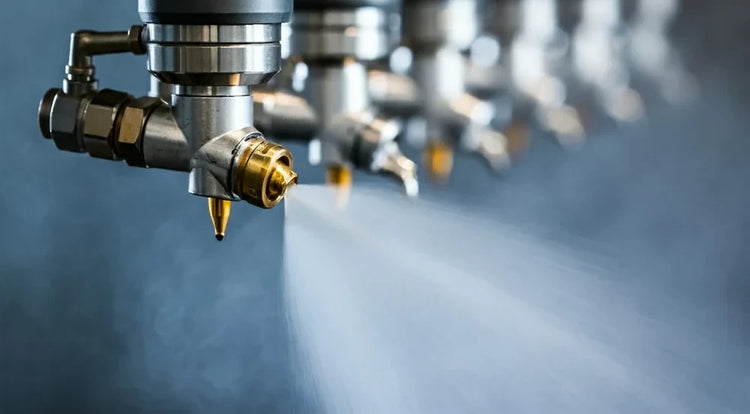
Sprühdüsen für Zellstoffwäsche und Siebung
Trommelwäscher-Brausestäbe, Diffusorwäscher-Sprühdüsen, Drucksieb-Verdünnungs- und Annahmeduschen, Zellstoffsortierer-Sprühdüsen und Faserreinigungsdüsen — Flachstrahl-Brausestäbe, Vollkegel-Verteilungsdüsen und Hochdruck-Siebreinigungssysteme in Wolframkarbid- und Duplex-Edelstahlausführung für abrasives Weißwasser und Zellstoffsuspension
Sprühdüsen für die Zellstoffwäsche und Siebung weisen einen Ausfallmodus auf, der bei fast keiner anderen industriellen Anwendung zu finden ist: Das Sprühsystem ist kontinuierlich in oder mit der Fasersuspension getaucht oder benetzt, die es zu reinigen oder zu trennen versucht. Eine Trommelwäscher-Brausestange, die tropft statt sprüht, unterwäscht die Zellstoffmatte nicht nur – sie überflutet die Matte lokal, reduziert die Entwässerung und erzeugt einen nassen Kanal, der während der Bahnbildung auf dem Sieb reißt. Eine Drucksieb-Akzeptduschdüse mit einer teilweise blockierten Düse reduziert die Wascheffizienz nicht proportional – sie erzeugt eine trockene Zone auf dem Siebkorb, die Fasern ansammelt und diesen Siebsektor fortschreitend blockiert, was letztendlich einen Siebausfall und einen ungeplanten Produktionsstopp auslöst.
NozzlePro liefert Flachstrahl-Brausestabdüsen für Trommel- und Bandwäscher, Vollkegeldüsen für die Verteilung von Diffusorwaschflüssigkeit und Verdünnungssammler, Hochdruck-Flachstrahldüsen für die Reinigung von Drucksiebkörben und Sortiererplatten sowie Feinnebeldüsen zur Schaumkontrolle in Waschfiltratsystemen. Wolframkarbid-Düseneinsätze sind Standard für alle Weißwasser- und Zellstoffpositionen – das Prozesswasser von Zellstofffabriken enthält Faserfeinanteile, Calciumcarbonat-Füllstoffe und Verunreinigungen aus dem Recyclingstrom, die Standard-Edelstahldüsen innerhalb von Wochen erodieren lassen. ISO 9001 zertifizierte Herstellung mit konsistenten Düsenabmessungen bei jedem Ersatzsatz.
Zellstoffwasch- und Siebprozesse verwenden Sprühdüsen in vier Hauptanwendungen: Trommelwäscher-Brausestäbe verwenden Flachstrahldüsen (0,5–3 bar, TC-Düseneinsätze) in Brausestabverteilern über die gesamte Trommelflächenbreite, um Waschflüssigkeit gleichmäßig auf die Zellstoffmatte auf der Trommeloberfläche zu verteilen – die Verteilungsgleichmäßigkeit innerhalb von ±5% über die Trommelbreite bestimmt direkt die Wascheffizienz und den Waschverlust (kg Na₂O, das mit Zellstoff pro trockenem Tonne mitgeführt wird); Diffusorwäscher-Sprühdüsen verwenden Vollkegeldüsen (1–5 bar) in ringförmigen Verteilerköpfen, um Waschflüssigkeit gleichmäßig in die Zellstoffsäule von Druckdiffusorbehältern zu injizieren – ungleichmäßige Injektion führt zu Kanalbildung, die Abschnitte des Zellstoffbetts umgeht und die Verdrängungswascheffizienz reduziert; Drucksiebkorb-Reinigungsdüsen verwenden Hochdruck-Flachstrahldüsen (8–25 bar, TC-Einsätze) in oszillierenden oder festen Brausesystemen, um die Sauberkeit der Siebkorböffnungen zu erhalten und die Bildung von Fasermatten zu verhindern, die zum Verblinden und reduzierten Gutstofffluss führen; und Faserreinigungs- und Knotensprühdüsen verwenden Flachstrahl- oder Vollkegeldüsen (2–8 bar) in Verdünnungs-, Annahme- und Ausschleusungsstufen-Sammlern von Zentrifugalreinigern, Knotenfängern und Feinsieben, um die Stoffkonsistenz aufrechtzuerhalten und Ausschussfasern von perforierten Platten zu entfernen. Wolframkarbid-Düseneinsätze sind die Mindestspezifikation für alle Positionen, die recyceltes Weißwasser, Prozesswasser oder Zellstoffsuspension verwenden – Standard-316L-Edelstahlöffnungen erodieren schnell im faserbeladenen, abrasiven Betrieb.
Düsengarnituren für Zellstoffwäsche und Siebung
Nach Anwendung oder Düsentyp einkaufen
Spritzanwendungen für Zellstoffwäsche und Siebung
Anwendungsspezifische Düsenempfehlungen für jede Wasch- und Siebposition
Trommelwäscher-Brausestäbe
Flachstrahldüsen (0,5–3 bar, TC-Düseneinsätze) in Brausestabverteilern über die gesamte Trommelflächenbreite tragen Waschflüssigkeit gleichmäßig auf die Zellstoffmatte auf, die sich auf der Trommeloberfläche von Rotations-Trommelwaschanlagen (Vakuum-Trommelwaschanlagen, Druck-Trommelwaschanlagen und Doppelbandpressen) bildet. Der Brausestab ist das primäre Werkzeug zur Verteilung des Waschwassers über die Matte – eine Verteilungsgleichmäßigkeit innerhalb von ±5% des mittleren Durchflusses an jeder Düsenposition entlang des Stabes ist das Designziel, da ein lokaler Flussüberschuss eine Mattenüberflutung und Kanalbildung verursacht, während ein lokales Flussdefizit ungewaschene Zonen hinterlässt, die restliches Schwarzlauge in das Filtratsystem leiten. Das Flachstrahlmuster ist für die Trommelwäsche korrekt: Der Flachstrahl verteilt die Waschflüssigkeit in einer Linie über die Trommelbreite mit scharfer Abgrenzung an den Strahlrändern, wodurch Überschneidungsverschwendung minimiert und eine Überbefeuchtung an benachbarten Positionen verhindert wird. Die Zuführungsleitungen des Brausestabs sollten als Umkehrrücklauf (Schleifenzuführung von beiden Enden) ausgeführt sein, um den hydraulischen Druck über alle Düsenpositionen auszugleichen – eine einseitige Zuführung erzeugt einen Druckgradienten von der Zuführung zum toten Ende, der zu einem progressiv geringeren Durchfluss an weiter entfernten Positionen führt. TC-Düseneinsätze sind unerlässlich – Trommelwäscher-Duschwasser ist typischerweise verdünntes Schwarzlaugefiltrat oder Prozesswasser, das Faserfeinanteile und gelöste Restfeststoffe enthält, die Standard-Edelstahldüsen innerhalb weniger Wochen erodieren lassen.
FlachstrahldüsenDiffusor-Wäscher-Sprühsysteme
Vollkegeldüsen (1–5 bar, TC-Einsätze) in ringförmigen Verteilerköpfen injizieren Waschflüssigkeit gleichmäßig in die Zellstoffsäule von atmosphärischen und druckbeaufschlagten Diffusorwaschern (Aufwärts- und Abwärtsstromkonfigurationen), wodurch eine Verdrängungswäsche über den gesamten Gefäßquerschnitt erreicht wird. Die Effizienz der Diffusorwäsche hängt vollständig von einer gleichmäßigen Flüssigkeitsverteilung ab – der Verdrängungswaschmechanismus funktioniert, indem saubere Waschflüssigkeit durch das gepackte Zellstoffbett gedrückt wird, um die schmutzige Flüssigkeit davor zu verdrängen. Jede Ungleichmäßigkeit in der Injektionsverteilung erzeugt bevorzugte Flusskanäle, in denen die Waschflüssigkeit Abschnitte des Zellstoffbetts umgeht, wodurch das Verdrängungswäscheverhältnis reduziert und der Waschverlust erhöht wird. Vollkegeldüsen im ringförmigen Verteilerkopf müssen eine überlappende Abdeckung über den ringförmigen Querschnitt des Verteilers bieten – Injektionslücken erzeugen die Kanalisierungswege, die die Verdrängungseffizienz beeinträchtigen. Die Gestaltung des Verteilungsringkopfs muss den Zellstoffsäulendruck und die Fasersuspensionsdichte in der Injektionshöhe berücksichtigen: Die Injektionsgeschwindigkeit der Düse muss den Widerstand des Zellstoffbetts überwinden, um eine radiale Penetration in das Bett zu erreichen, anstatt eines bevorzugten Kurzschlussflusses nach oben entlang der Gefäßwand. TC-Düseneinsätze sind für warmes Waschflüssigkeit, die gelöste organische Rückstände und Faserfeinanteile enthält, erforderlich.
VollkegeldüsenDrucksiebkorb-Reinigungsdüsen
Hochdruck-Flachstrahldüsen (8–25 bar, TC-Einsätze) in oszillierenden Duscharmen oder festen Verteilern innerhalb von Drucksiebgehäusen erhalten die Sauberkeit der Siebkorböffnungen und verhindern die fortschreitende Fasermattansammlung, die zu Siebverstopfungen, Kapazitätsverlust und ungeplanten Siebausfällen führt. Der Reinigungsmechanismus ist der hydraulische Aufprall – der Flachstrahl mit 8–25 bar liefert ausreichend Aufpralldruck auf die Siebdraht- oder Lochoberfläche, um Faserbündel, Harzablagerungen und Feinanteilansammlungen von den Öffnungsflächen zu lösen. Unter 8 bar ist die Aufprallkraft des Strahls unzureichend, um die Faser-Draht-Haftung zu brechen, die sich während der kontinuierlichen Siebung von Fasersuspensionen entwickelt. Über 25 bar kann der Strahl in Siebkörben mit feinen Öffnungen (0,10–0,15 mm Schlitzbreite) zu Ermüdungsschäden am Siebdraht führen. Die Konstruktion des oszillierenden Duscharms – bei der der Duscharm die Siebkorblänge durchfährt, während sich der Korb dreht – erreicht eine vollständige Abdeckung des Siebkorbs bei geringerem Gesamtwasservolumen als feste Verteiler, wodurch die Verdünnung des akzeptierten Zellstoffstroms reduziert wird. Die Oszillationsfrequenz des Duscharms muss an die Drehzahl des Siebkorbs und den Schlitz-/Lochabstand angepasst werden, um sicherzustellen, dass jede Öffnungsreihe bei jedem Durchlaufzyklus gereinigt wird. TC-Düseneinsätze sind zwingend erforderlich – Siebduschwasser ist typischerweise recyceltes Weißwasser oder Gutstromwasser, das Füllstoffpartikel und Faserfeinanteile enthält.
HochdruckdüsenFaserreinigungs- und Knotersprühdüsen
Flachstrahl- und Vollkegeldüsen (2–8 bar, TC-Einsätze) in Verdünnungssammlern, Annahmeduschverteilern und Ausschleusungsstufensprühsystemen von Zentrifugalreinigern (Hydrozyklonen), Knotenfängern und Grobsieben halten die Stoffkonsistenz aufrecht, entfernen Fasern von perforierten Platten und verdünnen Ausschussströme für eine effiziente Trennung und Verarbeitung. Knoter- und Grobsieb-Sprühdüsen arbeiten im höchstkonsistenten Zellstoffbestand des Siebraums – Ausschussströme mit 3–5 % Konsistenz sind faserig und viskos, und Sprühdüsen müssen eine ausreichende Strömungsgeschwindigkeit liefern, um die Fasermatte auf perforierten Platten zu durchdringen und die Platte für den Ausschussfluss offen zu halten. Die Verdünnungssammlerdüsen von Zentrifugalreinigern (Zyklonen) steuern die Eingangskonsistenz der Reinigerbatterien – eine Konsistenzschwankung von über ±0,1–0,2 % absolut über den Sammlerverteiler erzeugt eine entsprechende Variation der Trennleistung, da die Zyklonleistung stark von der Eingangskonsistenz abhängt. Vollkegeldüsen in Verdünnungssammlern müssen über alle Positionen hinweg auf den Durchfluss abgestimmt sein – eine ±5 % Düsendurchflussvariation erzeugt eine entsprechende ±0,05–0,10 % Konsistenzvariation, die in einzelne Zyklonkörper einer Mehrzyklonbatterie eintritt. TC-Düseneinsätze sind durchweg erforderlich – Gut- und Ausschussströme im Siebraum führen Faserfeinanteile und, in Mühlen, die Sekundärfasern verwenden, klebrige Verunreinigungen (Stickies) mit sich, die sich an Standard-Edelstahlöffnungen ansammeln und diese erodieren.
FlachstrahldüsenBand- und Scheibenfilter-Waschduschen
Flachstrahl-Brausestäbe (1–4 bar, TC-Einsätze) über die gesamte Breite von Bandpresswaschern und Scheibenfiltersektoren tragen frisches Waschwasser oder verdünntes Filtrat auf die Fasermatte auf bewegten Band- oder Scheibenoberflächen auf, wodurch eine Verdrängungswäsche von Restchemikalien erreicht wird, während die Matte unter mechanischer Kompression oder Vakuumdrainage steht. Die Verteilung der Bandwascher-Brause muss der Bandlaufgeschwindigkeit entsprechen – ein für eine gleichmäßige Abdeckung bei 20 m/min Bandgeschwindigkeit ausgelegter Brausestab kann bei 30 m/min eine unvollständige Abdeckung erzeugen, wenn die Sprühstrahlbreite bei höherer Geschwindigkeit keine ausreichende Überlappung bietet. Der Brausestab sollte in einem Winkel und einer Höhe positioniert werden, die die Strahlpenetration in die Mattenoberfläche maximiert, ohne dünne Mattenabschnitte zu durchblasen, was zu Kanalbildung und reduzierter Wascheffizienz führt. Die Duschdüsen des Scheibenfiltersektors müssen die gesamte Scheibensektorbreite abdecken, während sich die Scheibe dreht – der Düsenabstand des Brausestabs und die Abstandsabmessung werden für den spezifischen Scheibendurchmesser und die Rotationsgeschwindigkeit berechnet. Die Schaumkontrolle ist eine Sekundärfunktion einiger Scheibenfilter-Brausesysteme – Antischaummittel, die durch Düsen mit kleinen Öffnungen am Filtratrückführungssystem zugeführt werden, unterdrücken Schaum im Filtratbehälter, der sonst Lufteinschlüsse in der Filtratpumpe und ein reduziertes Vakuum auf der Scheibenfilteroberfläche verursacht. TC-Düseneinsätze für alle Positionen, die recyceltes Filtrat verwenden; Standard 316L SS ist für frische Heißwasser-Duschpositionen mit sauberer Wasserversorgung akzeptabel.
FlachstrahldüsenBehälter-, Sumpf- und Gefäß-CIP-Reinigung
Rotierende CIP-Sprühkugeln und hochwirksame Festdüsen (5–20 bar) in Zellstoffbehältern, Wäscherfiltratbehältern, Siebzufuhrbehältern sowie Annahme- und Ausschusslagertanks entfernen Faserablagerungen, Harzansammlungen und Kesselstein von den Gefäßinnenwänden während geplanter Stillstände. Zellstoffbehälter entwickeln im Inneren Faser- und Harzablagerungen an Wänden und Rührblättern, die das effektive Behältervolumen progressiv reduzieren und bei harzreichen Spezies (Kiefer, südliche Harthölzer) Pechansammlungen verursachen, die als Verunreinigungen in den Zellstoffstrom gelangen. Rotierende Düsenreinigungsvorrichtungen, die einen Aufpralldruck von 15–20 bar an der Gefäßwand erzeugen, sind der effektivste Ansatz zur Entfernung verhärteter Faser- und Pechablagerungen aus großen Behältervolumina – statische Sprühkugeln bei 3–5 bar bieten eine ausreichende Abdeckung, aber unzureichenden Aufprall für anhaftende Ablagerungen in Behältern, die über 60 °C mit harzhaltigen Zellstoffspezies betrieben werden. Material der CIP-Sprühdüsen für Gefäße: Die Filtrat- und Prozessflüssigkeiten in Zellstoffmühlenbehältern sind leicht alkalisch (pH 8–10) mit geringem Gehalt an gelösten Feststoffen – 316L SS Gehäusedüsen sind für die meisten CIP-Anwendungen in Behältern ausreichend; Duplex 2205 für hochtemperierte Positionen. TC-Düseneinsätze für jede CIP-Position, die recyceltes Prozesswasser anstelle von Frischwasser verwendet.
CIP & TankreinigungDüsenkonfigurationsreferenz — Zellstoffwäsche & Siebung
Empfohlener Düsentyp, Betriebsparameter, Material und wichtige Konstruktionshinweise für jede Position
| Anwendung | Düsentyp | Druck / Durchfluss | Material | Wichtige Konstruktionshinweise |
|---|---|---|---|---|
| Trommelwäscher-Brausestab | Flachstrahl-Brausestab | 0,5–3 bar über die Trommelflächenbreite | 316L SS oder Duplexgehäuse; TC-Düseneinsatz Standard | Rücklauf- (Umkehrrücklauf-) Sammelleitungszuführung gleicht den Druck über alle Positionen aus – einseitige Zuführung erzeugt einen Druckgradienten zum toten Ende, der zu geringem Durchfluss an entfernten Positionen führt; ±5% Durchflussgleichmäßigkeit als Ziel; vollständige Stabsätze ersetzen, nicht einzelne verschlissene Düsen |
| Diffusorwäscher-Laugenverteilung | Vollkegel-Ringverteilung | 1–5 bar; Injektionsgeschwindigkeit dimensioniert, um das Zellstoffbett zu durchdringen | 316L SS oder Duplexgehäuse; TC-Einsatz; EPDM-Dichtungen | Vollkegel bietet überlappende Ringabdeckung, verhindert Injektionslücken, die Kanäle im Zellstoffbett erzeugen; Injektionsgeschwindigkeit muss den Bettwiderstand für radiale Penetration überwinden – geringe Geschwindigkeit verursacht Kurzschlussfluss an der Wand |
| Drucksiebkorb-Reinigung | Oszillierender Flachstrahl-Brausearm | 8–25 bar; TC-Einsatz; Aufprall an der Siebkorboberfläche >2 bar | 316L SS Gehäuse; TC-Düse; PTFE- oder EPDM-Dichtungen | Unter 8 bar: unzureichender Aufprall, um die Faser-Draht-Haftung zu brechen; über 25 bar: Gefahr der Drahtermüdung bei feinen Schlitzen (<0,15 mm); Oszillationsfrequenz abgestimmt auf Korbrotationsgeschwindigkeit und Schlitzabstand für vollständige Abdeckung pro Zyklus |
| Drucksieb-Annahmeverdünnung | Vollkegel-Verdünnungsdüsen | 2–6 bar; durchflussangepasst ±5% über alle Positionen | 316L SS Gehäuse; TC-Einsatz für Weißwasserversorgung | Durchflussgleichmäßigkeit über alle Positionen steuert die Annahmekonsistenz – ±5% Düsenvariation verursacht ±0,05% Konsistenzvariation beim Eintritt in das Sieb; TC-Einsätze für Weißwasser- oder Prozesswasserversorgung erforderlich; Frischwasserversorgung ermöglicht SS-Düse |
| Knoter & Grobsieb-Spray | Flachstrahl-Plattenspray | 2–8 bar; Durchfluss dimensioniert für Plattenfreigabegeschwindigkeit | 316L SS Gehäuse; TC-Einsatz; verstärkter Sitz für hochkonsistenten Betrieb | Hohe Konsistenz des Ausschussstroms (3–5 %) erfordert ausreichende Sprühgeschwindigkeit, um die Fasermatte auf perforierter Platte zu durchdringen; Flachstrahlmuster richtet den Fluss im Winkel zur Plattenoberfläche aus; TC-Einsatz unerlässlich – Ausschussstrom führt Faserfeinanteile, Harz und Ablagerungen mit sich |
Bediente Arten von Wasch- und Siebausrüstung
Sprühlösungen für jede Waschanlage und Siebkonfiguration in der Zellstofffabrik
Drehvakuumfilterwaschanlagen
Flachstrahl-Brausebalken über die gesamte Trommelflächenbreite, Waschflüssigkeits- und Wiedereinpulpungsbrausestellen, Behälterverdünnungsdüsen und Filtratrücklauf-Schaumkontrolle. Häufigster Waschertyp in Kraftzellstofffabriken – das Design des Brausebalkens bestimmt direkt den Braunstoffwaschverlust.
Druckdiffusorwaschanlagen
Ringförmige Vollkegel-Verteilerköpfe auf Waschflüssigkeits-Injektionshöhe, Einlass- und Auslass-Konsistenzverdünnungsdüsen. Hohe Verdrängungswascheffizienz bei gleichmäßiger Injektionsverteilung – Kanalbildung durch schlechte Düsenverteilung ist der primäre Mechanismus für Effizienzverlust.
Atmosphärische Diffusorwaschanlagen
Mehrstufige ringförmige Verteilringe, Waschflüssigkeits-Injektionsköpfe in jeder Stufe, Annahme- und Überlaufverdünnungsdüsen. Gegenstromwäsche durch stufenweise Injektion erreicht – die Gleichmäßigkeit der Injektion jeder Stufe trägt zur gesamten Wascheffizienz bei.
Bandpressenwaschanlagen (Doppelband)
Hochdruck-Brausebalken über die gesamte Bandbreite in mehreren Waschzonen, Siebreinigungsbrausen, Rollenreinigungsdüsen und Kantenbesprühung. Bandgeschwindigkeit und Brausegleichmäßigkeit bestimmen die Wascheffizienz – die Abdeckung muss bei allen Betriebsbandgeschwindigkeiten überprüft werden.
Scheibenfilterwaschanlagen
Sektor-Brausebalken über die gesamte Scheibensektorbreite, Schaumkontrollldüsen für den Filtrattank und Scheibenreinigungs-Sprühanlagen. Die Gleichmäßigkeit der Sektorabdeckung pro Rotation bestimmt die Waschkonsistenz – die Positionierung des Brausebalkens wird für den spezifischen Scheibendurchmesser und die Sektorbreite berechnet.
Drucksiebe (Primär, Sekundär, Tertiär)
Oszillierende oder feste Korbreinigungs-Brausearme (8–25 bar), Annahmeverdünnungsverteiler und Zuführungskonsistenzkontrollldüsen. Siebkapazität und Annahmequalität hängen von der Sauberkeit des Korbs ab – Brausedruck unter 8 bar ist die häufigste Ursache für progressiven Kapazitätsverlust zwischen den Stillständen.
Knotenfänger & Grobsiebe
Gelochte Platten-Sprühdüsen, Rücklaufverdünnungsverteiler und Trommelsprühbalken. Erste Stufe des Siebsystems – Grobstoffentfernung vor den Primärsieben; Rücklaufstrom mit hoher Konsistenz erfordert hohe Sprühgeschwindigkeit zur Plattenreinigung.
Zentrifugalsichter (Zyklonbatterien)
Mehrfachbank-Verdünnungsverteilerdüsen, Annahme- und Rücklaufverteilerkonsistenzkontrolle und Sichtergehäuse-Waschsprühanlage. Die Gleichmäßigkeit des Verdünnungsverteilerflusses steuert direkt die Trenneffizienz – ±5% Düsenflussvariation verursacht Konsistenzschwankungen, die in die Zyklonkörper gelangen und die Effizienz der Entfernung schwerer Verunreinigungen reduzieren.
Feinsiebe & Schlitzsiebe
Hochdruck-Korbreinigungsbrausen für Feinschlitzkörbe (0,10–0,20 mm), Annahmeverdünnungsdüsen und Rücklaufstufensprühanlagen. Feinschlitzkörbe sind anfälliger für Verstopfungen als Lochkörbe – Brausedruck und -frequenz müssen für den Feinschlitzbetrieb erhöht werden, um die Siebkapazität zu erhalten.
Prinzipien der Düsenwahl für die Zellstoffwäsche und -siebung
Was bestimmt die korrekte Spezifikation für Trommelwäscher, Diffusoren, Siebe und Faserreinigungssysteme
- Die Ungleichmäßigkeit der Trommelwaschanlagen-Duschleiste wird als Waschverlust und nicht als Wasserverteilung gemessen – beides muss überwacht werden — Eine Trommelwaschanlagen-Duschleiste mit ±15 % Flussvariation über die gesamte Trommelfläche ist nicht nur ein Problem ungleichmäßiger Wasserverteilung – es ist ein Waschverlustproblem mit direkten wirtschaftlichen Folgen. Die Zonen, die 15 % weniger Waschwasser erhalten, haben proportional höhere Restlaugegehalte im gewaschenen Zellstoff, der Restalkali und gelöste organische Stoffe in die Bleicherei transportiert. Jedes zusätzliche kg/Atro-Tonne Natrium (ausgedrückt als Na₂O), das aufgrund unzureichender Wäsche in die Bleicherei gelangt, erfordert zusätzliche Bleichchemikalien zur Neutralisierung und stellt Kosten für die chemische Aufbereitung im Rückgewinnungskreislauf dar. Der Zusammenhang zwischen Duschgleichmäßigkeit und Waschverlust ist direkt: Messen Sie die individuellen Düsenflüsse bei jeder geplanten Wartung der Duschleiste, indem Sie den Fluss jeder Position 60 Sekunden lang sammeln, berechnen Sie den Variationskoeffizienten und ersetzen Sie die gesamte Leiste, wenn eine Position um mehr als 10 % vom Leistenmittelwert abweicht. Verfolgen Sie den Waschverlust (gemessen als Leitfähigkeit oder Natriumgehalt des gewaschenen Zellstoffstroms) als operativen KPI – die Flussgleichmäßigkeit ist der Frühindikator, der Waschverlust ist die nachlaufende Bestätigung. Wenn der Waschverlust ohne offensichtliche Prozessänderung zunimmt, ist die Duschleiste der erste Punkt, der überprüft werden muss.
- Der Reinigungsbrausedruck von Drucksieb-Körben muss an der Korboberfläche verifiziert werden – nicht am Versorgungsverteiler — Der Druckbereich von 8–25 bar für die Reinigung von Drucksieb-Körben bezieht sich auf den Aufpralldruck an der Korbdrahtoberfläche, nicht auf den Versorgungsverteiler des Brausesystems. Der Druckabfall zwischen Versorgungsverteiler und Korboberfläche hängt ab vom Abstand des Verteilers zum Korb, der Düsenauslassgröße und dem Durchflusskoeffizienten sowie dem internen Gehäusedruck (der mit der Siebbelastung und dem Annahmedruck variiert). Ein Versorgungsverteilerdruck von 15 bar mit einem schlecht dimensionierten Verteiler oder verschlissenen Düsenauslässen kann einen Korboberflächenaufprall weit unter 8 bar erzeugen – unzureichend, um Fasermatten zu lösen. Überprüfen Sie die tatsächliche Korbreinigungseffektivität betrieblich, indem Sie den Siebdifferenzdruck (Eingangsdruck minus Annahmedruck) über den Betriebszyklus zwischen den Stillständen verfolgen. Ein Sieb, dessen Differenzdruck im Betriebszyklus trotz funktionierender Brausesysteme stetig ansteigt, weist eine unzureichende Korbreinigung auf – entweder unzureichenden Aufpralldruck, unvollständige Korbabdeckung durch die Brausedurchführung oder beides. Wenn Sie den Verlust der Siebkapazität untersuchen, messen Sie die Düsenflüsse einzeln und berechnen Sie den Korboberflächenaufprall aus Düsenauslassgröße, Versorgungsdruck und Verteilergeometrie, bevor Sie annehmen, dass das Problem ein Korb- oder Prozessproblem ist.
- Die Einspritzgeschwindigkeit der Düsen im Diffusorwasch-Verteilring muss den Widerstand des Zellstoffbetts überwinden – nicht nur den Verteiler füllen — Die Einspritzdüsen für die Waschflüssigkeit in einem Diffusorwasch-Verteilring erfüllen eine grundlegend andere Funktion als die Brausedüsen an einem Trommelwäscher. Der Verdrängungswaschmechanismus in einem Diffusor erfordert, dass die eingespritzte Waschflüssigkeit radial in die Zellstoffbettsäule eindringt, anstatt bevorzugt entlang der Gefäßwand nach oben oder durch widerstandsarme Pfade im Faserbett zu strömen. Dieses Eindringen erfordert, dass die Einspritzgeschwindigkeit am Düsenausgang den Bettwiderstand am Einspritzpunkt übersteigt – dieser ist eine Funktion der Zellstoffkonsistenz, des Mahlgrads (Entwässerungsrate), der Holzart und des hydrostatischen Drucks der Flüssigkeitssäule über dem Einspritzpunkt. Ein Verteilringverteiler, der für die Durchflussgleichmäßigkeit korrekt dimensioniert ist, aber eine unzureichende Einspritzgeschwindigkeit aufweist, zeigt eine nahezu perfekte Druckverteilung über den Verteiler, während er keine ausreichende Betteindringung erzielt – die Waschflüssigkeit verteilt sich gleichmäßig um den ringförmigen Verteiler, kanalisiert aber durch den Ringspalt zwischen dem Faserbett und der Gefäßwand nach oben. Messen Sie das Verdrängungsverhältnis (das Verhältnis des tatsächlichen zum theoretischen Waschflüssigkeitsverbrauch) als Effizienz-KPI des Diffusors – es ist empfindlicher für die Verteilungsqualität als der alleinige Waschverlust, da es quantifiziert, wie effektiv die Einspritzflüssigkeit die schmutzige Flüssigkeit tatsächlich durch das Bett verdrängt, anstatt sie zu umgehen.
- TC-Einsätze sind für Weißwasser-Duschpositionen nicht optional – Verifizieren Sie die tatsächliche Wasserquelle, bevor Sie Standard-Edelstahl spezifizieren — Die Entscheidung zwischen TC-Düsen-Einsätzen und Standard-316L-SS-Düsen in Zellstoffwasch- und Sieb-Duschleisten erfordert die Kenntnis der tatsächlichen Wasserquelle an jeder Düsenposition – nicht die Designabsicht. In der Praxis werden Duschleisten, die für die Frischwarmwasserversorgung ausgelegt sind, häufig an recyceltes Weißwasser, Filtratrücklauf oder Prozesswasser angeschlossen, wenn Frischwassereinsparungsprogramme implementiert werden. Standard-316L-SS-Düsen in einer Duschleiste, die an Weißwasser mit Calciumcarbonat-Füllstoff (Kaolin, Titandioxid), Faserfeinteilen und recycelten Verunreinigungen angeschlossen ist, zeigen innerhalb von 4–8 Wochen bei typischen Duschdrücken eine sichtbare Düsenvergrößerung. Die betriebliche Konsequenz: Die Leiste scheint normal zu laufen (Wasser fließt), aber die individuellen Düsenflussraten haben sich um 15–25 % erhöht, da die Düsen erodieren, wodurch eine ungleichmäßige Verteilung entsteht, die mit der Zeit zunimmt. Überprüfen Sie die tatsächliche Wasserversorgung an jeder Duschleistenposition in der Mühle, nicht das P&ID-Designetikett – und spezifizieren Sie dann TC-Einsätze für jede Position, die an eine recycelte oder Prozesswasserquelle angeschlossen ist, und reservieren Sie SS-Düsen nur für Duschleisten, bei denen bestätigt ist, dass sie sauberes Frischwasser oder Kondensat liefern.
- Die Flussanpassung der Düsen des Zentrifugalreiniger-Verdünnungsverteilers steuert direkt die Trenneffizienz über die Reinigerbank hinweg — In einer mehrstufigen Zentrifugalreinigerbank (typischerweise 3–5 Stufen für die Kraftzellstoff-Braunstoffreinigung) muss die Konsistenz des Zulaufs zu jedem Reinigerkörper innerhalb von ±0,1–0,2 % absolut der Auslegungskonsistenz für jede Stufe gehalten werden. Die Trenneffizienz von Zentrifugalreinigern für Sand, Gries und schwere Verunreinigungen ist stark konsistenzabhängig – oberhalb der Auslegungskonsistenz wird die Faserphase zu viskos für eine effektive Zentrifugaltrennung, und schwere Partikel bleiben im Annahmestrom; unterhalb der Auslegungskonsistenz ändern sich die Zyklonhydraulik, und die Trenneffizienz feiner Partikel verschlechtert sich. Die Verdünnungsverteilerdüsen, die die Konsistenz am Eingang der Reinigerbank steuern, müssen einen gleichmäßigen Verdünnungswasserfluss zu jedem Reinigerkörper-Zulaufrohr liefern. Eine Düsenbank mit ±10 % Flussvariation – die ein einzelner verschlissener TC-Einsatz oder eine teilweise blockierte Düse in einem 20-Positionen-Verteiler erzeugen kann – erzeugt eine Konsistenzvariation von ±0,2 % über die Reinigerbank, genug, um die Entfernungseffizienz schwerer Rückstände in den Positionen mit der höchsten Konsistenz messbar zu reduzieren. Überprüfen Sie die Flussleistung der Verdünnungsverteilerdüsen bei jedem geplanten Stillstand und ersetzen Sie sie als komplette Sätze – das Ersetzen einzelner verschlissener Positionen bei Belassen benachbarter verschlissener Positionen stellt die Ungleichmäßigkeit innerhalb weniger Monate wieder her.
Warum NozzlePro für die Zellstoffwäsche und -siebung wählen?
TC-Verschleisseinsätze, durchflussangepasste Düsensätze und Anwendungsberatung für jede Wasch- und Siebstelle
Durchflussangepasste TC-Düsensätze für vorhersagbare Duschleistung – ISO 9001 zertifiziert
NozzlePro liefert Düsen für Zellstoffwasch- und Siebanlagen, Diffusorverteildüsen und Siebreinigungsdüsen mit Wolframkarbid-Düseneinsätzen als Standard für alle Prozesswasser- und Weißwasserpositionen. Die ISO 9001 zertifizierte Fertigung gewährleistet konsistente TC-Einsatzabmessungen und Düsenlochgeometrie über den gesamten Duschbalkensatz – ein Ersatzbalkensatz liefert die gleiche Flussverteilung wie der ursprüngliche, was die Voraussetzung für die Aufrechterhaltung von Waschverlust und Siebleistung auf dem Niveau ist, das bei der ursprünglichen Inbetriebnahme des Wäschers oder Siebs festgelegt wurde.
Durchflussangepasste Ersatzsätze: Duschbalken-Düsenersatzsätze, deren individuelle Durchflussraten bei Betriebsdruck vor dem Versand überprüft wurden – jede Position im Satz liegt innerhalb von ±3 % des Satzmittelwerts. Dies ist wichtig für Trommelwascher-Duschbalken, wo der Balken 40–120 Düsenpositionen über die Trommelbreite enthalten kann: Ein Ersatzsatz mit ±3 % Flussvariation liefert eine ±3 % Waschverteilungsgleichmäßigkeit; ein Satz mit ±15 % Variation aus unbestätigter Fertigung liefert eine ±15 % Verteilungsungleichmäßigkeit, die sich sofort in Waschverlustmessungen zeigt.
Unterstützung bei der Duschbalkenkonstruktion: Wir bieten Empfehlungen zur Düsengröße für Ihre Trommelflächenbreite, Trommelgeschwindigkeit, Duschabstandshöhe und Waschwasserdurchflussrate – einschließlich der Empfehlung für die Rücklaufverteilerkonstruktion, die den Verteilerdruck über alle Düsenpositionen hinweg ausgleicht. Dies ist technische Beratung zur Unterstützung des Duschbalken-Designs und der Spezifikation Ihres Prozesstechnik-Teams – die Prozessingenieure Ihrer Mühle führen die Validierung der Wascheffizienz durch und legen die Betriebsziele fest.
Umfassende Abdeckung für Waschen und Sieben: Jede Sprühposition vom Trommelwascher bis zu den Verdünnungsverteilern des Zentrifugalreinigers – TC-Konstruktionsstandard, gleichbleibende Düsenqualität von einer einzigen ISO 9001 zertifizierten Quelle und Anwendungsberatung für das gesamte Zellstoffaufbereitungssystem.
Häufig gestellte Fragen
Häufig gestellte Fragen zu Sprühdüsen für die Zellstoffwäsche, -siebung und Faserreinigung in Kraft- und mechanischen Zellstofffabriken
Wie beeinflusst die Ungleichmäßigkeit einer Trommelwascher-Duschleiste den Waschverlust und den Verbrauch von Bleichchemikalien?
Die Ungleichmäßigkeit einer Trommelwascher-Duschleiste führt zu einer ungleichen Waschwasserverteilung über die Zellstoffmatte auf der Trommeloberfläche, was den Waschverlust direkt erhöht – den Natriumgehalt (als Na₂O-Äquivalent) oder die gelösten organischen Stoffe, die mit dem gewaschenen Zellstoff in die nächste Prozessstufe gelangen. Der Mechanismus: Zonen der Zellstoffmatte, die von einer ungleichmäßigen Duschleiste unterdurchschnittlich viel Waschwasser erhalten, behalten einen höheren Restlaugegehalt als ausreichend gewaschene Zonen. Dieser Restalkali- und gelöste organische Gehalt passiert die Trommelwaschststufe und gelangt entweder in die nächste Waschstufe (erhöht die Belastung nachfolgender Wäscher) oder direkt in die Bleicherei. In der Bleicherei erfordert jedes zusätzliche kg/ODt Natrium (Na₂O-Äquivalent), das mit dem Zellstoff eintritt, eine Neutralisation durch zusätzliche Säure-Bleichchemikalien oder Restorganische, die den Oxidationsmittel vor dem Bleichen der Faser verbrauchen. Mühlen quantifizieren diesen Effekt typischerweise als „Carry-over“ oder „Waschverlust“, ausgedrückt in kg Na₂O/ODt – Industriestandards für die Vakuumtrommelwäsche liegen bei 8–12 kg Na₂O/ODt, wobei gut betriebene moderne Wäscher 6–8 kg Na₂O/ODt erreichen. Eine Duschleiste mit ±20 % Durchflussungleichmäßigkeit (hohe Zonen bei 120 % Mittelwert, niedrige Zonen bei 80 % Mittelwert) erhöht den durchschnittlichen Waschverlust um ca. 10–15 % über das, was derselbe Wäscher mit einer gleichmäßigen Dusche erreicht, da die Zonen mit geringem Durchfluss untergewaschen sind, während die Zonen mit hohem Durchfluss bereits den Punkt der abnehmenden Waschleistung überschritten haben. Das Ersetzen einer verschlissenen, ungleichmäßigen Duschleiste durch einen durchflussangepassten Ersatzsatz ist oft die kostengünstigste Maßnahme zur gleichzeitigen Reduzierung von Waschverlust und Bleichchemikalienverbrauch – und beide Verbesserungen sind innerhalb eines Produktionstages nach dem Austausch messbar.
Was verursacht den Kapazitätsverlust von Drucksieben und wie beeinflusst der Brausedruck die Wirksamkeit der Korbreinigung?
Der Kapazitätsverlust von Drucksieben zwischen den Stillständen wird durch fortschreitende Faserablagerungen auf den Siebkorböffnungen verursacht – Faserbündel, Feinstoffe und Harzablagerungen, die die offene Fläche von Schlitz- oder Lochkörben im Laufe der Zeit reduzieren, den Differenzdruck erhöhen und die Annahmedurchflussrate bei einer gegebenen Zufuhrrate verringern. Das Korbreinigungsbrausesystem ist der primäre Mechanismus zur Verhinderung dieser Ablagerungen. Die Reinigungswirksamkeit hängt von der Aufprallkraft an der Korboberfläche ab, nicht nur vom Wasservolumen oder dem Versorgungsdruck. Die Aufprallkraft an der Korboberfläche entspricht: (Austrittsgeschwindigkeit der Düse (bestimmt durch Düsenauslassgröße und Versorgungsdruck abzüglich Verluste) quadriert) mal Wasserdichte, angewendet über die Abdeckungsfläche der Düse an der Korboberfläche. Unterhalb eines Schwellenwerts – ca. 2–3 bar dynamischer Druck an der Korbdrahtfläche – werden Faserbündel und Harzablagerungen, die an den Korbdrahtoberflächen haften, nicht gelöst. Der erforderliche Versorgungsdruck, um diesen Schwellenwert an der Korboberfläche zu erreichen, hängt vom Abstand der Brausedüse zum Korb (typischerweise 10–50 mm bei oszillierenden Brausearmkonstruktionen), dem internen Betriebsüberdruck des Siebgehäuses und der Düsenauslassgröße ab. Eine nominelle Versorgung von 15 bar zu einem Brausearm mit verschlissenen TC-Düsen (durch Abrieb vergrößert) kann weniger als 8 bar effektiven Druck am Korb erzeugen, was zu einer progressiven Korbverstopfung führt. Verfolgen Sie den Trend des Siebdifferenzdrucks (die Rate des Differenzdruckanstiegs pro Betriebsstunde) als Hauptindikator für die Reinigungswirksamkeit – ein Sieb mit einem steigenden Differenzdrucktrend trotz funktionierender Brausesysteme weist eine unzureichende Reinigungsleistung auf, nicht ein Problem des Korbes oder des Zellstoffs. Wenn sich die Trendrate verdoppelt, überprüfen Sie die Abmessungen der Brausedüsen und ersetzen Sie den Satz, wenn der Düsenauslassdurchmesser um mehr als 8 % vom Nennwert zugenommen hat.
Worin besteht der Unterschied zwischen Verdrängungswascheffizienz und Verdünnungs-Extraktionswäsche, und wie beeinflusst das Düsendesign beide?
Verdrängungswäsche und Verdünnungs-Extraktionswäsche sind die beiden grundlegenden Mechanismen, die bei der Kraftzellstoffwäsche angewendet werden, und sie haben unterschiedliche Anforderungen an die Düsenverteilung. Verdrängungswäsche (verwendet in Diffusorwaschern und Druckdiffusorsystemen): Saubere Waschflüssigkeit wird in das Zellstofffaserbett injiziert und drückt (verdrängt) die schmutzige Flüssigkeit wie ein Kolben durch das Bett vor sich her. Die Effizienz der Verdrängungswäsche hängt entscheidend davon ab, wie gleichmäßig die injizierte Waschflüssigkeit über den gesamten Querschnitt der Zellstoffsäule verteilt wird – jede Ungleichmäßigkeit der Injektion erzeugt bevorzugte Flusskanäle, in denen die Waschflüssigkeit Abschnitte des Zellstoffbettes vollständig umgeht, was zu einem gemischten Ergebnis aus verdrängter sauberer Flüssigkeit und unverdrängter schmutziger Flüssigkeit im Austragsstrom führt. Die Düsenanforderungsbedingung für die Verdrängungswäsche ist: gleichmäßige Injektionsverteilung über den ringförmigen Querschnitt mit ausreichender Injektionsgeschwindigkeit, um das Faserbett radial zu durchdringen, anstatt entlang der Behälterwand kurzzuschließen. Vollkegeldüsen im ringförmigen Verteilungsring mit überlappenden Abdeckungszonen erreichen dies. Verdünnungs-Extraktionswäsche (verwendet in Rotationssiebfilterwaschern, Bandwaschern und Scheibenfiltern): Die Fasermatte wird auf einer Filterfläche gebildet, Waschflüssigkeit wird der Mattenoberfläche durch eine Dusche zugeführt, die Flüssigkeit verdünnt die Schwarzlauge in der Matte, und die Mischung wird dann durch das Filtermedium abgeleitet oder gepresst und als Filtrat extrahiert. Die Effizienz hängt davon ab, wie gleichmäßig die Waschflüssigkeit auf die Mattenoberfläche aufgetragen wird – eine ungleichmäßige Duschverteilung erzeugt Zonen unzureichend gewaschener Matten (hoher Restschwarzlauge), die mit geringerer Verdünnung extrahiert werden als angrenzende überwaschene Zonen. Die Düsenanforderungsbedingung für die Verdünnungs-Extraktionswäsche ist: gleichmäßige Flachstrahlabdeckung mit ±5 % Flussvariation über die gesamte Trommel- oder Bandbreite. Bei der Verdünnungs-Extraktionswäsche ist die Düsengleichmäßigkeit die primäre variable Größe, die der Bediener nach der Installation des Waschers kontrollieren kann – Trommelgeschwindigkeit, Vakuumpegel und Konsistenz werden typischerweise vom Prozess vorgegeben und selten geändert. Die Duschleiste ist der zugänglichste und wirksamste Wartungsgegenstand an einem Trommelwascher.
Wie sollten Duschleistendüsen für eine optimale Leistung des Trommelwaschers bemessen und positioniert werden?
Die Dimensionierung und Positionierung der Duschleistendüsen für Trommelwascher erfordert die gleichzeitige Angabe von vier Variablen: Düsengröße (Durchflussrate bei Betriebsdruck), Düsenabstand entlang der Leiste, Abstandshöhe (Abstand von der Düsenfläche zur Zellstoffmattenoberfläche) und Flachstrahlwinkel. Düsengröße: Die Gesamt-Durchflussrate der Duschleiste wird durch den Prozess bestimmt – typischerweise legt die Waschflüssigkeitsbilanz im Gegenstromwaschsystem die Gesamtmenge an Frischwasser oder verdünnter Flüssigkeit bei jeder Waschstufe fest. Die Anzahl der Düsenpositionen (bestimmt durch die Trommelbreite und den Düsenabstand) bestimmt dann die Durchflussrate pro Düse, woraus die Düsengröße bei Betriebsdruck ausgewählt wird. Düsenabstand: Flachstrahldüsen sollten so angeordnet werden, dass sich benachbarte Sprühstrahlen an der Mattenoberfläche um 15–25 % überlappen – dies verhindert trockene Bahnen zwischen den Abdeckungszonen der Düsen und vermeidet gleichzeitig eine übermäßige Überlappung, die zu lokalen Überflutungen führen würde. Bei 0,5 bar Betriebsdruck deckt eine typische Flachstrahldüse mit 80° Sprühwinkel und 150 mm Abstandshöhe eine Breite von ca. 220 mm ab – ein Düsenabstand von 180–190 mm ergibt eine Überlappung von 15–20 %. Abstandshöhe: Näher an der Matte (weniger als 100 mm) erhöht die Aufprallgeschwindigkeit und die Eindringtiefe der Matte, reduziert aber die Abdeckungsbreite, was einen geringeren Düsenabstand erfordert. Weiter von der Matte entfernt (mehr als 250 mm) bietet eine breitere Abdeckung pro Düse, reduziert aber die Aufprallgeschwindigkeit, was bei Drücken unter 1 bar möglicherweise nicht ausreicht, um eine dicke Fasermatte zu durchdringen. Der optimale Abstand liegt typischerweise bei 100–200 mm für Vakuumsiebfilterwascheranwendungen, wobei die genaue Höhe durch die Mattenstärke und die gewünschte Eindringtiefe des Waschwassers bestimmt wird. Sprühwinkel: 60–80° Flachstrahlwinkel sind Standard für Trommelwascheranwendungen – breitere Winkel reduzieren den Aufpralldruck pro Flächeneinheit; engere Winkel erfordern einen geringeren Abstand, um trockene Bahnen zu verhindern. Überprüfen Sie das Design der Duschleiste bei der gesamten Bandbreite von Mattenstärken und Trommelgeschwindigkeiten, bei denen der Wascher betrieben wird – der Auslegungspunkt ist normalerweise der durchschnittliche Betriebszustand, aber die schlechteste Waschleistung tritt bei maximalem Durchsatz (schnellste Trommelgeschwindigkeit, dickste Matte) auf, wo die Verweilzeit der Dusche am kürzesten ist.
Warum müssen Dilutionsdüsen von Zentrifugalreinigern durchflussabgeglichen sein und wie oft sollten sie ausgetauscht werden?
Zentrifugalreiniger (Zyklon-)Batterien in der Siebkammer der Zellstofffabrik erhalten den Stoff mit einer bestimmten Eingangskonsistenz – typischerweise 0,8–1,2 % für primäre Reinigerbatterien –, die durch Verdünnung von Stoffen höherer Konsistenz aus dem Siebkammer-Brustkasten mit Prozesswasser oder Weißwasser über eine Verdünnungsleitung erreicht wird. Jeder Zyklonkörper in der Batterie erhält die Zufuhr von einem Abzweig der Verdünnungsleitung, und die Verdünnungsdüse, die jeden Abzweig bedient, steuert den lokalen Verdünnungswasserfluss und somit die Eingangskonsistenz zu diesem Zyklonkörper. Wenn die Durchflussraten der Verdünnungsdüsen über die Leitung ungleichmäßig sind – aufgrund von Verschleiß, teilweiser Verstopfung oder Fertigungsvariationen –, erhalten verschiedene Zyklonkörper die Zufuhr mit unterschiedlichen Konsistenzen. Die Trenneffizienz von Zentrifugalzyklonen für Sand, Splitt, Rindenteile und schwere Verunreinigungen (der Zweck der Reinigungsstufe) nimmt um ca. 1–2 Prozentpunkte der Verunreinigungsentfernungseffizienz pro 0,1 % Erhöhung der Eingangskonsistenz über den Auslegungswert ab. Eine Verdünnungsleitung mit ±15 % Düsendurchflussvariation (typisch für verschlissene oder unüberprüfte Standard-Düsen) erzeugt eine Konsistenzvariation von ±0,15–0,2 % über die Batterie – die Zyklonkörper mit hoher Konsistenz erreichen eine um 3–4 Prozentpunkte geringere Verunreinigungsentfernung als die Auslegungsspezifikation. Über ein Produktionsjahr sammelt sich dieser Unterschied in der Verunreinigungsentfernung als höherer Grit- und Schmutzgehalt im an die Papiermaschine gelieferten Zellstoff an, was sich als erhöhter Siebverschleiß, Filzverunreinigung und Bahndefekte zeigt, anstatt als offensichtliches Wasch- oder Siebproblem. Austauschhäufigkeit: TC-Einsatz-Verdünnungsdüsen im Weißwasserdienst (Kalziumkarbonat, Kaolin, Siliziumdioxid-Gehalt, typisch für geschlossene Kreisläufe in der Mühle) zeigen typischerweise eine Vergrößerung der Öffnung um 8–12 % innerhalb von 6–9 Monaten nach der Installation. Ersetzen Sie vollständige Leitungssätze in 6-monatigen Intervallen oder immer dann, wenn eine einzelne Düse im Satz eine Erhöhung des Öffnungsdurchmessers um mehr als 10 % überschritten hat – der individuelle Austausch verschlissener Positionen ist kontraproduktiv, da die verbleibenden verschlissenen Positionen die Konsistenzverteilung weiterhin verzerren, bis auch sie ersetzt werden.
Sprechen Sie mit einem NozzlePro Spezialisten für Zellstoffwäsche und -siebung
Teilen Sie uns Ihren Waschertyp, Trommel- oder Scheibenabmessungen, Siebkorbspezifikationen, Wasserquelle und Durchsatz mit – wir spezifizieren durchflussabgeglichene TC-Einsatz-Duschleistendüsen, Diffusorverteilungsdüsen und Siebreinigungshardware mit anwendungstechnischer Unterstützung für jede Wasch- und Siebsprühposition.