
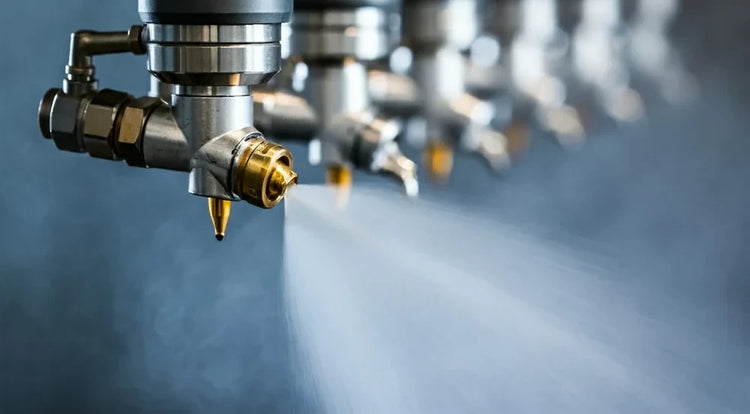
Sprühdüsen für
Asphalt & Straßenbelagsmaterialien
Die Asphaltproduktion verarbeitet einige der viskosesten, haftendsten und thermisch anspruchsvollsten Fluide in der gesamten industriellen Sprühanwendung. Bitumenemulsionen verstopfen Düsen, Aggregatstaub erzeugt abrasive Luftumgebungen, und Trommelmischer laufen kontinuierlich bei Temperaturen, die Polymerdüsenkomponenten innerhalb weniger Tage zersetzen. NozzlePro spezifiziert Düsen, die auf jede Phase abgestimmt sind – von der Emulsionsanwendung über die Staubkontrolle bis zur Trommelkühlung – und für die Bedingungen gebaut sind, unter denen eine Asphaltanlage tatsächlich betrieben wird.

Drei Sprühanwendungen in der Asphaltproduktion teilen eine gemeinsame Eigenschaft: Standard-Industriedüsen aus einem allgemeinen Katalog versagen in allen dreien, aus unterschiedlichen Gründen. Beim Sprühen von Bitumenemulsionen ist der Verstopfungsmechanismus Viskosität und Adhäsion – Bitumen härtet bei Raumtemperatur aus und bindet sich an jede Metalloberfläche, mit der es bei Stillstand des Flusses in Kontakt kommt. Bei der Staubunterdrückung von Aggregaten ist der Versagensmechanismus die Erosionskorrosion der Düsenöffnung durch dieselben abrasiven Partikel, die die Düse unterdrücken soll. Bei der Trommelmischerkühlung ist der Versagensmechanismus thermische Degradation – Polymerdichtungen und -gehäuse, die bei 60 °C angemessen funktionieren, versagen innerhalb weniger Tage bei Umgebungstemperaturen von 200–300 °C in der Nähe einer laufenden Mischtrommel.
Jede Anwendung erfordert eine andere Ausgangsspezifikation, und der Fehlerbereich bei falscher Auswahl ist gering – eine verstopfte Bitumendüse an einer Asphaltmaschine mitten auf der Straße hinterlässt einen Längsstreifen in der Fahrbahndecke; ein unterdimensioniertes Staubunterdrückungssystem führt zu einer Überschreitung der Vorschriften, die den Brechbetrieb stilllegen kann; eine überhitzte Mischtrommel produziert Asphalt außerhalb der Spezifikationen, der die Verdichtungsanforderungen nicht erfüllt.
Wo Sprühleistung die Ausgabequalität und Konformität bestimmt
Bitumenemulsionsspritzen
Grundierung & Haftgrund für StraßenbelägeBitumenemulsion ist eine Dispersion von Bitumentröpfchen in Wasser – eine stabile Emulsion bei Anwendungstemperatur, die beim Kontakt mit der Fahrbahnoberfläche aufbricht und einen gleichmäßigen Bitumenfilm hinterlässt, wenn das Wasser verdunstet. Sie wird als Grundierung auf vorbereitete Straßenuntergründe, als Haftschicht zwischen Asphaltschichten oder als Oberflächenbehandlung aufgetragen. Die Gleichmäßigkeit der Auftragsrate – gemessen in Litern pro Quadratmeter – ist eine Spezifikation für den Straßenbau, die bei jedem Projekt geprüft und dokumentiert wird.
Die Herausforderung für die Sprühdüse ist das Fluid selbst: Bitumenemulsionen sind viskos (50–500 cP je nach Sorte und Temperatur), haften stark an Metalloberflächen und härten in jeder Düsenöffnung aus, die nach dem Stoppen des Flusses mit Bitumenresten versehen ist. Eine Düse, die teilweise verstopft ist, fällt nicht sichtbar aus – sie reduziert ihre Durchflussrate und erzeugt ein gestreiftes Sprühbild, bei dem Düsen mit hohem Durchfluss übermäßig auftragen und Düsen mit geringem Durchfluss innerhalb desselben Sprühbalkens untermäßig auftragen.
Staubunterdrückung von Aggregaten
PM10 & PM2.5 Unterdrückung beim Brechen & SiebenDas Brechen und Sieben von Aggregaten in Asphaltanlagen erzeugt erhebliche Mengen an Partikeln in der Luft – Staubfraktionen im PM10-Bereich (unter 10 µm aerodynamischer Durchmesser) und PM2.5-Bereich (unter 2,5 µm), die in den meisten Rechtsordnungen durch Luftqualitätsstandards reguliert sind. Das Versäumnis, die Partikelemissionen unter den zulässigen Werten zu halten, kann zur Aussetzung der Betriebserlaubnis führen, was die Produktion von Aggregaten und damit die Asphaltproduktion stoppt.
Die Staubunterdrückung durch Wasservernebelung wirkt durch zwei Mechanismen: Tröpfchen im Bereich von 50–200 µm benetzen und agglomerieren Staubpartikel in der Luft, wodurch deren effektive Masse erhöht wird und sie sich absetzen; und die Vorbenetzung des Materials am Einspeisepunkt reduziert die Entstehung von luftgetragenen Feinpartikeln während des Brechens und Siebens. Beide Mechanismen müssen gleichzeitig aktiv sein, um eine effektive PM10-Kontrolle in einem Hochdurchsatz-Brechbetrieb zu gewährleisten.
Trommelmischerkühlung
Temperaturmanagement in kontinuierlichen MischtrommelnIn kontinuierlichen Trommelmischern – wo Zuschlagstoffe, Bitumen und Füllstoffe in einer rotierenden, von einem Brenner beheizten Trommel gemischt werden – hängt die Außentemperatur der Trommel von Durchsatz, Brennerleistung, Aggregatfeuchte und Umgebungsbedingungen ab. Bei heißem Wetter, hohem Durchsatz oder nach Feuchtigkeitsschwankungen im Aggregatstrom kann die Trommelschale überhitzen – wodurch die Asphalttemperatur über die Spezifikation ansteigt und eine vorzeitige Bindemitteloxidation verursacht wird, die die Ermüdungslebensdauer des fertigen Belags reduziert.
Wasser wird auf die Außenseite der Trommelschale aufgetragen, um die Temperatur innerhalb der Spezifikation zu halten. Dies ist keine Präzisionsanwendung – die primäre Anforderung ist eine hohe Durchflussabdeckung über den Trommelumfang mit ausreichender Wärmekapazität, um die überschüssige Wärme aufzunehmen. Die sekundäre Anforderung ist, dass die Wasserzufuhr proportional zur Trommeltemperatur gedrosselt werden kann, so dass sich die Kühlrate automatisch an die sich ändernden Produktionsbedingungen anpasst.
Bitumenemulsionsspritzen: Spülsysteme, Öffnungsauswahl und Gleichmäßigkeit der Auftragsrate
Das Spritzen von Bitumenemulsionen ist unter den industriellen Sprühanwendungen einzigartig, da das Wartungsprotokoll der Düsen – insbesondere das Spül- und Reinigungsverfahren am Ende jeder Arbeitsschicht – für die Leistung ebenso wichtig ist wie die anfängliche Düsenspezifikation. Eine Düse, die korrekt spezifiziert, aber nicht ordnungsgemäß gespült wird, ist innerhalb einer Woche unbrauchbar. Eine Düse, die korrekt gespült, aber falsch spezifiziert ist, erzeugt ungleichmäßige Auftragsraten, die die Abnahmeprüfung im Straßenbau nicht bestehen.
Warum Bitumenemulsionen anders verstopfen als andere viskose Flüssigkeiten
Die meisten viskosen Flüssigkeiten, die in eine Düsenöffnung gelangen, verlassen diese wieder – sie verlassen sie möglicherweise langsam oder mit reduzierter Durchflussrate, wenn die Viskosität hoch ist, aber sie verbinden sich nicht aktiv mit dem Inneren der Düse. Bitumen ist anders: Bei der Betriebstemperatur eines Sprühbalkens (50–85 °C) ist Bitumenemulsion flüssig und sprühbar. Wenn der Sprühbalken stoppt und die Temperatur sinkt – wie es an jeder Fuge, jedem Straßenabschnittsübergang und bei jeder Abschaltung am Ende des Tages der Fall ist – verliert die restliche Bitumenemulsion in der Düsenöffnung ihre Wasserphase durch Verdunstung und kühlt auf den Bitumen-Erweichungspunkt ab (40–60 °C für die meisten Straßenbitumene).
Am Erweichungspunkt geht das Bitumen von einer niedrigviskosen Flüssigkeit in einen halbfesten Zustand über, der stark an den Edelstahldüsenoberflächen haftet. Wenn es nicht innerhalb von 20–30 Minuten nach dem Abschalten mit heißem Wasser (mindestens 60 °C) ausgespült wird, setzt sich das Bitumen dauerhaft in der Öffnung fest. Im Gegensatz zu Kalkablagerungen, die chemisch gelöst werden können, lässt sich ausgehärtetes Bitumen bei sicheren Temperaturen nicht mit gängigen Chemikalien entfernen – es erfordert eine mechanische Reinigung oder den Austausch der Düse.
Jeder Bitumen-Sprühbalken muss innerhalb von 20 Minuten nach der letzten Sprühanwendung mit heißem Wasser (mindestens 60°C) gespült oder mit Druckluft gereinigt werden. Dies ist keine empfohlene Wartungspraxis – es ist die Betriebsbedingung, die die Wiederverwendung in der nächsten Schicht ermöglicht. Sprühbalken, die ohne Spülung abgeschaltet und über Nacht belassen werden, erfordern eine vollständige Demontage und manuelle Düsenreinigung, bevor sie wieder verwendet werden können.
- Das Design des Sprühbalkenverteilers sollte einen Spülanschluss am äußersten Ende des Balkens vorsehen – ein einseitiges Spülen lässt Restemulsion im Balken am äußeren Ende zurück, die sich in den letzten zwei oder drei Düsen jedes Balkens absetzt, der nicht vollständig gereinigt wird
- Auswahl des Düsenöffnungsdurchmessers basierend auf der Emulsionsqualität: hochviskose modifizierte Bitumenemulsionen (PMB-Emulsionen, 200–500 cP) erfordern bei gleicher Durchflussrate größere Öffnungen als Standard-Kationenemulsionen – die Spezifikation derselben Öffnung für beide führt bei PMB-Qualitäten zu Unterdruck und ungleichmäßiger Verteilung
- EPDM-Dichtungen in der gesamten Sprühbalkenbaugruppe – EPDM hat eine gute Beständigkeit gegenüber Bitumenemulsion (wasserführende Phase) bei 50–85 °C; NBR quillt in bituminösen Medien; PTFE ist die Alternative für Anwendungen bei höheren Temperaturen
- Kalibrierung der Auftragsrate: Jede Düse im Sprühbalken sollte vor dem ersten Einsatz in der Saison einzeln auf Durchfluss getestet werden – ein 5%iger Verschleiß der Öffnung über den Balken führt zu einer 5%igen Unterapplikation, die visuell nicht erkennbar ist, aber eine kalibrierte Auftragsratenprüfung nicht bestehen würde
Staubunterdrückung von Aggregaten: Tröpfchengröße für PM10-Abscheidung und Düsenverschleiß
Effektive Staubunterdrückung bei der Zerkleinerung und Siebung von Aggregaten erfordert, dass die Tröpfchengröße an die zu unterdrückende Partikelgröße angepasst wird – und dass diese Tröpfchengröße beibehalten wird, wenn die Düsenöffnung in der abrasiven Umgebung in der Nähe der Zerkleinerungsanlagen verschleißt. Beide Anforderungen ziehen in entgegengesetzte Richtungen: feinere Tröpfchen verbessern die PM10-Abscheideeffizienz, werden aber durch kleinere Öffnungen erzeugt, die schneller verschleißen; größere Öffnungen widerstehen dem Verschleiß, erzeugen aber gröbere Tröpfchen, die gegen feine Staubfraktionen weniger wirksam sind.
Das Prinzip der Anpassung von Tröpfchen- an Partikelgröße
Wassertröpfchen unterdrücken luftgetragenen Staub durch zwei Mechanismen – Trägheitsaufprall und Diffusion –, wobei jeder Mechanismus bei unterschiedlichen Partikel- und Tröpfchengrößen dominant ist. Für PM10-Partikel (1–10 µm) liegt der optimale Tröpfchendurchmesser für die Abscheidung durch Trägheitsaufprall bei etwa dem 10- bis 50-fachen des Partikeldurchmessers, wodurch der Ziel-Tröpfchenbereich bei 50–200 µm liegt. Tröpfchen, die feiner als 50 µm sind, folgen den Luftströmungen um große Partikel herum, anstatt auf sie zu treffen; Tröpfchen, die gröber als 500 µm sind, setzen sich zu schnell ab, um lange genug in der Staubwolke für eine effektive Abscheidung suspendiert zu bleiben.
Das bedeutet, dass das Staubunterdrückungssystem auf einen Ziel-Dv50 von 100–200 µm ausgelegt ist – gröber als in vielen anderen Sprühanwendungen. Der praktische Vorteil besteht darin, dass gröbere Tröpfchen durch größere Öffnungen (typischerweise 1,5–4 mm) erzeugt werden, die deutlich verschleißfester sind als die 0,3–0,8 mm großen Öffnungen, die für eine feine Zerstäubung erforderlich sind. In einer abrasiven Steinbruchumgebung, in der luftgetragene Siliziumpartikel kontinuierlich auf die Düsenoberflächen treffen, führt dieser Unterschied im Öffnungsdurchmesser zu einem 5- bis 10-fachen Unterschied in der Lebensdauer, bevor der Öffnungsverschleiß eine Erhöhung der Durchflussrate verursacht, die die Tröpfchenverteilung gröber als den effektiven PM10-Bereich verschiebt.
Vorbenetzung am Beschickungspunkt
Die Tröpfchenabscheidung in der Luft entfernt bereits luftgetragenen Staub. Für Primärbrecher mit hohem Durchsatz ist ein ergänzender Ansatz, Wasser direkt auf das Aggregat am Beschickungspunkt des Brechers vor dem Brechen aufzubringen – die Vorbenetzung der Materialoberfläche reduziert die anfängliche Staubentwicklung am Bruchpunkt um 40–60%, wodurch die Belastung des Luftunterdrückungssystems reduziert wird. NozzlePro kann die Vorbenetzungsdüsenanordnung für Ihre Brecherbeschickungsgeometrie zusätzlich zum Luftunterdrückungssystem nach dem Brecher spezifizieren.
- Wolframkarbid-Düseneinsätze in SS 316L-Gehäusen – TC-Härte von 1.400–1.600 HV gegenüber SS 316L bei 180 HV; in Siliziumstaubumgebungen in der Nähe von Primärbrechern halten TC-Einsätze 5–10x länger, bevor der Düsenverschleiß eine Erhöhung der Durchflussrate verursacht, die die Tröpfchenverteilung gröber als den effektiven PM10-Bereich verschiebt
- Düsenpositionierung 0,5–1,5 m über Übergabepunkten und Siebdecks – zu nah und die Tröpfchen berühren direkt die Aggregatoberfläche (was einen gewissen Vornässungseffekt bietet, aber die Effizienz der Lufterfassung reduziert); zu weit und die Tröpfchen haben sich abgesetzt, bevor sie die darunter erzeugte Staubwolke erreichen
- Vollständige oder teilweise Verkleidung von Übergabeschächten ermöglicht Staubunterdrückung bei geringeren Wassermengen – offene Übergabepunkte erfordern deutlich mehr Düsenabdeckung, um die gleiche Stauberfassungseffizienz wie ein teilweise gekapselter Schacht zu erzielen, in dem die Staubwolke eingeschlossen ist
- Zeitplan für Düsenflussprüfung: Alle Staubunterdrückungsdüsen alle 200 Betriebsstunden in Quarzsand- oder Granitbrechanlagen überprüfen und durchflussprüfen – der Orifice-Verschleiß im abrasiven Betrieb ist kontinuierlich und nichtlinear; eine Düse mit 110 % des Nennflusses erzeugt zu grobe Tröpfchen für die PM10-Abscheidung
Trommelmischerkühlung: Abdeckung, Durchflussrate und Materialauswahl bei 300 °C Umgebungstemperatur
Die Kühlung von Trommelmischern ist die einfachste der drei Sprühanwendungen in Asphaltanlagen hinsichtlich der Fluidchemie – es handelt sich um sauberes Wasser bei Umgebungstemperatur, das auf eine Stahltrommeloberfläche aufgetragen wird. Sie ist die anspruchsvollste hinsichtlich der Materialauswahl – die Düse arbeitet in einer Umgebung mit 200–300 °C in der Nähe des Trommelausgangs, wobei sie zeitweise der Strahlungswärme des Trommelmantels selbst ausgesetzt ist. Die Düsenspezifikation wird fast ausschließlich durch die thermische Umgebung und nicht durch die Fluideigenschaften bestimmt.
Dauerhafter Hochtemperatur-Umgebungsbetrieb
Die Umgebungstemperatur um das Austragsende eines Trommelmischers – wo der heiße Mischasphalt ausgetragen wird und die Oberflächentemperaturen des Trommelmantels am höchsten sind – ist keine transiente Hochtemperaturbedingung. Die Trommel läuft während der gesamten Produktionssaison 8–16 Stunden pro Tag kontinuierlich bei erhöhter Temperatur. Jede Düsenkomponente, die diese Temperatur nicht kontinuierlich und unbegrenzt tolerieren kann, ist für den Trommelkühlungsdienst nicht geeignet.
Die praktische Implikation ist einfach: Polymerdüsenkörper (PVDF, PTFE, PP) sind ausgeschlossen – selbst PTFE, ausgelegt für 260 °C, arbeitet an der Grenze seiner Dauerbetriebstemperatur in der Trommelumgebung und ist anfällig für thermischen Abbau an Hot Spots in der Nähe des Brennerauslasses. PEEK (ausgelegt für 250 °C) ist grenzwertig. Nur metallische Düsenkörper – mindestens 316L SS – sind für diesen Dienst zuverlässig geeignet. Ebenso sind elastomere Dichtungen, die für 150 °C ausgelegt sind (Viton Standardqualität), grenzwertig; Hochtemperatur-Viton (GFLT-Qualität) oder PTFE-Dichtungen sind die entsprechende Spezifikation.
Wenn hartes Wasser zur Trommelkühlung verwendet wird, bilden sich während der Produktionssaison Calciumcarbonatablagerungen an der Außenseite des Trommelmantels. Diese Kalkschicht wirkt als Wärmeisolierung – sie reduziert die Wirksamkeit der Wasserkühlung und erfordert mehr Wasserdurchfluss, um die gleiche Reduzierung der Trommeltemperatur zu erreichen. Der Kalk bietet auch eine Oberfläche für weitere Ablagerungen, die sich im Laufe der Zeit verstärken. Eine Enthärtung der Trommelkühlwasserversorgung verhindert die Kalkbildung sowohl am Trommelmantel als auch an den Düsenöffnungen gleichzeitig.
- 316L SS Düsenkörper mit PTFE- oder Hochtemperatur-Viton-Dichtungen – die einzig zuverlässige Materialkombination für den Dauerbetrieb bei Umgebungstemperatur der Trommel; Dichtungen zu Beginn jeder Produktionssaison überprüfen
- Das Abdeckungsdesign sollte die Trommeldrehung berücksichtigen – die Sprühstange bedeckt den unteren Bogen des Trommelumfangs; die Trommeldrehung bringt die gekühlte Oberfläche wieder in den Sprühbereich und führt die erwärmte Oberfläche heraus; eine Abdeckungsüberlappung von mindestens 30 % stellt sicher, dass kein Abschnitt des Trommelmantels eine vollständige Umdrehung ohne Wasserkontakt absolviert
- Durchfluss-proportionale Steuerung, gekoppelt an die Austragstemperatur der Trommel – eine feste Durchflussrate verschwendet Wasser bei milden Bedingungen und bietet bei Spitzenlastbedingungen eine unzureichende Kühlung; eine proportionale Steuerung reduziert den Wasserverbrauch um 30–40 % über die Produktionssaison im Vergleich zu einem festen Maximaldurchfluss
- Antitropf-Absperrung verhindert Wasseransammlungen unter der Trommel zwischen den Produktionsperioden – angesammeltes Wasser verunreinigt das Trommelinnere mit Mineralablagerungen und kann bei verschlissenen Trommeldichtungen in das Trommelinnere gelangen, was den Feuchtigkeitsgehalt der Mischung beeinträchtigt
Düsenauswahl nach Asphaltanlagenanwendung
Nutzen Sie diese Tabelle als erste Orientierung. Kontaktieren Sie NozzlePro mit Ihren spezifischen Produktionsparametern – Emulsionsgrad, Brecherdurchsatz, Trommeldurchmesser und lokale Wasserqualität – für eine standortspezifische Empfehlung.
| Anwendung | Düsentyp | Ziel-Dv50 | Druck | Schlüsselanforderung | Materialien |
|---|---|---|---|---|---|
| Bitumenemulsion – Standard kationisch (50–150 cP) | Flachstrahldüsenleiste | 300–800 µm | 20–60 PSI | Antitropf; Heißwasserspülkompatibilität; ±3% Durchflussgleichmäßigkeit | SS 316L EPDM-Dichtungen |
| Bitumenemulsion – PMB modifiziert (200–500 cP) | Flachstrahl, größere Öffnung | 500–1.200 µm | 30–80 PSI | Größere Öffnung für PMB-Viskosität; beheizte Zuleitung; PTFE-Dichtungen für höhere Temperaturen | SS 316L PTFE-Dichtungen |
| Aggregat-Staubunterdrückung – PM10-Erfassung in der Luft | Vollkegel, mittlere Öffnung | 100–200 µm | 40–100 PSI | Abriebfeste Öffnung; TC-Einsatz; 0,5–1,5 m über der Staubquelle positioniert | SS 316L Gehäuse TC-Einsatz |
| Aggregat-Vornässung am Brechereingang | Vollkegel oder Flachstrahl | Grob – 500–1.500 µm | 20–60 PSI | Gleichmäßige Abdeckung des Aggregatquerschnitts; abriebfester Körper | SS 316L PTFE-Dichtungen |
| Trommelmischerkühlung – Standard-Wasserqualität | Vollkegel oder Flachstrahl, große Öffnung | Grob – nicht kritisch | 20–60 PSI | Kontinuierlicher Hochtemperatur-Umgebungsbetrieb; SS-Gehäuse; Antitropf | SS 316L HT Viton- oder PTFE-Dichtungen |
| Trommelmischerkühlung – hartes Wasser / Kalkrisiko | Vollkegel, große Öffnung (3–8 mm) | Grob – nicht kritisch | 20–60 PSI | Kalkbeständige Düsenform; Wasserenthärter vorschalten; Antitropf | SS 316L PTFE-Dichtungen |
Spezifizieren Sie nach Ihren Standortbedingungen, nicht nach der Katalogvorgabe
Asphaltanlagen-Sprühanwendungen werden von standortspezifischen Variablen dominiert – Emulsionsgrad und -temperatur, Aggregathärte und Siliziumgehalt, lokale Wasserhärte und Trommelbetriebstemperaturbereich. Kontaktieren Sie NozzlePro mit Ihren Produktionsparametern, und wir werden den Düsentyp, die Öffnungsgröße, das Material und das Wartungsprotokoll für jede Sprühanwendung in Ihrer Anlage spezifizieren.
Materialien für die Betriebsbedingungen von Asphaltanlagen
Bitumenemulsionen, abrasiver Aggregatstaub und kontinuierliche Hochtemperatur-Umgebungen in der Trommel stellen jeweils unterschiedliche Materialanforderungen. NozzlePro spezifiziert Düsenkörper, Düseneinsatz und Dichtungsmaterial als komplette Baugruppe, die auf jede Anwendung in Ihrer Anlage abgestimmt ist.
Drei Anwendungen. Drei verschiedene Spezifikationen.
Bitumenemulsion, Aggregat-Staubunterdrückung und Trommelkühlung erfordern jeweils einen anderen Düsentyp, ein anderes Material und ein anderes Betriebsprotokoll. Kontaktieren Sie NozzlePro mit Ihrem Anlagenlayout und Ihren Produktionsparametern – wir spezifizieren jede Stufe korrekt und stellen das Wartungsprotokoll bereit, das jedes System funktionsfähig hält.