
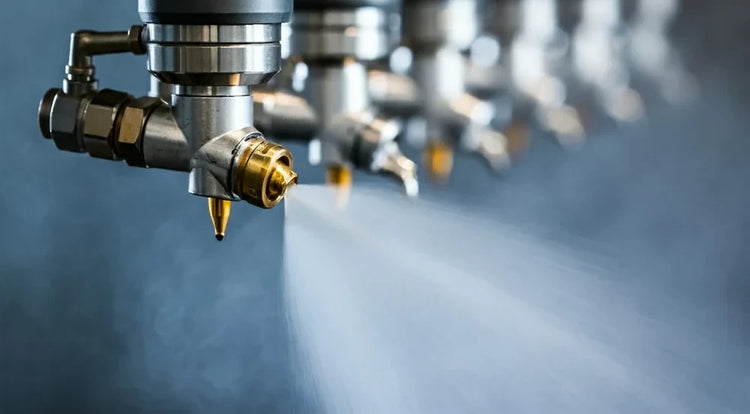
Spray Nozzle Materials & Chemical Compatibility Guide
Nozzle body and seal material selection organized by what you are spraying — strong acids, alkalis, oxidizers, solvents, abrasive slurries, high-temperature steam, food-contact, and more — with specific material recommendations for each chemical environment
How to use this guide: Find your chemical environment in the sections below. Each section gives the best, acceptable, and avoid materials for nozzle body and seals — organized by what you are spraying, not by material properties. Quick answers: strong acids (HCl, H₂SO₄, HF) → PVDF body, PTFE seals; sodium hypochlorite (bleach) above 5% → Hastelloy C-276 body, Viton seals; abrasive slurry (limestone, ore, coal) → any body with tungsten carbide orifice insert; high-temperature steam above 150°C → 316L SS or Hastelloy, PTFE seals; food-contact wash-down → 316L SS body, EPDM or Viton seals, NSF/3-A listed; organic solvents (acetone, MEK, toluene) → 316L SS body, PTFE seals — avoid all elastomers except PTFE.
Most important rule: When in doubt, test. Obtain a sample of the actual liquid, immerse a nozzle body coupon and seal material sample for 7 days at operating temperature, and measure weight change and dimensional change. Published compatibility charts are guides — actual chemical mixture concentrations, temperature, and impurities can change the result significantly from what a single-chemical chart predicts.
Two factors override every compatibility chart: temperature and concentration. A material that is "acceptable" for hydrochloric acid at 10% concentration and 20°C may fail within days at 30% concentration and 60°C. The reason: corrosion rates typically double for every 10°C temperature increase (Arrhenius relationship), and many corrosion mechanisms are highly non-linear with concentration — 316L SS that handles dilute sulfuric acid adequately is rapidly attacked by concentrated H₂SO₄ above 60%. Every compatibility recommendation in this guide assumes ambient temperature unless otherwise noted. For elevated-temperature service, always apply a safety factor by moving one step up the materials hierarchy — if 316L SS is "acceptable" at ambient, specify Hastelloy at elevated temperature.
Seal materials fail independently of body materials — a Hastelloy body with a Buna-N (NBR) O-ring will fail in concentrated acid service because NBR is not acid-resistant, even though the metallic body is. Always specify both body material and seal material when ordering nozzles for chemical service. The most common seal materials in industrial nozzles: Buna-N (NBR) — general water and mild chemicals; EPDM — mild acids, caustics, water, steam to 150°C; Viton (FKM) — strong acids, hydrocarbons, oxidizers; PTFE — nearly universal chemical resistance, highest-temperature rating, lowest elasticity (not ideal for seals requiring significant compression).
Strong Acids — HCl, H₂SO₄, HNO₃, HF, Phosphoric Acid
The most chemically aggressive nozzle service environment — material selection determines whether service life is measured in years or days
Hydrochloric Acid (HCl) — All Concentrations
HCl is one of the most aggressively corrosive acids for metallic nozzle materials. It attacks the passive oxide layer on stainless steel rapidly, even at low concentrations — 5% HCl will cause visible corrosion on 316L SS within days. The non-oxidizing nature of HCl (unlike nitric acid) means that conventional stainless steels cannot maintain passivity in contact with it.
PVDF (Kynar) Body + PTFE Seals
Best choice for HCl at all concentrations up to 37% at temperatures below 60°C. PVDF is inherently resistant to HCl across the full concentration range; no passive film required. Maximum operating pressure: 150 PSI.
Use for: Dilute to concentrated HCl spray; chemical dosing; pH adjustment nozzles; acid cleaning systemsHastelloy C-276 Body + Viton Seals
Best metallic option for HCl service at elevated temperatures (above 60°C) where PVDF pressure rating is insufficient. Hastelloy C-276 resists HCl at all concentrations up to approximately 50°C; above 50°C, test actual service conditions. Viton (FKM) seals required — Buna-N and EPDM are attacked by HCl.
Use for: High-pressure HCl service; elevated temperature HCl; applications where PVDF pressure limit (150 PSI) is inadequateSulfuric Acid (H₂SO₄) — Concentration-Dependent Selection
H₂SO₄ compatibility is highly non-linear with concentration — the correct material at one concentration can fail catastrophically at another. Dilute H₂SO₄ (below 10%) is non-oxidizing and attacks most metals similarly to HCl. Concentrated H₂SO₄ (above 70%) is strongly oxidizing and actually passivates some metals (cast iron, carbon steel) that dilute H₂SO₄ attacks. The intermediate range (50–70%) is the most aggressive for most materials.
Below 40% H₂SO₄ — PVDF + PTFE Seals
PVDF provides excellent resistance to dilute-to-moderate sulfuric acid at ambient temperatures. Above 40% or above 40°C, test before specifying PVDF — resistance degrades at higher concentrations and temperatures.
Dilute H₂SO₄ acidification, pH adjustment, pickling rinse spray40–70% H₂SO₄ or Elevated Temp — Hastelloy C-276 + Viton
The intermediate-concentration range is the most corrosive for most materials. Hastelloy C-276 provides the broadest resistance across this range. Test at actual concentration and temperature before finalizing specification.
Concentrated H₂SO₄ dosing, acid plant scrubbing, sulfation spray systemsAbove 93% H₂SO₄ — Cast Iron or Carbon Steel
Concentrated oleum and fuming H₂SO₄ passivates cast iron and carbon steel — an unusual case where base metals outperform SS. Verify with supplier for your specific concentration and temperature. Not applicable to spray nozzle service in most cases.
Fuming sulfuric acid storage and transfer — rarely applicable to spray nozzle serviceHydrofluoric Acid (HF) — Special Case
HF requires special treatment because it attacks materials that resist most other acids — including glass, silica, and many ceramics — and produces acutely toxic fumes. HF also attacks metallic alloys differently from HCl: it can stress-corrosion crack high-strength alloys and produces insoluble fluoride films that can complicate seal selection. Engineering expertise is required for any HF spray application.
PVDF Body + PTFE Seals — Standard for HF
PVDF is the material of choice for HF spray nozzles at all practical concentrations and temperatures below 60°C. PTFE seals — not Viton (FKM reacts with anhydrous HF at elevated temperatures). Maximum operating pressure 150 PSI. Avoid glass-filled PVDF grades — the glass filler is attacked by HF.
All HF spray applications: semiconductor wafer cleaning, glass etching spray, fluoride dosingCitric Acid, Phosphoric Acid, Acetic Acid — Organic and Weak Mineral Acids
Organic acids and weak mineral acids are significantly less aggressive than strong mineral acids but still attack some nozzle materials — particularly brass, bronze, and carbon steel — at elevated concentrations or temperatures. The most common industrial applications: phosphoric acid for metal cleaning and passivation, citric acid for descaling and odor neutralization, acetic acid in food and pharmaceutical processes.
316L SS Body + Viton Seals — Standard for Weak Acids
316L SS provides adequate service life for citric acid, phosphoric acid (below 50%), dilute acetic acid, lactic acid, and most food-grade organic acids at ambient temperature. Viton seals preferred over Buna-N for acid service. Replace annually or more frequently if visible surface discoloration develops.
CIP descaling with citric acid, phosphoric acid metal treatment, food processing weak acid sprayPVDF + PTFE — For Concentrated Weak Acids or Elevated Temperature
When phosphoric acid exceeds 50% concentration or is used at elevated temperature (above 60°C), or when acetic acid is glacial (above 80%): PVDF provides the corrosion resistance that 316L SS cannot reliably maintain at these conditions.
Concentrated phosphoric acid spray, glacial acetic acid, elevated temperature weak acid serviceAlkalis and Caustics — NaOH, KOH, Ammonia, Amines
Caustic environments attack different materials than acids — notably, caustics attack aluminum, zinc, and PVDF at high concentrations
Sodium Hydroxide (NaOH / Caustic Soda) and Potassium Hydroxide (KOH)
Caustic soda is one of the most widely used chemicals in industrial spray applications: scrubber caustic injection, CIP cleaning, pH adjustment, and chemical processing. 316L SS handles dilute caustic well at ambient temperature, but stress corrosion cracking (SCC) is a risk for SS in hot concentrated caustic (above 50°C, above 30% NaOH) — a failure mode that can occur without visible advance warning.
316L SS Body + EPDM or Viton Seals — Standard Service
316L SS is the standard material for caustic spray service at ambient to moderate temperatures (below 50°C). EPDM seals for caustic service are excellent; Viton (FKM) is also acceptable. Buna-N (NBR) is adequate for dilute caustic but not recommended for concentrated NaOH. Replace SS nozzles if operating above 50°C in concentrated caustic — SCC risk.
Caustic scrubber nozzles, CIP caustic spray, pH adjustment, general industrial caustic dosing at ambient temperatureHastelloy C-276 + Viton — Hot or Concentrated Caustic
For NaOH above 30% concentration at temperatures above 50°C: Hastelloy C-276 eliminates the SCC risk that affects SS. Viton seals. More expensive than SS — justify by elevated temperature or concentration, not routine dilute caustic service.
Hot caustic CIP (above 60°C), concentrated NaOH above 30%, evaporator spray systems with hot caustic concentrateAmmonia (NH₃ Solution), Ammonium Hydroxide, and Industrial Amines
Ammonia solution (aqueous NH₃) and amine-based chemicals are used in scrubbers, SNCR systems, odor control, and chemical synthesis. Ammonia specifically attacks copper alloys — brass and bronze — through a mechanism called stress corrosion cracking that can cause rapid failure even in mildly concentrated solutions.
316L SS Body + EPDM Seals — Standard for Ammonia
316L SS provides reliable service across all practical ammonia concentrations (1–30% aqueous) at ambient and elevated temperatures. EPDM seals for aqueous ammonia; Viton also acceptable. Polypropylene or PVDF bodies for low-pressure ammonia odor control spray systems.
SNCR urea/ammonia injection, NH₃ scrubber nozzles, ammonia odor control fog systems, ammonium hydroxide dosingOxidizing Agents — Sodium Hypochlorite, Hydrogen Peroxide, Chlorine Dioxide, Ozone
Oxidizers are uniquely damaging because they attack the passive film that makes stainless steel corrosion-resistant — at concentrations far below what would be considered "strong"
Sodium Hypochlorite (NaOCl / Bleach) — Concentration-Dependent Specification
Sodium hypochlorite is the most commonly misspecified chemical for nozzle material selection in industrial applications. The widely available guidance that "stainless steel resists chlorine" refers to passive SS in dilute chlorinated water — not to concentrated hypochlorite solution in direct contact with the nozzle body. Commercial bleach (10–12% NaOCl) causes rapid pitting corrosion of 316L SS at concentrations above 2–3%, through a chloride attack mechanism that specifically destroys the passive oxide layer. This is why FGD odor control systems and wastewater H₂S suppression systems experience rapid nozzle corrosion when SS nozzles are used with concentrated hypochlorite dosing.
Below 2% NaOCl — 316L SS + Viton Seals
Dilute hypochlorite at working concentrations below 2% (equivalent to approximately 20,000 ppm free chlorine): 316L SS provides adequate service life at ambient temperature. Viton (FKM) seals — Buna-N (NBR) is oxidized by hypochlorite within weeks. Monitor for pitting if the working concentration approaches 2%.
Dilute bleach disinfection spray, low-concentration odor control, diluted CIP sanitizer spray2–10% NaOCl — Hastelloy C-276 + Viton Seals
For working concentrations of 2–10% NaOCl: Hastelloy C-276 provides 2–5× longer service life than 316L SS. Viton seals mandatory. This range covers most industrial odor suppression and H₂S neutralization systems using stock bleach diluted to working concentration.
H₂S odor suppression at wastewater treatment, industrial disinfection at 5–10% dilution, CIP sanitizing sprays above 2%Above 10% NaOCl — PVDF + PTFE Seals
For undiluted commercial bleach (10–12%) or concentrated hypochlorite above 10%: PVDF body with PTFE seals. Even Hastelloy C-276 shows accelerated corrosion above 10% NaOCl at ambient temperature. Maximum operating pressure 150 PSI. PTFE seals — Viton can be attacked by very concentrated hypochlorite at elevated temperature.
Undiluted bleach dosing systems, high-concentration sanitizer injection, chemical feed injectors handling concentrated hypochlorite before dilutionHydrogen Peroxide (H₂O₂) and Chlorine Dioxide (ClO₂)
H₂O₂ is preferred over hypochlorite for applications requiring no chlorine residual — wastewater H₂S neutralization, food and pharmaceutical disinfection, and semiconductor cleaning. ClO₂ is the most effective per-unit oxidant for H₂S control at high concentrations. Both attack 316L SS at concentrations used in industrial applications.
H₂O₂ below 10% — 316L SS + Viton Seals
Dilute hydrogen peroxide at working concentrations (3–10%) used for odor suppression, disinfection, and water treatment: 316L SS provides adequate service at ambient temperature. Viton seals. Monitor for any surface discoloration indicating oxidative attack.
H₂S suppression at 3–10% H₂O₂, food processing disinfection spray, wastewater treatment oxidant dosingH₂O₂ 10–35% or ClO₂ — Hastelloy C-276 + Viton or PVDF + PTFE
Industrial-strength H₂O₂ (35% stock solution) and all ClO₂ concentrations: specify Hastelloy C-276 as the minimum metallic option, or PVDF for ambient-temperature service within 150 PSI pressure limit. PTFE seals for highest-concentration oxidizer service.
Concentrated H₂O₂ injection, ClO₂ generation system nozzles, high-efficiency H₂S oxidation dosingOrganic Solvents — Acetone, MEK, Toluene, Alcohols, Esters
Solvents attack elastomeric seals far more severely than nozzle bodies — the seal material selection is the critical decision in solvent service
Ketones (Acetone, MEK), Aromatics (Toluene, Xylene), and Esters
Most organic solvents do not corrode metallic nozzle bodies — 316L SS, Hastelloy, and brass all have acceptable chemical resistance to most solvents from a corrosion perspective. The dominant failure mode in solvent spray nozzles is seal swelling or dissolution: Buna-N (NBR) and EPDM elastomers absorb aromatic solvents and ketones, swelling dramatically and losing their sealing function within hours to days of exposure.
316L SS Body + PTFE Seals — Universal Solvent Specification
316L SS body with PTFE seals is the standard and broadly correct specification for any organic solvent spray application. PTFE has near-universal chemical resistance to organic solvents — it does not swell or dissolve in ketones, aromatics, esters, or most chlorinated solvents. Viton (FKM) seals are acceptable for many solvents but check specific compatibility — Viton swells in ketones (acetone, MEK) at high concentrations. Buna-N and EPDM are not acceptable for solvent service.
Solvent spray coating nozzles, solvent injection for cleaning, aromatic solvent dosing, ester spray applicationsAvoid PVDF in Solvent Service
PVDF, which is the best material for most acid services, is attacked by some organic solvents — specifically polar aprotic solvents (dimethylformamide, DMSO, NMP) and some esters and ketones at elevated temperature. Do not default to PVDF for solvent service without confirming compatibility for the specific solvent and temperature.
Check PVDF compatibility specifically for: acetone above 50°C, NMP, DMF, DMSO, ethyl acetate above 40°CAlcohols (Methanol, Ethanol, IPA) and Glycols
Alcohols and glycols are significantly less aggressive than aromatic solvents and ketones. Alcohols have minimal effect on most seal materials at ambient temperature, though methanol at elevated temperature and high concentration can swell some elastomers. IPA (isopropyl alcohol) is widely used in pharmaceutical and electronics cleaning spray systems.
316L SS Body + Viton or EPDM Seals
316L SS with Viton seals handles all common alcohols (methanol, ethanol, IPA, n-butanol) and glycols (ethylene glycol, propylene glycol) at all concentrations and ambient temperature. For pharmaceutical spray applications requiring documentation: specify FDA-compliant elastomers (EPDM or Viton grades with FDA status). For heated glycol spray above 80°C: verify seal compatibility at actual service temperature.
IPA cleaning spray, ethanol disinfection, glycol dosing, pharmaceutical alcohol spray systemsAbrasive Slurries — Limestone, Ore, Coal, Cement, Sand
Abrasion is a mechanical failure mode, not a chemical one — the solution is hardness, not corrosion resistance
Industrial Abrasive Slurries — Limestone, Fly Ash, Ore, Mineral Processing, Coal
Abrasive wear in spray nozzle orifices is governed by the relative hardness of the abrasive particle vs. the orifice surface material. When the abrasive particle is harder than the orifice surface (which is the case for most mineral slurries against SS), micro-cutting and micro-ploughing at the orifice face enlarge the orifice progressively. The Mohs hardness comparison is the correct framework: particles above Mohs 5–6 (harder than 316L SS at Mohs 5–6) cause rapid abrasive wear of SS nozzle orifices. Only tungsten carbide (Mohs 9–9.5) and ceramic orifice inserts are harder than most industrial abrasive particles.
Any Body Material + Tungsten Carbide Orifice Insert
Tungsten carbide (TC) orifice inserts are the standard solution for abrasive slurry nozzle service. The TC insert provides an extremely hard orifice surface (Mohs 9–9.5) that resists micro-cutting from limestone (Mohs 3), silica (Mohs 7), alumina (Mohs 9), and most industrial mineral abrasives. The nozzle body can be 316L SS or Hastelloy depending on the chemical environment — the orifice insert determines wear resistance, the body material determines corrosion resistance. TC inserts are held in the body by press-fit, shrink-fit, or mechanical retention and can be factory-installed in most standard spiral, hollow-cone, flat-fan, and full-cone nozzle bodies.
FGD limestone slurry, ore processing slurry, coal handling water, cement washdown, mining process water, fly ash slurry, any mineral slurry with Mohs hardness above 4Body Material Selection for Corrosive Abrasive Slurry
When the slurry is both abrasive and corrosive (acid mine drainage, FGD acidic slurry at pH 4–6), the body material must address both: TC insert for abrasion resistance at the orifice; Hastelloy C-276 body for acid corrosion resistance on all body surfaces contacting the slurry. 316L SS body for neutral-pH abrasive slurries (pH 6–8). PVDF body is not recommended for highly abrasive slurries — abrasive particles impacting the polymer body erode the body surface even when the TC insert protects the orifice.
Acid mine drainage spray: Hastelloy + TC; Limestone FGD: Hastelloy + TC; Neutral ore slurry: 316L SS + TC; Coal handling: 316L SS + TCHigh-Temperature Service — Steam, Hot Process Fluids, Furnace Environments
Temperature is the single factor most likely to change a correct material selection into an incorrect one
Hot Water and Steam Service (80–300°C)
High-temperature service eliminates polymer nozzle body and seal options progressively as temperature increases: polypropylene fails above 80°C; PVDF softens above 120°C under pressure; EPDM seals reach their limit near 150°C; Buna-N (NBR) fails above 120°C. Above 150°C, metallic nozzle bodies with PTFE seals are the only reliable configuration. Above 250°C, even PTFE creeps under sustained pressure load and requires periodic re-torquing or replacement.
316L SS Body + PTFE Seals — Up to 450°C (Clean Steam)
316L SS with PTFE seals is the standard specification for hot water and steam nozzles at temperatures up to approximately 450°C for clean water/steam service. PTFE seals maintain chemical inertness and dimensional stability to 260°C continuous (short-term excursions to 300°C). Above 260°C: metal-to-metal seat or graphite packing; no organic seals. Verify pressure rating at temperature — yield strength of SS decreases above 300°C.
Steam humidification, hot water spray, process vessel cooling with hot water, heat treat quench hot rinse, spray drying inlet air humidificationHastelloy C-276 or Inconel 625 — Corrosive Hot Fluids or Extreme Temperature
When the hot fluid is also corrosive (hot acid, hot caustic above 50°C, hot chloride solutions): Hastelloy C-276 provides corrosion resistance that 316L SS cannot reliably maintain at elevated temperature. For furnace environments and radiant heat exposure above 600°C: Inconel 625, which maintains strength and oxidation resistance at extreme temperatures. SNCR lance tip nozzles on water-cooled lances in 850–1,100°C furnace environments: Inconel 625 standard specification.
Hot acid spray above 60°C: Hastelloy; SNCR injection lances 850–1,100°C: Inconel 625; quench tower above 400°C: Inconel 625 or 316L SS with thermal shieldingFood Contact, Pharmaceutical, and Sanitary Spray Applications
Regulatory compliance and cleanability requirements drive material selection as much as chemical resistance
Food-Contact Spray, CIP/SIP Systems, Pharmaceutical Manufacturing
Food and pharmaceutical spray nozzle material requirements are driven by two parallel considerations: (1) chemical resistance to the cleaning and sanitizing agents used in CIP/SIP cycles (typically NaOH 1–4%, nitric acid 0.5–2%, sodium hypochlorite 50–200 ppm, peracetic acid 0.1–0.3%, steam sterilization at 121–134°C); and (2) regulatory compliance — 3-A Sanitary Standards, FDA 21 CFR, EU 10/2011, and USP Class VI for pharmaceutical applications. Surface finish is a specification: Ra ≤ 0.8 µm for food contact, Ra ≤ 0.4 µm for pharmaceutical, to prevent biofilm harboring and ensure cleanability.
316L SS (Electropolished) + FDA-Grade EPDM Seals
Electropolished 316L SS (surface finish Ra ≤ 0.8 µm) with FDA-grade EPDM seals is the standard specification for food and beverage spray nozzles. 3-A certified nozzles are available for dairy applications requiring 3-A compliance. Electropolishing removes surface inclusions, smooths micro-roughness, and enriches the chromium oxide passive layer — improving both cleanability and corrosion resistance vs. mechanically polished SS. Specify 316L (not 304) for CIP acid contact (nitric acid CIP will pit 304 SS over time).
Food processing spray coating, CIP spray headers, dairy washdown, beverage container rinsing, institutional food equipment cleaningPharmaceutical Grade — USP Class VI EPDM or PTFE Seals
For injectable pharmaceutical manufacturing, biopharmaceutical, and USP water systems: specify USP Class VI elastomers (EPDM or silicone tested per USP Class VI extractables protocol) or PTFE. Nozzle body finish Ra ≤ 0.4 µm (electropolished 316L or better). Passivated per ASTM A967 or equivalent. Document material certificates and extraction test data. SIP (Steam-In-Place) sterilization at 121°C: all nozzle components must withstand repeated SIP cycles without degradation.
Injectable manufacturing spray systems, USP purified water distribution, cleanroom humidification, bioreactor sprayPeracetic Acid (PAA) — PVDF + PTFE or Hastelloy + Viton
Peracetic acid at 0.1–0.5% working concentration is increasingly used as a food-safe sanitizer. At these concentrations: 316L SS is generally acceptable but shows higher corrosion rates than with caustic or mild acid CIP. For higher concentrations or more frequent exposure: PVDF with PTFE seals provides better resistance. Some PAA formulations contain hydrogen peroxide (HP/PAA blends) — confirm compatibility for the specific blend.
Food plant PAA sanitizer spray, beverage line PAA COP/CIP, organic-certified PAA-based sanitization systemsSeawater, Brines, and High-Chloride Environments
Chloride ions are the primary cause of stainless steel failure — seawater and brines attack SS through pitting, not uniform corrosion
Seawater, Brine, and High-Chloride Process Water
Chloride ions (Cl⁻) are the specific chemical species that cause pitting corrosion of stainless steel by locally breaking down the passive oxide film. The critical pitting temperature (CPT) — the temperature above which pitting initiates — depends on the chloride concentration and the SS grade: 316L SS has a CPT of approximately 15–25°C in 3.5% NaCl (seawater concentration). This means that 316L SS can be marginally acceptable in seawater at cold ambient temperatures but will pit at typical warm operating temperatures. For marine applications and high-chloride process water above ambient temperature: Hastelloy C-276 or Duplex SS (2205) are the minimum specification.
Hastelloy C-276 + Viton Seals — Marine and High-Chloride Standard
Hastelloy C-276 resists pitting and crevice corrosion in seawater and high-chloride environments across the full industrial temperature range. The molybdenum content (15–16%) specifically enhances resistance to pitting initiation by chloride. Specify for offshore platform washdown nozzles, desalination plant spray systems, aquaculture spray systems, and any coastal or marine industrial spray application.
Offshore washdown, desalination spray, aquaculture aeration, marine equipment cooling, coastal industrial wash systemsPVDF + PTFE — Where Metallic Corrosion Is a Concern and Pressure Allows
PVDF has excellent resistance to chloride solutions at all concentrations and ambient temperatures — no pitting mechanism applies to polymer bodies. For seawater and brine spray applications within the 150 PSI pressure limit: PVDF provides a cost-effective alternative to Hastelloy where high-pressure metallic construction is not required.
Low-pressure seawater misting, brine fog systems, salt spray test chamber nozzles, coastal humidity controlNozzle Body Material Properties at a Glance
Key specifications for the seven primary nozzle body materials — for rapid design reference
316L SS (316L Stainless Steel)
The universal baseline material for industrial spray nozzles. Good corrosion resistance in dilute acids, most alkalis, clean water, and mild process chemicals. Vulnerable to chloride pitting above 15–20°C and to strong acids (HCl, concentrated H₂SO₄).
Max temp: 870°C (oxidizing); Max pressure: 10,000+ PSI (body limited); Hardness: Mohs 5–6; Cost: ●○○○○Hastelloy C-276
Premium nickel-chromium-molybdenum alloy. Outstanding resistance to strong acids, oxidizers, chlorides, and mixed chemical environments where 316L SS fails. The first-upgrade material for any application where SS shows rapid corrosion. Higher cost but often necessary for compliance-critical service.
Max temp: 1,040°C; Pitting resistance (PREN): 69 vs 316L at 23; Hardness: Mohs 5–6; Cost: ●●●○○Monel 400 (Ni-Cu Alloy)
Nickel-copper alloy with excellent resistance to non-oxidizing acids, seawater, and hydrofluoric acid — historically used before Hastelloy for HF and marine service. Less versatile than Hastelloy C-276 for oxidizing service; not recommended for concentrated oxidizing acids or hypochlorite.
Max temp: 480°C continuous; Best for: HF, seawater, non-oxidizing acids, reducing environments; Cost: ●●○○○Inconel 625
Nickel-chromium-molybdenum-niobium alloy. The highest-temperature metallic nozzle material in common industrial use. Used primarily for SNCR lance tip nozzles and extreme-temperature quench applications. Excellent oxidation resistance above 500°C where Hastelloy reaches its service limit.
Max temp: 980°C continuous; 1,100°C short-term; Best for: SNCR lances, extreme quench; Cost: ●●●●○PVDF (Polyvinylidene Fluoride / Kynar)
The most broadly chemically resistant polymer nozzle body material. Resistant to strong acids, strong oxidizers, and most organic solvents. Pressure limit 150 PSI; temperature limit 120°C under pressure. Not compatible with polar aprotic solvents (DMF, DMSO, NMP) or hot concentrated caustic.
Max temp: 120°C under pressure; Max pressure: 150 PSI; Chemical resistance: excellent for acids and oxidizers; Cost: ●●○○○Polypropylene (PP)
Low-cost polymer body for mild chemical service at low pressure and ambient temperature. Good resistance to dilute acids, alkalis, and aqueous salt solutions. Temperature limit 80°C limits use to ambient-temperature applications. Not suitable for strong oxidizers, aromatic solvents, or concentrated acids.
Max temp: 80°C; Max pressure: 100 PSI; Best for: dilute chemical dosing, fog systems, low-pressure ambient service; Cost: ●○○○○Brass (Cu-Zn Alloy)
Traditional material for non-corrosive clean water spray nozzles and municipal applications. Never use in acid service, ammonia, amines, or seawater (dezincification). Not acceptable for food contact due to lead content in some alloys. Cost-effective for clean water indoor applications.
Max temp: 150°C; Avoid: acids, ammonia, seawater, chlorine, food contact; Best for: clean water only; Cost: ●○○○○Seal Material Selection — The Factor Most Often Overlooked
Buna-N (NBR): General-purpose seal for water, mineral oils, dilute alkalis, and mild chemical service. Not acceptable for: acids (even dilute), oxidizers (bleach, H₂O₂), aromatic solvents (toluene, xylene), ketones (acetone, MEK), or ozone. The most commonly misapplied seal material in chemical spray systems — it is cheap and widely available, which leads to its use in services it does not tolerate.
EPDM: Excellent for water, steam (to 150°C), dilute acids (pH above 4), caustics, and many aqueous chemical solutions. Not acceptable for: petroleum products, mineral oils, most organic solvents, or aromatic hydrocarbons. The standard seal for food processing and CIP applications — available in FDA-compliant grades. Often specified as a generic upgrade from Buna-N without checking solvent compatibility.
Viton (FKM): The broadest chemical resistance among elastomeric seals: strong acids, strong oxidizers, hydrocarbons, most solvents, and elevated-temperature service to 200°C. Not recommended for: ketones at high concentration (Viton swells in acetone), low-molecular-weight esters, and some amines. The correct first-choice seal for any unknown or aggressive chemical environment where PTFE flexibility is insufficient for the sealing application.
PTFE: Near-universal chemical resistance — resists virtually all acids, alkalis, solvents, and oxidizers to 260°C continuous. Limitation: PTFE is not an elastomer — it does not recover from compression as well as FKM or EPDM, and it cold-flows under sustained load (creep), potentially requiring periodic re-torquing. For static seals (face seals, flat gaskets): PTFE is excellent. For dynamic or compression seals requiring elasticity: Viton is often more practical.
Quick-Reference Compatibility Matrix
A = Excellent (2+ year expected service life); B = Good (1–2 years); C = Marginal (6–12 months, monitor closely); D = Avoid (rapid failure)
| Chemical Environment | 316L SS | Hastelloy C-276 | PVDF | Brass | Viton Seal | EPDM Seal |
|---|---|---|---|---|---|---|
| Clean water (ambient) | A | A | A | A | A | A |
| HCl — all concentrations | D | A | A | D | A | C |
| H₂SO₄ — dilute (<10%) | C | A | A | D | A | C |
| H₂SO₄ — concentrated (>50%) | D | B | C | D | A | D |
| HF — all concentrations | D | C | A | D | C | D |
| NaOH — dilute (<30%), ambient | A | A | A | D | A | A |
| NaOH — concentrated, hot (>50°C) | C | A | B | D | A | B |
| Ammonia / NH₃ solution | A | A | A | D | A | A |
| NaOCl / bleach <2% | B | A | A | D | A | C |
| NaOCl / bleach 2–10% | D | A | A | D | A | D |
| H₂O₂ — 3–10% | B | A | A | D | A | C |
| Acetone / MEK (ketones) | A | A | C | A | C | D |
| Toluene / xylene (aromatics) | A | A | B | A | A | D |
| Ethanol / IPA (alcohols) | A | A | A | A | A | A |
| Seawater / high chloride brine | C | A | A | D | A | A |
| Steam / hot water >150°C | A | A | D | C | A | B |
| Citric acid / phosphoric acid | A | A | A | C | A | A |
| Limestone slurry (FGD) | C | A | D | D | A | A |
Ratings are for ambient temperature unless noted. Elevated temperature lowers rating by one grade for most materials. Test actual process fluid and conditions before finalizing specification. TC orifice insert recommendation applies independently of body material for any abrasive slurry service regardless of the above ratings.
Frequently Asked Questions — Nozzle Material Compatibility
Direct answers to the most common nozzle material selection questions
What is the best nozzle material for hydrochloric acid (HCl)?
PVDF (Kynar) body with PTFE seals is the best choice for HCl at all concentrations (1–37%) at temperatures below 60°C and operating pressures below 150 PSI. PVDF provides inherent chemical resistance to HCl without relying on a passive film — the mechanism that fails for stainless steel in HCl service. For elevated temperatures (above 60°C) or pressures above 150 PSI where PVDF is not suitable: Hastelloy C-276 body with Viton (FKM) seals. Never use 316L SS, 304 SS, brass, or bronze in HCl contact — all fail within days to weeks at even dilute concentrations through chloride-induced pitting and crevice corrosion. The passive oxide layer on stainless steel cannot be maintained in the presence of HCl at any practical concentration.
What nozzle material is best for sodium hypochlorite (bleach)?
Material selection for sodium hypochlorite depends critically on concentration. Below 2% NaOCl (working concentration): 316L SS with Viton seals is acceptable at ambient temperature — monitor for early pitting signs. Between 2–10% NaOCl: Hastelloy C-276 body with Viton seals — 316L SS corrodes rapidly at this concentration through chloride-driven oxidative pitting. Above 10% NaOCl (undiluted commercial bleach): PVDF body with PTFE seals — even Hastelloy shows accelerated attack at this concentration at ambient temperature. Critical installation note: inject concentrated hypochlorite upstream at a dilution mixing point — never directly at the nozzle. Concentrated bleach evaporating at the orifice face between spray cycles creates locally very high concentrations that attack even the correct body material. Buna-N (NBR) and EPDM seals are attacked by hypochlorite at all concentrations — always specify Viton (FKM) seals for any NaOCl service.
What nozzle material lasts longest in highly abrasive environments?
Tungsten carbide (TC) orifice inserts provide the longest service life in abrasive slurry environments — typically 5–10× longer than 316L SS orifices in the same service. The mechanism: abrasive wear rate scales with the hardness ratio between the abrasive particle and the orifice surface. TC at Mohs 9–9.5 is harder than virtually all industrial mineral abrasives (limestone Mohs 3, quartz/silica Mohs 7, alumina Mohs 9). 316L SS at Mohs 5–6 is softer than most industrial abrasives, leading to rapid micro-cutting wear. TC inserts are available for most hollow-cone, flat-fan, full-cone, and spiral nozzle types — the TC insert provides the orifice, while the nozzle body can be specified separately for corrosion resistance (316L SS for neutral pH slurry, Hastelloy C-276 for acidic slurry). For extreme abrasion where even TC inserts wear rapidly: ceramic (Al₂O₃ or ZrO₂) orifice inserts are an alternative — harder than TC in some configurations but more brittle (higher fracture risk from impact).
Can I use stainless steel nozzles in seawater service?
316L SS in seawater is marginal — acceptable for short-term or infrequent exposure in cold temperatures (below 15°C), but will develop pitting corrosion in sustained seawater contact above ambient temperature. The failure mechanism is chloride pitting: Cl⁻ ions at seawater concentration (~19,000 ppm) locally destroy the passive oxide film on SS at temperatures above the critical pitting temperature (CPT), which is 15–25°C for 316L SS in seawater. Above 25°C — which covers most industrial seawater applications in tropical or subtropical environments, or any heated seawater — 316L SS will pit progressively and fail within months. For sustained seawater service: Hastelloy C-276 is the standard metallic specification (PREN = 69 vs. 316L SS PREN = 23 — a far higher pitting resistance equivalent number). PVDF is an excellent alternative for ambient-temperature, lower-pressure seawater spray applications (desalination fog, aquaculture misting, coastal washdown) where its 150 PSI pressure limit is acceptable. Brass must never be used in seawater — dezincification of the zinc component occurs rapidly, leaving a porous copper sponge with no structural integrity.
How do I choose between Viton and EPDM O-ring seals for a spray nozzle?
The choice between Viton (FKM) and EPDM depends on the chemical environment, temperature, and whether the application involves petroleum products. EPDM is the better choice for: hot water and steam service (excellent to 150°C, better than Viton in prolonged steam); dilute caustic (NaOH, KOH); mild acids at pH above 4; aqueous salt solutions; and most food and CIP applications where FDA-grade EPDM is available and well-established. EPDM is attacked by: petroleum oils and fuels, most organic solvents, strong acids, and hypochlorite — do not use EPDM in any of these services. Viton (FKM) is the better choice for: strong acids (all concentrations), oxidizers (NaOCl, H₂O₂, HNO₃), aromatic solvents (toluene, xylene), aliphatic hydrocarbons (hexane, mineral spirits), chlorinated solvents, and general unknown or aggressive chemical environments. Viton is the safer default choice for any acid or oxidizer service. The limitation of Viton: it is attacked by ketones (acetone, MEK) at high concentrations and by some low-molecular-weight esters — if the spray includes ketone solvents, specify PTFE seals instead. When in doubt between Viton and EPDM: choose Viton — it has broader chemical resistance and is the correct choice for a wider range of industrial applications, with the ketone exception being the main practical limitation.
Do I need to change nozzle material when I increase chemical concentration or temperature?
Yes — both concentration increases and temperature increases frequently require upgrading the nozzle material specification, even when the current material is performing acceptably. The chemical engineering principle: corrosion rates typically double for every 10°C increase in temperature (Arrhenius relationship). A material with a 24-month service life at 20°C may have only a 6-month service life at 40°C, and a 6-week service life at 60°C. Concentration effects are often non-linear: 316L SS may handle 5% NaOCl poorly (rapid pitting) while 2% NaOCl is marginally acceptable — a threefold concentration increase is not a gradual change but a step change across a threshold. The practical approach when a process change is planned: (1) check the quick-reference matrix or the environment-specific guidance in this guide for the new conditions; (2) if the new conditions move the material from the A or B rating to C or D, upgrade to the next material tier before the process change takes effect; (3) if the change is borderline: install sample coupons of both the current and the proposed upgrade material in the actual process stream for 30 days before the system change, and measure material loss and surface condition on each. This coupon test is the most reliable method for a specific process mixture that may not match any single-chemical compatibility chart exactly.
Not Sure Which Material Fits Your Chemical Environment?
Share your chemical name, concentration, temperature, operating pressure, and whether the service is continuous or intermittent — our application engineers will specify the correct body material, orifice insert, and seal material for your exact process conditions.