
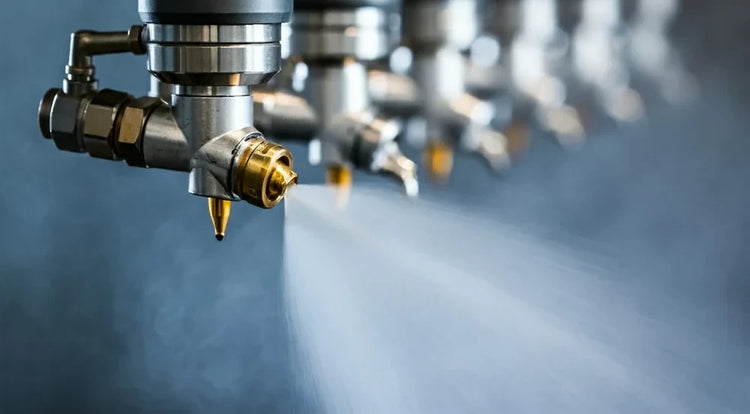
Sprühdüse
Materialauswahl-Leitfaden
Das richtige Düsenmaterial für Ihre Anwendung hängt von der zu versprühenden Flüssigkeit, der Betriebstemperatur und den mechanischen Anforderungen des Betriebs ab. Dieser Leitfaden behandelt jedes NozzlePro-Gehäusematerial und jede Dichtungsoption – was jedes gut bewältigt, was nicht und wie man zwischen ähnlichen Optionen wählt.
Jede Sprühdüse hat zwei Materialentscheidungen: das Gehäusematerial (Messing, Edelstahl, PVDF usw.) und das Dichtungsmaterial (PTFE, EPDM, Viton usw.). Beide müssen chemisch kompatibel mit der zu versprühenden Flüssigkeit und der Betriebstemperatur sein. Ein Gehäuse aus Edelstahl 316 mit EPDM-Dichtungen, das mit Ihrer Flüssigkeit inkompatibel ist, ist ebenso ein Fehler wie das falsche Gehäusematerial – und Dichtungsversagen ist oft schneller und schwieriger zu erkennen.
Arbeiten Sie zuerst die Gehäusematerialien durch, um das richtige Strukturmaterial für Ihre Anwendung zu finden, und überprüfen Sie dann das Dichtungsmaterial anhand Ihrer spezifischen Flüssigkeit. Wenn Sie sich bezüglich der Kompatibilität unsicher sind, kontaktieren Sie vor der Bestellung das NozzlePro-Anwendungsteam mit dem Namen oder der Zusammensetzung der Flüssigkeit, der Konzentration und der Betriebstemperatur.
Messing ist das Standardmaterial für das breiteste Spektrum von NozzlePro-Sprühdüsen. Seine Kombination aus Bearbeitbarkeit, Dimensionsstabilität und mäßiger Korrosionsbeständigkeit macht es zur richtigen Wahl für Wasser, milde Reinigungslösungen und die meisten Standard-Industrieanwendungen, bei denen die Flüssigkeit nicht stark korrosiv ist und Metallionenverunreinigungen kein Problem darstellen.
Messing ist eine Kupfer-Zink-Legierung – dies ist wichtig für die Kompatibilität. Anwendungen mit Ammoniak oder Aminen können unter bestimmten Bedingungen Spannungsrisskorrosion in Messing verursachen. Anwendungen, die einen metallfreien Kontakt mit dem Produkt erfordern (Lebensmittel, Pharmazeutika, Elektronik), sollten Edelstahl- oder Kunststoffalternativen verwenden. Für die Mehrheit der industriellen Spül-, Kühl- und Prozesssprühanwendungen, die wasserbasierte Flüssigkeiten bei Umgebungstemperaturen bis mäßigen Temperaturen verwenden, bietet Messing die beste Kombination aus Leistung und Wert.
Edelstahl 316 ist das Standard-Upgrade von Messing für jede Anwendung, die korrosive Flüssigkeiten, erhöhte Temperaturen oder Anforderungen an die Produktreinheit beinhaltet. Die Zugabe von Molybdän (2–3%) zur 316-Legierung verbessert die Beständigkeit gegen Chlorid-Lochkorrosion im Vergleich zu Edelstahl 304 erheblich – wodurch 316 die richtige Wahl für Spül- und CIP-Anwendungen in der Lebensmittelverarbeitung, Pharma- und Chemieindustrie ist, wo Reinigungs- und Prozesschemikalien beteiligt sind.
316 SS bewältigt das gesamte Spektrum von neutralen bis mäßig sauren und alkalischen Lösungen, die Messing nicht kann – verdünnte Schwefelsäure, Natriumhydroxidlösungen in mäßigen Konzentrationen, die meisten gängigen Reinigungsmittel, heißes Wasser und Dampf sowie viele Lösungsmittel. Seine Temperaturbeständigkeit bis ca. 204°C macht es geeignet für Heißwasserwäschen, Dampf und Prozesssprühanwendungen bei erhöhten Temperaturen, wo Kunststoffmaterialien unzureichend wären.
304 vs. 316 Edelstahl – Immer 316 angeben
NozzlePro gibt 316 Edelstahl als Standard für alle Edelstahldüsen an. Beim Kauf von jedem Lieferanten bestätigen Sie bitte, dass die Legierung 316 (UNS S31600) und nicht 304 (UNS S30400) ist. Der Unterschied ist wichtig – 304 hat keine Molybdänzugabe und ist wesentlich anfälliger für Chlorid-Lochkorrosion in feuchten Industrieumgebungen, in denen Sprühdüsen betrieben werden. Ersetzen Sie 304 nicht durch 316 bei Sprühdüsenanwendungen, die chloridhaltige Flüssigkeiten oder Umgebungen betreffen.
Polyvinylidenfluorid (PVDF, kommerziell als Kynar vertrieben) ist das Fluorkunststoffmaterial der Wahl für Sprühdüsenanwendungen, die aggressive Chemikalien umfassen, die die Fähigkeiten von Edelstahl 316 übersteigen. Seine Beständigkeit gegen starke Säuren, starke Basen, Oxidationsmittel, Halogene und viele organische Lösungsmittel ist ausgezeichnet – in den meisten aggressiven chemischen Umgebungen überlegen gegenüber 316 SS.
PVDF ist besonders häufig in pharmazeutischen und chemischen Fertigungsanwendungen zu finden, die Peressigsäure (PAA) Desinfektionsmittel, Wasserstoffperoxid, starke Hypochloritlösungen und Mineralsäuren verwenden. Es ist auch geeignet, wenn ein metallfreier Produktkontakt erforderlich ist und die chemische oder Temperaturbeständigkeit von Polypropylen unzureichend ist. PVDF hat eine gute mechanische Festigkeit und Schlagfestigkeit im Vergleich zu anderen Fluorkunststoffen – es lässt sich gut bearbeiten und hält präzise Düsengrößen zuverlässig ein.
Polypropylen ist das kostengünstigste Kunststoffdüsenmaterial und bietet eine gute chemische Beständigkeit gegenüber einer Vielzahl milder Säuren, Laugen und wässriger Lösungen bei Temperaturen unter ca. 175 °F. Es ist das richtige Material, wenn kein Metall erforderlich ist, die Kosten minimiert werden müssen und die Betriebstemperatur und die chemische Aggressivität innerhalb der Polypropylen-Fähigkeiten liegen.
Die Einschränkungen von Polypropylen sind die Temperatur- und Lösungsmittelbeständigkeit. Oberhalb von 175 °F wird es weich und verliert seine Dimensionsstabilität, was zu einer Verformung der Düsenöffnung und einer unzuverlässigen Sprühleistung führt. Gegen aromatische Kohlenwasserstoffe (Toluol, Xylol), chlorierte Lösungsmittel, stark oxidierende Säuren und konzentrierte Schwefelsäure hält Polypropylen nicht stand. Für diese Anwendungen ist PVDF oder Edelstahl die richtige Wahl.
Hastelloy C-276 ist eine Nickel-Molybdän-Chrom-Legierung mit außergewöhnlicher Korrosionsbeständigkeit in hochaggressiven chemischen Umgebungen – Umgebungen, die Edelstahl 316 schnell angreifen. Seine Kombination aus hohem Nickel-, hohem Molybdän- und Wolframgehalt verleiht ihm Beständigkeit gegenüber oxidierenden und reduzierenden Säureumgebungen, halogenidhaltigen Lösungen und Mischsäuresystemen, die mit jedem metallischen Material der unteren Stufe unbrauchbar wären.
Hastelloy-Sprühdüsen werden für chemische Prozessanwendungen spezifiziert, die Salzsäure in erhöhten Konzentrationen oder Temperaturen, nasse Chlorgaswäsche, Mischsäuresysteme und hochkorrosive Prozessströme in der Spezialchemikalien- und Pharmaproduktion umfassen. Der Kostenaufschlag gegenüber 316er Edelstahl ist beträchtlich – Hastelloy C-276 sollte nur dann spezifiziert werden, wenn eine Anwendungsprüfung bestätigt, dass 316er Edelstahl oder PVDF keine ausreichende Lebensdauer bieten. Kontaktieren Sie das Anwendungsteam von NozzlePro, um zu bestätigen, ob Hastelloy tatsächlich erforderlich ist, bevor Sie bestellen.
Wenn die Flüssigkeit Feststoffe mitführt
Standard-Düsenmaterialien verschleißen schnell in Flüssigkeiten, die suspendierte Feststoffe mitführen. Wenn sich die Düsenöffnung durch Abrieb vergrößert, steigt die Durchflussrate über die Spezifikation hinaus an und die Qualität des Sprühmusters verschlechtert sich – oft ohne sichtbares Anzeichen dafür, dass die Düse verschlissen ist.
Abrieb in Sprühdüsen tritt hauptsächlich an der Düsenöffnung auf – dem Punkt der höchsten Flüssigkeitsgeschwindigkeit. Wenn Partikel im Flüssigkeitsstrom mit hoher Geschwindigkeit durch die Düsenöffnung strömen, erodieren sie den Düsenrand und vergrößern die Öffnung. Die Erosionsrate hängt von der Partikelhärte, der Partikelkonzentration, der Partikelgröße und der Flüssigkeitsgeschwindigkeit (die durch den Betriebsdruck bestimmt wird) ab. Höherer Druck bedeutet höhere Düsenöffnungsgeschwindigkeit und schnelleren Verschleiß.
Wenn Abrieb ein Problem darstellt, ist die effektivste Lösung ein härteres Düsenmaterial – entweder ein gehärteter Einsatz in einem Standardgehäuse oder eine Vollhartstoffdüse. Die Verbesserung der Lebensdauer durch den Einsatz eines Hartmaterials beträgt typischerweise das 5- bis 20-fache im Vergleich zu Standardmessing oder -edelstahl für abrasive Flüssigkeiten.
Eine verschlissene Düsenöffnung ist mit bloßem Auge nicht sichtbar, bis der Schaden schwerwiegend ist. Die praktische Erkennungsmethode ist die regelmäßige Durchflussmessung: Sammeln Sie die Ausstoßmenge jeder Düse in einem Messbehälter für eine Minute und vergleichen Sie sie mit dem Nennfluss bei Ihrem Betriebsdruck. Ein Durchflussanstieg von mehr als 10–15 % über die Neudüsenspezifikation hinaus zeigt an, dass sich die Düsenöffnung über akzeptable Grenzen hinaus vergrößert hat und die Düse ersetzt werden sollte. Legen Sie einen routinemäßigen Durchflussprüfplan fest, der auf Ihrer erwarteten Lebensdauer basiert – warten Sie nicht auf sichtbare Schäden oder offensichtliche Verschlechterung des Sprühmusters.
Die zweite Materialentscheidung — genauso wichtig wie das Gehäuse
Die Dichtungskompatibilität wird getrennt vom Gehäusematerial geprüft. Ein Gehäuse, das chemisch mit Ihrer Flüssigkeit kompatibel ist, kann mit einer Standarddichtung kombiniert werden, die es nicht ist – und die Dichtung wird zuerst versagen, was zu Leckagen führt, bevor das Gehäuse Korrosion zeigt.
Düsendichtungen sind die O-Ringe, Dichtungen und Sitzmaterialien an der Gewindeverbindung, zwischen Gehäuseabschnitten oder am Düssensitz. Sie sind der vollen Flüssigkeitschemie und -temperatur ausgesetzt. Dichtungsausfälle äußern sich als Leckagen an der Gehäuseverbindung – was sofort auftreten kann, wenn die Flüssigkeit das Dichtungselastomer aggressiv angreift, oder allmählich, wenn die Dichtung über Wochen des Betriebs anschwillt, aushärtet oder sich verschlechtert.
Materialauswahl nach Anwendungsart
Verwenden Sie diese Tabelle als Ausgangspunkt. Überprüfen Sie immer die spezifische Flüssigkeitszusammensetzung, Konzentration und Temperatur vor der endgültigen Auswahl.
| Anwendung / Flüssigkeitstyp | Messing | 316 SS | PVDF | PP | Empfohlene Dichtung |
|---|---|---|---|---|---|
| Wasser & allgemeine Reinigung | ✓ | ✓ | ✓ | ✓ | EPDM oder PTFE |
| Heißwasser & Dampf (>82 °C) | ◑ bis ~120 °C | ✓ | ◑ bis 120 °C | ✗ | EPDM oder PTFE |
| Lebensmittelverarbeitung CIP | ✗ | ✓ | ✓ | ◑ | EPDM oder PTFE |
| Pharmazeutisch / Sanitär | ✗ | ✓ | ✓ | ◑ | PTFE oder EPDM |
| Verdünnte Säuren (pH 3–6) | ◑ | ✓ | ✓ | ✓ | PTFE oder EPDM |
| Starke Säuren (HCl, H₂SO₄ >10%) | ✗ | ✗ | ✓ | ◑ | PTFE |
| Ätznatron / Alkali (NaOH) | ◑ nur verdünnt | ✓ | ✓ | ✓ | EPDM oder PTFE |
| Peressigsäure / H₂O₂ | ✗ | ◑ | ✓ | ◑ | PTFE |
| Erdöle & Kraftstoffe | ✓ | ✓ | ◑ | ✗ | Viton oder Buna-N |
| Organische Lösungsmittel (Aromaten) | ✓ | ✓ | ◑ | ✗ | Viton oder PTFE |
| Abrasive Schlämme | ✗ | ◑ gehärteter Einsatz | ✗ | ✗ | Abhängig von der Flüssigkeit |
✓ = generell kompatibel | ◑ = kompatibel unter Bedingungen oder Einschränkungen | ✗ = nicht empfohlen. Vor der Spezifikation gegen spezifische Flüssigkeit, Konzentration und Temperatur prüfen.
Materialauswahl – Vorgehensweise
Material ausgewählt.
Bereit zur Wahl der Anschlussgröße?
Nachdem Gehäuse- und Dichtungsmaterial bestätigt wurden, besteht der nächste Schritt in der Auswahl der richtigen NPT-Anschlussgröße für Ihr Rohr oder Ihre Verteilerleitung.