
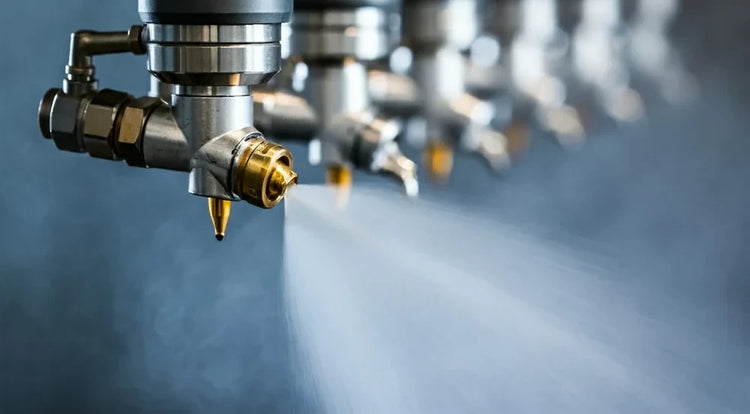

304 vs. 316L Stainless Steel Nozzles: Which Is Right for Your Washdown Environment?
Both grades handle water and light detergents without complaint. But push into chlorinated sanitizers, acidic cleaners, or high-salinity process lines — and the choice between them becomes the difference between a nozzle that lasts and one that pits, seizes, or fractures.
Stainless steel is the default material for industrial spray nozzles for good reason: it handles heat, resists most common cleaners, and outlasts plastic alternatives by years in demanding environments. But "stainless steel" is not a single specification. The two grades that show up most often in washdown and process spray applications — 304 and 316L — behave very differently once chemistry, temperature, and cleaning cycle frequency enter the picture.
The question engineers ask most often: is it worth specifying 316L, or will 304 do the job? The answer depends entirely on your environment. This guide lays out the differences in plain terms and maps each grade to the applications where it performs best.
304 stainless steel is the cost-effective, general-purpose choice for washdown environments that use mild detergents and municipal water. 316L adds 2–3% molybdenum to the alloy, which significantly increases resistance to chloride corrosion, acids, and saline solutions — making it the correct specification for food and beverage CIP lines, dairy processing, chemical handling, and any application where hypochlorite sanitizers are used regularly. Where chloride exposure is low and budgets are tight, 304 performs well. Where chemistry is aggressive or regulatory hygiene standards apply, 316L is the safer long-term investment.
Side-by-side comparison: 304 vs. 316L stainless steel nozzles
| Attribute | 304 Stainless Steel | 316L Stainless Steel |
|---|---|---|
| Alloying elements | 18% chromium, 8% nickel | 16% chromium, 10% nickel, 2–3% molybdenum |
| Corrosion resistance |
Moderate Susceptible to pitting in high-chloride environments |
High Resists chlorides, dilute acids, and saline solutions |
| Chloride threshold | Pitting risk above ~200 ppm chloride at elevated temps | Performs reliably in high-chloride process lines |
| Temperature range | Up to ~870°C intermittent; continuous service to ~925°C | Similar range; better stress-corrosion performance at elevated temps in corrosive media |
| Weldability / low carbon | Standard 304; 304L available for weld-heavy assemblies | 316L = low carbon by default; minimizes carbide precipitation at welds |
| Relative cost | Lower — typically 10–20% less than 316L | Higher — molybdenum addition increases material cost |
| Best for | General washdown, parts washing, car wash, light sanitation | CIP systems, dairy, food & beverage, chemical lines, marine |
| Common sanitizers | Mild detergents, low-concentration QAC sanitizers | Hypochlorite (bleach-based), peracetic acid, caustic NaOH |
| Regulatory fit | General industrial | Preferred for 3-A Sanitary Standards, USDA, and FDA-regulated lines |
Temperature limits are for air/dry service; corrosive media significantly reduces safe operating thresholds for both grades.
Which grade fits your application?
Rather than a single recommendation, the right choice follows from three questions: What chemistry is the line exposed to? How frequent are cleaning cycles? And are there regulatory hygiene requirements? Use the cards below as a starting point.
General-purpose washdown & light sanitation
The right call when chemistry is mild and budget matters. Performs reliably for years in low-chloride environments.
- Parts washing and degreasing stations
- General facility and floor washdown
- Car wash and vehicle wash bays
- Municipal water spray applications
- Light-duty agricultural spraying
- Non-food industrial cooling
Corrosive chemistry, sanitary, & regulated lines
Required when chlorinated sanitizers, acids, or saline solutions are present — or when hygiene standards demand it.
- CIP (Clean-in-Place) tank and vessel cleaning
- Dairy processing and milk handling lines
- Food & beverage production washdown
- Chemical processing and handling
- Marine and coastal environments
- Pharmaceutical and life sciences washdown
Why molybdenum is the deciding factor
The practical difference between 304 and 316L comes down to a single alloying addition: molybdenum. At 2–3% by weight in 316L, it dramatically changes how the steel responds to chloride ions.
In 304, chloride ions attack the passive chromium-oxide layer that gives stainless steel its corrosion resistance. Once that layer is breached at a point defect, pitting begins — and pitting is self-accelerating. The pit creates a low-pH, high-chloride microenvironment that keeps corroding even after the bulk chemistry is diluted or rinsed away. Over time, pits grow deep enough to structurally compromise a nozzle orifice or fitting thread.
Molybdenum in 316L stabilizes and repairs the passive layer in chloride-rich environments, dramatically slowing pit initiation. It also improves resistance to crevice corrosion — the failure mode that attacks the tight spaces around O-ring grooves, thread roots, and nozzle tip seats, which are exactly the areas that see the most concentrated chemistry in a spray system.
For applications using hypochlorite (bleach-based) sanitizers — standard in dairy, food processing, and many healthcare washdown protocols — 316L is not an upgrade. It is the correct base specification.
The chloride rule of thumb
If your cleaning or sanitizing chemistry contains chlorine in any form — hypochlorite, chlorinated alkaline cleaners, or even high-mineral-content well water above 200 ppm chloride — specify 316L. The cost premium over 304 is typically recovered within the first replacement cycle of a corroded 304 nozzle.
If your line runs on municipal water and neutral or mildly alkaline detergents with no chlorinated sanitizers, 304 is a sound and economical choice.
Food & beverage and dairy: why 316L is the default
In food and beverage production, washdown is not optional and chemistry is not mild. CIP systems cycle through caustic (sodium hydroxide) washes, acid rinses (nitric or phosphoric acid), and hypochlorite sanitizers — often multiple times per shift. Nozzles in CIP spray balls, tank washing headers, and conveyor washdown stations see this chemistry at elevated temperatures repeatedly.
316L holds up to this regimen where 304 does not. Beyond corrosion resistance, the low-carbon designation matters: 316L's reduced carbon content minimizes carbide precipitation at heat-affected zones during welding or brazing, which can otherwise create sensitized grain boundaries — a common site for intergranular corrosion in process piping and fitted nozzle assemblies.
Sanitary standards reinforce the material choice. 3-A Sanitary Standards, which govern surface finish and material requirements for dairy equipment, and FDA guidance for food-contact surfaces both recognize 316L as the preferred stainless alloy. If your facility is audited against these standards, 316L in product-contact spray applications is not a preference — it is an expectation.
Chemical processing: when neither grade is enough
It is worth stating clearly: both 304 and 316L have limits. In strongly acidic environments — concentrated hydrochloric acid, sulfuric acid above dilute concentrations, or hydrofluoric acid — neither grade performs well. For highly aggressive chemical spray applications, engineered plastics (PVDF, PTFE, polypropylene) or specialty alloys are the appropriate specification, not stainless steel of either grade.
316L extends the workable chemistry range significantly versus 304 in moderate-acid and high-chloride service, but it is not a universal corrosion solution. Matching nozzle material to the full chemistry profile — including pH range, chloride concentration, temperature, and cycle frequency — is the correct engineering approach. If you are uncertain, NozzlePro's team can help you work through the material selection for your specific process conditions.
Frequently asked questions
Not always. 316L offers superior corrosion resistance in chloride-rich and acidic environments, but in applications that use mild detergents and low-chloride water, 304 performs reliably and costs less. Specifying 316L across the board where 304 would suffice adds cost without adding service life. Match the grade to the actual chemistry, not a blanket preference.
The "L" stands for low carbon. Standard 316 contains up to 0.08% carbon; 316L caps carbon at 0.03%. This matters most in welded assemblies: lower carbon content reduces the risk of chromium carbide precipitation at weld heat-affected zones, which can create sensitized areas prone to intergranular corrosion. For most nozzle body applications, 316L is the standard stocking grade because it performs well in both welded and non-welded service.
It depends on the chemistry. In general facility washdown areas where hypochlorite sanitizers are not used, 304 can perform adequately. In product-contact zones or CIP lines where chlorinated sanitizers, acid washes, or caustic cleaners cycle regularly, 316L is the appropriate specification — both for corrosion performance and to align with 3-A Sanitary Standards and FDA expectations for food-contact materials.
316L nozzles typically carry a 10–20% material cost premium over equivalent 304 parts, driven by the molybdenum content. In applications where 304 would corrode and require frequent replacement, 316L is almost always the lower total cost of ownership. The premium is most easily justified in any line running chlorinated sanitizers, acidic cleaners, or saline solutions.
Yes. NozzlePro stocks spray nozzles in both 303/304 and 316L stainless steel across a wide range of spray patterns, flow rates, and connection types. Use the nozzle selection guides to filter by material, or contact the team directly for help matching grade and configuration to your application.
Find the right stainless steel nozzle for your line
Browse NozzlePro's full range of 304 and 316L stainless nozzles filtered by spray pattern, flow rate, and connection type.
View Nozzle Selection GuidesNot sure which grade fits your chemistry? Talk to our team and we will help you spec it correctly.
Material performance data reflects general industry reference ranges. Actual corrosion behavior depends on specific chemistry concentration, temperature, cycle frequency, and mechanical conditions. Consult engineering resources or contact NozzlePro for application-specific guidance.


