
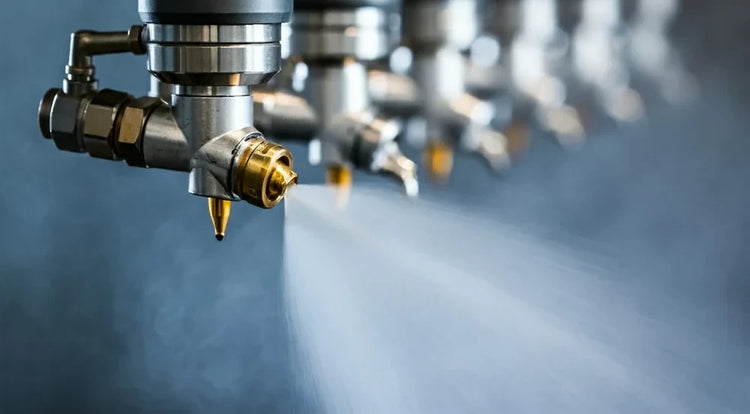

Spray Nozzles for Tissue Paper Machines:
A Complete Application Guide
Every section of a tissue machine — from forming fabric to Yankee dryer — depends on correctly specified spray nozzles. This guide covers what each application demands, why the wrong nozzle degrades production quality and energy efficiency, and how to specify a consistent nozzle program across multiple machines.
Key Takeaways
- Every section of a tissue machine uses spray nozzles — forming showers, felt cleaners, Yankee coating, chemical application, dust suppression — each with distinct pressure, pattern, and material requirements.
- Press felt cleaning shower nozzles are the highest-impact nozzle application on a tissue machine: felt condition directly governs drainage, sheet dryness, dryer steam demand, and machine speed.
- Creping adhesive and release agent application on the Yankee cylinder requires precise, uniform droplet distribution across the full machine width — air-atomizing nozzles are the standard for fine, consistent film control.
- High-pressure cleaning nozzles in abrasive felt and wire cleaning service wear significantly faster than low-pressure nozzles — hardened stainless or tungsten carbide inserts are required for consistent needle jet geometry over extended service intervals.
- Multi-machine mills benefit from standardizing nozzle specifications across all machines — reducing spare parts inventory, simplifying maintenance training, and enabling volume pricing on replenishment orders.
A tissue paper machine is one of the most nozzle-intensive processes in all of manufacturing. From the moment a dilute fiber furnish is jetted onto the forming fabric through to the final wound parent roll, spray nozzles are active at every section — cleaning fabrics, conditioning felts, applying chemistry to the Yankee cylinder, dosing retention and drainage aids, and suppressing the paper dust that accumulates in the dry end.
What sets tissue machine nozzle applications apart from general industrial spraying is the direct, quantifiable link between nozzle performance and machine productivity. A partially blocked felt cleaning shower doesn't just waste water — it allows felts to blind, which reduces drainage, which increases the moisture content of the sheet entering the Yankee, which forces a speed reduction to stay within steam budget. The cost of a worn or poorly specified nozzle is measured not in the nozzle's purchase price, but in the production tons per day that machine can no longer achieve.
This guide walks through each section of a tissue machine in order, covering the nozzle types, operating parameters, and material specifications that determine reliable, efficient performance — and what NozzlePro needs from your mill to supply the right nozzle for each application.
Why Nozzle Specification Drives Machine Performance
In most industrial processes, a suboptimal spray nozzle creates an efficiency penalty — slightly more water used, slightly less uniform coverage — but the process continues at acceptable quality. In tissue paper production, the relationship between spray performance and machine output is far tighter. The nozzles on a tissue machine are not accessories to the process; they are integral components whose performance directly determines what the machine can produce.
Consider felt cleaning showers: a needle jet nozzle that has worn from its specified orifice diameter to 15% oversize produces a wider, lower-velocity spray that impacts the felt at reduced force. The felt retains more fiber fines and resin than a clean felt would. Drainage through the felt in the press nip decreases. The sheet exits the press section with more moisture. The Yankee cylinder must work harder to evaporate that moisture. Machine speed must come down to stay within the dryer's steam capacity. A single set of worn nozzles in the felt cleaning shower has cascaded into a measurable reduction in machine efficiency — and the cause is invisible to anyone who isn't measuring nozzle performance specifically.
"On a tissue machine, every nozzle is in the critical path of production quality. There is no spray application on these machines that is genuinely peripheral — each one is connected, directly or indirectly, to speed, quality, or energy."
Forming Section: Wire and Fabric Shower Nozzles
High-pressure flat fan or needle jet nozzles are used in forming fabric (wire) cleaning showers on tissue machines. These nozzles produce a concentrated, high-impact spray directed against the fabric travel direction, dislodging fiber fines and chemical residues that accumulate in the fabric structure. Operating pressures typically range from 5–15 bar for low-pressure showers to 40–80 bar for high-pressure needle jet cleaners. Wire conditioner showers use lower-pressure full cone nozzles to distribute chemical treatment across the fabric width for release and drainage maintenance.
The forming fabric (wire) carries the dilute fiber furnish from the headbox slice across the forming zone, where water drains through the fabric mesh to form the paper web. As the fabric travels in a continuous loop, it accumulates fiber fines, fillers, and chemical residues that partially block the mesh openings, reducing drainage efficiency and potentially leaving marks on the sheet.
Low-Pressure Conditioning Showers
Low-pressure oscillating showers positioned on the return run of the fabric apply water continuously to flush loose surface deposits before they can compact. These showers typically use flat fan nozzles at 2–5 bar, oscillating across the machine width to ensure uniform coverage without creating a fixed wet streak in the fabric. The key specification here is even distribution across the full fabric width and a spray angle that provides coverage overlap between nozzle passes.
High-Pressure Needle Jet Cleaners
High-pressure needle jet showers use solid stream or very narrow flat fan nozzles at 40–80+ bar, directed at a precise angle against the fabric travel direction. The hydraulic impact of the concentrated jet dislodges compacted fiber and chemical deposits that low-pressure showers cannot reach. Nozzle spacing in these headers is critical — too wide and coverage gaps allow blinding zones to develop; too close and the impingement zones interfere with each other, reducing effective cleaning force.
NozzlePro's pulp and paper tissue nozzle collection covers showers, cleaning, Yankee coating, and chemical application across all sections of the tissue machine.
Press Section: Felt Cleaning Showers
Press felt condition directly controls drainage in the press nip, which determines how much moisture the sheet carries into the Yankee dryer. A blinded felt drains less water per pass, producing a wetter sheet that requires more steam to dry — forcing either a speed reduction or a quality compromise. Because the Yankee dryer is typically the capacity-limiting section of a tissue machine, anything that increases its moisture load reduces machine throughput. Correctly specified high-pressure needle jet shower nozzles maintain felt permeability throughout the felt's service life, protecting both machine speed and energy efficiency.
Press felts are engineered textiles that perform a specific hydraulic function: accepting water expelled from the fiber web during press nip loading, carrying that water away from the nip, and releasing it under vacuum and shower action on the return run. The felt's ability to do this degrades continuously during production as fiber fines, starch, sizing agents, pitch, and biocide residues penetrate and accumulate in the felt's batt structure.
High-Pressure Felt Cleaning Shower Configuration
The standard high-pressure felt cleaning shower consists of a header spanning the machine width, fitted with needle jet nozzles at close spacing (typically 25–50mm centers), directed against felt travel at an angle of approximately 15°–30° from perpendicular. This angle ensures the impingement zone maximizes fiber extraction rather than simply compressing residue deeper into the felt structure.
| Shower Type | Operating Pressure | Nozzle Pattern | Primary Function |
|---|---|---|---|
| Low-pressure conditioning | 2–5 bar (30–75 PSI) | Full cone or flat fan | Continuous felt lubrication; surface flush; chemical application |
| Medium-pressure cleaning | 5–20 bar (75–290 PSI) | Narrow flat fan or needle jet | Removal of surface fiber accumulation; supplemental cleaning between high-pressure cycles |
| High-pressure needle jet | 20–80+ bar (290–1160+ PSI) | Solid stream / needle jet | Deep cleaning of embedded fiber fines, pitch, and resin deposits from felt batt structure |
| Uhle box vacuum shower | 2–8 bar (30–115 PSI) | Flat fan — directed into vacuum slot | Water removal assistance; felt dewatering ahead of vacuum slot |
Nozzle Wear in High-Pressure Felt Cleaning Service
High-pressure needle jet nozzles in felt cleaning service wear faster than almost any other nozzle application in the mill — the combination of high operating pressure, abrasive particles dislodged from the felt, and continuous 24-hour duty creates demanding erosive conditions. Standard 316L stainless steel nozzles may show measurable orifice enlargement within a few months of operation in mills with hard or process water. High-pressure nozzles with hardened stainless steel or tungsten carbide orifice inserts are specified in these applications to maintain consistent needle jet geometry over the full interval between planned maintenance shutdowns.
Yankee Dryer: Creping Adhesive and Release Agent Application
Air-atomizing spray nozzles are the standard for creping adhesive application on Yankee dryer cylinders. They produce a very fine, uniform droplet cloud at precisely controlled low liquid flow rates — essential because creping adhesive is applied in an extremely thin film, precisely dosed across the full machine width. The uniformity of that film determines creping consistency and tissue softness. Hydraulic flat fan nozzles are used in some formulations where viscosity or temperature makes air atomization impractical. In either case, even distribution across the machine width with no high or low application zones is the primary specification requirement.
The Yankee cylinder is the heart of a tissue machine — the large heated drum onto which the wet web is pressed, dried to near-final moisture, and then crêped off by a doctor blade to create the characteristic tissue texture. The creping process depends entirely on the adhesive bond between the sheet and the Yankee surface: too little adhesive and the sheet doesn't crêpe properly; too much and the sheet won't release cleanly from the doctor blade.
Creping Adhesive Application
Creping adhesive — typically a polyamide or polyvinyl alcohol-based formulation — is applied to the Yankee surface in a continuous thin film using spray nozzles positioned in a traversing or fixed header ahead of the sheet transfer point. Air-atomizing nozzles are the standard choice because they produce the fine, controllable droplet size needed to lay down a uniform, thin film at the very low application rates typical of tissue operations (often measured in milliliters per minute across a 5-meter machine width).
Because the adhesive film is applied to a rotating cylinder surface at speed, any non-uniformity in the spray pattern — heavy edges, light center zones, periodic droplet variation — translates directly into variation in creping performance across the width of the tissue. This variation shows up in the finished product as differences in softness, bulk, or appearance across the reel. Specifying the correct air-to-liquid ratio, nozzle positioning, and application rate for each adhesive formulation is the critical engineering task in this section.
Release Agent Application
Release agents — typically mineral oil or silicone-based formulations — are applied to the Yankee surface or directly to the creping doctor blade to control the adhesive tack level and prevent sheet breaks during creping. These are applied at very low flow rates using fog or fine mist nozzles, requiring uniform distribution without over-application that would contaminate the sheet or reduce adhesive effectiveness.
Supplying Nozzles for Your Tissue Machine Fleet
NozzlePro supplies spray nozzles for every section of the tissue machine — from high-pressure felt cleaners to Yankee coating systems — standardized and packaged to simplify procurement across multiple production lines.
Shop Pulp & Paper Nozzles Request a QuoteChemical Application Nozzles
Beyond cleaning and coating, tissue machines use spray nozzles at multiple points to dose process chemicals that control drainage, retention, formation, and microbial activity. Each chemical application has distinct flow rate, distribution, and material requirements.
Retention & Drainage Aids
Dosed at very low flow rates into the approach system or headbox. Precision full cone or hollow cone nozzles at low pressure ensure the chemical is distributed into the furnish stream without localized overdose zones that would affect formation.
Full Cone Nozzles →Biocide Application
Applied to the wire pit, chest, or shower water system to control microbial growth. Chemical-resistant nozzle materials (PP or PVDF depending on the biocide formulation) are required. Consistent low-rate distribution is the priority.
Chemical-Resistant Nozzles →Sizing & Softener Application
Applied to the tissue web or the Yankee hood to impart wet strength, softness, or lotion characteristics. Air-atomizing nozzles provide the fine, controlled mist needed for uniform surface treatment at very low application rates.
Air-Atomizing Nozzles →Anti-Rewet & Felt Conditioners
Applied to felt surfaces on the return run to maintain permeability and control rewetting. Full cone nozzles at low pressure distribute chemical uniformly across the felt width with coverage overlap to avoid untreated zones.
Full Cone Nozzles →Dry End: Dust Suppression and Trim Handling
The dry end of a tissue machine — the reel, slitter, and winding sections — generates significant paper dust from the cutting, slitting, and handling of the dried tissue web. This dust creates fire and explosion risk, accumulates on equipment and electrical systems, and affects product quality if it resettles onto the tissue surface. Spray nozzles play two roles in dry end dust management.
Dust Suppression Mist Systems
Fog and mist nozzles positioned at slitters, reel spools, and high-dust-generation points produce fine water droplets (50–150 microns) that collide with and agglomerate airborne paper dust particles, adding mass and causing them to fall out of the air. The critical constraint in tissue applications is water addition rate — even a small amount of excess moisture redeposited on tissue can cause quality failures. Fog nozzle systems in tissue dry ends are designed to achieve dust suppression at the minimum possible water addition rate.
Trim Squirt Nozzles
Trim squirt nozzles produce a solid, high-velocity water jet used to cut and direct paper trims at reel changes and sheet breaks. Solid stream nozzles at 10–30 bar provide the clean-cutting jet geometry needed to separate the trim ribbon cleanly and direct it into the trim chute without causing the jet to deflect or deflect the trim into an unintended direction. Nozzle alignment and jet coherence length are the critical parameters in trim squirt applications.
Dust suppression, trim handling, and dry-end spray systems. NozzlePro's fog, mist, and solid stream nozzles cover every dry-end tissue machine application.
Material Selection for Paper Mill Environments
Paper mill spray nozzles operate in environments that combine mechanical stress (high-pressure operation), chemical exposure (process additives, biocides, cleaning agents), and thermal cycling (hot process water, steam). Material selection must address all three.
| Material | Best Paper Mill Applications | Key Advantage | Limitation |
|---|---|---|---|
| 316L Stainless Steel | All shower applications; forming and felt cleaning; general process water service | Broad chemical compatibility; standard for most process water chemistries; durable | Moderate wear resistance at high pressure; not suitable for strong chloride environments |
| Hardened Stainless (416 SS) | High-pressure needle jet shower nozzles in felt and wire cleaning service | Significantly higher orifice wear resistance than 316L — maintains needle jet geometry longer | Lower corrosion resistance than 316L; requires appropriate process water chemistry |
| Tungsten Carbide Insert | Highest-duty high-pressure cleaning nozzles; abrasive service | Maximum orifice dimensional stability — up to 30× longer than standard stainless in abrasive service | Higher unit cost; brittle — requires protected installation against impact damage |
| Polypropylene (PP) | Chemical dosing nozzles; biocide application; low-pressure chemical shower service | Broad chemical resistance at moderate cost; handles most paper mill chemical additives | Limited to low-pressure applications; lower temperature limit than stainless |
| PVDF | Aggressive chemical application; chlorinated biocides; high-purity applications | Excellent resistance to chlorine-based biocides and oxidizing agents | Higher cost; limited to moderate pressures; over-specified for standard process water service |
Managing Nozzles Across Multiple Machines
For tissue mills operating multiple production machines — whether two lines or ten — nozzle procurement and maintenance management becomes a strategic consideration, not just a parts-ordering task. The decisions made when specifying nozzles for one machine, multiplied across a full production fleet, have significant implications for inventory cost, maintenance efficiency, and spare parts availability.
The Case for Standardization
When each machine in a tissue mill runs different nozzle specifications — different part numbers for the same function on different lines, sourced from different suppliers — maintenance teams must carry a larger spare parts inventory, training on nozzle identification and replacement becomes more complex, and the risk of installing the wrong nozzle in the wrong position increases. Cross-machine standardization addresses all of these by aligning nozzle specifications across machines wherever the operating conditions are equivalent.
In a four-machine tissue mill, a standardized nozzle program could mean a single part number for felt cleaning needle jets across all four machines — one SKU to stock, one specification to maintain, one supplier relationship to manage. The volume of a multi-machine order also typically unlocks pricing advantages that single-machine orders don't achieve.
What NozzlePro Delivers for Multi-Machine Mills
- Cross-machine audit comparing current nozzle specifications across all production lines to identify standardization opportunities
- Unified part numbering that maps to each machine section, simplifying maintenance documentation and spare parts requisition
- Consolidated supply: a single order covering all machines and all sections — reducing procurement overhead and shipping cost
- Volume pricing on multi-machine programs that recognizes the long-term supply relationship value
- Technical support for specification upgrades where a current nozzle is underperforming in any section of any machine
What to Have Ready When You Contact NozzlePro
To specify nozzles accurately and respond quickly — whether you need replacements for a single shower header or a complete nozzle package across a four-machine operation — NozzlePro needs the following information. The more detail you provide upfront, the faster we can deliver a complete, accurate specification and pricing.
Tissue Machine Nozzle Quote Checklist
Operating multiple tissue machines? Contact NozzlePro with your machine count and section requirements — we'll build a standardized nozzle program across your full production fleet.
Frequently Asked Questions
What spray nozzles are used on a tissue paper machine?
Tissue machines use multiple nozzle types across different sections: high-pressure needle jet and flat fan nozzles for forming wire and press felt cleaning showers; air-atomizing nozzles for creping adhesive and release agent application on the Yankee cylinder; full cone nozzles for felt conditioning and chemical application; fog and mist nozzles for dry-end dust suppression; and solid stream nozzles for trim squirts and reel change cutting. Each section has distinct pressure, pattern, and material requirements.
Why is felt cleaning shower nozzle selection so critical in tissue production?
Press felt condition directly governs drainage in the press nip — which determines how much moisture the web carries into the Yankee dryer. A blinded felt drains less water, producing a wetter sheet that requires more steam to dry. Because the Yankee is typically the speed-limiting section of a tissue machine, any increase in moisture load forces either a machine speed reduction or a quality compromise. Correctly specified high-pressure needle jet shower nozzles maintain felt permeability throughout the felt's service life, protecting both throughput and energy efficiency. Visit NozzlePro's pulp and paper tissue collection for engineered cleaning shower options.
What nozzle applies creping adhesive on a Yankee dryer?
Air-atomizing spray nozzles are the standard for creping adhesive application. They produce a very fine, uniform droplet cloud at very low liquid flow rates — critical because creping adhesive is applied in an extremely thin film across the full machine width, and any non-uniformity in application translates directly into variation in creping performance and tissue quality. Hydraulic flat fan nozzles are used in some applications where adhesive viscosity or formulation makes air atomization impractical.
How often should tissue machine shower nozzles be replaced?
Replacement interval depends on operating pressure, water quality, and nozzle material. High-pressure needle jet shower nozzles in hard water or process water service can show measurable wear within months. The practical approach is to check nozzle flow rates at standard pressure during planned felt changes or roll changes, and replace any nozzle that has drifted beyond 10–15% of nominal flow. A worn needle jet nozzle produces a wider, lower-impact pattern that fails to maintain felt cleanliness — compounding performance degradation across the felt's remaining service life. Specifying tungsten carbide insert nozzles for the highest-pressure positions extends service intervals significantly.
What nozzle material is best for paper mill process water service?
316L stainless steel is standard for most paper mill shower applications and handles typical process water chemistry well. High-pressure felt cleaning nozzles in abrasive service benefit from hardened stainless steel (416 SS) or tungsten carbide orifice inserts to maintain critical needle jet geometry over extended service intervals. Chemical dosing nozzles that contact biocides, retention aids, or sizing agents may require PP or PVDF depending on the specific formulation's chemical compatibility requirements.
Can NozzlePro supply nozzles for all four of our tissue machines in one order?
Yes — NozzlePro regularly supplies complete multi-machine nozzle programs for tissue mills, with standardized specifications across all production lines to simplify inventory management, maintenance, and spare parts procurement. A consolidated multi-machine order also typically achieves better pricing than individual machine orders. To build a complete program, provide machine count, machine width, the sections requiring nozzles, and any existing part numbers or specifications you have. NozzlePro will produce a comprehensive specification and quotation covering every section of every machine in a single package. Contact us to get started.
Ready to Standardize Your Tissue Machine Nozzle Supply?
Whether you operate one machine or ten, NozzlePro delivers a complete, standardized nozzle program — from high-pressure felt cleaning showers to Yankee coating systems — with consolidated supply and volume pricing for multi-machine mills.
Request a Multi-Machine Quote Shop Pulp & Paper Nozzles


